
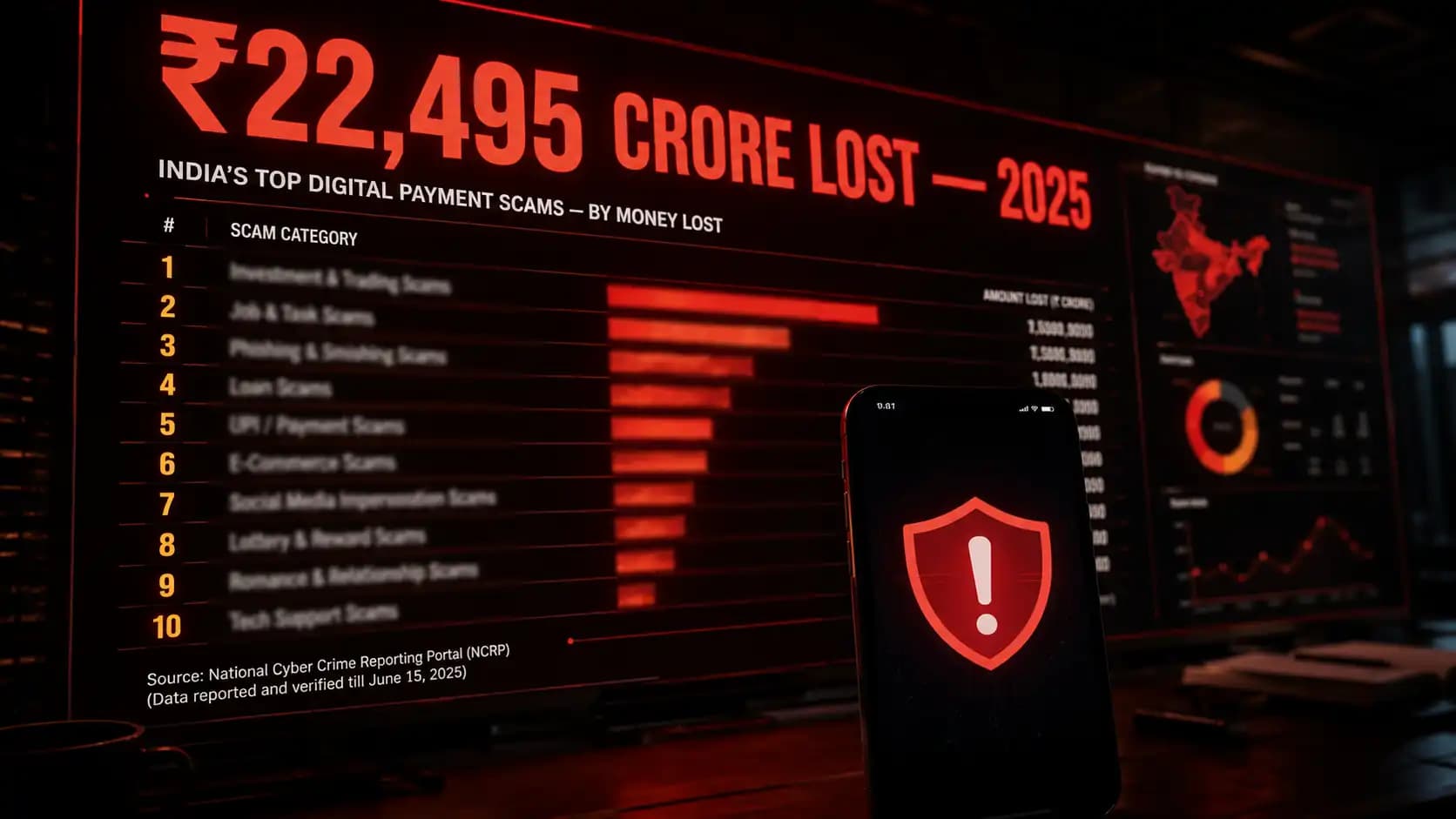
Reported cyber fraud losses remain severe. The safest response is to pause, verify independently, and report quickly.
The top scams in India 2026 are no longer limited to crude lottery messages. The latest cyber fraud in India uses fake trading apps, police impersonation, UPI payment tricks, stolen identities, AI generated voices, and carefully rehearsed social engineering. A convincing profile, video call, app dashboard, or caller ID is not proof that the person behind it is genuine.
National Cyber Crime Reporting Portal figures reported in February 2026 show 28.15 lakh complaints and ₹22,495 crore in reported losses during 2025. Investment scams accounted for about 76% of that money, digital arrest about 9%, and sextortion about 4%. These shares rank scams by financial impact, not by how often each scam occurred. That distinction matters.
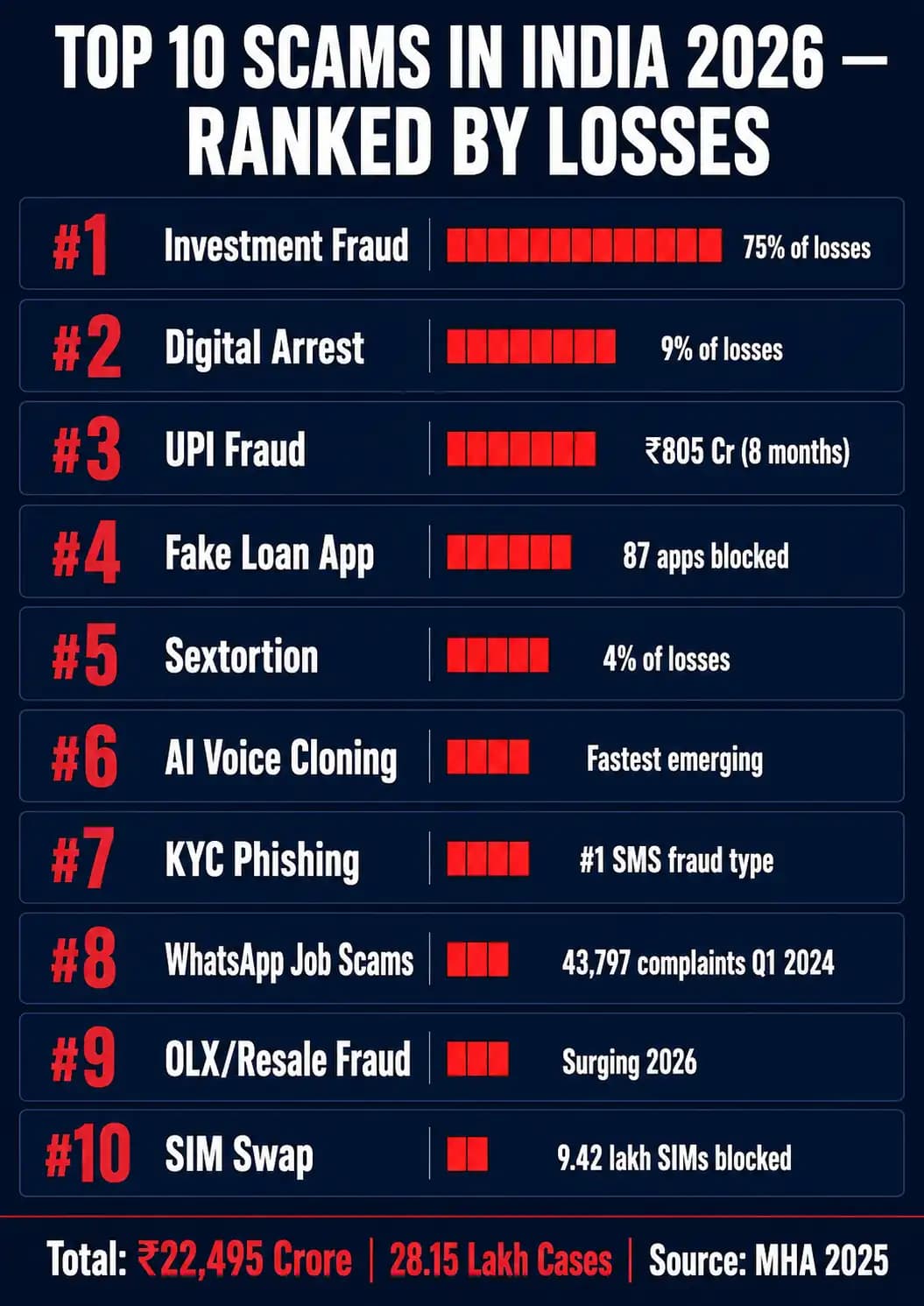
The Scale: ₹22,495 Crore Reported Lost in 2025
The 2025 total was slightly below the ₹22,845 crore reported for 2024, but complaint volume rose about 24% from 22.68 lakh to 28.15 lakh. Immediate intervention through the Citizen Financial Cyber Fraud Reporting and Management System had saved more than ₹7,130 crore across 23.02 lakh complaints by early 2026. Reporting is not a formality. It can interrupt the movement of stolen funds.
A newer official update adds a wider perspective. At an NHRC discussion on 9 June 2026, officials said Indians had lost about ₹52,976 crore to cyber enabled fraud over six years, with nearly 8% linked to digital arrest scams. That six year figure must not be confused with the ₹22,495 crore reported for calendar year 2025.
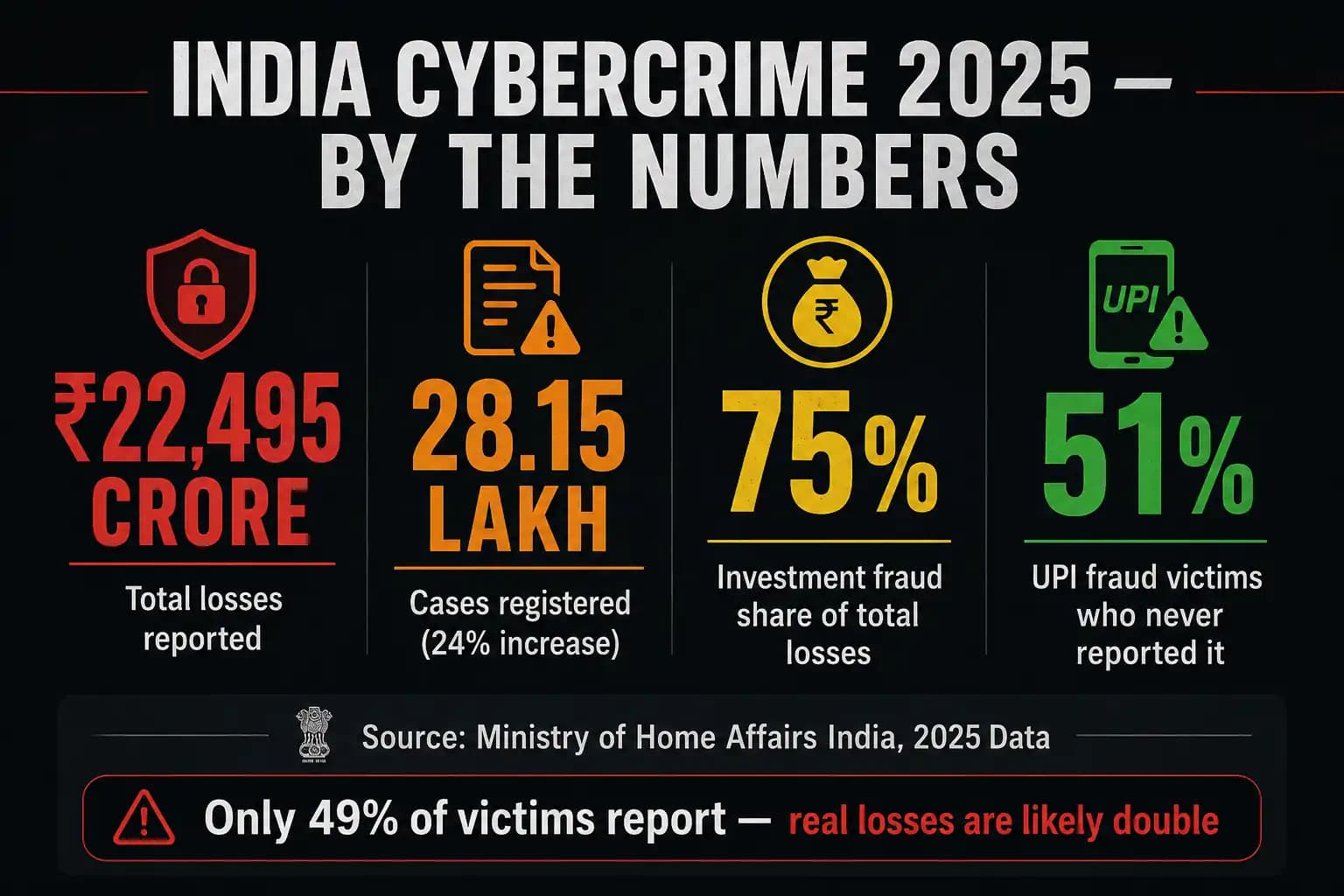
Note: the 51% non-reporting figure shown is from a survey, not NCRP administrative data.
How to Use This List
Treat this as a threat map, not a prediction. A scam can overlap several categories. A WhatsApp job offer may become an investment scam. A KYC link may lead to SIM takeover and UPI fraud. Read the warning signs for every category, save the official reporting steps, and share the relevant full guide with family members.
The 10 Most Common Scams India 2026 Readers Must Recognise
#1: Investment Fraud, About 76% of Reported Losses
Investment fraud causes the largest financial damage. Victims are added to WhatsApp or Telegram groups where fake experts show fabricated profits from stocks, IPOs, crypto, or forex. A polished app displays rising returns, but it is only a screen controlled by criminals. Small withdrawals may be allowed first. When the victim invests heavily, withdrawals stop and a fake tax or unlocking fee appears.
Real enforcement cases show how industrial this crime has become. The Enforcement Directorate documented a network using deceptive investment apps, 24 shell companies, mule accounts, and overseas cryptocurrency transfers. Before investing, verify the intermediary through SEBI and read our stock market tip scam guide and crypto investment scam red flags. Guaranteed returns and pressure to install an unknown app are enough reasons to leave.
#2: Digital Arrest Scam, About 9% of 2025 Losses
A caller claims to be from police, CBI, ED, RBI, customs, or a courier company. The victim is accused of money laundering or receiving an illegal parcel, then ordered to remain on video while transferring funds to a safe account. There is no legal concept of digital arrest in India. Real agencies do not investigate a citizen by demanding money over WhatsApp or Skype.
The harm is real. Maharashtra Police reported that a 72 year old Mumbai businessman was kept under coercive video contact for 40 days and lost ₹58.13 crore. In June 2026, CBI searches across more than 80 locations targeted a network tied to over 200 digital arrest cases. Hang up, call 1930, and follow the digital arrest response guide.
#3: UPI Fraud, ₹805 Crore in Eight Months of FY 2025 to 2026
UPI fraud includes collect requests disguised as refunds, QR codes presented as a way to receive money, screen sharing apps, fake support calls, and manipulated payment screenshots. Entering a UPI PIN authorises a debit. You never need a PIN to receive money.
A Finance Ministry response cited 10.64 lakh UPI fraud incidents involving ₹805 crore in the first eight months of FY 2025 to 2026. This narrower banking statistic is not directly comparable with the entire 2025 NCRP loss total. Learn the seven UPI scam tricks, use the UPI ID verification guide, and recognise the wrong transfer refund scam.
#4: Fake Loan App Harassment
Illegal lending apps offer instant credit, request access to contacts and photos, then use edited images, threats, and public shaming to force repayment far beyond the disclosed amount. In December 2025, the government told Parliament that MeitY had blocked 87 illegal loan lending applications under Section 69A after due process. A blocked app count is an enforcement measure, not a count of victims.
Borrow only through an RBI regulated bank or NBFC, confirm the lender on the RBI website, and deny unnecessary contact or gallery access. If harassment begins, preserve evidence, tell trusted contacts, report the app, and use the fake loan app action plan.
#5: Sextortion and Video Call Blackmail
A stranger starts a flirtatious video call, records or fabricates sexual content, then threatens to send it to relatives, colleagues, or social media contacts. Paying rarely ends the abuse because payment proves the victim can be pressured. Block communication, preserve account details and payment demands, tighten social privacy, and report the offender. Do not negotiate.
The 2025 category data attributed about 4% of reported cyber fraud losses to sextortion. The psychological cost is not captured in that number. Our sextortion response guide explains what to save, whom to contact, and why victims should not pay.
#6: AI Voice Cloning Family Emergency Scams
Criminals can use public audio or stolen voice notes to imitate a child, spouse, manager, or friend. The call creates an emergency and asks for an immediate transfer. Voice alone is no longer reliable identity proof. Hang up and call the person on a known number, ask a private question, or use a family code word.
AI voice cloning is an emerging technique, but there is not yet a reliable official India wide loss total that proves a precise financial ranking. It belongs on this list because the attack can defeat instinctive trust. Set up the protocol in our AI voice cloning family guide and share the senior citizen cyber safety checklist.
#7: KYC Update Phishing by SMS and WhatsApp
The message says your bank account, PAN, FASTag, wallet, or SIM will be blocked unless KYC is updated immediately. The link opens a lookalike login page or installs a malicious app. Banks do not ask for an OTP, PIN, password, or remote access during KYC. Open the official app yourself or visit a branch.
Use the KYC update scam guide, learn the checks in our phishing detection guide, and verify suspicious domains with the fake website checklist. Never use the contact number inside a threatening message.
#8: WhatsApp Job and Task Scams
A recruiter offers easy income for liking videos, reviewing hotels, or completing product tasks. Early rewards build confidence. The victim is then moved to Telegram, asked to deposit money for premium tasks, and shown a fake profit balance. Each attempt to withdraw triggers another fee.
Legitimate employers do not require workers to deposit money to unlock wages. Search the company independently, verify the recruiter, and never trust earnings visible only inside a chat or unknown dashboard. Read the full Telegram task scam playbook and the broader WhatsApp scam guide.
#9: OLX and Resale Platform Fraud
A fake buyer may send a QR code and claim scanning it will credit your account. A fake seller may demand a token amount, transport fee, or military identity based advance. Stay inside the platform, meet safely, inspect the item, and confirm money in your own bank app. A screenshot is not payment confirmation.
Marketplace users should read our OLX fraud guide, fake online seller warning signs, and parcel delivery scam guide. Refuse any transaction where the other person instructs you how to receive money through a PIN or QR code.
#10: SIM Swap Account Takeover
Scammers collect personal data, impersonate the subscriber, and obtain a replacement SIM or manipulate the victim into activating an eSIM. When the real phone loses network service, OTPs and recovery calls reach the criminal. Treat unexplained loss of signal as a financial emergency.
Call the telecom provider from another phone, freeze bank access, change important passwords, and report unauthorised transactions. Do not share eSIM QR codes or telecom OTPs. The SIM swap emergency guide provides a step by step response, while the Aadhaar protection guide helps reduce identity misuse.
Quick Reference: How to Stay Safe
Top 10 scams in India in 2026 ranked by financial impact and current threat relevance:
- Investment fraud: about 76% of reported 2025 cyber fraud losses
- Digital arrest scam: about 9% of reported 2025 losses
- UPI fraud: ₹805 crore across eight months of FY 2025 to 2026
- Fake loan apps: 87 illegal lending apps blocked by MeitY by December 2025
- Sextortion: about 4% of reported 2025 cyber fraud losses
- AI voice cloning family emergency calls
- KYC update phishing through SMS and WhatsApp
- WhatsApp and Telegram job task scams
- OLX and resale platform advance payment fraud
- SIM swap and eSIM account takeover
Total reported in India during 2025: ₹22,495 crore across 28.15 lakh complaints. Report financial cyber fraud immediately at 1930 and cybercrime.gov.in.
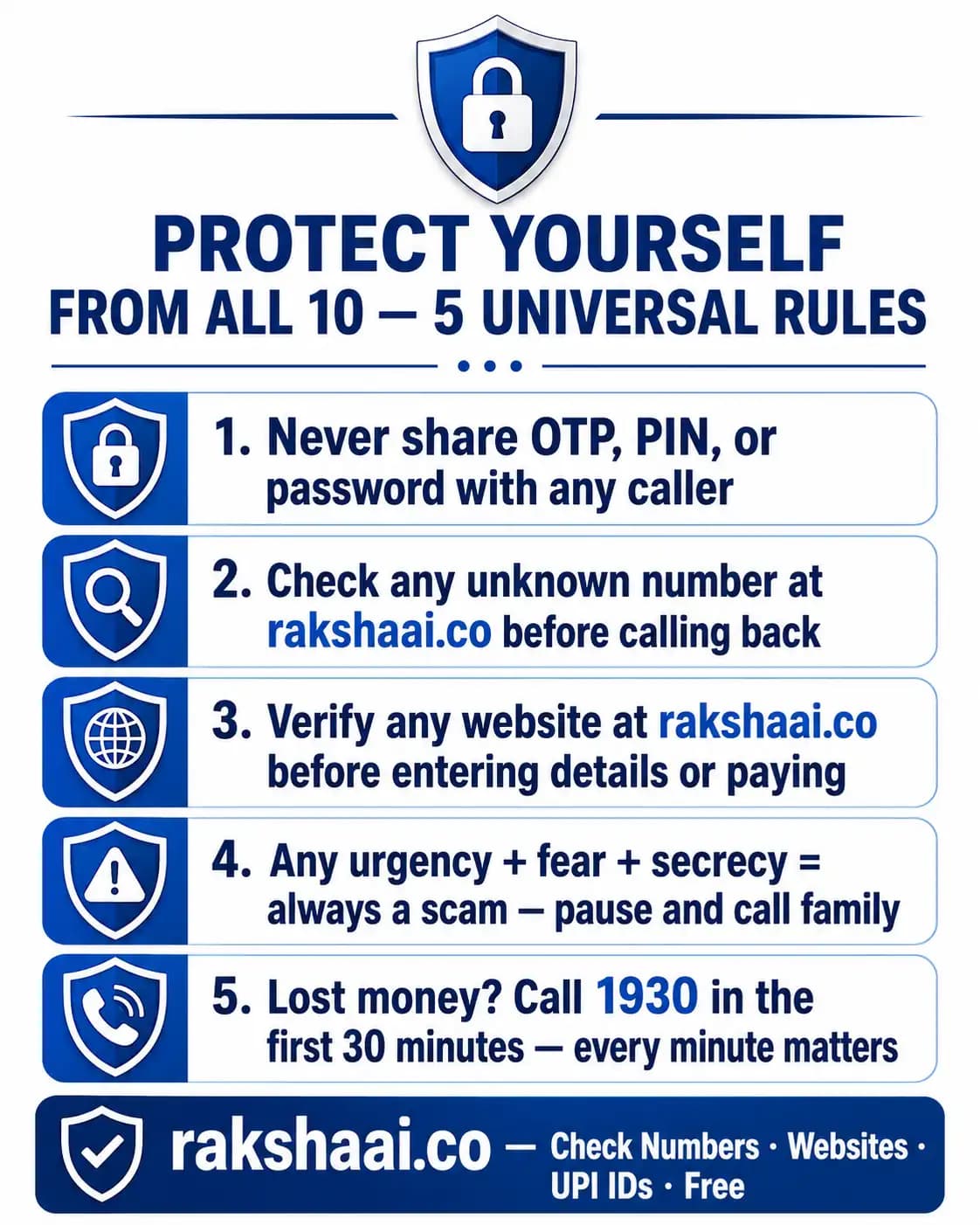
How to Avoid Scams in India: Five Universal Rules
- Never share an OTP, UPI PIN, card PIN, password, or eSIM code.
- Verify through a saved number, official app, or manually typed official website.
- Never pay to receive money, unlock earnings, cancel a case, or release a refund.
- Treat urgency plus fear plus secrecy as a command to pause and call someone you trust.
- If money is lost, call the cybercrime helpline India 1930 immediately, notify the bank, and file online.
If you have already paid, follow our first 30 minutes recovery guide. For suspicious callers, use the phone number verification guide. Romance profiles, gaming rewards, fake rentals, and customer care impersonation are covered in our romance scam, gaming app scam, rental scam, and fake customer care guides.
Real Cases, Research Notes, and Source Credits
This article separates calendar year totals, financial year banking data, surveys, and multi-year official estimates. That prevents a common reporting error where numbers from different denominators are presented as one ranking.
- ThePrint, February 2026: NCRP and MHA figures for 28.15 lakh 2025 complaints, ₹22,495 crore in losses, and the investment, digital arrest, and sextortion shares.
- Press Information Bureau, 9 June 2026: NHRC discussion citing about ₹52,976 crore lost over six years and nearly 8% linked to digital arrest.
- I4C digital arrest advisory: official modus operandi, precautions, and confirmation that digital arrest has no basis in Indian law.
- Akashvani News, 25 June 2026: Operation Chakra 6 searches across more than 80 locations in a network associated with over 200 cases.
- Akashvani News, 17 October 2025: the ₹58.13 crore Mumbai digital arrest case and use of thousands of mule accounts.
- The Indian Express, February 2026: Finance Ministry data for 10.64 lakh UPI frauds worth ₹805 crore in eight months of FY 2025 to 2026.
- Lok Sabha written answer: 87 illegal loan lending applications blocked by MeitY.
- Enforcement Directorate Annual Report 2024 to 2025: case study on fake IPO and stock investment apps, shell companies, mule accounts, and overseas transfers.
Frequently Asked Questions
How much money did Indians lose to cyber fraud in 2025?
National Cyber Crime Reporting Portal data reported in February 2026 put losses reported during 2025 at ₹22,495 crore across 28.15 lakh complaints. These are reported figures, not an estimate of every fraud that occurred.
What is the fastest growing scam in India in 2026?
Digital arrest remains one of the most dangerous impersonation scams. A June 2026 NHRC discussion said nearly 8% of cyber enabled fraud losses over six years were linked to digital arrest. AI voice cloning is also an emerging method, but no official national loss total yet supports a precise rank for it.
How do I report a scam in India?
Call the National Cybercrime Helpline at 1930 immediately for financial fraud, then file a detailed complaint at cybercrime.gov.in. Keep transaction IDs, screenshots, phone numbers, UPI IDs, URLs, and chat records.
Which Indian states report the most cybercrime?
Counts vary by dataset, year, and whether the measure is portal complaints, FIRs, or fraud losses. Do not assume a single state ranking applies to every scam. Online fraud targets people across urban and rural India.
How much UPI fraud was reported in the first eight months of FY 2025 to 2026?
A Finance Ministry response reported 10.64 lakh UPI fraud incidents involving ₹805 crore during the first eight months of FY 2025 to 2026. This is a different reporting period from the full calendar year 2025 cybercrime total.
Pause before you pay
Check suspicious numbers, websites, and UPI IDs on RakshaAI. Your report can warn another Indian before the same scam reaches them.
Check or report on RakshaAIMore from RakshaAI Blog
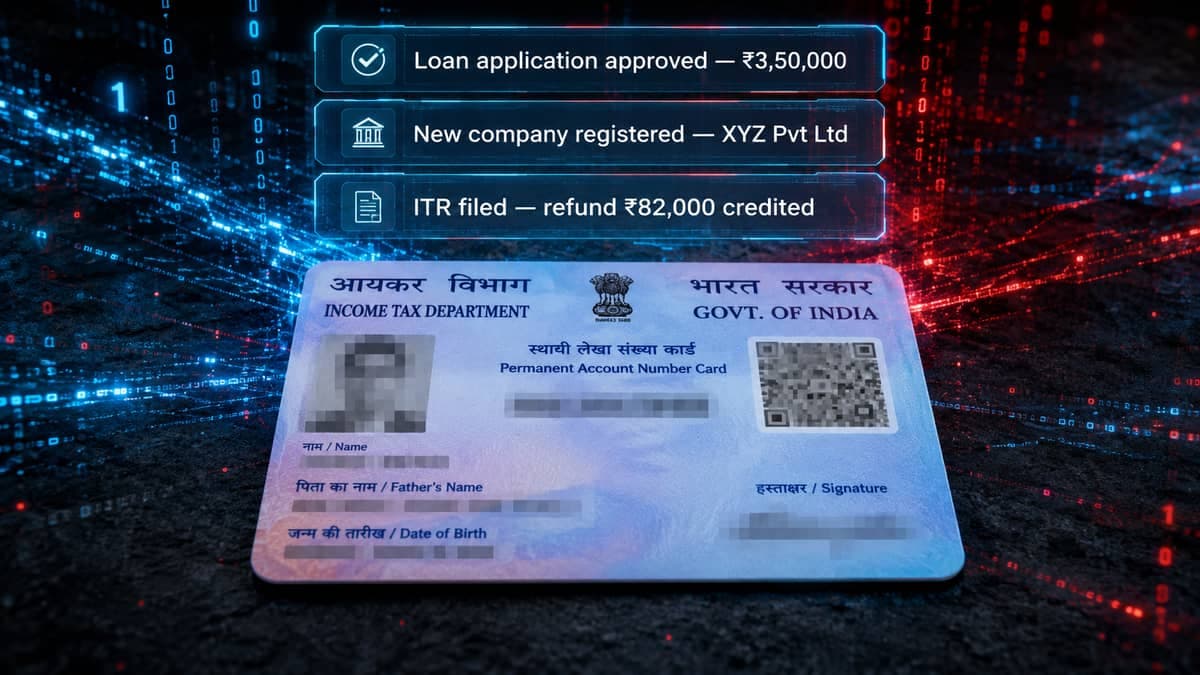
PAN Card Fraud India: How Scammers Are Misusing Your PAN in 2026

Social Media Account Cloning India: When Scammers Become You Online

Cyber Fraud Case Studies India 2026: Real Victims, Real Losses, Real Lessons
Stay Protected Online
Use RakshaAI to check websites, phone numbers, and UPI IDs for scams free, instant, no sign-up required.
RakshaAI is a private platform by Ehatech Services Pvt. Ltd. Not affiliated with any government body. Editorial policy