
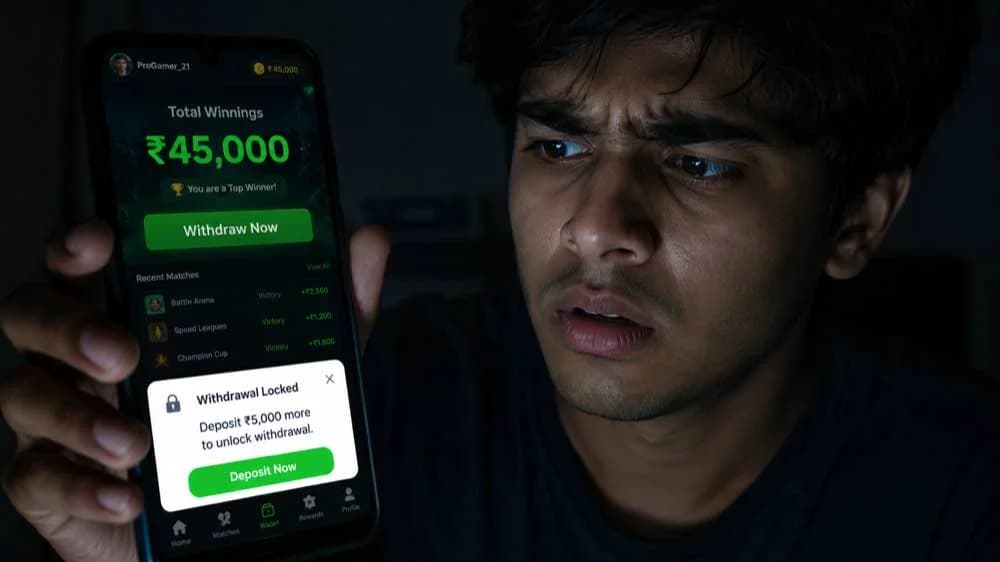
A fraudulent gaming dashboard showing inflated balance and blocked withdrawal button the core mechanics of India's earn-to-play scam.
India has more than 568 million mobile gamers, making it the largest gaming market in the world by user count. Scammers have built an entire fraud industry on top of that number. Fake gaming apps modelled on legitimate platforms like WinZO, MPL, and Dream11 are distributed via WhatsApp referral links, social media ads, and Telegram groups, promising daily cash earnings for playing simple games.
The trap is always the same. The app lets you win small amounts in the first session to build excitement and credibility. Then, when you try to withdraw, a fee appears: a deposit to "activate" your account, a tax payment to unlock earnings, a top-up to reach the minimum withdrawal threshold. Every payment opens a new reason your money cannot leave the app. The balance you see on screen is fictional.
How to identify a fake gaming app in India
- 1App was shared via WhatsApp or Telegram, not found on Play Store
- 2Requires a registration deposit or "activation fee" before you can play
- 3You win easily in the first 2-3 sessions, then hits get harder
- 4Withdrawal is blocked with a new condition every time you try
- 5Customer support is only reachable on WhatsApp, not via official channels
- 6App requests bank login credentials or UPI PIN inside the interface
- 7Check the app website at rakshaai.co before downloading anything
If even one applies, do not deposit anything. Report the app link immediately.
Why Gaming Apps Are a Scammer's Ideal Vehicle
A gaming app has unique psychological advantages that make it more effective for fraud than a straightforward fake investment or job portal. Games are designed to deliver intermittent rewards, which create genuine excitement and anticipation. Scammers exploit this mechanism deliberately: the early wins in a fake gaming app are scripted, not random. The algorithm is set to let you win enough to feel the dopamine response before the withdrawal trap is revealed.
The referral mechanics built into these apps provide free distribution. Every recruited player becomes a voluntary recruiter, sharing the app across their personal WhatsApp contacts with a commission promise attached. This means the fraud spreads through trusted personal networks rather than cold advertising, making victims less suspicious and more willing to deposit.
Unlike investment scams that require patience and a longer con, gaming app fraud can complete the cycle from install to deposit loss in under 48 hours. The average victim loses between Rs 2,000 and Rs 15,000 before realising the withdrawal will never process.
The Earn-to-Play Trap: How It Unfolds Step by Step
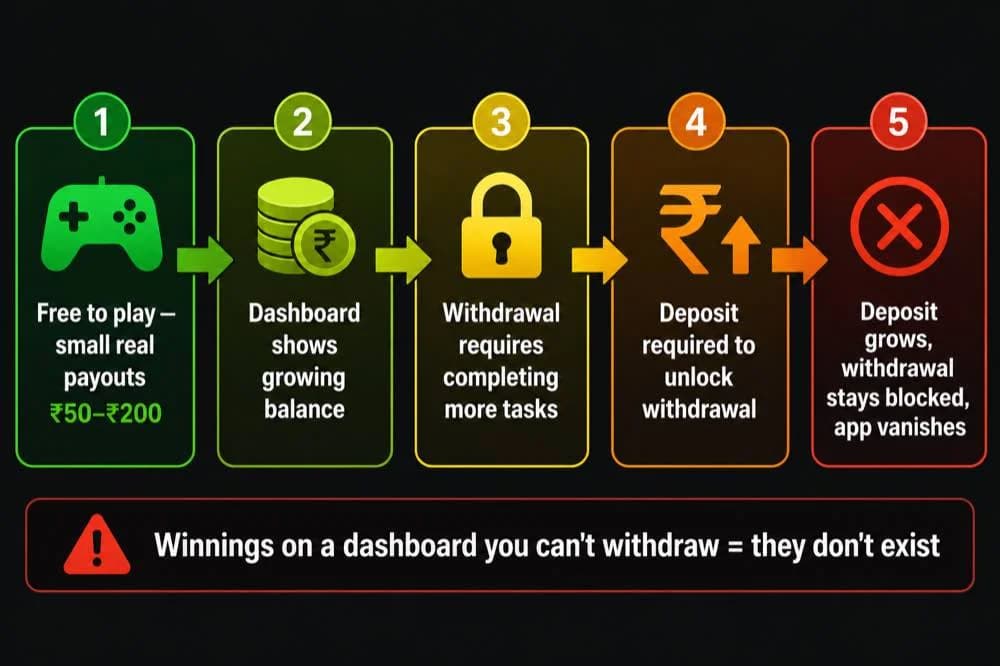
The scripted progression from install to deposit trap that virtually every fake gaming app follows.
Step 1: Discovery via a Referral Link
The entry point is almost always a WhatsApp message from a contact, a Telegram gaming group, or a social media ad showing screenshots of someone's earnings. The link bypasses the Play Store entirely and installs a side-loaded APK file directly to your phone. Side-loaded apps are not reviewed by Google and carry significant security risks beyond the deposit scam itself.
Step 2: The Welcome Win
You are given a small free balance on registration, usually Rs 50 to Rs 150. The first game session is scripted to let you win. This is not a feature; it is the hook. The purpose is to demonstrate that the platform works and that winning is achievable. At this point, you have not lost any real money, and the app feels completely legitimate.
Step 3: The Withdrawal Wall
When you attempt to withdraw your winnings, you encounter the first condition: your balance has not reached the minimum withdrawal threshold, which is conveniently set just above what you have earned. To reach it, you need to top up with real money. This is the first deposit, and it is typically small enough to feel like a reasonable investment.
Step 4: Escalating Conditions
After you top up, new conditions appear in sequence: a tax clearance payment, an account verification fee, a "VIP upgrade" to unlock the withdrawal function, or a TPIN registration charge. Each payment is positioned as the final step before your money is released. None of them are. The app's backend is designed to manufacture new reasons to collect more deposits indefinitely until the victim either runs out of money or stops paying.
Step 5: The Disappearance
When victims stop depositing or begin demanding their money back, the response from customer support slows down and eventually stops. In some cases, the app itself stops responding or shows an error on login. The WhatsApp support contact goes silent. The balance and the "earnings" simply vanish along with the money deposited.
Real Gaming Apps vs Fake Ones: How to Tell Them Apart
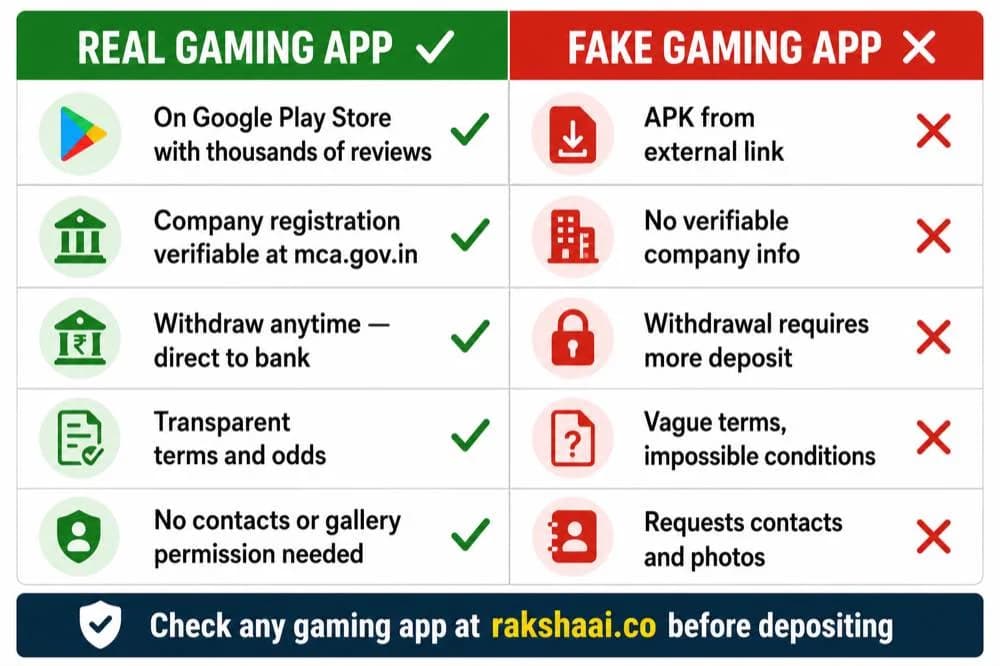
Side-by-side comparison of a legitimate gaming platform and a fraudulent clone app.
Legitimate gaming platforms in India share several verifiable characteristics. Fake apps consistently fail on multiple points of this checklist.
- Play Store listing with verified developer name. Search for the app name directly in the Google Play Store. The developer name and download count should match what the app claims. A fake app will either not appear on the Play Store or will appear with a developer name you cannot verify. Never install a gaming app from a link sent via WhatsApp.
- Registered company address and GST number. Legitimate platforms publish their registered company name, address, and GST registration in the app's About section or website footer. Search the company name on the MCA portal (mca.gov.in) to confirm it is a real registered entity. Fake apps use placeholder addresses or omit this information entirely.
- No deposit required to withdraw your own winnings. A platform that requires you to deposit real money before releasing winnings you have already earned is fraudulent by definition. Legitimate apps have withdrawal minimums, but those thresholds are reached through gameplay, not through additional deposits.
- Official support channels with traceable contact information. Real gaming companies publish a support email address, a registered helpline number, and a postal address on their website. If the only support channel is a WhatsApp group or a number that connects to a personal phone, the platform is not legitimate.
- Reviews and ratings on independent platforms. Search for the app name on Google along with the word "withdrawal" or "scam". Fraudulent apps almost always generate complaints about blocked withdrawals within weeks of launch. The absence of any review presence outside the app itself is also a warning sign.
The 7 Red Flags That Identify a Fake Gaming App
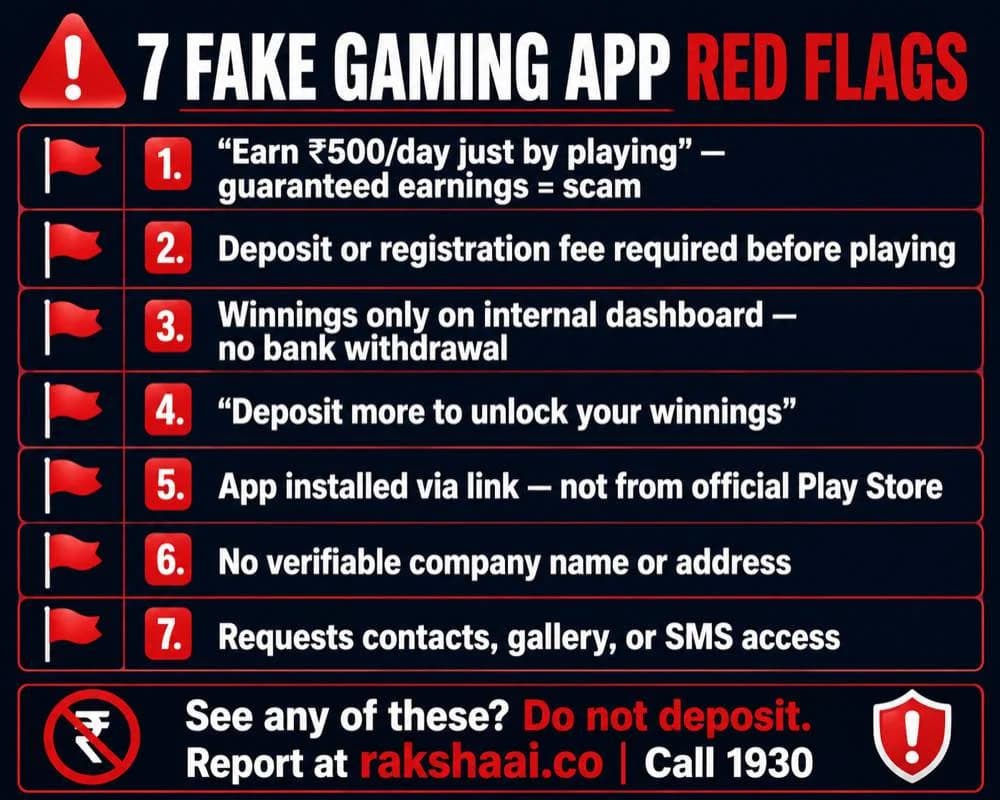
All 7 warning signs visible in fraudulent gaming apps. Any single flag is enough to stop and investigate.
- The app is shared via a referral link, not the Play Store. Legitimate gaming platforms are distributed through official app stores. Any app that reaches you via a WhatsApp or Telegram link and requires manual APK installation is automatically suspect, regardless of how professional it looks.
- A deposit or activation fee is required to start earning. Real earn-to-play platforms have free entry. If the app requires any payment before you can access your balance or begin playing, it is a scam. The "free coins" given at registration are not real money and cannot be withdrawn.
- Wins are unusually easy in the first few sessions. If you win consistently at a skill-based game that millions of people play competitively, your early results are scripted. Legitimate platforms have real competition; scam apps have programmed win rates that drop after the initial hook.
- Each withdrawal attempt reveals a new condition. A sequence of conditions blocking withdrawal, each one appearing only after the previous fee is paid, is the defining signature of this fraud type. No legitimate financial platform operates this way.
- Customer support exists only on WhatsApp. Support that is available only through WhatsApp or a personal phone number is designed to disappear. Legitimate companies have verifiable support infrastructure that cannot be erased by deleting a chat.
- The app asks for your UPI PIN or banking login inside the interface. No legitimate payment integration in India requires your UPI PIN to be typed into an app outside of the official UPI payment dialog. Any app that collects these credentials directly has built its interface specifically to steal them.
- The referrer earns a commission on your deposits. The most effective fake gaming apps include a referral commission structure where the person who recruited you earns money every time you top up. This is why the initial referral feels so enthusiastic: the recruiter has a direct financial incentive to get you to deposit.
What To Do If You Have Already Deposited Money
Act immediately. Every hour of delay reduces the chance of a transaction freeze and fund recovery.
- Stop all further payments to the app. No additional payment will unlock your withdrawal. The conditions are designed to escalate indefinitely. Every rupee you pay after the first deposit is additional loss with zero chance of return.
- Screenshot every transaction and every app screen. Capture your payment history, the app balance screen, the withdrawal error message, and any WhatsApp conversations with support. These are your evidence for the cybercrime complaint.
- Call 1930 immediately. The National Cybercrime Helpline can initiate a transaction freeze request to the receiving bank within hours of your complaint. The faster you call, the higher the chance the receiving UPI account still holds your money.
- File at cybercrime.gov.in within 24 hours. Attach all your screenshots. Include the UPI IDs you paid to, the app name or APK file name, and the WhatsApp numbers involved. A registered complaint creates a legal record and activates formal investigation processes.
- Contact your bank to dispute the UPI transactions. Raise a fraud dispute for each UPI payment made to the app. Banks are required to investigate fraud claims and can work with the NPCI to freeze beneficiary accounts under the Chargeback and Dispute framework.
- Report the app link at RakshaAI. Submit the app website or APK download link at rakshaai.co/website-safety-checker so other Indians who search for the same link receive a warning before they download and deposit.
For the complete post-fraud recovery guide, see Got scammed online in India? Do these 5 things in 30 minutes.
Frequently Asked Questions
How do I identify a fake gaming app in India?
Check for these signs: the app requires a deposit to unlock your earnings, withdrawals are blocked unless you pay a fee, the app is not on the official Google Play Store, customer care is only on WhatsApp, and the app was shared via a referral link rather than found organically. Check any app website at rakshaai.co before installing.
Is it safe to earn money from gaming apps in India?
Legitimate apps like Dream11, MPL, and WinZO are registered, DPDP-compliant platforms listed on the official Play Store. Fake apps clone these brands and use an identical interface to scam users into depositing money. Always download from the official Play Store and verify the developer name matches the official company.
What should I do if a gaming app blocked my withdrawal in India?
Stop all deposits immediately. Screenshot all payment confirmations and app screens. Call 1930 to report the fraud. File a complaint at cybercrime.gov.in within 24 hours. The faster you report, the higher the chance of a transaction freeze. Do not pay any additional unlock fee it will not release your money.
Can I get my money back from a gaming app scam in India?
Recovery is possible but not guaranteed. File at cybercrime.gov.in within 24 hours and call 1930 immediately. If you paid via UPI, contact your bank to raise a fraud dispute. If the bank can reach the receiving account before it is emptied, a freeze may be ordered. Acting within the first few hours dramatically improves the odds.
Are earn-to-play gaming apps legal in India?
Legitimate skill-based gaming platforms are legal in most Indian states. Fraudulent apps that collect deposits under a false promise of winnings are illegal under the Indian Penal Code and IT Act. If an app promises guaranteed earnings and then withholds your money behind repeated fees, it is a criminal fraud operation, not a gaming platform.
Final Thoughts
Fake gaming apps work because they are engineered to feel exactly like real ones. The interface is polished, the early wins are real and exciting, and the referral system means your trust is borrowed from someone you already know. The only protection is knowing the mechanics of the trap before it is triggered.
The single most effective rule is this: never pay money to receive money from an app. Any legitimate platform that owes you earnings will release them without requiring a deposit, a tax clearance, or an activation fee. The moment any condition like this appears, stop and report immediately.
Share this article with anyone who plays mobile games or is interested in earn-to-play apps. The people most targeted are young adults looking for supplementary income, a category that includes millions of Indian students and gig workers. One conversation about these patterns could prevent a significant financial loss.
Free Tool
Got a link to a gaming or earning app?
Check the website before downloading or paying anything. RakshaAI scans for fraud signals in under 5 seconds. Free, no sign-up required.
Check the App Website now →100% free · No sign-up required · Save 1930 in your contacts
More from RakshaAI Blog
Stay Protected Online
Use RakshaAI to check websites, phone numbers, and UPI IDs for scams free, instant, no sign-up required.
RakshaAI is a private platform by Ehatech Services Pvt. Ltd. Not affiliated with any government body. Editorial policy