
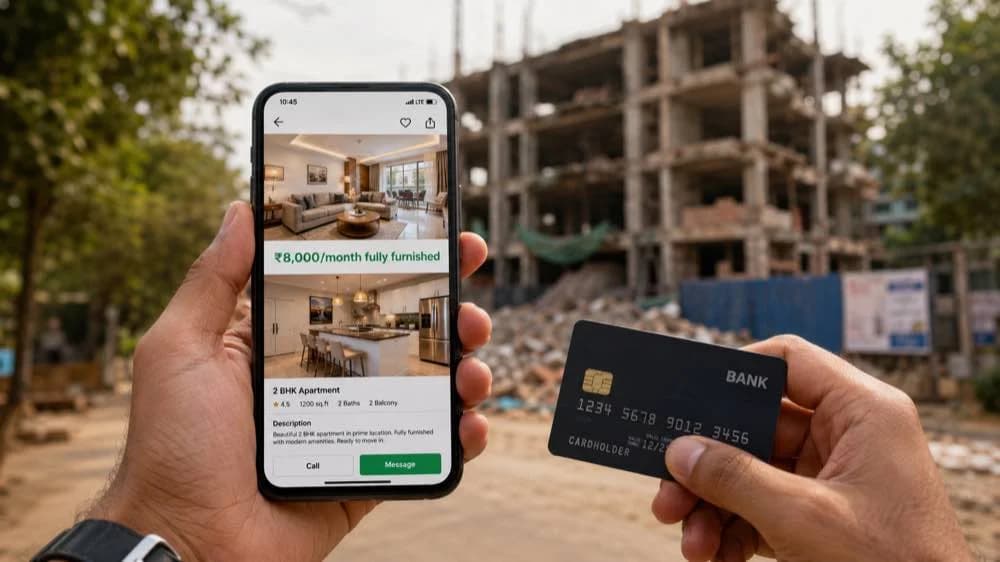
A beautiful listing on a property portal, a bank card ready to pay advance, and a derelict building in the background. This contrast is exactly what fake rental fraud looks like in India.
India's cities attract millions of migrants every year: students arriving for college, professionals relocating for work, and families moving to metro areas for better opportunities. Every one of them needs to find a place to live quickly, often from a distance, before they arrive. Scammers have built an entire fraud category around this vulnerability.
Fake rental listings circulate on legitimate platforms including NoBroker, MagicBricks, and 99acres, as well as in WhatsApp groups and Telegram channels dedicated to housing in specific cities. The listings are indistinguishable from real ones: professional photos, accurate-looking addresses, competitive amenities, and prices just below the market rate. The scammer's goal is simple: collect an advance deposit before any in-person visit is possible, and then disappear.
How to verify a rental property before paying advance in India
- 1Video call the landlord and ask them to show the flat on camera live
- 2Visit the property in person before any payment non-negotiable
- 3Verify the landlord's ownership with the building society or local registry
- 4Check that the property address matches what is listed, in person
- 5Search the landlord's phone number at rakshaai.co for scam reports
- 6Never transfer advance to an account before signing a rental agreement
- 7Be suspicious of rents 30 to 50% below market rate too good means fake
Rule: Never transfer advance based on photos and phone calls only.
Why Rental Scams Are Surging in India's Cities in 2026
Three converging trends have made rental fraud one of India's fastest-growing cybercrime categories in 2026. First, post-pandemic migration into metros has accelerated, with Bengaluru, Hyderabad, Pune, and Chennai seeing record inflows of professionals and students. Demand for affordable housing significantly exceeds supply in these cities, creating the urgency that scammers exploit.
Second, property listing platforms have become the default starting point for housing searches. Scammers invest in creating convincing fake listings that survive platform verification, often by using stolen photos from real listings already on the same platform. A fake listing on NoBroker looks identical to a genuine one because the scammer has used the platform's own image library as source material.
Third, UPI has made advance payment frictionless. A scammer who was previously limited by the complexity of collecting money across cities can now receive advance rent in seconds via a UPI ID, before the victim has had any opportunity to verify the property or the landlord. The money moves faster than suspicion develops.
How the Fake Rental Scam Works: 3 Variants
Variant 1: The Fake Listing on Property Portals
A listing appears on NoBroker, MagicBricks, or 99acres with professional photos of a well-furnished apartment, an accurate-sounding address in a desirable area, and a price 20 to 40 percent below comparable listings in the same locality. The listing is designed to generate immediate interest from budget-conscious searchers.
When you contact the number listed, the person responds quickly and professionally. They claim to be the flat's owner or a direct broker. They mention that the property has been getting a lot of interest and that another applicant is already in discussion. To secure the flat, you are asked to transfer a token advance or a booking amount before visiting, after which a formal agreement will be shared and the visit arranged.
Once the advance is transferred, the responses slow down, reasons for delaying the visit multiply, and eventually the contact stops entirely. Reporting the listing to the platform often finds it has already been removed.
To check whether listing photos are stolen, right-click any image in a browser and run a reverse image search. Stolen photos frequently appear on multiple listings across different platforms with different addresses and prices. This single check exposes the majority of fake portal listings in under one minute. For a full guide on spotting fake websites and listings in India, see our dedicated article.
Variant 2: The WhatsApp Group Rental Fraud
City-specific WhatsApp groups for housing, PG, and flatmate searches have become a primary recruitment channel for rental scammers. A fake listing is posted in a group with hundreds of members, complete with photos and a below-market price. Because the group is moderated by real people and is trusted by its members, the listing receives an implicit endorsement.
The fraud mechanics are identical to the portal variant, but the urgency is amplified by the public nature of the group. Multiple people may express interest in the same post, which creates competitive pressure and shortens the time the victim spends on due diligence. The scammer often posts the same listing across multiple city housing groups simultaneously.
WhatsApp groups have no listing verification process. Anyone can post anything, and the group admin cannot always identify fraudulent listings before damage occurs. Treat every listing in a WhatsApp housing group with the same scrutiny you would apply to a cold message from an unknown number.
Variant 3: The PG and Hostel Advance Scam
This variant specifically targets students and young professionals who are new to a city and unfamiliar with its neighbourhoods. Fake PG listings are posted on housing portals, Facebook groups, and Instagram pages claiming to offer furnished rooms with meals in cities like Pune, Bangalore, Hyderabad, and Delhi.
The PG scam is particularly effective because the target demographic is often moving from another city or state, which makes an in-person visit before payment genuinely difficult. Scammers exploit this logistical constraint explicitly, framing the advance as a reservation fee that guarantees the room while the student completes their relocation.
The amount requested is typically small enough to feel reasonable: Rs 2,000 to Rs 5,000 for a room reservation. This low threshold lowers the victim's guard. Upon arrival in the city, the victim discovers the address does not match any PG, the contact is unreachable, and the advance is gone.
How to Verify Any Rental Property Before Paying Advance
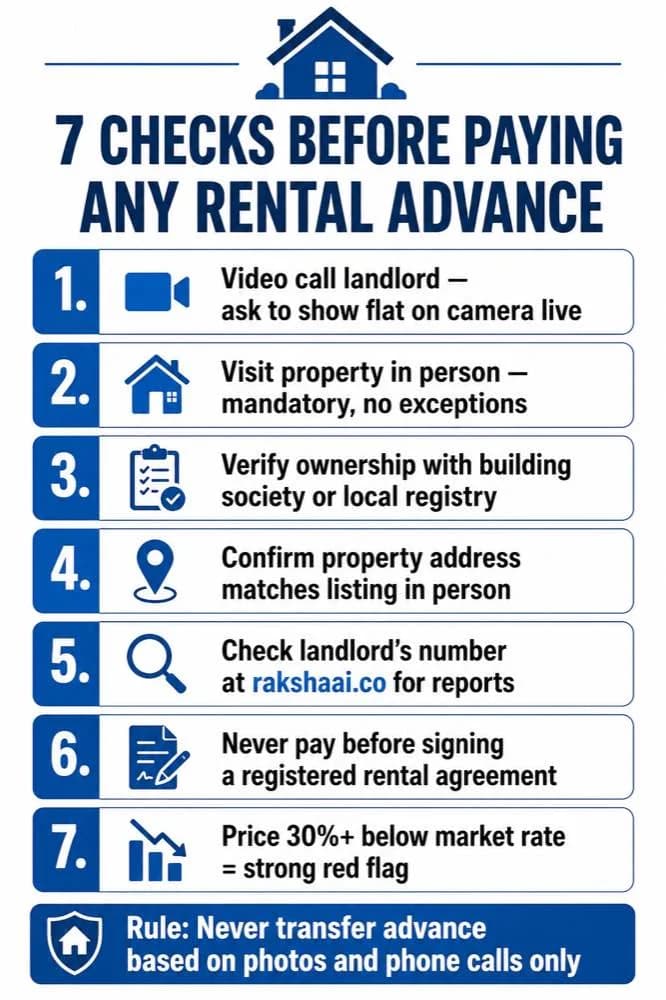
All 7 verification steps before paying any rental advance in India. Each step independently catches a different type of fake listing.
- Video call the landlord and ask for a live walkthrough. Request a video call during which the landlord walks through the flat in real time, opening doors, showing the kitchen and bathrooms, and pointing out the building exterior. A scammer operating with stolen photos cannot produce a live video of a property they do not control. If the landlord refuses or gives any reason why a video call is not possible, treat it as a definitive red flag.
- Visit the property in person before any payment. This is non-negotiable. If you are relocating from another city and a visit is genuinely not possible before arrival, arrange for a trusted contact in the destination city to visit on your behalf. No legitimate landlord objects to a property viewing before advance payment. Any resistance to an in-person visit is the single strongest signal of fraud.
- Verify ownership with the building society or local registry. Speak to the building's security guard, a society committee member, or neighbouring flat owners. Ask them to confirm the owner's name and whether the flat is available for rent. This verification takes five minutes and cannot be faked. A scammer has no relationship with the building and will avoid any suggestion of this check.
- Confirm the address in person before paying. Search the address on Google Maps, verify that the building exists, and cross-check the street-view imagery with the exterior photos in the listing. Fake listings frequently use real addresses for unrelated buildings or composite addresses that do not actually exist.
- Check the landlord's number at RakshaAI. Search the contact number at rakshaai.co/phone-number-checker. If others have already reported the number for rental fraud, it will appear in the results. This check takes under 30 seconds and is completely free.
- Never transfer advance before a signed registered agreement. A registered rental agreement is a legal document that can be produced and verified. Any landlord asking for advance before a written agreement is either running a fraud or asking you to take a financial risk that no legitimate transaction requires. Token amounts before agreement signing are also unnecessary negotiate this firmly.
- Cross-check the rent against comparable listings. Open 99acres.com or NoBroker and filter by the same locality, flat type, and furnishing level. If the rent in the listing is more than 25 to 30 percent below the market rate for equivalent properties, treat the price itself as a red flag. Scammers set prices low to attract more inquiries and generate competitive urgency.
Red Flags in a Rental Listing
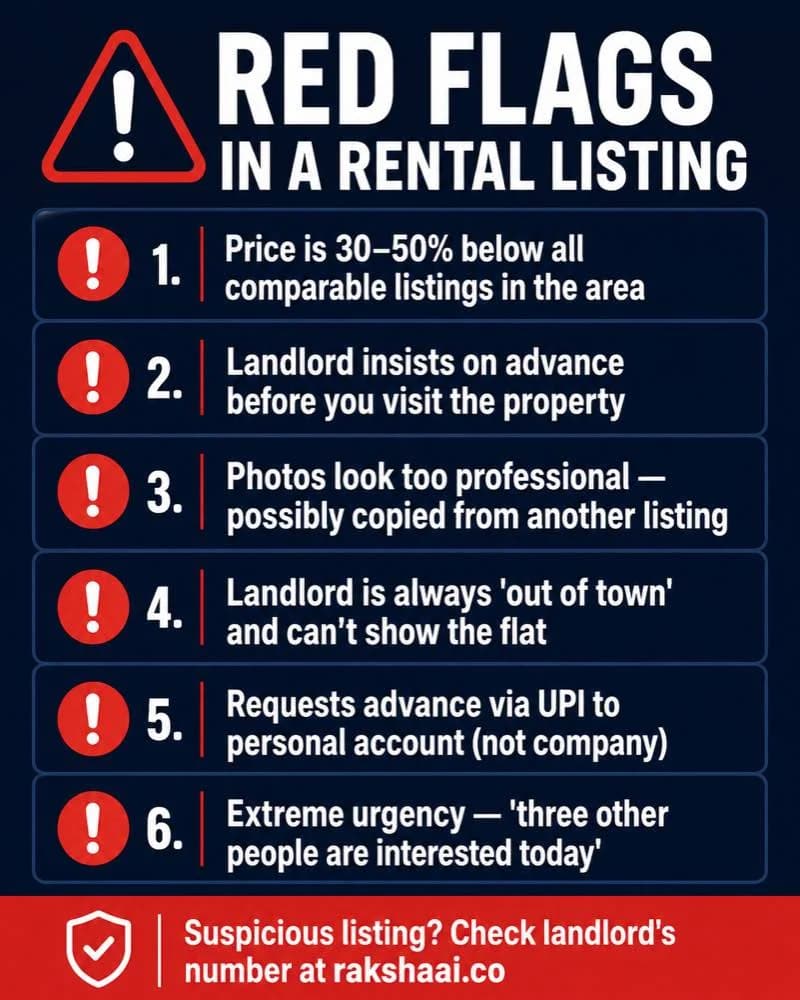
Six warning signs in every fake rental listing. Any single flag is reason to pause and investigate.
Beyond the verification checklist, these six signals appear consistently in fraudulent rental listings across every platform and format.
- Price is 30 to 50 percent below all comparable listings in the area. A scammer's primary acquisition tool is price. A below-market listing attracts volume while creating urgency: "at this price, it will go fast." If a 2BHK in Koramangala lists for Rs 8,000 when every other comparable flat is Rs 14,000 to Rs 18,000, the low price is not a deal it is the bait.
- The landlord insists on advance before allowing a site visit. The advance-before-visit demand is the core mechanism of rental fraud. There is no legitimate reason a landlord cannot show a property to a prospective tenant. Any framing of advance payment as a prerequisite for the viewing appointment is a scam structure.
- Listing photos appear on multiple listings or look professionally staged. Run a reverse image search on the listing photos. Fraudulent listings reuse stolen images from interior design portfolios, other rental listings, or real estate websites. If the same photo appears in listings at different addresses or cities, the listing is fake.
- The landlord is always "out of town" or unavailable for a visit. A scammer who does not control the property cannot facilitate a site visit. The out-of-town excuse, often accompanied by an offer to send the keys by courier after payment, is a classic rental fraud script. The courier-keys variation has defrauded thousands of international students searching for Indian rental housing from abroad.
- Advance is requested via UPI to a personal account rather than a company. Legitimate property brokers and large landlord operations typically collect payments through a business account with a traceable registered entity. Requests for UPI payment to a personal number with no supporting documentation reduce traceability and are a consistent feature of rental fraud.
- Extreme urgency: three other people are interested today. Manufactured competition is a pressure tactic designed to prevent due diligence. Real landlords do not communicate the interest of competing applicants to push you into paying faster. If the conversation includes any version of "someone else may take it by tonight," slow down rather than speed up.
Safe Rental Checklist Before You Transfer a Single Rupee
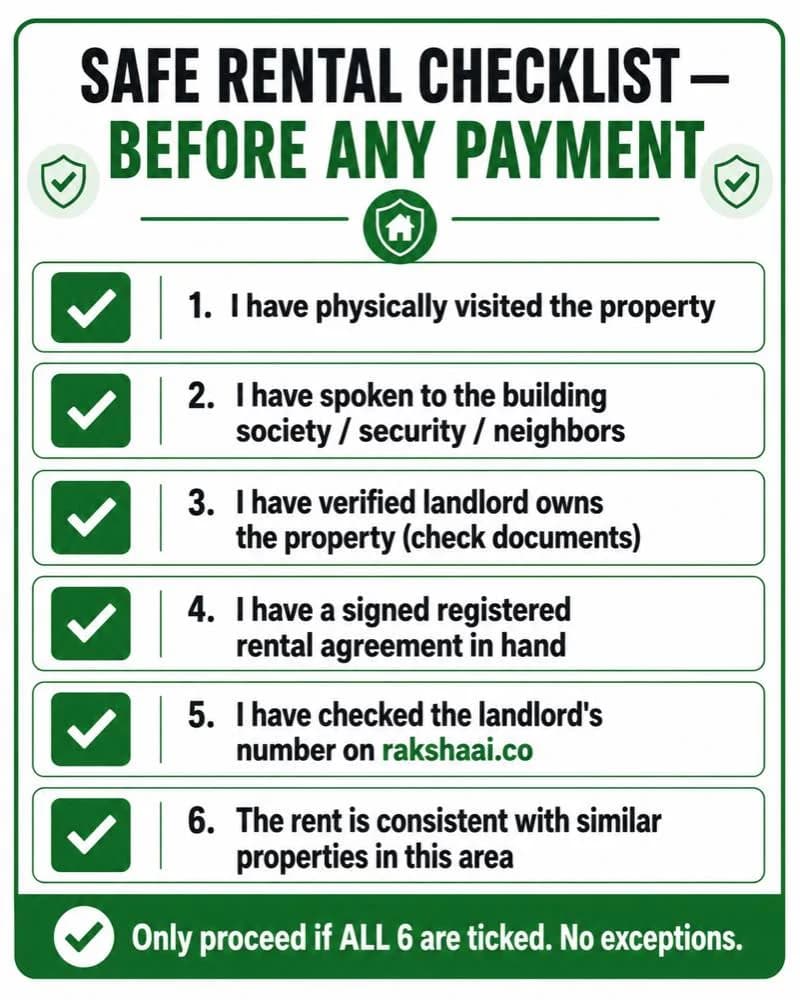
All 6 must be completed before any payment. Not five. Not four. All six.
Before transferring any amount token, booking fee, security deposit, or first month's rent confirm that every item on this checklist is complete.
- I have physically visited the property and it matches the listing.
- I have spoken to the building security guard, society committee member, or a neighbour who confirmed the flat is available.
- I have verified that the person I am paying is the owner or a legitimate registered broker for this property.
- I have a signed registered rental agreement in my hand before any payment is made.
- I have checked the landlord's phone number at rakshaai.co and found no fraud reports.
- The rent is consistent with comparable properties on NoBroker, 99acres, or MagicBricks for the same area and flat type.
Only proceed if all six are completed. If any single item is unresolved, do not transfer money and do not let urgency pressure you into doing so.
What To Do If You Have Already Been Scammed
Act within the first hour. UPI fraud recovery is time-critical: accounts can be frozen before the money moves if you report fast enough.
- Stop all further payments immediately. No additional payment, regardless of what the scammer says, will recover your advance. Every subsequent transfer is additional loss.
- Screenshot every transaction receipt and every conversation. Capture your UPI payment confirmations, the listing screenshots, and every WhatsApp or phone call record with the scammer. These are your primary evidence.
- Call 1930 immediately. The National Cybercrime Helpline can initiate a freeze request to the receiving bank in real time. Provide the scammer's UPI ID, phone number, and the exact amount transferred. The faster you call, the higher the probability the receiving account can be frozen before the money is withdrawn.
- File at cybercrime.gov.in within 24 hours. Register a complaint with all supporting evidence. The complaint creates a legal record and activates formal bank investigation protocols. Include the property address from the listing, the platform where you found it, and all contact details for the scammer.
- Contact your bank to raise a UPI fraud dispute. Ask your bank to raise a chargeback dispute for the transfer. Under NPCI's fraud reporting framework, banks are required to investigate and escalate these disputes. The sooner you raise the dispute, the better the outcome.
- Report the listing and the number at RakshaAI. Submit the scammer's number at rakshaai.co and the listing link at rakshaai.co/website-safety-checker so other Indians who encounter the same listing or number receive a warning before they pay.
For the complete fraud recovery guide, see Got scammed online in India? Do these 5 things in 30 minutes. For a guide on spotting all types of fake online listings, see our article on how to check any fake website in India.
Frequently Asked Questions
How do fake rental listings appear on NoBroker and MagicBricks?
Scammers create fake listings using photos of real properties copied from other listings or real estate websites. They post these at below-market prices to attract inquiries. When contacted, they ask for an advance booking amount before any in-person visit and then disappear.
Can I get my advance rent back if I was scammed in India?
Call 1930 immediately with the scammer's phone number and UPI ID. File at cybercrime.gov.in. If the transfer was made via UPI, early reporting gives the best chance of flagging the receiving account. After 24 hours, recovery becomes significantly harder.
What is the PG accommodation scam in India?
Scammers post fake PG and hostel listings targeting students and young professionals. They take advance deposits for rooms that either do not exist or are already occupied. The scam is especially active in cities with large student populations including Pune, Bangalore, Hyderabad, and Delhi.
How do I know if a rental price is suspiciously low?
Check the going rate on NoBroker, MagicBricks, or 99acres.com for similar properties in the same area. If the listed price is 30% or more below comparable listings, treat it as a red flag. Scammers use low prices to generate urgency and push you to book before thinking clearly.
Is it safe to pay advance rent via UPI in India?
Only if you have visited the property in person, verified the landlord's identity and ownership, and signed a registered rental agreement. Never transfer advance based on photos and a phone conversation alone. Also check the landlord's UPI payment safety guide before transferring any amount.
Final Thoughts
Fake rental scams work because they target a moment of genuine need under real time pressure. A student arriving in Pune for college, a professional relocating to Bangalore for a new job, a family moving to Delhi for a better school all of them need housing quickly and all of them are susceptible to a well-crafted listing that appears to solve the problem at the right price.
The protection is a single non-negotiable rule: never pay advance without visiting the property in person. No amount of urgency, no how professionally the conversation is handled, and no how compelling the photos look can substitute for physically standing in the flat you are about to pay for. The in-person visit is the only check that a scammer cannot bypass.
Share this article with anyone searching for a rental in an Indian city, especially students moving cities for the first time. The demographic most targeted by PG and hostel scams is exactly the group least likely to know these patterns. A single share could prevent a significant financial loss at a critical moment.
Free Tool
Got a landlord number or listing link?
Check any phone number, website link, or UPI ID on RakshaAI before responding or paying. No sign-up. No cost. Results in under 5 seconds.
Check a Landlord Number now →100% free · No sign-up required · Save 1930 in your contacts
More from RakshaAI Blog

Stay Protected Online
Use RakshaAI to check websites, phone numbers, and UPI IDs for scams free, instant, no sign-up required.
RakshaAI is a private platform by Ehatech Services Pvt. Ltd. Not affiliated with any government body. Editorial policy