
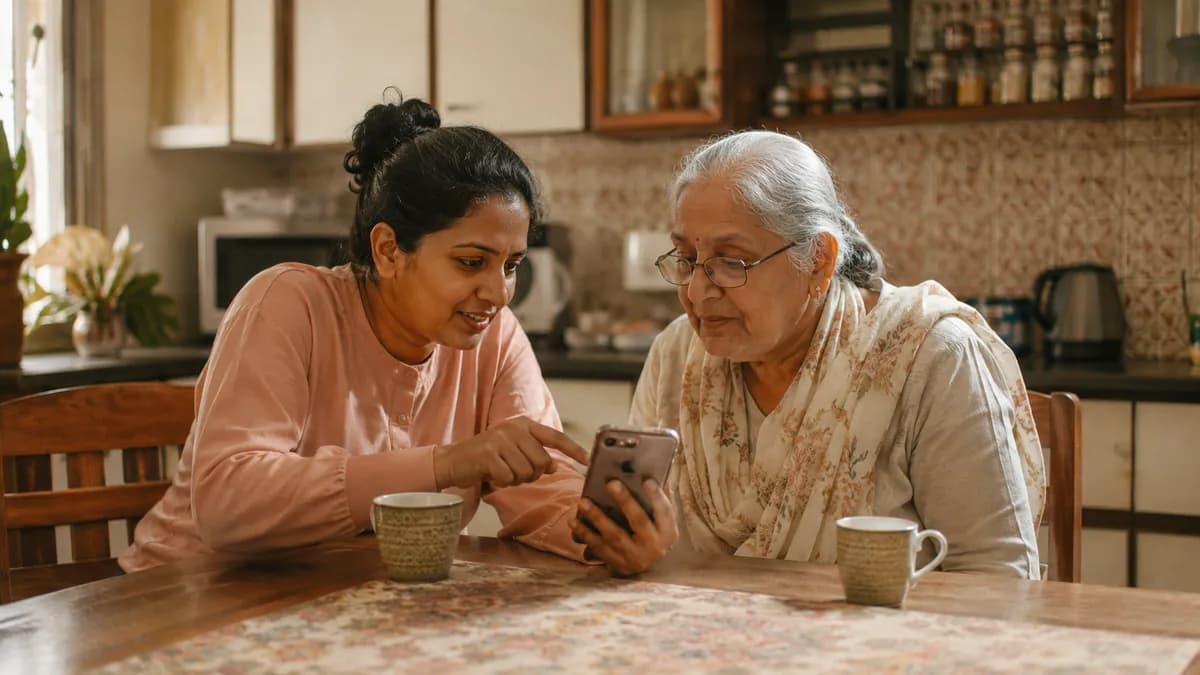
Fifteen minutes at the kitchen table teaching a parent the rules in this guide protects them better than any app, any antivirus, or any bank alert ever will.
Cyber safety for senior citizens in India is no longer optional family advice. It is urgent. If you are searching for how to protect parents from online scam attempts in India, the numbers explain why: in Nagpur alone, nearly 60% of all cyber fraud victims in 2025 were senior citizens, and the city lost Rs 45.77 crore to cyber fraud in a single year (source: Nagpur Today). In Indore, fraudsters cheated more than 8,100 victims of over Rs 100 crore in 2025, with digital arrest emerging as the single biggest weapon and elderly residents the primary targets (source: The420.in).
This guide is written to be shared. Send it to your parents, sit with them for fifteen minutes, and walk through the 10 rules together. Every rule is one sentence. Every rule stops a real scam that is running in India right now.
Why Senior Citizens Are the Most Targeted Group in India
Online fraud awareness for elderly India has become its own field of study inside police cyber cells, because scammers do not target senior citizens by accident. They target them by design, for four specific reasons:
- A lifetime of savings in one place. Retired people hold fixed deposits, pension funds, and property sale proceeds, exactly the pools of money a scammer wants to reach in one strike.
- Deep respect for authority. A generation raised to comply with police, courts, and banks is far more likely to obey a caller claiming to be a CBI officer.
- Less exposure to digital fraud patterns. Someone who started using a smartphone at 60 has never seen a phishing link, a fake KYC SMS, or a spoofed caller ID before.
- Isolation. Scammers explicitly instruct victims to tell no one. An elderly person living alone, away from children in another city, has no one nearby to break the spell.
Scam call centres train their scripts around these exact psychological patterns. The result shows up in police data across the country: seniors are not just victims among many, they are the preferred target. Scam awareness for parents India is therefore not something to get to eventually. It is the highest-value fifteen minutes you can spend with your family this week.
The 5 Scams Most Likely to Target Your Parents
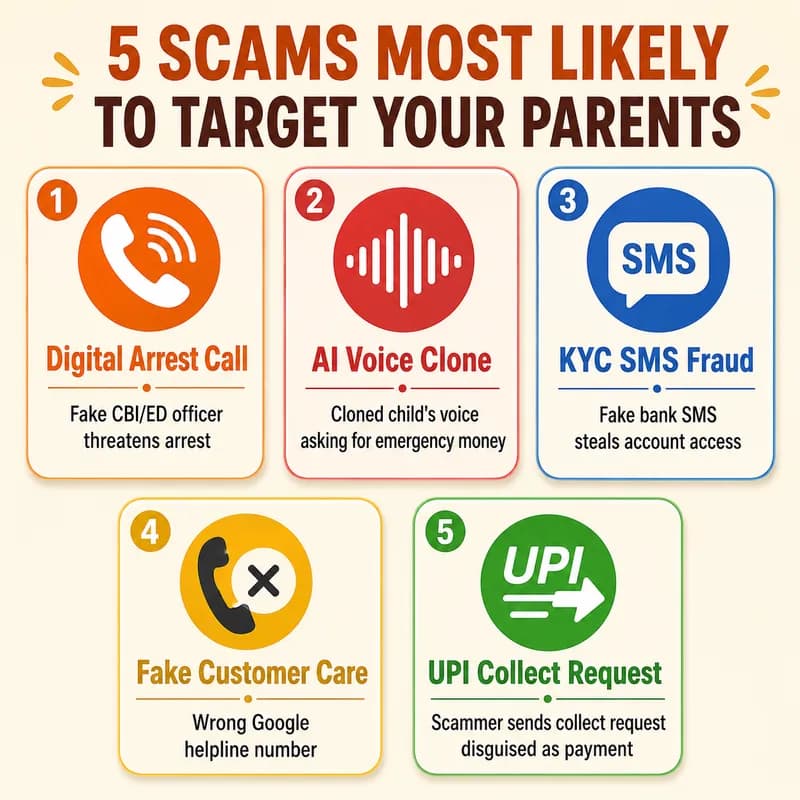
The five fraud formats most likely to reach your parents' phone this year. Show them this image, each one is explained below.
Digital Arrest Calls
A caller claiming to be from the CBI, ED, customs, or police says your parent's Aadhaar, phone number, or bank account is linked to a crime, then keeps them on a video call under a fake "digital arrest" while pressuring them to transfer money to "verify" or "settle" the case. There is no such thing as a digital arrest under Indian law. No government agency arrests anyone over the phone or asks for money on a call. Read the full breakdown in our digital arrest scam guide.
AI Voice Cloning Family Emergency Calls
With just a few seconds of audio pulled from social media, scammers clone a son's or daughter's voice and call the parent sobbing: an accident, an arrest, a kidnapping, money needed immediately. The voice sounds real because it technically is real. The defence is simple and absolute: hang up and call your child back on their saved number. Our guide to AI voice cloning scams in India explains how the technology works and every red flag to teach your family.
KYC Update SMS Fraud
An SMS warns that the bank account, or the SIM card, will be blocked today unless KYC is updated through a link. The link opens a fake bank page that captures login details, or installs an app that reads OTPs. Banks never send KYC links by SMS. The safe habit: delete the SMS and open the official bank app directly. See the full pattern in our KYC update scam guide.
Fake Customer Care Numbers
A senior searches Google for a bank, airline, or gas agency helpline and calls the first number that appears, which scammers have planted through fake listings and ads. The "agent" then walks them through installing a screen-sharing app or making a "refundable" verification payment. Always take helpline numbers from the official website or the back of the bank card, and check any suspicious number first. Our guide to fake customer care number scams covers this in detail.
UPI Collect Request Scams
A scammer sends a UPI collect request disguised as an incoming payment, a refund, a pension credit, or a lottery. The victim enters their UPI PIN believing they are receiving money, and instead authorises a payment out of their account. The rule to teach: entering a UPI PIN only ever sends money, never receives it. Every current UPI trick is documented in our guide to UPI scams in India.
Real Cases: This Is Happening to Real Families
These are documented, sourced cases from Indian police records and national newspapers. Each one began with a single phone call to a senior citizen.
Ludhiana, August 2024
82-Year-Old Vardhman Group Chairman Loses Rs 7 Crore in a Two-Day Digital Arrest
S P Oswal, the 82-year-old chairman of the Vardhman Group, was kept under "digital arrest" for two days by fraudsters posing as CBI officers and Supreme Court officials. They staged a fake virtual courtroom, complete with a man impersonating the Chief Justice of India, and served forged arrest warrants carrying ED and Mumbai Police stamps. He transferred Rs 7 crore before the fraud was discovered. Police later froze accounts and recovered Rs 5.25 crore, and two suspects were arrested from Guwahati. If one of India's most successful industrialists can be trapped this way, any parent can.
Source: Business StandardSouth Mumbai, December 2024 to March 2025
86-Year-Old Woman Held Under Fake Arrest for Two Months, Loses Rs 20.25 Crore
Scammers posing as law enforcement told an 86-year-old South Mumbai woman that her Aadhaar had been misused for illegal transactions. Over more than two months they forced her to stay at home, called every three hours to check her location, threatened cases against her daughter, and extracted Rs 20.25 crore of her life savings. Three arrests followed, and police traced links to an international fraud network. Her family found out only after the money was gone.
Source: Free Press JournalDelhi, 2025
"Save Me, Mom": AI Clone of Daughter's Voice Costs 65-Year-Old Rs 2 Lakh
A 65-year-old Delhi woman received a call in which her daughter's voice, sobbing and pleading, claimed she had been kidnapped and money was needed immediately. The voice was an AI clone built from a few seconds of publicly available audio. The mother transferred Rs 2 lakh before discovering her daughter had been safe at home the entire time. Analysts note that elderly people and women living alone are the primary targets of this scam format.
Source: The420.inThree different cities, three different amounts, one identical pattern: fear, urgency, secrecy, and a senior citizen alone on the phone. Every rule in the next section exists to break that pattern.
10 Simple Rules Every Senior Citizen Must Know
10 cyber safety rules every senior citizen in India must know:
10 rules that stop every major scam
- 1No government agency ever calls to arrest you on the phone. Hang up
- 2Never share OTP with anyone, ever, for any reason
- 3Your bank will never ask for your password or PIN over a call
- 4If a family member calls with an emergency, hang up and call them back directly
- 5Never scan a QR code someone sends you. It takes money, not gives it
- 6Never click links in SMS or WhatsApp claiming to be from your bank
- 7Before any UPI payment, check the receiver name matches who you expect
- 8If a call creates urgency or fear, wait 10 minutes and call a family member
- 9Never install an app anyone sends via link. Only use Play Store or App Store
- 10Save 1930 in your phone. Call it immediately if you suspect fraud
Every scam described in this article is defeated by at least one of these 10 rules.
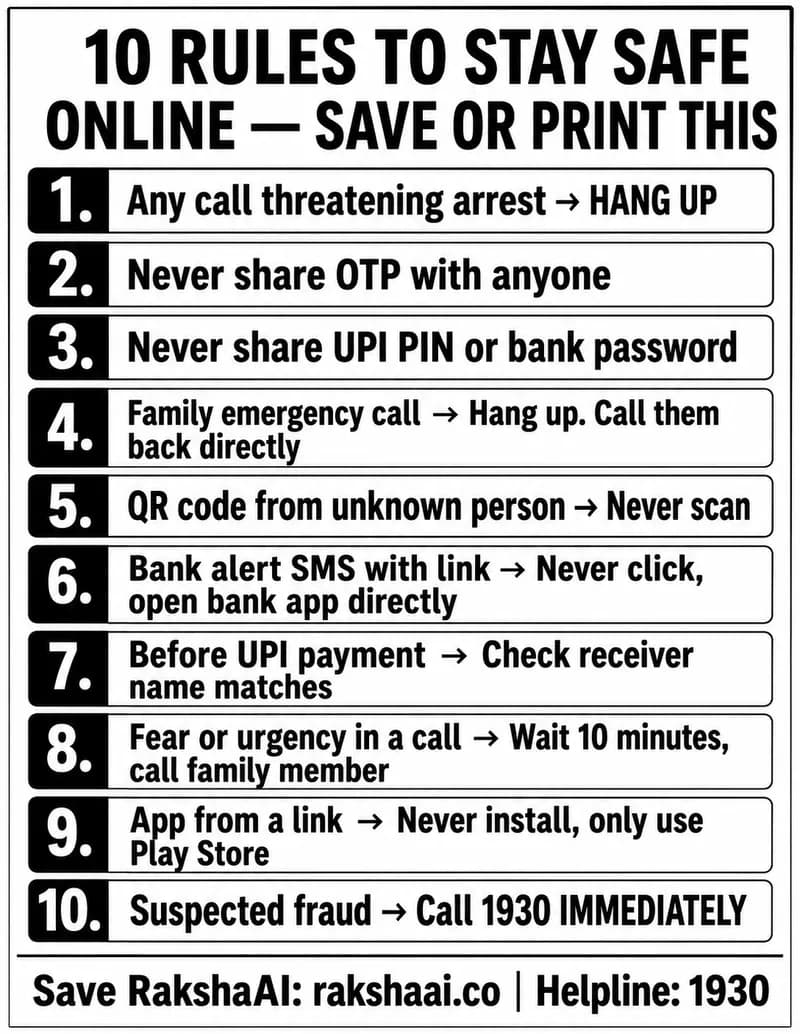
Print this card and put it on the fridge or next to the landline. It is designed to be read at a glance, mid-call, at the exact moment it is needed.
Do not just forward these rules. Sit with your parents and practice them. Role-play a scam call: pretend to be a "CBI officer" and let them practice hanging up. Digital safety tips for senior citizens India work only when they become reflexes, and reflexes are built by rehearsal, not by reading.
WhatsApp Safety Rules for Senior Citizens
WhatsApp is where most Indian seniors live online, and it is where most scam messages, fake KYC links, and forwarded fraud reach them. WhatsApp safety for elderly India comes down to five settings and habits you can configure on their phone in ten minutes:
- Lock down privacy. Set Last Seen, Profile Photo, and About to "My Contacts" only, so scammers cannot harvest their photo and status for impersonation.
- Enable two-step verification. Settings, Account, Two-step verification. This single toggle blocks WhatsApp account takeover, which scammers use to message the entire family asking for money.
- Never click links from unknown senders. No bank, no electricity board, no courier company sends payment links on WhatsApp.
- Forward before acting. Teach them one habit: any message about money, KYC, prizes, or emergencies gets forwarded to you before they act on it. You become the filter.
- Video call to verify. If a "relative" messages from a new number asking for help, insist on a video call first. Scammers refuse; real relatives never do.
UPI Safety Rules for Senior Citizens
UPI safety for senior citizens India starts with correcting one misunderstanding that scammers exploit constantly: many seniors believe entering a UPI PIN is needed to receive money. It is not. The PIN only ever authorises money going out. Once that is clear, four rules cover everything:
- Never accept a collect request you did not initiate, whatever the message claims it is for
- Never share the UPI PIN with anyone, including anyone claiming to be from the bank or the UPI app
- Always read the receiver name on the confirmation screen before paying, and stop if it does not match
- Never scan a QR code sent by an unknown person, QR codes are for paying, not receiving
If an unknown number sends a payment request or claims a refund is waiting, check the number first at the free RakshaAI phone number checker. It takes five seconds and cross-references reported fraud numbers across India.
How to Set Up a Family Emergency Protocol
Every scam that reaches a senior citizen depends on one thing: the victim acting alone, in fear, without checking with family. A family emergency protocol removes that possibility permanently. It takes fifteen minutes to set up, and it defeats digital arrest calls, voice cloning calls, and every "urgent money" scam in one move.
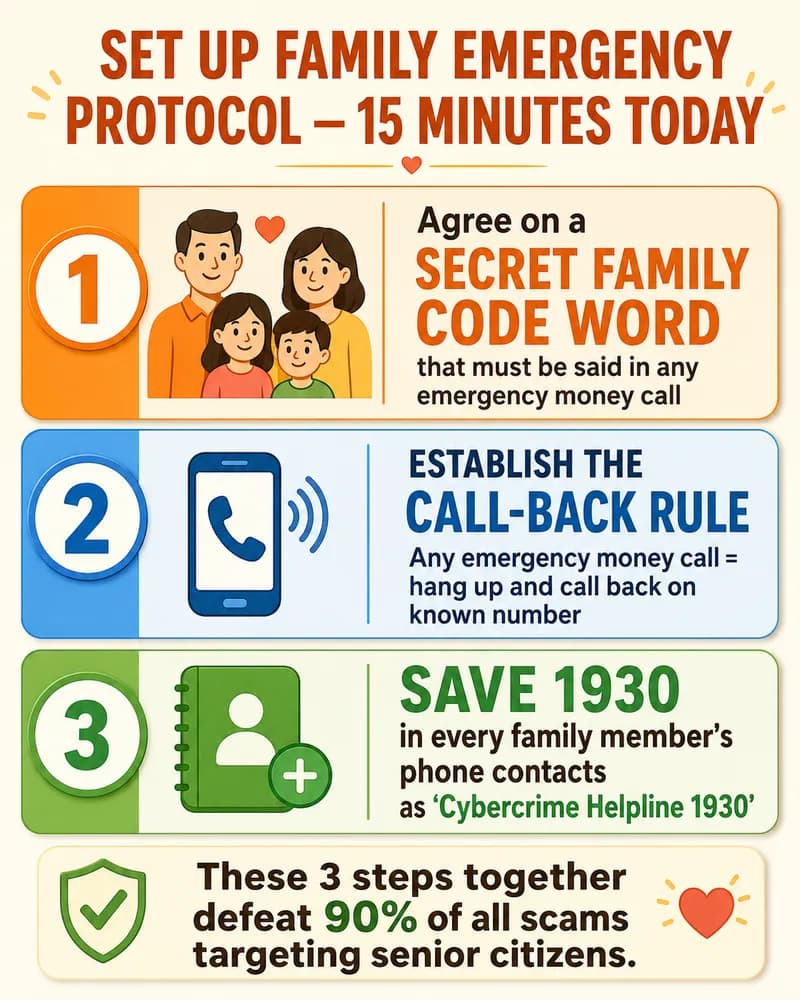
Three steps, fifteen minutes, one family meeting. Set this up this weekend, before the call comes.
- Agree on a secret family code word. Pick a word no outsider could guess, and agree that any genuine emergency call involving money must include it. An AI voice clone can copy a voice perfectly, but it cannot know the code word.
- Establish the call-back rule. Any emergency money call, from anyone, means hang up and call that person back on the number already saved in the phone. No exceptions, not even if the caller begs them to stay on the line. Especially if the caller begs them to stay on the line.
- Save 1930 in every family member's phone as "Cybercrime Helpline 1930". If fraud is suspected or money has moved, this is the first call. Follow it with a written complaint at cybercrime.gov.in, the national portal run under the Ministry of Home Affairs, whose cyber safety advisories are published at mha.gov.in.
If money has already been transferred, speed matters more than anything else. Follow the step-by-step recovery sequence in Got scammed online in India? Do these 5 things in 30 minutes.
Frequently Asked Questions
Why are senior citizens targeted more in cyber scams in India?
Senior citizens typically have significant savings built over a lifetime, are more trusting of authority figures, may be less familiar with digital fraud patterns, and are more likely to comply when threatened with legal consequences. Scammers specifically train their scripts to exploit these psychological patterns. Police data reflects the outcome: in Nagpur, nearly 60% of all cyber fraud victims in 2025 were senior citizens.
How do I teach my parents to identify scam calls in India?
Start with one rule: hang up on any call that creates fear or demands secrecy, then call you. Practice this with them until it is automatic. Also set up the free RakshaAI number checker on their phone so they can check any unknown number before calling back. Simple, one-step habits work best. This is how to teach parents about online scams India-wide: one reflex at a time, rehearsed together.
What WhatsApp settings should I enable for my elderly parents?
Privacy settings: set Last Seen, Profile Photo, and About to "My Contacts" only. Enable two-step verification. Teach them to never click links from unknown senders and to forward any suspicious message to you before acting on it.
Should elderly parents use UPI in India?
Yes. UPI is generally safe when basic rules are followed. The key rules: never accept collect requests they did not initiate, never share the UPI PIN with anyone, always verify the receiver name before paying, and never scan QR codes sent by unknown people.
What should a senior citizen do immediately after getting a scam call in India?
Hang up. Do not call the number back. Call a trusted family member. If any money was already transferred, call 1930 immediately and then call the bank's official number from the back of the card. File a complaint at cybercrime.gov.in with all details.
Final Thoughts
An 82-year-old industrialist lost Rs 7 crore. An 86-year-old widow lost Rs 20.25 crore. A 65-year-old mother lost Rs 2 lakh to a voice that sounded exactly like her daughter. None of them were careless people. They were simply alone on the phone with professionals trained to manufacture fear, and no one had ever walked them through what those calls sound like.
That is the entire gap this guide closes. Share this article with your parents today, sit with them for fifteen minutes, practice the 10 rules, and set up the family code word. Scammers rely on silence between generations. One conversation at the kitchen table takes that weapon away for good.
Sources and References
Every statistic and case referenced in this article is drawn from the following public sources. We link out directly so you can verify the original reporting yourself.
- Digital arrest and Rs 7 crore heist: how the Vardhman Group head was tricked, Business Standard
- 86-year-old South Mumbai woman loses Rs 20 crore of savings in digital arrest fraud, Free Press Journal
- Mumbai woman loses Rs 20 crore in digital arrest scam, police probe conspiracy, Business Standard
- AI voice clone scam cheats Delhi elderly woman in fake kidnapping fraud, The420.in
- Rs 45.77 crore lost to cyber fraud in 2025, 60% of victims senior citizens in Nagpur, Nagpur Today
- Cyber fraud in Indore: over Rs 100 crore lost in 2025, digital arrest the biggest weapon, The420.in
Free Tool
Unknown number called your parents?
Check any phone number at RakshaAI before anyone calls back. Instant result. No sign-up. No cost.
Check a Number Now →100% free · No sign-up required · Save 1930 in your contacts
More from RakshaAI Blog
Electricity Bill Scam India: That Disconnection Today SMS Is Always Fake

AI Scam India: How Artificial Intelligence Is Making Fraud More Dangerous in 2026
Credit Card Fraud India 2026: How Scammers Clone and Misuse Your Card
Stay Protected Online
Use RakshaAI to check websites, phone numbers, and UPI IDs for scams free, instant, no sign-up required.
RakshaAI is a private platform by Ehatech Services Pvt. Ltd. Not affiliated with any government body. Editorial policy