

The phone glows in the dark. A single recorded moment is now being used to extort money. You are not alone - and you must not pay.
You accepted a video call from an unknown number. The call lasted under two minutes. Within hours, a message arrives: "I recorded this. Pay me or I send it to your family, your contacts, your employer."
This is sextortion - India's fastest-growing cyber blackmail crime. It does not require you to have done anything wrong. It does not require real content. And it does not end with payment. Every rupee you pay proves you will pay again, and demands escalate immediately.
India's National Cybercrime Helpline (1930) receives thousands of sextortion complaints every month. Victims include students, working professionals, homemakers, and senior citizens. The scam is organised, industrialised, and running at scale across the country.
If you are being sextorted in India right now - do this immediately
- 1Do NOT pay - payment extends the blackmail, it never ends it
- 2Screenshot all threats and the scammer's profile as evidence
- 3Block the scammer on all platforms immediately
- 4File a complaint at cybercrime.gov.in - handled with complete confidentiality
- 5Call 1930 for immediate cybercrime support
- 6Tell a trusted person - isolation is the scammer's greatest weapon
Important: Indian cybercrime police handle sextortion confidentially. Reporting does not publicize content.
What Is Sextortion and How Bad Is It in India?
Sextortion is a form of cyber blackmail where a scammer threatens to publish real, fabricated, or AI-generated intimate content about you unless you pay money. The threat alone - regardless of whether any real content exists - is sufficient for criminals to extort victims for thousands or lakhs of rupees.
India's cybercrime data shows sextortion accounts for approximately 4% of all cybercrime financial losses. What makes this number deceptive is that sextortion is one of the most severely under-reported crimes in India. Shame, fear, and the belief that paying will end it silences the majority of victims. For every complaint filed, many more victims quietly pay.
Under Indian law, sextortion is a serious criminal offence. Perpetrators face 3 to 7 years imprisonment under IT Act Section 67 (obscene content), Section 66E (privacy violation), BNS Section 75 (sexual harassment), and Section 351 (criminal intimidation).
How Sextortion Scams Work in India in 2026
Sextortion scammers in 2026 use four distinct methods. All four have one thing in common: they do not require your genuine participation. The trap works whether you cooperated, clicked a link, or simply had public photos online.
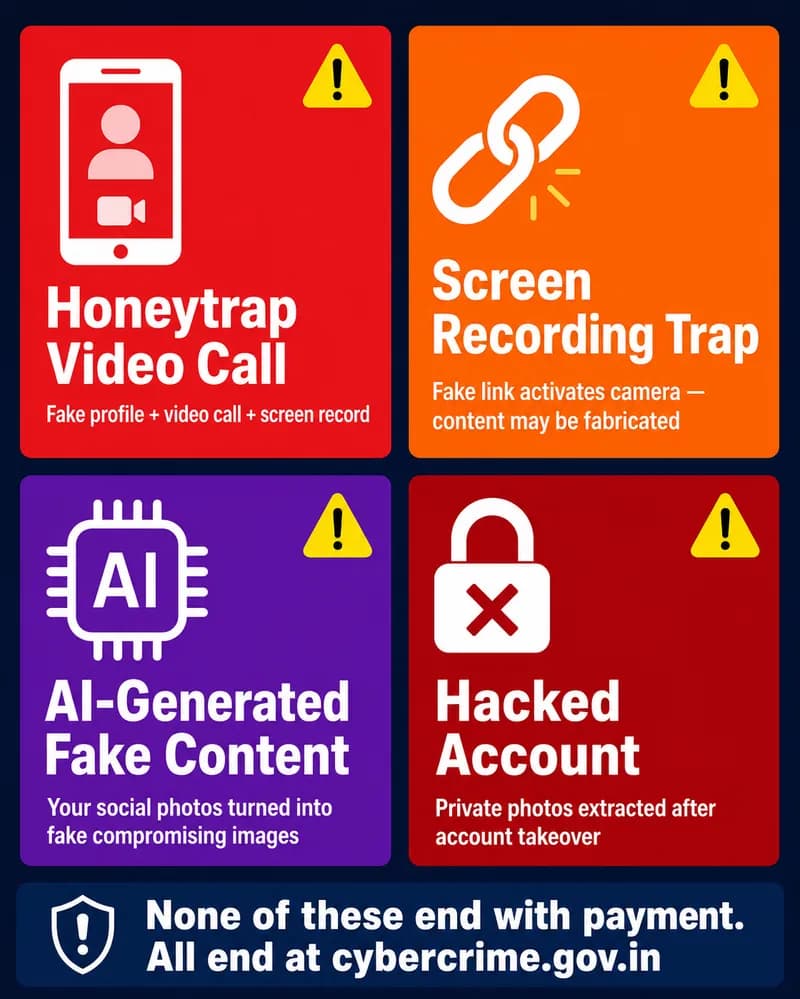
The four methods used in India in 2026. None of them end with payment.
Version 1: The WhatsApp or Instagram Honeytrap
The most common variant. A fake profile contacts you - usually an attractive stranger - and moves quickly to building trust. Within days or even hours, the conversation is steered toward a video call. During the call, the scammer shows intimate content, hoping to provoke a reciprocal response. The entire call is screen-recorded.
You do not have to reciprocate. Even your face on camera during the call is enough. The recording is then used as the basis for the threat. Many victims say they did nothing at all during the call - the edited clip is presented deceptively regardless.
Version 2: The Screen Recording Trap
A link is sent claiming to show a message, a photo, or a video call request. Clicking the link activates the camera or microphone in the background without your knowledge. The content captured may be real or fabricated using AI tools. Either way, the extortion message follows shortly after.
Rule: Never click links sent by unknown contacts, especially those asking you to verify identity, view a photo, or accept a call. Check any suspicious link at rakshaai.co/website-safety-checker before opening.
Version 3: AI-Generated Fake Content
In 2026, AI image generation tools can create realistic fake compromising images from publicly available social media photos. Scammers do not need a video call or a camera link. They need only your Instagram or Facebook profile.
This content is entirely fabricated. It is a lie. But under Indian law, threatening to publish fabricated sexual content is criminal extortion with the same legal weight as threatening to publish real content. The scammer is committing a serious crime regardless of whether the content has any basis in reality.
Setting your social media photos to private or friends-only significantly reduces exposure to this variant. This one action removes the raw material scammers need.
Version 4: The Hacked Account
If your social media or cloud storage account is compromised through phishing or a reused password, private photos and videos can be extracted directly. The extortionist then demands payment in exchange for not publishing this content.
Two-factor authentication (2FA) on all social accounts closes this attack vector. A scammer who cannot access your account cannot steal private content from it.
Who Is Being Targeted?
Sextortion in India targets people across all demographics, but certain groups are more frequently targeted based on how scammers operate:
- Young adults (18-35): High social media usage creates more entry points via fake profiles and public photos.
- Professionals: The threat of exposure to employers or colleagues amplifies the psychological pressure to pay.
- Students: Targeted because they are less likely to report out of fear of judgment from family.
- Anyone with public social media: AI-generated fake content variants target anyone whose photos are publicly visible online.
The scam does not discriminate by gender. Men, women, and non-binary individuals are all targeted. The scammers are not selective - they run these operations at industrial scale, targeting thousands of people simultaneously.
Why Paying Makes It Worse, Not Better

Screenshot this. Share it. Someone you know may need it today.
Every documented case of sextortion follows the same pattern after the first payment: the demands increase immediately. A scammer who received ₹5,000 will demand ₹20,000 next. A scammer who received ₹20,000 will demand ₹1 lakh. The first payment tells them two things that make them certain you will pay again.
First, you are afraid enough to pay. Second, you have money. From that moment, you are no longer a cold target - you are a confirmed revenue source. The blackmail does not end because you paid. It escalates because you paid.
There is no recorded case anywhere in India or globally where a single sextortion payment ended the extortion. Police investigators and cybercrime support organisations consistently document the same trajectory: payment leads to more payment until the victim runs out of money or reaches out for help.
The only action that reliably ends sextortion is removing the scammer's leverage. That means refusing to pay, reporting to police (who investigate confidentially), and not isolating yourself. Isolation - the fear and shame that keeps victims quiet - is the scammer's most powerful weapon.
What To Do If You Are Being Sextorted Right Now
You are a crime victim. This is not your shame. Indian cybercrime police handle these cases with complete confidentiality - reporting does not publicize anything.
- Do not pay anything. This is the most important step. Every payment confirms you are a viable target and makes the problem worse, not better.
- Screenshot all threats. Capture the scammer's profile, messages, the account name, and any payment demands. This is your evidence.
- Block the scammer immediately. Block on WhatsApp, Instagram, and every other platform they used to contact you. This removes one channel of harassment.
- File at cybercrime.gov.in. Select "Cyber Blackmail / Sextortion" as the category. Upload your screenshots. The complaint is treated with complete confidentiality. No content is published or shared publicly.
- Call 1930. India's National Cybercrime Helpline provides immediate support and can flag the scammer's accounts and payment methods in real time.
- Tell someone you trust. A family member, friend, or counsellor. Isolation makes sextortion dramatically worse. The shame belongs entirely to the criminal, not to you.
- Report the phone number on RakshaAI. Your report at rakshaai.co/phone-number-checker flags the number for other Indians before they become the next target.
How to Protect Yourself Going Forward
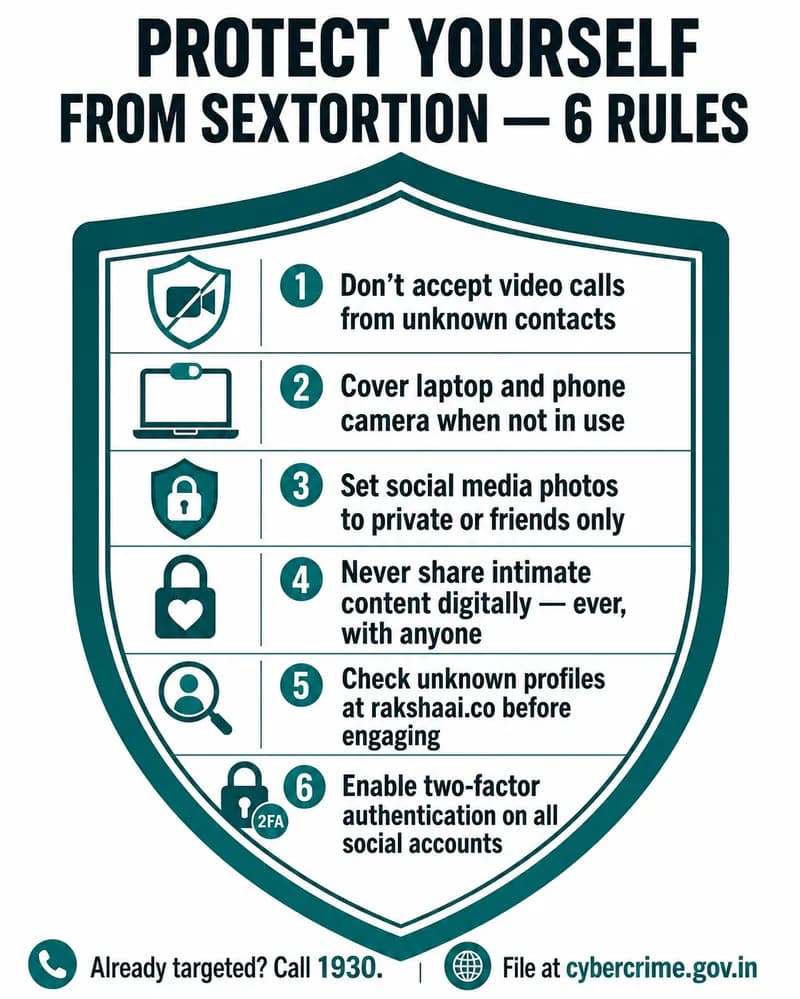
Share this checklist on WhatsApp - it takes 2 minutes to implement.
Sextortion prevention comes down to removing the raw material and access points that scammers rely on. These six steps close the most common attack vectors:
- Reject video calls from unknown contacts. No legitimate person needs a video call with a stranger. A contact you have not verified should not have access to your camera.
- Cover your laptop and phone camera when not in use. A simple physical cover eliminates the risk from malicious links that activate your camera.
- Set social media photos to private or friends only. Public photos are the raw material for AI-generated fake content. Making them private removes that material entirely.
- Never share intimate content digitally. No platform, no app, no private chat is truly secure. Content shared digitally can always be extracted.
- Check unknown profiles before engaging. Search the phone number or profile link at rakshaai.co before responding to unknown contacts.
- Enable two-factor authentication on all social accounts. 2FA prevents the account takeover that enables the hacked-account variant of sextortion.
Frequently Asked Questions
Should I pay a sextortion scammer in India?
Never. Payment does not stop sextortion - it signals you will pay again and demands escalate immediately. File at cybercrime.gov.in and call 1930. These cases are handled with complete confidentiality by police.
Can AI generate fake sextortion content from social media photos?
Yes. In 2026, AI image tools can generate realistic fake compromising images from publicly available social media photos. This content is entirely fabricated but constitutes criminal blackmail under IT Act Section 67 and BNS Section 75 regardless. The fact that it is fake does not weaken your legal case - it strengthens the criminal's charges.
Is sextortion illegal in India?
Yes. Sextortion is covered under IT Act Section 67 (obscene content), Section 66E (privacy violation), BNS Section 75 (sexual harassment), and Section 351 (criminal intimidation). Penalties range from 3 to 7 years imprisonment depending on the charges.
How do I report sextortion in India?
File at cybercrime.gov.in (select Cyber Blackmail/Sextortion), call 1930, and file an FIR at your local cybercrime police station. All are confidential. Also report the scammer's number at rakshaai.co to warn other Indians.
What if the sextortion content is AI-generated and completely fake?
The law applies equally. Threatening to publish fabricated sexual content is criminal extortion regardless of whether it is real or AI-generated. Report it identically - file at cybercrime.gov.in and call 1930. The AI-generated nature of the content actually adds charges against the perpetrator.
Final Thoughts
Sextortion works because it weaponises fear and shame. Scammers have engineered every part of this crime to make victims feel that silence and payment are their only options. They are not. Reporting does not publicize anything. Police handle these cases confidentially. The content, real or fake, is not shared during investigations.
The single most powerful thing you can do if you are being sextorted is to refuse to pay and reach out for help. Tell a trusted person. File a complaint. Call 1930. The scammer loses their leverage the moment you stop being isolated.
Share this article with someone in your life who is active on social media. The scam is growing, it is targeting people of every age and background, and the next person it targets could be someone you care about.
Free Tool
Got a suspicious video call request or unknown link?
Check any phone number or link on RakshaAI instantly before engaging. No sign-up. No cost. Results in under 5 seconds.
Check a Number or Link now →100% free · No sign-up required · Save 1930 in your contacts
More from RakshaAI Blog
PAN Card Fraud India: How Scammers Are Misusing Your PAN in 2026
Social Media Account Cloning India: When Scammers Become You Online
Cyber Fraud Case Studies India 2026: Real Victims, Real Losses, Real Lessons
Stay Protected Online
Use RakshaAI to check websites, phone numbers, and UPI IDs for scams free, instant, no sign-up required.
RakshaAI is a private platform by Ehatech Services Pvt. Ltd. Not affiliated with any government body. Editorial policy