
E-Commerce Fraud in India 2026: Warning Signs & How to Protect Yourself
E-commerce fraud is any criminal trick that exploits online shopping platforms from fake ecommerce websites to counterfeit deliveries to steal money or data from Indian shoppers.
In the past year, 35% of Indians encountered fake products while shopping online, and the National Consumer Helpline processed ₹36.8 crore in e-commerce refund disputes between April 2025 and January 2026 alone.
Below you will find all 7 types of online store scams explained clearly, the red flags to spot early, and exact steps to report online shopping fraud and recover your money in India.
Not Sure If That Shopping Site Is Real?
CHECK WEBSITE SAFETY FREE →Free · No login required · Instant results · Built for Indian shoppers
India's Online Shopping Boom Has a Dark Side
India crossed 300 million online shoppers in 2024. With that growth came an explosion of opportunity not just for honest businesses, but for an entire ecosystem of fraudsters who have built sophisticated operations specifically targeting Indian consumers.
These aren't just poorly-made scam websites that any savvy person would dismiss. Modern fake e-commerce sites use stolen brand assets, genuine-looking product photos, fabricated customer reviews, and realistic checkout flows. Some even offer COD cash on delivery because they know that reduces your suspicion, only to deliver sealed boxes filled with sand or old newspapers.
The scale is staggering. In 2023 alone, over 1.1 lakh e-commerce fraud complaints were filed with India's National Consumer Helpline and that's only the reported cases. Most victims, embarrassed or unaware of the process, never file a complaint at all.
The Golden Rule
- Any deal more than 60% off market price from an unknown site is almost always a scam.
- Sites that accept only UPI/bank transfer (no COD, no card) have zero buyer protection.
- A professional-looking website is not proof of legitimacy. Scam sites can look perfect.
- Always pay with credit card where possible it offers the strongest chargeback protection.
- Open every package on video while the delivery agent waits this is your only evidence.
- Verify any unfamiliar website on RakshaAI before completing your first purchase.
How Big Is India's Online Shopping Fraud Problem?
India's e-commerce sector crossed 300 million shoppers in 2024 and with that growth came an explosion of fraud. From fake sites to phantom deliveries, Indian consumers lost crores in preventable scams last year alone.
7 Types of E-Commerce Fraud in India 2026 See Articles Below
Online shopping scams in India are not one single crime. Scammers use seven distinct methods, each exploiting a different moment in the shopping journey. Click any card below for the complete guide on that fraud type.
Fake Shopping Website Fraud
Very HighScammers create convincing copy-cat stores with real brand logos and fake products. After you pay, nothing arrives or you receive a worthless substitute.
Cash on Delivery (COD) Scam
Very HighYou receive an unordered COD parcel with a low amount like ₹99–₹299. Paying confirms your address data for larger scams. The parcel contains junk.
Counterfeit and Fake Products
HighA third-party seller on Amazon, Flipkart, or Meesho ships a counterfeit version of a branded product. ASPA/CRISIL 2026: 9 in 10 urban Indians bought counterfeit at least once.
Advance Payment Trap
Very HighA seller demands full upfront payment outside the platform often via UPI or bank transfer. Once you pay, the seller disappears and the order never ships.
Social Media & WhatsApp Shopping Scam
HighFake seller pages on Instagram and WhatsApp groups offer steep discounts. Products are never delivered or are cheap imitations. AI deepfake shopping scams rose sharply in 2025–26.
Fake Seller on Marketplace Fraud
HighFraudulent sellers on Amazon India, Flipkart, and Meesho list products, collect payment, then mark the order 'Delivered' without shipping. Victims get a tracking ID for an empty or wrong package.
Phantom Delivery Scam
HighYour order is marked 'Delivered' before you ever receive it. A fake or empty package follows to beat the refund window. The scammer disappears with your payment.
How E-Commerce Fraud Actually Works in India
Every type of online store scam follows the same three-stage playbook. Understanding this playbook protects you against all seven fraud types at once.
Target Selection
Scammers build target lists from leaked e-commerce databases, social media users who engage with shopping posts, WhatsApp deal groups, and price comparison platforms. Festive season shoppers are the highest-value targets McAfee's 2024 survey found 45% of Indian consumers were affected during the October festive season alone. Dark patterns on ecommerce India platforms, such as 'drip pricing' and 'bait and switch' now officially classified by CCPA's 2023 Guidelines are used to distort your decision-making before the scam even begins.
Approach & Trust Building
Fake stores are built to look exactly like Flipkart, Amazon India, or Myntra. AI deepfake shopping scam techniques in 2025–26 now generate convincing product photos, fake review profiles, and influencer endorsements automatically. WhatsApp shopping scam India groups pose as reseller networks with 'flash sale' offers. Fraudulent sellers on marketplaces accumulate five-star reviews through early legitimate sales before switching to counterfeit goods. The advance payment trap uses urgency 'stock running out,' 'offer expires tonight' to push payment before you verify.
Execution & Disappearance
The fraud completes the moment payment is made. A fake shopping website takes the payment and closes within days. A marketplace fraudster marks the order delivered before shipping. A COD scammer uses your address data. A phantom delivery scam manipulates courier tracking to show delivery status before any package moves. Unlike UPI transactions, marketplace disputes require a formal platform complaint process before a bank can intervene making speed critical. File a complaint with the National Consumer Helpline or cybercrime.gov.in within 24 hours for the best chance of recovery.
Is That Shopping Website Safe? Check It in 10 Seconds
CHECK WEBSITE NOW →"I Paid ₹4,200 in Cash. The Box Had Sand in It." A Real Account
Sunita (name changed), a homemaker from Kanpur, saw an Instagram ad for a pressure cooker set a brand she recognised for ₹4,200, marked down from ₹8,500. The seller's page had 4.8 stars, dozens of comment photos showing happy customers with the same product. She selected COD because "at least I won't lose money upfront."
The package arrived three days later, well-packaged and sealed with what looked like official courier tape. The delivery agent seemed friendly, collected the cash, handed over the receipt, and left. Sunita brought the box inside, cut it open and found sand, some crumpled newspapers, and two broken clay pots.
"I called the number on the seller's page. The first time it rang. The second time, invalid number. The Instagram page had vanished. I sat there for twenty minutes just not believing what had happened."
The reviews were fabricated. The 'brand' photos were stolen. The comments were from a paid review farm that posted bulk reviews on multiple fraudulent pages simultaneously. The courier had no idea the seller had packed and sealed the box themselves.
Sunita filed a complaint with the National Consumer Helpline and cybercrime.gov.in. Her case was registered, but since she paid cash, recovery was extremely difficult. Her story is replicated thousands of times every month across India.
The COD Safety Rule:
Always open your package on video while the delivery agent is still at your door. Ask them to wait 60 seconds. If the contents are wrong, you have a witness and documented proof and the agent can refuse to leave until you resolve the issue.
How Are Fake E-Commerce Sites Built So Convincingly?
You might wonder: how can a site look so legitimate and be completely fraudulent? The answer is that building a convincing fake shopping site now costs almost nothing and takes under a day. Scammers use Shopify, WooCommerce, or free website builders, download stolen product images from legitimate retailers, and populate the site with AI-generated or plagiarised product descriptions.
They register domains that mimic popular brands using numbers instead of letters (amaz0n), adding 'india', 'official', or 'store' to known names, or creating entirely fictional-sounding legitimate businesses. They run Facebook and Google ads with genuine-looking product shots to reach thousands of potential victims.
Many fake sites even have entire return policy pages, 'about us' sections with stock photos of 'team members', GST numbers (often fake or stolen), and customer service email addresses that never respond. The entire objective is to cross the psychological threshold of trust long enough for you to enter your payment details or hand over cash.
Once enough orders accumulate, the site goes dark. The domain is usually abandoned and a new one registered within days. By the time victims start complaining, there is nothing left to trace.
Anatomy of a Fake Site
- DomainRegistered 4–8 weeks ago, mimics a real brand name
- SSL CertificateFree HTTPS proves nothing about legitimacy
- Product ImagesStolen from Amazon, Flipkart, or brand websites
- ReviewsBulk-purchased from review farms, all 5-star, no photos
- Price60–90% below real market price to attract clicks
- PaymentUPI only, or payment gateway with no buyer protection
- Lifespan7–90 days before abandoning and relaunching elsewhere
The HTTPS Myth
Many people believe a padlock icon means a site is safe. It doesn't. HTTPS only means the connection is encrypted not that the site owner is trustworthy. Over 80% of phishing and fake shopping sites now use HTTPS. The padlock is necessary but nowhere near sufficient.
Instagram & Facebook Shopping Scams: Why They're So Effective
Social media shopping scams deserve their own section because they're fundamentally different from website fraud and they're growing three times faster. On Instagram and Facebook, a fake seller's page can look almost indistinguishable from a genuine small business, complete with reels, story highlights, and customer testimonial videos (all stolen or staged).
The scam usually works like this: you see an ad for a product often clothing, skincare, electronics, or jewellery at a price that's attractive but not obviously suspicious. You click, explore a well-curated page, maybe DM the seller. They respond quickly, professionally, and warmly. They ask you to pay via UPI or bank transfer 'to avoid transaction fees'. Once you pay silence.
Some sophisticated scammers even deliver the first few orders correctly building trust, encouraging larger repeat purchases, and getting word-of-mouth referrals before eventually taking large advance payments and disappearing.
7 E-Commerce Fraud Warning Signs You Should Never Ignore
These warning signs apply across all seven fraud types. If even one appears in any shopping interaction, treat it as a potential scam until you can independently verify it.
A shopping website with no physical address, no working customer care number, and payment only via UPI or bank transfer
A price that is 40–70% below the MRP on every other platform if it seems too good to be true, it is
A seller asking you to continue the transaction outside the platform on WhatsApp, by phone, or via a separate link
A COD parcel you did not order arriving at your door do not pay, do not open, note the courier details
An order marked ‘Delivered’ before the promised delivery window, with no physical package received
A social media page or WhatsApp group offering brand-name products at clearance prices with no verifiable seller identity
A customer care representative asking for your OTP to ‘process a refund’ or ‘verify your order’ this is always a scam
Who Do E-Commerce Scammers Target And Why?
The honest answer is: everyone. E-commerce fraud doesn't discriminate the way some other scams do. You don't need to be naive or inexperienced to fall for a convincing fake site you just need to be in a hurry, excited about a deal, or distracted while ordering on your phone.
That said, certain groups are disproportionately targeted. First-time online shoppersparticularly in tier-2 and tier-3 cities are prime targets because they lack the reference experience to notice inconsistencies. Festival season shoppers are targeted with fake 'Big Billion Day' or 'Great Indian Festival' clone sites that perfectly mimic legitimate platform sales.
Deal hunters who actively search for the cheapest price across platforms are another major target group scammers specifically appear in Google Shopping results for high-value items like TVs, laptops, and smartphones, knowing that deal-seeking behaviour bypasses normal caution.
First-time shoppers
Lack comparison basis
Festival deal hunters
Excitement overrides caution
Mobile-first users
Small screen hides URL red flags
Social media shoppers
Platform trust transferred to seller
How to Protect Yourself from Online Shopping Scams 5 Rules
These five e-commerce fraud prevention rules address the specific tactics scammers use in India. Each rule eliminates multiple fraud types simultaneously.
Only shop on platforms you can verify independently
Before entering any payment details on a new shopping website, check it on RakshaAI's Website Safety Checker. Look for an operational customer care number, a physical address, and a consistent return policy. Fake ecommerce websites rarely have all three. Scam detector sites flag thousands of new fraudulent domains every week checking takes 10 seconds.
Never pay outside the platform
The moment a seller on Amazon India, Flipkart, or Meesho asks you to pay via a direct UPI transfer, a WhatsApp link, or a third-party account stop. All legitimate marketplace transactions happen through the platform's own payment system. Off-platform payments have no buyer protection and no dispute mechanism.
Verify seller identity and reviews before purchasing
For any new seller on a marketplace, check how long the seller account has been active and whether reviews are spread across time or all posted in a short period. Fake ecommerce store detection is easier when you sort reviews by 'Most Recent' rather than 'Most Helpful' scammers game algorithms on the helpful sort. For social media purchases, always ask for a GST number and a verifiable business address.
Open COD parcels before paying the delivery agent
This eliminates the COD fraud scam. You have the legal right to inspect any cash-on-delivery parcel before paying. If the delivery agent refuses to allow inspection, refuse the parcel and note the tracking details. If you receive an unordered COD parcel, reject it at the door and report the sender's information to the National Consumer Helpline at 1800-11-4000.
Urgency is always a manipulation tactic
Every festive sale scam India involves manufactured time pressure: 'Only 2 left,' 'Offer ends in 10 minutes,' 'Special deal only for you.' Real e-commerce platforms do not pressure customers to bypass security steps. If any shopping interaction feels rushed, slow down, verify the seller, and use an established platform's checkout rather than a direct payment link.
Trusted Platform vs. Fake Shopping Site Spot the Difference
Trusted Platform (Amazon, Flipkart)
- Multiple payment options including COD and credit card
- Seller account age and review history visible
- Platform-backed buyer protection and disputes
- Working 24/7 customer support number
Fake Shopping Site
- Only UPI or bank transfer no COD, no card option
- Domain registered less than 30–60 days ago
- No real phone number, no traceable address
- Prices 60–90% below market rate on every item
The 60-Second Check
Check any unfamiliar shopping site on RakshaAI's Website Safety Checker before entering payment details it's free and takes less than 60 seconds.

Online Shopping Myths vs. Reality
Myth
COD means I'm safe if it's fake I won't lose anything.
Reality
COD scams are extremely common. Fraudsters deliver sealed boxes filled with sand, bricks, or old clothes. You've paid cash, the agent is gone, and there is no refund mechanism. COD is safer than advance UPI transfer, but not risk-free.
Myth
The site has a secure padlock, so it must be genuine.
Reality
HTTPS only encrypts the connection between your browser and the server. It says nothing about whether the site owner is legitimate. Virtually all fake shopping sites in 2025 have SSL certificates because they're free and automatic.
Myth
A site with thousands of reviews and a 4.8-star rating is trustworthy.
Reality
Review farms in India sell bulk 5-star ratings starting from ₹500 for 100 reviews. Fake reviews are now indistinguishable from real ones without using review analysis tools. Rating count and score alone are meaningless.
Myth
I can always get my money back if I complain quickly.
Reality
Cash COD payments are almost never recovered. UPI payments to fraudulent accounts are recoverable only if reported within hours via 1930. Credit card chargebacks take 30–90 days and are not guaranteed. Prevention is everything.
E-Commerce Fraud Statistics India 2026
Figures drawn from the ASPA–CRISIL ‘State of Counterfeiting in India 2025’ report (March 2026), McAfee's Global Festive Shopping Survey 2024, the National Consumer Helpline annual data, and CCPA enforcement records for FY 2025–26.
| Fraud Type | % of E-Commerce Complaints | Key Platform / Channel |
|---|---|---|
| Counterfeit and Fake Products | 35% | Amazon India, Meesho, Myntra third-party sellers |
| Non-delivery and Phantom Delivery | 28% | Marketplace sellers all platforms |
| Fake Shopping Websites | 18% | Social media ads, Google search ads |
| COD Fraud (unordered parcels) | 10% | Tier-2/3 cities Shadowfax, Ekart couriers |
| Advance Payment / Off-platform Trap | 5% | WhatsApp, Instagram shopping pages |
| Social Media Shopping Scam | 3% | Instagram shops, Facebook Marketplace |
| Fake Seller Customer Care Impersonation | 1% | WhatsApp fake support numbers |
Urban India carries the highest volume: Mumbai, Delhi, Bengaluru, Hyderabad, and Pune account for 61% of all e-commerce fraud complaints. The fastest growth is in Tier-2 and Tier-3 cities Jaipur, Lucknow, Surat, Patna where quick commerce and social commerce adoption is outpacing fraud awareness. The CCPA's February 2026 enforcement actions ₹10 lakh fines on Amazon, Flipkart, Meesho, and Meta signal that platform accountability will intensify through 2026.
More E-Commerce Fraud Guides Updated 2026
Go deeper on any online shopping scam type. Each guide is written in plain language, backed by real Indian cases, and updated with 2026 data.
How to Spot a Fake Shopping Website Before You Lose Money
7 checks in 60 seconds domain age, payment methods, customer care, and more. Works for any site you've never bought from before.
Read More →COD Parcel Fraud India: How to Handle an Unordered Package
A COD order you never placed is at your door. Here's exactly what to do, who to call, and how to report the sender.
Read More →Counterfeit Products Online India: How to Spot Fakes and Get a Refund
Amazon, Flipkart, Meesho and social seller checks: seller verification, BIS, brand QR, packaging signals, and refund steps.
Read More →Instagram Shopping Scams India: How AI Deepfakes Are Trapping Buyers
Fake brand pages with AI-generated product photos and influencer impersonation. How the scam works and how to identify it in 2026.
Read More →How to Get a Refund After an Online Shopping Scam in India
Step-by-step: platform dispute, National Consumer Helpline, bank chargeback, cybercrime.gov.in, and Consumer Forum complaint.
Read More →Dark Patterns in E-Commerce India: 13 Tricks Platforms Use Against You
CCPA identified 13 manipulative design tactics on Indian e-commerce platforms. Here is what each one looks like and how to spot it.
Read More →Related Free Safety Tools
E-commerce fraud is one part of India's broader digital fraud landscape. Use these free tools to stay safe across all categories.
Recent E-Commerce Scam Alerts
Updated March 2026 from RakshaAI user reports and verified advisories
CCPA Advisory
CCPA Issues Warning Against 5 Fake Shopping Sites Using Big Billion Days Branding
Consumer Alert
Meesho COD Fraud Wave: Unordered Parcels Targeting Residential Addresses in Lucknow and Jaipur
Platform Warning
Fake Amazon India Seller Uses AI-Generated Reviews Phantom Delivery Scam Reported Across 8 Cities
Cyber Crime Alert
WhatsApp Reseller Group Scam: Fake Festive Clearance Offers Steal ₹2.8 Crore
How to Report E-Commerce Fraud in India Step by Step
If you have been scammed while shopping online, you have multiple official avenues available. Act within 24–48 hours for the best chance of a refund or platform resolution.
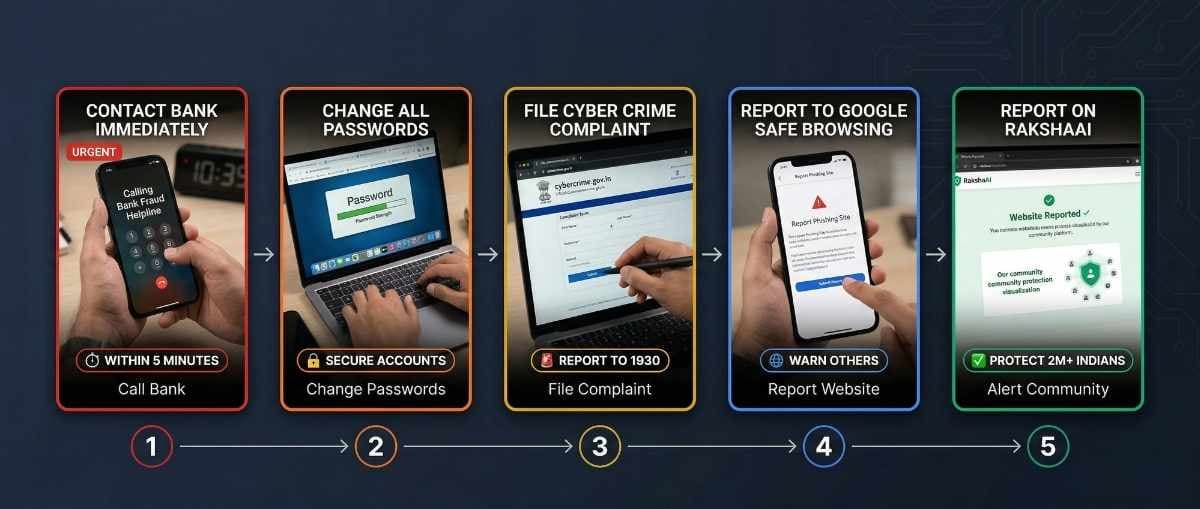
Call 1930 (National Cyber Crime Helpline) for Online Payment Fraud
DO FIRSTIf you lost money via UPI, net banking, or card payment to a fake shopping site, call 1930 immediately. The CFCFRMS system has helped recover ₹5,489 crore across 17.82 lakh complaints. Provide: your transaction ID, the amount, the website or seller UPI ID, and the time of payment.
File a Complaint on the Platform and Escalate to the National Consumer Helpline
DO FIRSTFile a formal complaint inside the shopping app: Amazon India dispute centre, Flipkart buyer protection, or Meesho customer care. If the platform does not resolve within 48 hours, escalate to the National Consumer Helpline at 1800-11-4000. The NCH facilitated ₹36.8 crore in e-commerce refunds between April 2025 and January 2026, and operates under the Consumer Protection Act 2019.
File on cybercrime.gov.in
Visit cybercrime.gov.in and select 'Report Financial Cyber Crime.' Upload: a screenshot of the fraudulent order or transaction, the seller's ID, any WhatsApp or SMS conversations, and the platform complaint reference number. The case number activates formal investigation protocols.
Raise a Chargeback with Your Bank or Card Provider
If you paid by credit or debit card, contact your bank and request a chargeback under the dispute resolution process. Under RBI guidelines, your bank must respond within 48 hours. Ecommerce chargebacks are your strongest recovery tool for card payments to fake websites, as the payment processor can reverse the transaction if the merchant cannot prove delivery. Always raise the platform dispute first before the bank chargeback.
File a Complaint with CCPA or Consumer Forum
For non-delivery, counterfeit products, or platform-level violations, file a complaint with the Central Consumer Protection Authority at consumerhelpline.gov.in. The CCPA imposed penalties of ₹10 lakh each on Amazon, Flipkart, Meesho, and Meta in February 2026. District Consumer Forums handle individual claims, particularly for losses above ₹20,000.
⏱️ Recovery Timeline for Online Shopping Fraud
Report This Scam and Warn 2 Million+ Indian Shoppers
Your report goes live within 4–6 hours and appears in search results for the scammer's site or seller ID.
Your Safe Shopping Checklist
Run through this before every purchase from an unfamiliar seller
Domain is at least 6 months old (checked on WHOIS)
Site has a real phone number I called it and someone answered
Price is within 30–40% of market price, not 70–90% off
Multiple payment options available, including COD or credit card
Reviews span many months with mixed ratings (not all 5-star in one week)
I searched the site name + 'scam' or 'complaint' on Google
For COD, I will open the package on video before the agent leaves
I am paying with a credit card where possible for chargeback protection
I verified the URL carefully no extra letters, numbers, or misspellings
I checked the site on RakshaAI's website checker
Frequently Asked Questions About E-Commerce Fraud in India
Everything you need to know about online shopping scams in India answered simply.
Is e-commerce legit and safe to use in India?
What is e-commerce fraud and how does it happen?
What should I do if I get scammed while shopping online?
How do I identify a fake ecommerce website?
What is the COD fraud scam and how do I handle unordered parcels?
What is the National Consumer Helpline and how does it help?
What are dark patterns in ecommerce India and are they illegal?
How do fake sellers on Amazon and Flipkart operate?
What is a chargeback and how do I use it for ecommerce fraud?
Which types of online shopping scams are most common in India in 2026?
Shop Smarter. Report Fraud.
Protect Every Indian Shopper.
Received a package that wasn't what you ordered? Found a suspicious shopping site? Every report you make helps RakshaAI warn thousands of other shoppers before they become victims. It takes 60 seconds and it's completely free.
🇮🇳 India-focused online fraud guidance · Free consumer access · No registration required