
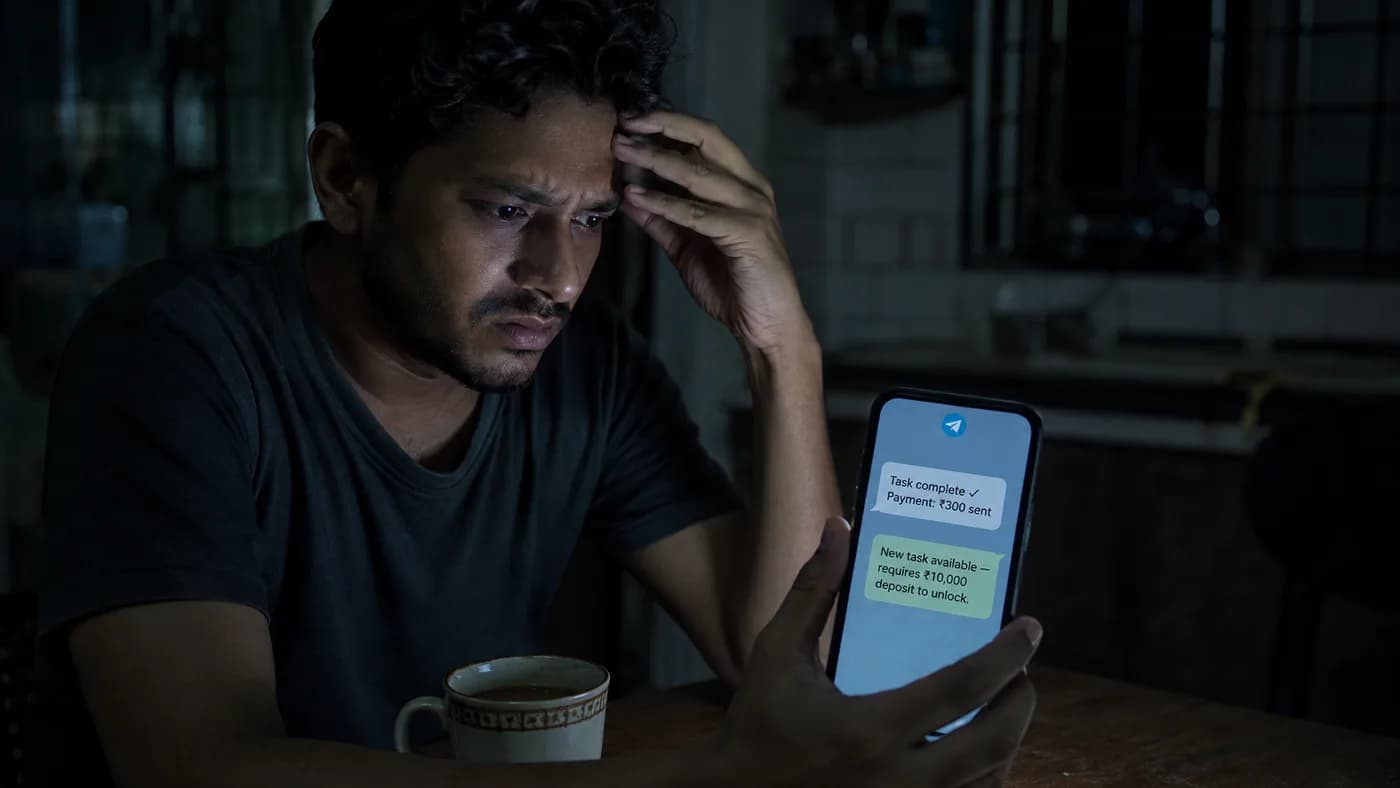
The moment the trap closes: after earning trust with small payments, the scammer demands a large deposit to "unlock" the next task.
It starts with an innocent-looking WhatsApp message: "Hi, we have a part-time work-from-home opportunity. Simple tasks, flexible hours, earn ₹500–₹2,000 per day. Interested?"
Thousands of Indians reply yes every day. Most are job seekers, students, or homemakers looking to supplement their income. What they do not know is that they have just entered the first stage of India's fastest-growing financial fraud the Telegram task scam.
In 2025, India's cybercrime helpline (1930) received over 7,000 task-scam complaints per month. Estimated losses crossed ₹100 crore. Victims lose an average of ₹2–5 lakh before realising the entire operation was fabricated.
How the Telegram task scam works in India 5 stages
- 1You receive a WhatsApp or Instagram job offer for simple online tasks
- 2You join a professional-looking Telegram group with fake co-workers and supervisors
- 3You complete small tasks (liking videos, following accounts) and receive real small payments to build trust
- 4You are offered high-paying "special tasks" that require an advance deposit to unlock
- 5The deposit grows, the profit dashboard is fake, and all withdrawals are permanently blocked
Already deposited money? Call 1930 immediately. Do not send another rupee.
Stage 1: The WhatsApp Job Offer That Looks Too Easy
The scam always begins with an unsolicited message via WhatsApp, Instagram DM, LinkedIn, or even SMS. The message uses friendly, professional language. It mentions a company name that sounds legitimate ("DigiMedia Solutions", "TaskForce Global", "EarnPro India"). The job description is deliberately vague: "online tasks", "data entry", "digital marketing assistant".
What makes this opening dangerous is how plausible it feels. India has a genuine gig economy. Millions of people do earn real money completing micro-tasks. Scammers exploit exactly that context to make their first approach indistinguishable from a real opportunity.
Red flag at this stage: No legitimate employer recruits via unsolicited WhatsApp messages. Real companies post on Naukri, LinkedIn, or their own website. Any job that arrives unrequested in your inbox should be treated as suspicious by default.
Stage 2: The Telegram Group That Looks Professional
Once you show interest, you are directed to a Telegram group. The group appears highly professional: it has a company logo, a pinned message with "official guidelines", and dozens of active members sharing their completed tasks and daily earnings.
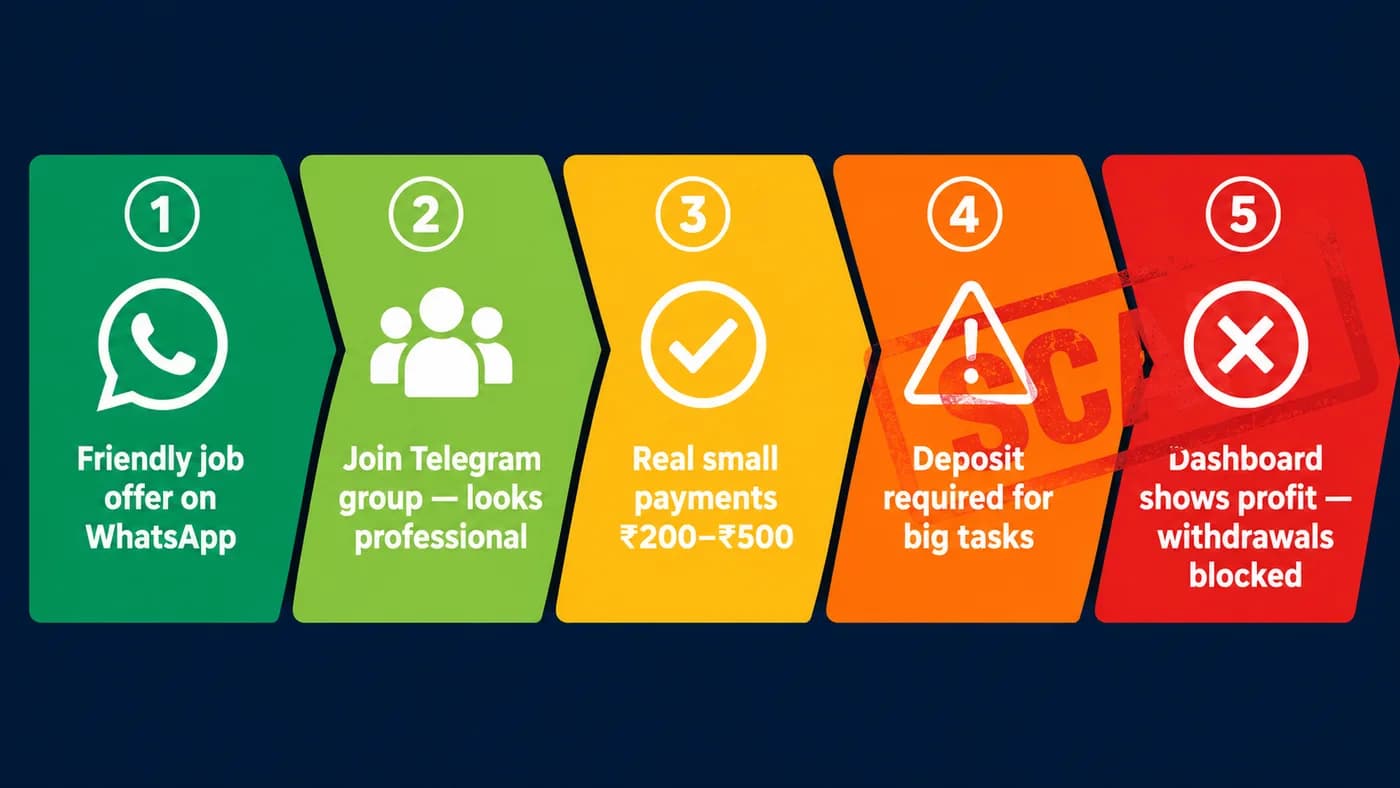
The 5 stages of the Telegram task scam from a friendly WhatsApp message to a completely blocked account.
Almost every person in the group is a scammer or a bot. The "supervisors" are scammers playing a role. The "co-workers" posting their earnings screenshots are fabricated accounts designed to manufacture social proof. You are the only real person in the room.
Red flag at this stage: Legitimate employers do not move hiring to Telegram. Any recruitment process that requires you to join a Telegram group is a serious warning sign.
Stage 3: Real Small Payments That Build Trust
This is the most psychologically effective part of the scam, and the reason it works so well. After completing your first few tasks typically liking YouTube videos, following Instagram accounts, or rating apps you receive real money. ₹200, ₹300, sometimes ₹500 lands in your UPI account or bank.
These payments are not a mistake. They are an investment by the scammers. Every rupee they pay you in Stage 3 is designed to make you believe the operation is legitimate, so you will deposit thousands or lakhs in Stage 4. The psychological principle at work is called "sunk cost combined with proof of legitimacy." Once you have received real money, your guard drops.
Red flag at this stage: The tasks themselves are a red flag. Liking YouTube videos and following accounts in bulk is artificial engagement manipulation. Any platform paying you to do this is either engaged in fraud or feeding into a larger scam. Real companies pay for skills, not clicks.
Stage 4: The Advance Deposit Trap
After a few days of small legitimate payments, you are offered a "premium task" or "VIP order" that promises dramatically higher returns ₹5,000–₹50,000 for a single task. The catch: you need to deposit a "security amount" or "task activation fee" to access it. The amount starts small: ₹1,000 or ₹2,000.
You deposit it. Your "dashboard" shows a profit. You are told you can withdraw after completing more tasks. The supervisor encourages you to take the next premium task. The required deposit for that one is ₹10,000. Then ₹50,000. Then ₹1 lakh.
Each time you hesitate, a group member posts a "withdrawal success" screenshot. Your supervisor reassures you. The pressure is constant and calibrated. Victims in documented cases have deposited multiple times taking out loans, borrowing from family because the dashboard shows growing profits that feel just one task away from being withdrawable.
The rule: No legitimate job on earth requires you to deposit money to complete a task. This is the definitive indicator that you are in a scam. Stop immediately.
Stage 5: The Fake Dashboard and Blocked Withdrawals
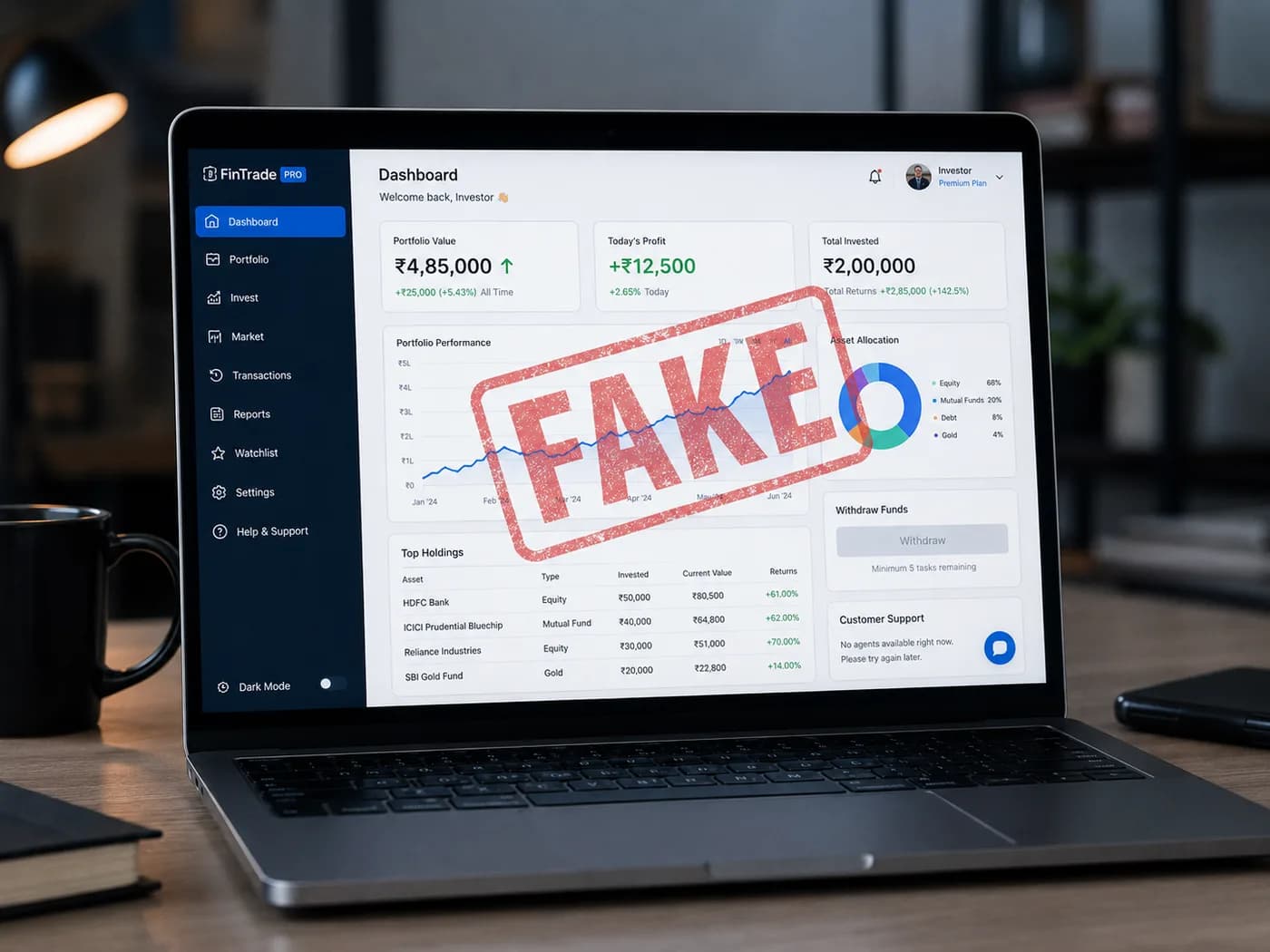
Every number on this dashboard is fabricated. The "Withdraw" button will never work.
When you finally attempt to withdraw your accumulated "earnings", the platform invents a new obstacle. You need to pay a "tax clearance fee" first. Or a "withdrawal activation charge". Or your account is "frozen pending KYC verification" that requires another deposit.
The dashboard showing your ₹4,85,000 portfolio or ₹2 lakh in pending earnings does not represent real money. It is a web interface built specifically to manufacture the illusion of wealth. The entire technical infrastructure the app, the dashboard, the transaction history exists only to keep you paying.
At some point, the scammers decide you have nothing more to give. The Telegram group is deleted. The "supervisor" number is blocked. The website goes offline. Your money is gone.
8 Red Flags That Confirm It Is a Telegram Task Scam
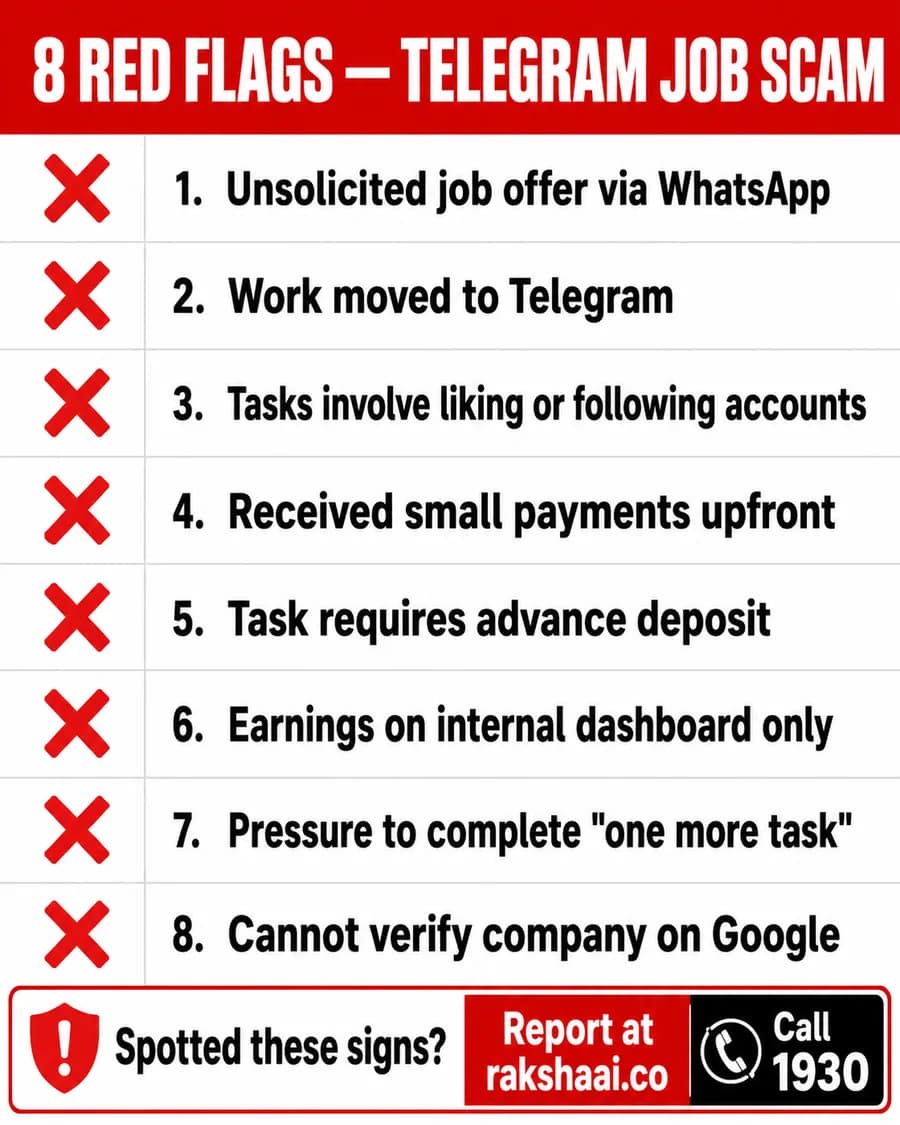
If you see even 3 of these, stop immediately.
- Unsolicited job offer via WhatsApp or Instagram. Real employers do not cold-message job seekers on personal messaging apps.
- Work moved to Telegram. Professional companies use email, official portals, or verified apps not Telegram groups.
- Tasks involve liking or following accounts. Authentic gig work involves skills, not artificial engagement manipulation.
- You received small payments upfront. This is deliberate trust-building, not evidence of legitimacy. It is the bait.
- A task requires an advance deposit. No legitimate employer asks you to pay to work. This is the line that separates odd from criminal.
- Earnings only visible on an internal dashboard. Real payments appear in your bank. If your "balance" only exists inside their app, it does not exist.
- Pressure to complete "one more task". Urgency, countdown timers, and constant supervisor messages are manufactured pressure tactics.
- Cannot verify the company on Google, MCA21, or LinkedIn. A real company has a traceable public footprint. If it does not exist outside of Telegram, it does not exist.
The "Pig Butchering" Playbook Behind These Scams
Telegram task scams are a variant of what cybersecurity researchers call pig butchering(sha zhu pan), a term that originated in Chinese-language criminal forums. The name is brutal but accurate: scammers "fatten the pig" building trust, delivering small wins, showing growing profits before the final "slaughter", when they take everything.
Many operations running task scams in India are coordinated from criminal compounds in Myanmar, Cambodia, and parts of China. Investigations by Indian authorities have revealed that some operators in these compounds are themselves trafficking victims people who were lured with legitimate job offers and then coerced into running scams under threat of violence.
Indian nationals are often involved as mule account operators people who receive and forward funds in exchange for a commission, without necessarily understanding the full scale of the operation they are enabling. Operating a mule account is a criminal offence under Indian law.
What to Do the Moment You Realise You Have Been Scammed
Speed is everything. The first 30–60 minutes after a fraudulent transfer give the highest chance of account freezing. Call 1930 before reading anything else.
- Stop sending money immediately. Every additional deposit goes directly to criminals. No new payment will unlock your funds that promise is always a lie.
- Screenshot everything. Capture all Telegram conversations, transaction receipts, the group name, admin numbers, and the dashboard. You will need this evidence.
- Call 1930 immediately. India's National Cybercrime Helpline can flag destination bank accounts in real time. The faster you call, the higher the chance of stopping or reversing the transfer.
- Contact your bank. Report every transaction as fraud and ask your bank to raise a dispute. Provide them the transaction IDs and receiver account details.
- File at cybercrime.gov.in. A formal FIR creates a legal record and is required for any insurance or court proceedings.
- Check the scam number on RakshaAI. Your report at rakshaai.co/phone-number-checker helps flag the number for other Indians before they become the next victim.
How Big Is This Problem? Official Data on Cybercrime Losses in India (2021–2025)
The following figures come from MHA/I4C Parliamentary responses (Lok Sabha, Dec 2025 and Rajya Sabha, Feb 2026). Investment and task-based scams which include the Telegram task fraud are the single largest category of cybercrime loss in India.
| Year | NCRP Complaints | Total Loss | YoY Change |
|---|---|---|---|
| 2021 | 2.62 lakh | ₹551 crore | Baseline |
| 2022 | 9.66 lakh | ₹2,290 crore | +316% loss |
| 2023 | 15.56 lakh | ₹7,465 crore | +226% loss |
| 2024 | 22.68 lakh | ₹22,845 crore | +206% loss (peak) |
| 2025 | 28.15 lakh | ₹22,495 crore | +24% cases, loss steady |
Task-Scam Specific: Jan–Apr 2024 (MHA/I4C Official Category Breakdown)
62,687
Investment / task-based fraud cases
just 4 months
₹222.58 Cr
Money lost to task-based fraud
Jan–Apr 2024 only
22,680
NCRP complaints naming Telegram
Q1 2024 alone
MHA declared Telegram “the new dark web” in its 2024 Annual Report. Investment + task-based scams account for ~77% of all cybercrime losses in India.
Source: MHA Lok Sabha written reply Dec 2, 2025 · Rajya Sabha Feb 11, 2026 · I4C six-year data · Business Standard (May 2024) citing MHA Jan–Apr 2024 category breakdown. Cumulative loss 2020–2025: ₹52,976 crore across all cybercrime categories.
Real Telegram Task Scam Cases Reported by Indian News Outlets
Every case below was covered by a verifiable Indian news outlet. Together they show that no city, age group, or profession is immune and that the scam has only grown bolder since 2023.
15,000+ Victims, ₹712 Crore Stolen via "Rate Hotels, Like YouTube Videos" Racket
India's largest documented Telegram task scam bust. Victims were offered ₹866 profit on a ₹1,000 investment for liking videos. Gang used 65 bank accounts under 33 shell companies, routing funds as USDT crypto via Dubai to Chinese masterminds. Terror financing link to Hezbollah confirmed. 9 arrested; 3 Chinese masterminds absconding.
Pregnant Woman Seeking Work-From-Home Income Loses ₹7.7 Lakh to Telegram Task Scam
Radhika had recently resigned and was searching for income. She saw a Facebook ad promising money for watching videos. Paid ₹100, received ₹300. Deposits escalated through Bitcoin trading and "frozen team funds" each problem invented a new fee. ₹7.7 lakh lost across five days. Three bank accounts frozen by police.
Delhi Police Bust Telegram Gang: 5 Arrested Including Gang Leader Who Used Crypto to Launder Funds
Victim added to Telegram group "971 CBOE" for Google hotel reviews. Promised 30–40% returns. Dashboard showed inflated profits, withdrawal always blocked. Gang's kingpin: Ravindra Vishnoi, 28, a pharmacy owner from Rajasthan. Funds laundered via USDT crypto through mule accounts in India, Nepal, and Singapore.
Rohtak Villager Loses ₹10.14 Lakh After "Rating Hotels" Unlocked Endless Deposit Demands
Jatin from Morkhedi village received a Telegram offer for hotel rating tasks. First ₹7,000 task showed ₹14,000 "profit." Then ₹28,000, then ₹64,700 each time told to complete "one more task or lose everything." Only ₹4,400 ever withdrawn. 4 accused arrested from Rajasthan, charged under BNS Sections 318(4) and 61(2).
Engineer Loses ₹51 Lakh After Fake "P&B Solutions" Promised WFH E-Commerce Tasks
Recruited into a Telegram group for a fake company called "P&B Solutions" supposedly managing e-commerce product listings. Small real payments built trust. Final demand: ₹11 lakh to "release supposed earnings." Funds vanished; group deleted. Case with Cyberabad Cyber Crime Police.
Ahmedabad Employee Pays ₹30.5 Lakh via UPI/IMPS Across 19 Days for "Google Maps Review Tasks"
A 38-year-old Vatva GIDC employee received a WhatsApp message about posting Google Maps restaurant reviews. Small payments convinced him it was real. Moved to crypto trading, then "capital verification" schemes. Each deposit triggered a new excuse: low credit score, VIP upgrade required, incomplete tasks. 19 days, 30.5 lakhs, nothing recovered.
Complete Timeline: Documented Telegram Task Scam Cases in India (2023–2026)
A date-wise record of verified cases from Kerala and Maharashtra to UP and Gujarat showing how this scam operates identically across every Indian state and victim profile.
| Date | Victim / City | Amount Lost | Entry Tactic & Outcome |
|---|---|---|---|
| Jul 23, 2023 | 15,000+ victims (national) · Hyderabad bust | ₹712 crore | "Rate hotels + like YouTube videos" 9 arrested, funds via USDT to China; terror link confirmed |
| Aug–Sep 2023 | 7 individuals · Kannur, Kerala | ₹42.35 lakh | WhatsApp job → Telegram, ₹50/video like → investment scheme; largest single victim ₹29 lakh |
| Aug 18–19, 2023 | Individual · Maharashtra | ₹2.4 lakh | Telegram online job offer → trust built with small payments → ₹2.4 lakh investment → scammers disappeared |
| Mar 10–14, 2024 | Radhika (pregnant, WFH seeker) · Chennai | ₹7.7 lakh | Facebook ad → Telegram group → Bitcoin trading → "frozen funds" penalty loop → 3 accounts frozen by police |
| Mar–Apr 2025 | Shruti Bhola · Gomtinagar, Lucknow | ₹4.98 lakh | "Global Financial Group" Telegram → ratings + link tasks → ₹3 lakh RTGS transfer in final trap |
| Jul 2025 | Woman, 29 · Delhi | ₹17 lakh | Remote work on Telegram → review writing → UPI escalation loop → 5 arrested including 19-yr-old dropout |
| Aug 10, 2025 | Munirka Village resident · Delhi | ₹17.31 lakh | "971 CBOE" Telegram group → Google hotel reviews → 30–40% return promises → 5 arrested (kingpin: pharmacy owner) |
| Aug 16, 2025 | Jatin, village resident · Rohtak, Haryana | ₹10.14 lakh | Hotel rating tasks on Telegram → ₹7K → ₹14K "profit" shown → ₹64,700 demanded → 4 arrested from Rajasthan |
| Oct 30, 2025 | Engineer · Cyberabad, Hyderabad | ₹51 lakh | Fake "P&B Solutions" WFH job → e-commerce listing tasks → ₹11 lakh final demand to "release earnings" |
| Dec 2025–Jan 2026 | Individual, 38 · Ambegaon, Pune | ₹12.30 lakh | Small task payments built trust → larger transfers demanded for "higher-value tasks" → disappeared |
| Mar 22–Apr 26, 2026 | Subhash Chand Sharma · Shalimar Garden, Ghaziabad | ₹9.65 lakh | Google review tasks → crypto investment → 29% "activation fee" + 30% "tax" demanded to unblock withdrawals |
| Mar 11–Apr 1, 2026 | Private employee, 38 · Vastral, Ahmedabad | ₹30.5 lakh | Google Maps review WhatsApp offer → crypto trading → 19 days, multiple "VIP upgrade" and "credit score" pretexts |
| Apr 8–10, 2026 | Young man · Panki, Kanpur | ₹3.50 lakh | WhatsApp promotional call → review/sharing tasks → 58 separate UPI transactions across multiple accounts |
Sources: The Quint, The News Minute, OnManorama, BusinessToday, Sunday Guardian Live, The Hans India, The420.in. All amounts as reported by respective news outlets.
Frequently Asked Questions
Is the online task job on WhatsApp real?
Legitimate companies do not recruit via unsolicited WhatsApp messages. Task-based jobs that require you to deposit money to "unlock" tasks are always scams. No exception exists to this rule.
How do I know if a Telegram job group is a scam?
Red flags include: requires upfront deposit, profits shown on an internal dashboard only, cannot withdraw earnings, urgent pressure to complete more tasks, and fake testimonials from group members who are actually scammer-controlled accounts.
Can I get my money back from a Telegram task scam?
Call 1930 immediately. Filing within 30–60 minutes gives the best chance of freezing the destination account. Also file at cybercrime.gov.in with all screenshots of conversations and transactions. After 24 hours, recovery becomes significantly harder as scammers move funds through multiple mule accounts.
Who runs Telegram task scams in India?
Many operations are coordinated from organised crime networks in Myanmar, Cambodia, and China. Some Indian nationals are also involved as "mule account" operators who receive and forward money for a commission. Both the operators and mule account holders face criminal liability under Indian cyber law.
What is the pig butchering scam?
Pig butchering (sha zhu pan) is a long-term investment or job scam where criminals build deep trust over weeks or months before stealing large amounts. The name refers to "fattening the pig" before slaughter. Telegram task scams are a faster, volume-focused version of the same technique, targeting job seekers rather than investors.
Final Thoughts
The Telegram task scam is not a sophisticated technical attack. It is a psychological operation that works by exploiting genuine financial need, the credibility of small upfront payments, and the human tendency to trust people and groups that have been helpful in the past.
The single most powerful protection is knowing the rule before you need it: no legitimate employer ever asks you to deposit money to complete a task. That line, once crossed, is always a crime being committed against you.
Share this article with at least one person in your family or network who is currently looking for work. The scam is active, it is growing, and the next person it targets could be someone you care about.
Free Tool
Got a suspicious job offer or Telegram link?
Check any phone number, URL, or Telegram invite link on RakshaAI instantly. No sign-up. No cost. Results in under 5 seconds.
Check a Number or Link now →100% free · No sign-up required · Save 1930 in your contacts
More from RakshaAI Blog
Fake Scholarship Scam India: Students Losing Lakhs to Education Fraud in 2026
Cyber Safety for Students India: Scams Targeting College Students in 2026
Job Scam India 2026: Fake MNC Offer Letters and Advance Salary Frauds
Stay Protected Online
Use RakshaAI to check websites, phone numbers, and UPI IDs for scams free, instant, no sign-up required.
RakshaAI is a private platform by Ehatech Services Pvt. Ltd. Not affiliated with any government body. Editorial policy