
Phone Scams in India 2026: All Types, Fake Caller ID & How to Stop Spam Calls
Phone scams in India are the single largest entry point for financial cyber fraud in 2026. Every day, 1.35 crore scam calls are placed across Indian telecom networks targeting bank customers, Aadhaar holders, UPI users, and anyone who answers an unknown call.
The tools driving this surge are cheap and accessible: caller ID spoofing apps cost as little as ₹200/month on Telegram and can display any number, including your bank's official helpline. Complaints to the 1930 helpline alone logged ₹4,200 crore in losses in the 12 months to February 2026, a 42% year-on-year rise in phone fraud complaints.
This page covers all 7 types of phone scams targeting Indians in 2026, how to recognise each one, the 7 warning signs to stop a call immediately, how to report to the right authority (1930, Chakshu portal, cybercrime.gov.in), and what to do if you've already been targeted.
Received a Suspicious Call?
Check the number in 5 seconds free fraud database lookup
A Phone Call Is the Most Trusted Channel Scammers Have
Email has spam filters. SMS has some limitations. But a phone call from what appears to be a known, trusted number triggers an almost instinctive response to engage, comply, and respond. Fraudsters understand this deeply.
Phone fraud or 'vishing' (voice phishing) accounts for the initiation of nearly 87% of all cyber financial fraud in India according to MHA data. The caller doesn't need your username, password, or access to your device. All they need is your OTP and a phone call is the easiest way to get it.
India's telecom infrastructure serves 1.1 billion subscribers, and the cost of placing thousands of scam calls per day using VoIP is negligible. A single call that yields ₹5 lakh more than covers the cost of a scam call operation running thousands of attempts simultaneously from a single rented facility.
Three Things No Legitimate Caller Ever Asks
- Your OTP. Not your bank, not TRAI, not the police, not SEBI. An OTP is a one-time password no institution ever needs to hear it read aloud.
- Your full debit/credit card number together with CVV and expiry. Partial numbers used for verification are a separate matter full card details are never needed on a call.
- To dial a USSD code (*21*, *67*, ##) to 'verify' your SIM or 'secure' your account. These codes activate call forwarding to the scammer's number.
- If a call makes you feel anxious or rushed, hang up immediately. Legitimate organisations do not mind when you say 'I will call back on the official number.'
- Caller ID is NOT proof of identity. The number on screen can be any number the caller chooses. Trust the content of the call, not the display.
How Big Is Phone Scam Fraud in India Right Now?
Phone calls remain India's single most common fraud entry point in 2024. Caller ID spoofing means the number you see on your screen can never be trusted. Every year millions of Indians share OTPs, PINs, and banking details with scammers they genuinely believed were their bank or the police.
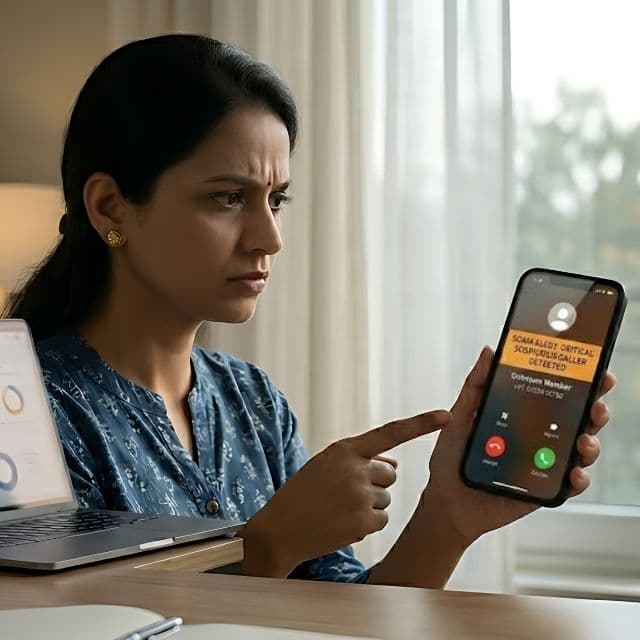
7 Types of Phone Scams in India 2026 Complete Guide
Phone fraud in India is not one crime it is seven distinct scam types, each with its own script, target, and method. Recognise all seven to protect yourself and your family.
Fake Caller ID and Bank Impersonation
Scammers spoof your bank's official number using caller ID spoofing apps. They pose as your bank's fraud team and request your OTP to 'block a suspicious transaction.' Your account is drained once you share.
Vishing India Voice Phishing Attacks
A scammer calls pretending to be a KYC officer, insurance agent, or bank representative. They extract account details, Aadhaar numbers, or PAN through a scripted, professional-sounding conversation.
SIM Swap Fraud India The Silent Takeover
Fraudsters use your Aadhaar and personal data to request a SIM replacement from your telecom operator. Once the new SIM activates, all your OTPs and banking alerts route to them.
Fake TRAI Call India Disconnect Threat Scam
Caller claims to be from TRAI or DoT and says your number will be disconnected in 2 hours due to 'illegal activity.' Victims are transferred to a 'cybercrime officer' who demands payment or personal data.
Missed Call Scam India Wangiri Fraud
You receive one ring from an international number. Calling back connects you to a premium-rate service. Charges accumulate in seconds. The wangiri scam is the world's oldest phone fraud, still growing in India.
Fake Police Call Digital Arrest via Phone
Caller claims to be CBI, ED, or police. Says your number is linked to a crime. Demands payment to 'clear your name.' This is the phone-based version of digital arrest scam. Average victim loss: ₹3.5 lakh.
WhatsApp Call Scam India Video Blackmail
Scammer initiates a WhatsApp video call and uses deepfake or pre-recorded explicit content to create screenshots. Victim is blackmailed into paying to prevent the content from being 'shared with contacts.'
How Phone Scams Work in India The 3-Stage Playbook
Every phone scam in India follows the same three-stage structure. Knowing the playbook breaks the psychology before the call even begins.
Stage 1 Target Selection
Scammers buy or scrape lists of mobile numbers from data leaks, SIM dealer networks, or purchased KYC databases. Numbers linked to specific banks, recently issued credit cards, or UPI registrations are prioritised. Basic personal data (name, partial account number) is often bundled with the number to make the call appear more credible.
Stage 2 Fake Caller ID Trust Building
Using a caller ID spoofing india app, the scammer sets the outgoing number to match your bank's official helpline, a government department, or sometimes a family member's number. The displayed number bypasses your instinct to screen unknown callers. The script opens with a detail you recognise (your name, your bank, the last four digits of your card) to establish instant credibility.
Stage 3 Execution and Disappearance
The call creates urgency ('your account will be blocked in 10 minutes') and a simple ask ('just share the OTP to cancel the transaction'). Once the OTP, UPI PIN, or remote access is surrendered, the fraud is completed in under 90 seconds. The VoIP number is discarded, the scammer's SIM is replaced, and the money is routed through mule accounts within minutes. Recovery statistics fall sharply if you wait more than 30 minutes to report to 1930.
Suspicious Caller? Verify in 5 Seconds Before You Call Back
Check any Indian phone number against our live fraud database free, no sign-up
How a Fake Caller ID Call Unfolds Step by Step
Understanding this sequence in advance is the single most effective defence because once you recognise the pattern mid-call, the psychology loses its power.
The Fraudster Picks a Target Number
They choose a number you're likely to trust your bank's customer care, TRAI, CBI, or even a number in your own contact list. This takes seconds to set up using widely available VoIP services.
Your Phone Displays the Fake Number
The call reaches you with the spoofed number prominently displayed. Standard smartphones have no mechanism to detect this mismatch the display is entirely controlled by the caller's signalling data.
The Caller Builds Credibility Fast
They greet you by name, cite your partial account number, location, or recent transaction data bought from data breaches or leaked customer databases. This shocks you into believing the call is genuine.
Urgency and Fear Are Injected
DANGER ZONEA problem is announced a suspicious transaction, an account about to be blocked, an arrest warrant. The urgency eliminates rational thinking and shortens the decision window dramatically.
Sensitive Information Is Extracted
DANGER ZONEOTP, full card number, CVV, PIN, UPI handle, Aadhaar one piece at a time. Each question sounds routine. By the time the damage is obvious, enough information has been shared for complete account takeover.
Funds Are Drained and Contact Ends
With OTP and account access, funds are transferred within seconds. The call ends abruptly. Calling the same number back connects to the real bank who knows nothing about the call. The spoofed number leaves no trace.
"The Number Matched My Bank. I Checked It Three Times." A Real Account
Priya (name changed), a 44-year-old school principal from Pune, received a call at 11 AM on a Tuesday. The number displayed on her screen matched exactly the customer care number printed on her bank card she'd saved it as "HDFC Customer Care" months earlier after a previous call.
The caller introduced himself as a senior fraud investigation officer, informed Priya of a suspicious transaction of ₹37,000 on her account at a Delhi merchant, and that her card was about to be temporarily blocked as a precaution. He then asked her to 'confirm her identity' by verifying her card number ending digits, account registered mobile number, and lastly the OTP that would arrive 'to confirm the fraud block was applied correctly'.
Priya received three OTPs. She read all three aloud because the caller explained each was for a different 'security step'. The call lasted nine minutes and sounded completely professional throughout.
Within 12 minutes of the call ending, ₹1,87,000 had been transferred from her account across three transactions each authorised by the OTPs she had read aloud. When she called the real HDFC customer care (the same number the one that had appeared on her screen), they had no record of any outbound call to her.
The number she saw was spoofed. The fraud investigation officer did not exist. The 'suspicious transaction' was invented to create the context in which handing over an OTP would feel logical even prudent.
The Rule That Would Have Saved ₹1.87 Lakh:
No bank, ever, sends you an OTP and then asks you to read it aloud on a phone call. An OTP is a password that only you should know. The moment anyone asks you to voice an OTP, the call is fraudulent regardless of the number shown.
The USSD Call Forwarding Trap OTP Theft Without Any App
One of the most technically elegant phone scams requires no app installation, no link click, and no OTP from the victim. It just requires you to dial a USSD code the caller provides.
The pretext varies: 'Dial this code to verify your SIM is not being cloned', 'Enter this code to activate the fraud protection we're applying to your account', or 'Our system requires this to confirm your identity before unblocking your card.'
What these codes actually do: USSD codes like *21*[number]#,*67*[number]#, or*004*[number]# silently activate call forwarding on your SIM redirecting all incoming calls (and voice OTPs) to the scammer's number, without any visible notification.
With call forwarding active, the scammer then initiates 'forgot password' flows on your banking apps and email accounts. The OTP that would ring to your phone goes instead to their device. Every account that relies on voice OTP is compromised without a single OTP ever reaching you.
*#21#Check active call forwarding status (safe read only)##002#Deactivate ALL call forwarding on your SIM immediately#21#Deactivate unconditional call forwardingNEVER dial*21*, *67*, *004* as instructed by any caller everYour Bank Calling vs. A Scammer Know the Difference
Your Real Bank
- Never asks for your full card number, CVV, PIN, or OTP on an incoming call under any circumstances
- Never threatens immediate account blocking within minutes to pressure a fast decision
- Never asks you to install any app, dial any USSD code, or transfer money to a 'safe account'
- Sends official notices for KYC via registered mail, branch visit, or in-app notification not phone calls
Phone Scammer
- Displays your bank's exact helpline number using caller ID spoofing the display cannot be trusted
- Creates extreme urgency: 'your account will be blocked in 30 minutes unless you verify now'
- Asks you to dial a USSD code (*21*number#) this silently redirects your OTPs to the scammer
- Knows your name and partial account details sourced from data breaches to seem legitimate
The Golden Rule
Hang up and call back yourself on the number printed on the back of your card or from the bank's official website. A real bank will always be reachable that way. A scammer will not.
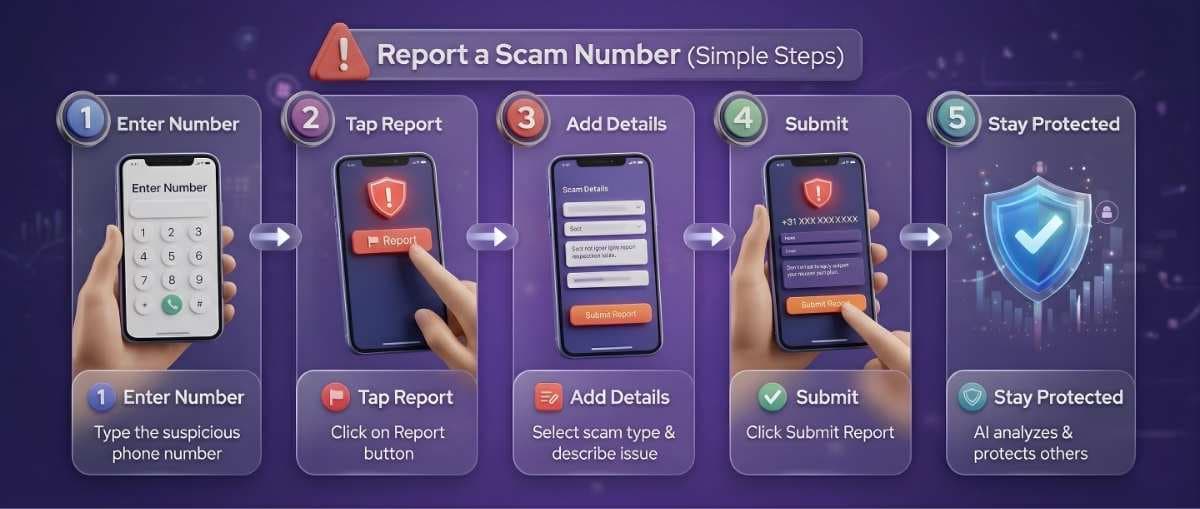
7 Phone Scam Warning Signs You Should Never Ignore
Any single one of these signals means you should end the call and verify independently through an official channel.
The caller says your phone number will be 'disconnected,' 'blocked,' or 'deactivated' in a set time TRAI and DoT never call individuals for this reason
The caller asks for your OTP to 'verify your identity,' 'complete KYC,' or 'prevent fraud' no bank, government agency, or telecom operator ever needs your OTP
You receive a single ring (one missed call) from an international number you don't recognise calling back may connect you to a premium-rate service
The displayed caller ID matches your bank's official number but the conversation involves urgency, OTP requests, or demand for payment
The caller transfers you to a 'senior officer,' 'cyber cell officer,' or 'RBI representative' this escalation is a social engineering tactic, not a real transfer
Your phone suddenly loses network signal for 30 minutes or more while everything else works normally this is the first sign of SIM swap fraud india
Any caller claims your Aadhaar number, PAN, or bank account is 'involved in illegal activity' and demands immediate payment or personal data to 'resolve the case'
Phone Scam Myths vs. Reality
Myth
If the caller ID matches a number I already have saved, the call is definitely legitimate.
Reality
Caller ID is trivially faked. Any number can be displayed by any caller using freely available VoIP services. A matched display name only means the caller chose to spoof a number you trust it is not identity verification.
Myth
I registered for DND, so I won't receive spam calls.
Reality
DND filters commercial promotional calls but does not protect against fraudulent calls, which use VoIP and constantly rotate numbers. DND is a useful reduction tool but not a security layer against scam calls.
Myth
Scam calls are obvious because they use poor audio quality or heavily accented voices.
Reality
Modern scam operations in India especially those operating from call centres use trained staff, scripted professionally in regional languages, with clear audio. Many victims describe the calls as indistinguishable from genuine customer service.
Myth
I'm safe because I never give away my password I only shared the OTP.
Reality
An OTP is a one-time password. Sharing it is identical in consequence to sharing a password. Every OTP authorises a specific action a transfer, a login, a password reset the moment it is entered by anyone who has it.
How to Report Phone Fraud in India Step by Step
Use all five channels for the best chance of freezing funds and preventing the scammer from targeting others. The first 30 minutes are critical.
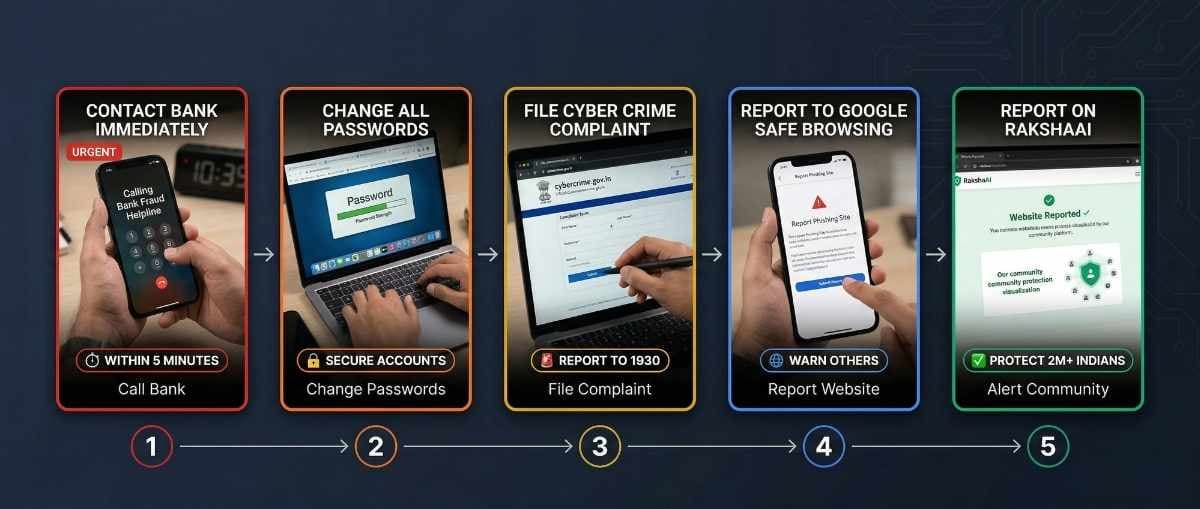
Call 1930 National Cyber Crime Financial Helpline
DO FIRSTThe 1930 helpline is operated by the Ministry of Home Affairs under I4C. Call immediately if you transferred money, shared an OTP that resulted in a transaction, or gave account credentials to a phone scammer. Provide: your name, the scammer's phone number, the amount lost, the time of the call, and your transaction reference. The 1930 helpline can flag the receiving account and initiate a freeze request within minutes.
Report via DoT's Sanchar Sathi Chakshu Portal
DO FIRSTVisit sancharsaathi.gov.in and click 'Report Suspect Fraud Communication.' This portal is specifically designed for reporting fraudulent voice calls, SMS, and WhatsApp messages. Your report is automatically shared with TRAI, DoT, and all telecom operators simultaneously. For SIM swap fraud india cases, also use the CEIR mobile number fraud section to block the fraudulently obtained SIM.
File on cybercrime.gov.in
Go to cybercrime.gov.in and select 'Report Financial Cyber Crime.' Attach: a screenshot of the call log, any SMS or WhatsApp messages from the scammer, bank transaction records showing the unauthorised debit, and the case number from your 1930 call if available. This complaint generates an FIR-level reference that banks and courts recognise for phone scam recovery india proceedings.
Alert Your Bank Immediately for Financial Losses
Call your bank's 24/7 fraud line and request a 'dispute' on any transaction initiated during or immediately after the fraudulent call. Under RBI guidelines, your bank must respond to fraud disputes within 48 hours. For OTP fraud via phone cases, banks can review whether the OTP-authenticated transaction was consistent with your usual behaviour. Raise a chargeback if a debit card was used.
File an FIR at Your Local Cybercrime Police Station
A physical FIR strengthens your case for phone scam recovery india, particularly for losses above ₹10,000. Bring your cybercrime.gov.in complaint reference, 1930 case number, call logs, and bank statements. The Consumer Protection Act 2019 also provides a route to the National Consumer Helpline for telecom fraud complaints involving harassment or threats.
Phone Scam Recovery Timeline Act Fast
0–30 min
Call 1930 + bank fraud line
30 min–2 hrs
File Chakshu report + change UPI PIN
2–24 hrs
File cybercrime.gov.in complaint
24–72 hrs
File FIR at cybercrime police station
Report This Phone Scam to Help Others
Add this number to our database so other Indians are warned before answering
How to Stop Phone Scams 5 Protection Rules
Five rules that together block every type of phone scam in India. Apply all five for maximum protection.
Register on TRAI DND 1909 and Report via Sanchar Sathi Chakshu
SMS 'START DND' to 1909 or call 1909 to register for Do Not Disturb. This blocks unsolicited commercial calls within 7 working days. For fraud-specific reporting, visit sancharsaathi.gov.in and use the Chakshu portal to report suspected scam calls, SMS, or WhatsApp messages. Your reports are shared across all telecom operators simultaneously.
Use Truecaller and RakshaAI Before Answering Unknown Calls
Install Truecaller to see community-flagged spam identifiers for unknown callers. Before calling back any missed call, especially international numbers, check the number on RakshaAI's Phone Number Checker. This takes 5 seconds and can prevent you from connecting to a premium-rate scam number or a flagged fraud operation.
Never Share OTPs, UPI PINs, or Aadhaar Over Any Phone Call
No bank, telecom operator, government agency, or OTP-required service will ever ask you for your OTP, UPI PIN, ATM PIN, or CVV over the phone. This is the single most important rule to prevent OTP fraud via phone india. Treat any such request as an immediate confirmation that the call is fraudulent regardless of what the caller ID displays.
Monitor Your SIM Signal SIM Swap Sends an Early Warning
If your phone loses all mobile signal for more than 20–30 minutes while Wi-Fi continues working normally, immediately call your operator's fraud line from another phone. This unexplained outage is the most reliable early warning of SIM swap fraud india in progress. Act before the new SIM fully activates to prevent OTP rerouting.
Always Hang Up and Verify Through the Official Channel Independently
Never rely on information or numbers provided during a suspicious call. If a 'bank officer' calls you, hang up and call the number on the back of your card or from the bank's official website. If a 'TRAI officer' calls, hang up TRAI does not call individuals. No legitimate authority will object to you calling them back independently. A scammer will object; a real official will not.
Phone Scam Statistics India 2026
Data from TRAI, MHA I4C, and the 1930 helpline annual report (12 months to February 2026).
| Scam Type | Share of Complaints | Average Loss | Risk Level |
|---|---|---|---|
| Fake Bank Caller ID / OTP Theft | 38% | ₹42,000 | Very High |
| Fake TRAI / DoT Disconnect Call | 22% | ₹28,000 | Very High |
| SIM Swap Fraud India | 14% | ₹95,000 | Extreme |
| Fake Police / Digital Arrest | 11% | ₹3.5 lakh | Extreme |
| Missed Call Scam (Wangiri) | 8% | ₹2,500 | Medium |
| WhatsApp Call Blackmail | 5% | ₹65,000 | Very High |
| Vishing / KYC Impersonation | 2% | ₹18,000 | High |
More Indian Phone Scam Guides
Each scam type has its own complete guide with reported cases, tactics, and step-by-step defence.
Vishing India 2026
How voice phishing works, scripts scammers use, and how to verify any caller's identity in under 60 seconds.
SIM Swap Fraud India
The silent takeover how fraudsters get your SIM replaced without you knowing, OTP rerouting, and how to stop it.
Fake TRAI Call India
Complete breakdown of the TRAI disconnect threat scam what they say, how to verify, and the official TRAI stance.
Missed Call Scam India
The wangiri fraud explained which country codes to never call back, and how charges accumulate in seconds.
Digital Arrest Scam India
Fake CBI, ED, and police calls how the digital arrest phone scam works and why ₹3.5 lakh is the average victim loss.
WhatsApp Call Scam India
Video call blackmail and impersonation via WhatsApp how deepfake screenshots are created and what to do if targeted.
Related Free Safety Tools
Phone Number Checker
Check any Indian phone number against our fraud database. See if a number has been reported as a scam caller.
Website Safety Checker
Verify if a website linked to you in a suspicious call is a known fraud site.
UPI ID Checker
Verify UPI IDs before sending money essential if a caller provided a payment address.
Recent Phone Scam Alerts in India
Fake TRAI Disconnect Call Surge +91-960x numbers
TRAI issued a fresh advisory warning after a 300% spike in fake disconnect threat calls using spoofed 9600-prefix numbers. Never respond to disconnection threats TRAI does not call individuals.
WhatsApp Video Call Blackmail Targeting Professionals
DoT's Chakshu portal reported a 180% rise in WhatsApp video call blackmail reports in Q1 2026, with corporate employees and government staff the primary targets. Do not accept video calls from unknown numbers.
SIM Swap Fraud 14 Cases Filed in Mumbai Cybercrime in One Week
Mumbai cybercrime unit reported a coordinated SIM swap operation using leaked Aadhaar data. Watch for sudden unexplained signal loss. Call your operator immediately if you lose signal for 20+ minutes.
Fake CBI Officer Calls Victims Transferred ₹8 Crore in Single Month
MHA's I4C unit flagged a 60% increase in fake CBI/ED calls in January 2026. Callers use badge numbers, case IDs, and court document references. Remember: no law enforcement agency collects money via phone.
Recent Phone Scam Cases & Deep Dives
Time-stamped guides from the RakshaAI blog covering the latest phone fraud patterns in India.
How to Check Any Phone Number for Scam Reports
Free ways to verify an unknown caller before you call back or act on instructions.
Read article →Fake Customer Care Number Scam: Google Results Lying to You
Scammers rank fake helplines above official ones. How to find the real number.
Read article →AI Voice Cloning Scam: Fake Emergency Calls Targeting Families
A cloned voice of your child or parent asking for urgent money. How to verify.
Read article →Frequently Asked Questions About Phone Scams in India
Answers to the most common questions about phone scams and spam calls in India.
What are the most common types of phone scams in India in 2026?
What is vishing and how does it target Indians?
How does fake caller ID work and can I verify the real number?
What is SIM swap fraud India and how do I know if I am a victim?
How does the fake TRAI call India scam work?
What is the missed call scam in India and how do I avoid it?
What should I do immediately if I shared my OTP with a phone scammer?
How do I register on TRAI DND 1909 to reduce spam calls?
Can I trace the real location of a phone scammer in India?
What is the WhatsApp call scam and how does it work?
Got a Suspicious Call?
Check It. Report It.
Check any phone number against India's largest crowd-sourced fraud database before you call back. Or report a scam call to protect the next person from the same number.
🇮🇳 India-focused phone fraud guidance · Free consumer access · No registration required