
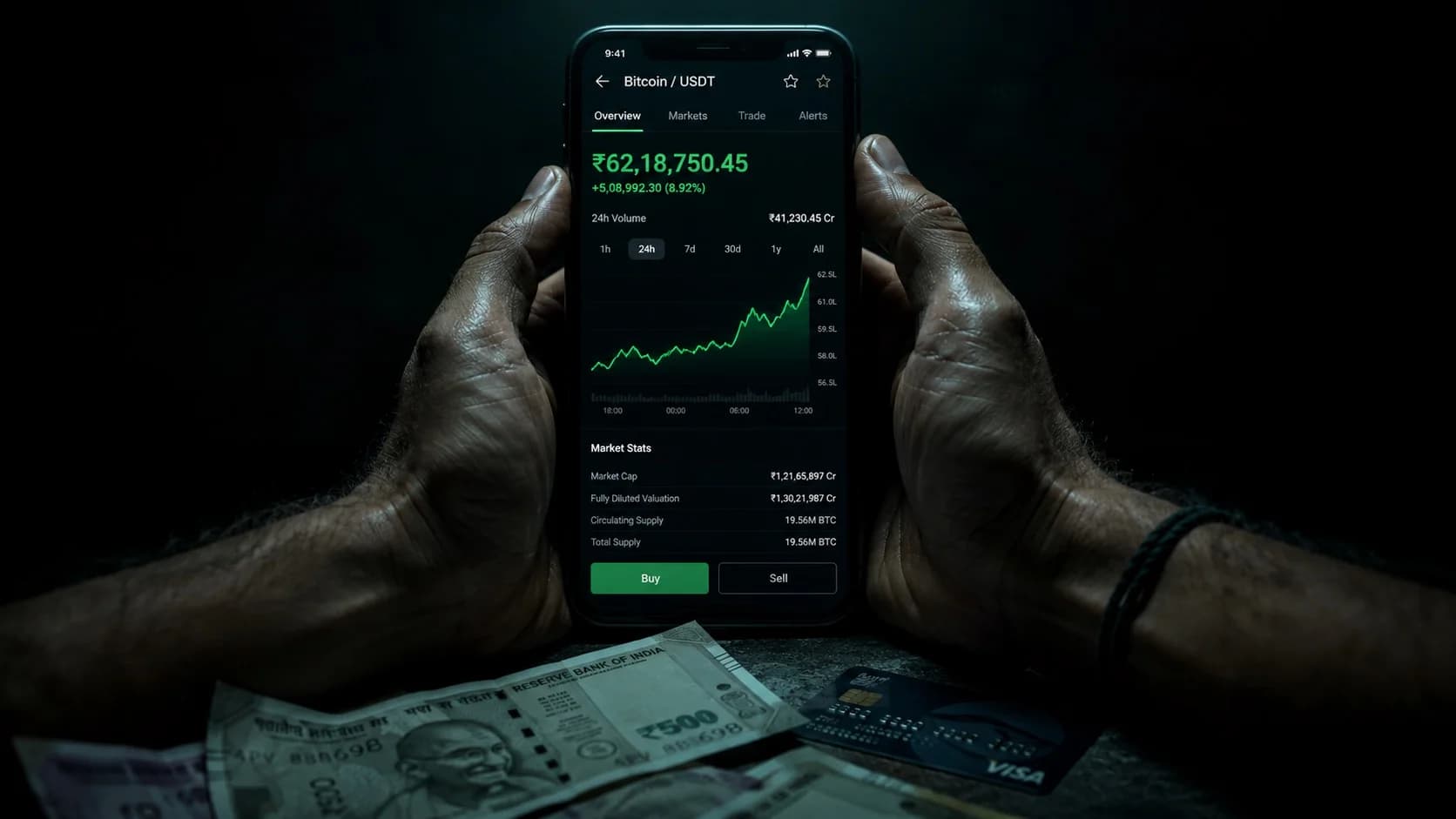
Fake platforms show convincing live charts and growing balances until you try to withdraw.
Someone you met online a new friend, a romantic interest, a WhatsApp group contact mentions a crypto investment platform with remarkable returns. They have been earning 20% a month. They show you their dashboard. It looks real. The app is polished. The support team responds instantly.
Before you transfer a single rupee, read this guide.
India's National Cyber Crime Reporting Portal recorded ₹22,845 crore in total online fraud losses in one year. Crypto investment scams are among the fastest-growing categories and unlike UPI fraud or phishing, victims often invest willingly over weeks or months before realising what happened. In just the first week of May 2026, crypto scam losses surpassed ₹3 crore.
Here are the 8 red flags that if you know them make fake crypto platforms immediately identifiable.
How to identify a crypto investment scam in India 8 red flags
- 1Guaranteed high returns 10–30% monthly
- 2Platform not listed on CoinGecko or CoinMarketCap
- 3Someone befriended you online before introducing the investment
- 4Urgency to invest more "offer closes tonight"
- 5Withdrawal requires paying extra "tax" or "unlock fee"
- 6App must be installed from a link, not the official app store
- 7Platform not registered with FIU India (check fiuindia.gov.in)
- 8Celebrity endorsement from an unverified social media account
If you suspect a crypto scam, stop all transfers and call 1930.
What Is Pig Butchering And Why India Is the Primary Target
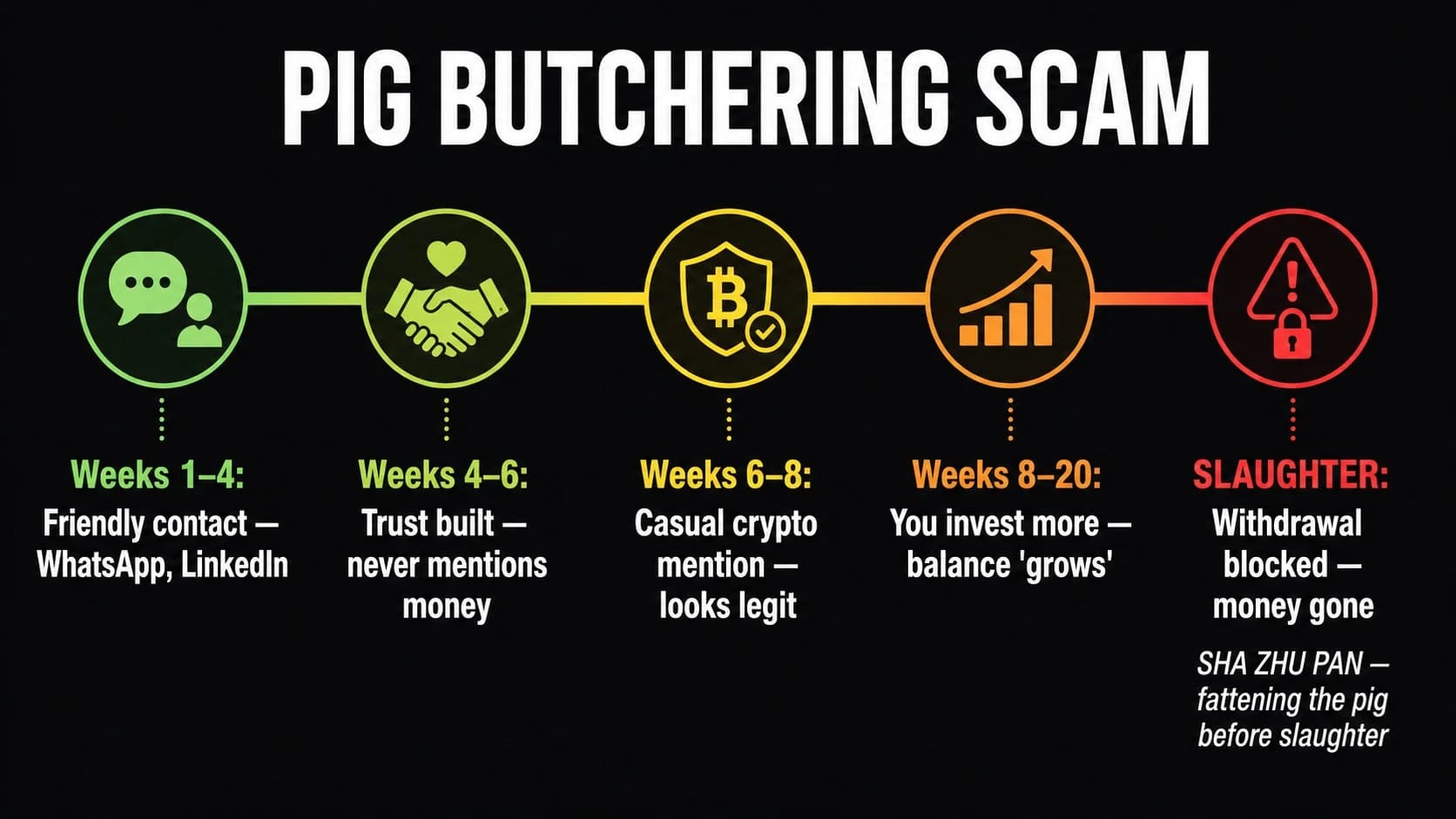
The full pig butchering playbook from first contact to "withdrawal blocked".
Pig butchering known in Chinese as sha zhu pan, meaning "fattening the pig before slaughter" is the most sophisticated and financially devastating crypto scam operating in India today. Unlike a phishing link that takes 30 seconds to spring, pig butchering takes weeks or months to execute.
The scam has five phases:
- Weeks 1–4 Friendly contact. A stranger reaches out on WhatsApp, LinkedIn, Instagram, or a dating app. They are warm, intelligent, and never mention money. They ask about your life, your work, your family.
- Weeks 4–6 Trust built. Conversations deepen. A friendship or romantic connection forms. The person may send gifts, spend hours talking, and show genuine-seeming interest in your wellbeing. Money is still never mentioned.
- Weeks 6–8 Casual crypto mention. The person mentions they invest in crypto "on the side." They show you their earnings casually, not as a pitch. The platform looks professional. They offer to teach you how it works.
- Weeks 8–20 You invest and your balance "grows". Your initial deposit shows impressive returns on a convincing dashboard. Small withdrawals may even succeed at first to build confidence. You are encouraged to deposit more. Your balance on screen keeps climbing.
- Slaughter. When you try to withdraw a significant amount, the platform demands a "tax payment" or "compliance unlock fee" before releasing funds. You pay. They demand more. The platform eventually goes dark. The person disappears. The money is gone.
India is a primary target because of the large number of English-speaking users on WhatsApp and LinkedIn, high aspiration for investment returns in a volatile economy, and the cultural tendency to trust relationships before questioning motives.
The 8 Red Flags in Detail
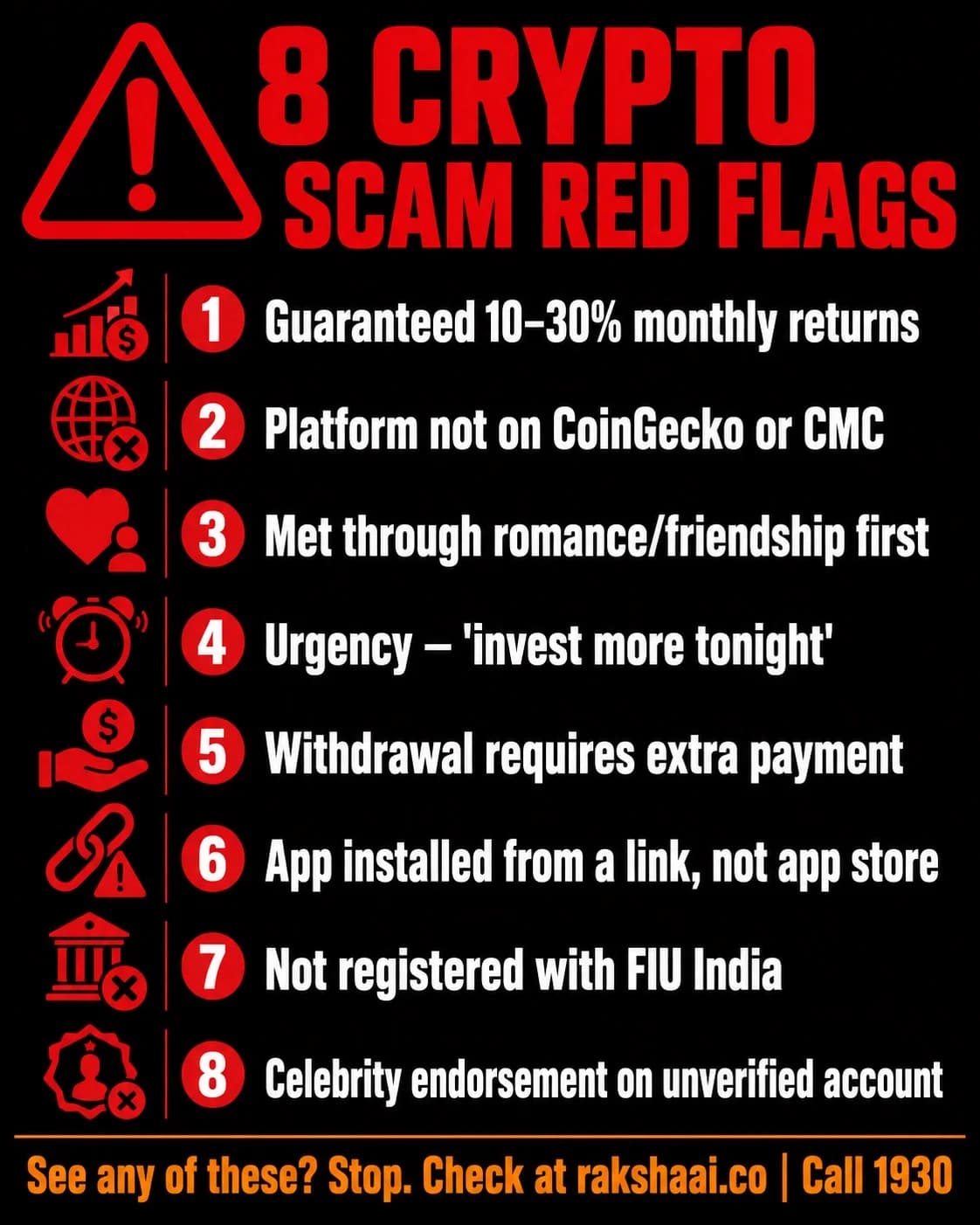
See any of these? Stop. Check at rakshaai.co. Call 1930.
Red Flag 1: Guaranteed returns of 10–30% per month
No legitimate investment guarantees returns. Crypto markets are volatile even the most experienced institutional investors do not promise fixed monthly profits. Any platform advertising guaranteed returns of 10% or more per month is lying. This is the single most reliable indicator of fraud.
The numbers are designed to sound credible without being absurdly high. "20% per month" sounds more believable than "200% in a week" but it is equally impossible to guarantee.
Red Flag 2: Platform not listed on CoinGecko or CoinMarketCap
CoinGecko and CoinMarketCap (CMC) are independent, publicly accessible databases that track legitimate cryptocurrency projects. If a platform's token or exchange is not findable on either, it does not exist in the legitimate crypto ecosystem.
Go to coingecko.com and search the platform name before depositing anything. Absence from these databases is not a minor oversight every real project wants to be listed for visibility and credibility.
Red Flag 3: You met through online friendship or romance first
Legitimate investment platforms are found through ads, searches, media coverage, and app store listings. They are never introduced to you by a new online friend who reached out unexpectedly. If the person who introduced you to the investment is someone you met online and have never seen in person, the relationship itself is part of the scam.
Red Flag 4: Urgency "invest more tonight," "offer closes in 2 hours"
Artificial urgency is a pressure tactic designed to prevent you from pausing to verify. Real investment opportunities do not expire at midnight. If you feel rushed or pressured to deposit before you have completed your own checks, that pressure is deliberate and is a scam technique.
Red Flag 5: Withdrawal requires extra "tax" or "unlock fee"
This is the mechanism of theft. Once you try to withdraw a significant amount, the platform invents a regulatory requirement: a "compliance fee," a "withdrawal tax," or a "risk deposit." No legitimate platform operates this way. Withdrawal fees where they exist on real exchanges are deducted from your balance, not demanded as additional payments.
Rule: Any platform that asks you to pay money to access your own money is stealing from you.
Red Flag 6: App installed from a link, not the App Store or Play Store
Apple and Google both require apps to pass security and policy reviews before listing. Fake crypto platforms cannot pass these reviews, so they ask you to install their app by clicking a link and enabling "install from unknown sources" on Android, or through an enterprise certificate workaround on iOS.
If the platform's app is not findable in the official App Store or Google Play Store, do not install it. The app is designed to look real while showing fabricated balances.
Red Flag 7: Not registered with FIU India
Under India's Prevention of Money Laundering Act (PMLA), all Virtual Asset Service Providers (VASPs) which includes crypto exchanges operating in India must register with the Financial Intelligence Unit (FIU-IND). You can check registration status at fiuindia.gov.in.
An unregistered platform is operating illegally in India. This alone is reason enough to never use it, regardless of any other claims.
Red Flag 8: Celebrity endorsement from an unverified account
Scammers create fake accounts impersonating Indian celebrities, successful entrepreneurs, or well-known investors or they use deepfake videos to make platforms appear endorsed by famous people. Always verify that celebrity social accounts are the official verified accounts (blue tick or gold tick). Even verified accounts can be hacked check for unusual recent posting patterns.
Safe Platform vs Fake Platform: Know the Difference at a Glance
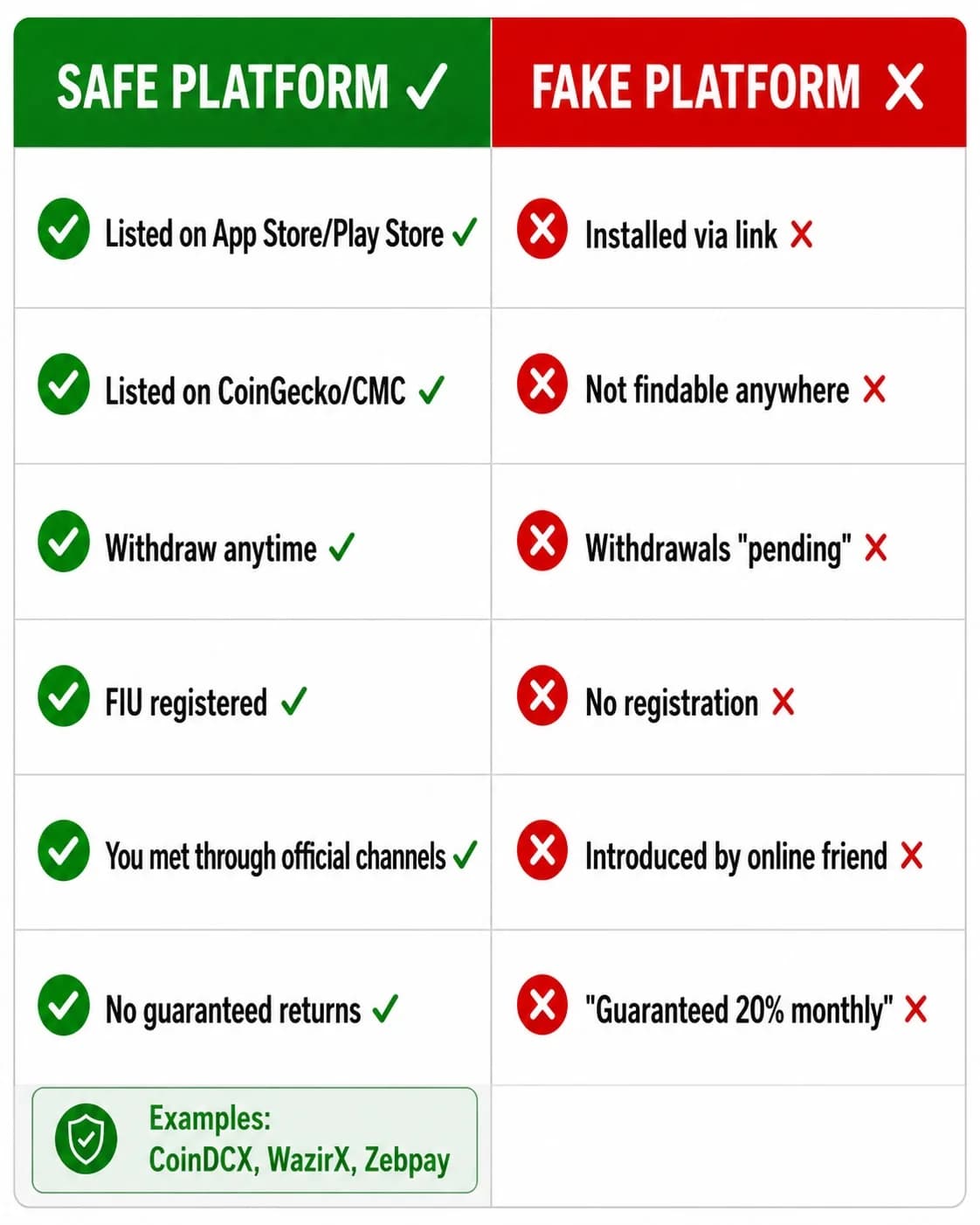
A legitimate platform checks every box on the left column. One fail on the right stop immediately.
The differences between a real and fake crypto platform are consistent and predictable. Here is the complete comparison:
- App store vs link installation. Legitimate platforms CoinDCX, WazirX, Zebpay, CoinSwitch are all downloadable directly from the App Store and Google Play. Fake platforms require a custom link because they cannot pass official app store reviews.
- CoinGecko/CMC listed vs not findable. Real crypto assets and exchanges are indexed on independent data aggregators. Fake platforms operate tokens that exist only within their own closed ecosystem.
- Withdraw anytime vs withdrawals "pending." On legitimate exchanges, withdrawals are processed within minutes to hours depending on network congestion. On fake platforms, withdrawals are perpetually pending or blocked behind new fee requirements.
- FIU registered vs no registration. Check fiuindia.gov.in. The list of registered VASPs is public.
- Official channels vs introduced by an online friend. You do not discover a real exchange through a WhatsApp contact you met three weeks ago. You find it through official advertising, press coverage, or app store listings.
- No guaranteed returns vs "guaranteed 20% monthly." Legitimate platforms show real market prices and acknowledge risk. They never guarantee returns.
How to Verify a Crypto Platform Before Depositing
These four steps take under 5 minutes and will tell you definitively whether a platform is legitimate:
- Check FIU registration. Go to fiuindia.gov.in and search the platform name in the list of registered VASPs. Not there? Do not deposit.
- Search on CoinGecko. Go to coingecko.com and search the platform name or the name of the coin they are asking you to invest in. No result? It is fabricated.
- Find it in the App Store or Play Store. Search directly in the official app store. If it is only available via a link, it has failed official security review.
- Check the URL on RakshaAI. Go to rakshaai.co/website-safety-checker and paste the platform URL. RakshaAI cross-references it against reported scam databases and returns a risk assessment in under 5 seconds.
If any one of these checks fails, the platform is almost certainly fraudulent. All four passing does not guarantee safety new scam platforms appear daily but failure on any single check is decisive.
What to Do If You Have Already Transferred Money
Speed is the only variable that determines recovery. Crypto scam funds move quickly through layered accounts every hour you wait reduces the chance of freezing the destination account.
Act in the next 30 minutes
- 1Stop do not transfer anything more, even if promised that an extra payment will unlock your balance
- 2Screenshot everything all chats with the introducer, the platform interface, all transaction records
- 3Call 1930 India's National Cybercrime Helpline and report the bank account or wallet address you transferred to
- 4Contact your bank fraud desk immediately if you paid via NEFT/IMPS request a transaction reversal
- 5File a detailed complaint at cybercrime.gov.in with screenshots and amounts
- 6Report the platform URL at rakshaai.co to protect other Indians from the same platform
Recovery is possible especially where the scammer used Indian bank accounts for the initial transfer, which is common in the early stages of crypto fraud. The 1930 helpline has authority to flag accounts for freezing while an investigation is opened.
The Scale of Crypto and Investment Fraud in India: Official Data (2021–2025)
The figures below are drawn from MHA Parliamentary replies (Lok Sabha, Dec 2, 2025 and Rajya Sabha, Feb 2026) and I4C official data. Investment and trading scams the category that includes fake crypto platforms now account for ~77% of all cybercrime financial losses in India.
| Year | Total Cybercrime Loss | NCRP Complaints | Inv. Fraud Share |
|---|---|---|---|
| 2021 | ₹551 crore | 2.62 lakh | |
| 2022 | ₹2,290 crore | 6.94 lakh | Growing |
| 2023 | ₹7,463 crore | 13.10 lakh | ~65% |
| 2024 | ₹22,845 crore | 22.68 lakh | ~77% (peak) |
| 2025 | ₹22,495 crore | 21.77 lakh | ~77% |
Investment & Trading Fraud: 2024 Category Breakdown (Full Year, MHA Data)
2,28,094
Stock trading scam complaints
₹4,636 crore lost
1,00,360
Investment scam complaints
₹3,216 crore lost
20,043
Trading scams (Jan–Apr 2024 only)
₹1,420 crore in 4 months
Cumulative loss 2020–2025: ₹52,976 crore across all cybercrime categories (I4C six-year data). Top affected states in 2025: Maharashtra ₹3,203 Cr · Karnataka ₹2,413 Cr · Tamil Nadu ₹1,897 Cr · UP ₹1,443 Cr.
Source: MHA Lok Sabha reply Dec 2, 2025 · Rajya Sabha Feb 2026 · I4C official data · Business Standard (May 27, 2024) citing MHA category breakdown.
Documented Crypto Investment Scam Cases Reported by Indian News Outlets
From a pan-India ₹17,000 crore Bitcoin Ponzi to a gang of police constables running a crypto racket these are real, verified cases that show the full scale and variety of crypto fraud targeting Indians.
GainBitcoin / GB21 Ponzi: 80,000 Investors Cheated, ₹6,606 Cr Diverted to Overseas Shell Firms
Amit Bhardwaj promised 10% per month returns for 18 months. Collected 80,000 BTC from ~80,000 Indian investors via GainBitcoin, GBMiners, and GB21. Fled to Dubai, arrested in Bangkok, died in custody 2022. Ayush Varshney Forbes 30 Under 30 Asia honoree arrested as technical architect at Mumbai airport on March 10, 2026. ₹6,606 crore diverted through 9 overseas companies.
Highrich / HR Crypto Coin Ponzi: ED Freezes ₹277 Crore, 28 FIRs, CBI Takes Over
K.D. Prathapan and Sreena Prathapan promised 15% annual returns via "HR Crypto Coin" their own fabricated cryptocurrency. Classic Ponzi: new investor money paid old investors. ₹1,651 crore raised from thousands across India. ED froze ₹244 crore in bank accounts + ₹33.7 crore immovable assets. Kerala Police filed 28 FIRs; case handed to CBI.
Tamil Film Associate Producer Among 6 Arrested for "BR IIFL PRO" Fake Trading App Scam
Fraudsters impersonated BlackRock and IIFL to create "BR IIFL PRO" a fake SEBI-approved trading app. Victim told he would get 500% profit in 2 months. Then demanded a 20% "service charge" before any withdrawal. 6 arrested including film associate producer R Saravanapriyan (34), a chit company owner, and a currency exchange shop owner.
3 Hyderabad Retirees Lose ₹4.4 Crore to Separate Crypto Scams in 4 Months
Three victims: (1) 62-yr retired engineer ₹1.72 Cr via 25+ investment transfers. (2) 76-yr retired employee ₹80 lakh via digital arrest. (3) 69-yr retired govt employee ₹1.89 Cr after seeing an Instagram AI crypto trading ad and contacting "investment advisor Maheswari" on WhatsApp. All cases registered March 12, 2026.
Gang Operating from a Hotel Ran ₹100 Crore Fake Forex and Crypto Racket Across Multiple States
Operated from a hotel in Ramgarhtal, Gorakhpur. Opened fake bank accounts using others' identities, fabricated profit statements, then vanished when withdrawals were requested. Laptops, phones, and user credentials recovered. 4 arrested; 2 absconding. Funds routed through hundreds of mule accounts across states.
BotBro / Cross Market: ₹3,200 Crore AI Crypto Bot Scam, Mastermind on Interpol Red Notice
Promised 5–10% monthly returns from AI-powered crypto trading bots (BotBro, Cross Market, Mine Crypto). ₹10,000 license fee first, then larger investments. All platforms disappeared in October 2025. ED froze ₹170 crore across ~30 shell company accounts. Mastermind Lavish Choudhary, Dubai-based, has an Interpol Red Notice issued against him.
Complete Timeline: Major Crypto Investment Scam Cases in India (2024–2026)
A date-wise record spanning Ponzi schemes, fake trading apps, pig butchering, and deepfake celebrity endorsements every major documented crypto fraud case in India.
| Date | Victim / City | Amount Lost | Platform / Method |
|---|---|---|---|
| 2015–2022 | ~80,000 investors · Pan-India (GainBitcoin / GB21) | ₹17,000 Cr peak | Ponzi: 10%/month return promised; 80,000 BTC collected; founder died in custody; Forbes 30U30 architect arrested Mar 2026 |
| 2023–2024 | Thousands · Kerala (Highrich / HR Crypto Coin) | ₹1,651 crore | Own crypto coin Ponzi; 15% annual returns promised; ED froze ₹277 Cr; 28 FIRs; CBI probe |
| Jan 22, 2024 | Multiple states (12) · Dehradun base | ₹13 crore | Posed as Flipkart "gift manager" → Telegram crypto/task websites; arrested from Karnataka |
| Apr 2024 (arrests Oct 2024) | Chennai businessman · Tamil Nadu | ₹14 crore | "BR IIFL PRO" fake SEBI-approved app impersonating BlackRock + IIFL; 6 arrested incl. Tamil film associate producer |
| May 2023–Aug 2024 | Man, 48 · Thane, Maharashtra | ₹87.48 lakh | Fake WhatsApp USDT group; multiple UPI IDs used; 6 accused; 15-month operation |
| Aug 2024 | Multiple investors · Balangir, Odisha | ₹76 lakh | "GBE Crypto Trading" fake app; impersonated Cyprus-based GBE Brokers; 4 arrested from Rajasthan; 60+ accounts frozen |
| Nov–Dec 2024 | Retired engineer, 65 · Hyderabad | ₹1.28 crore (USDT) | "531 DBS Stock Profit Group" WhatsApp → fake trading app; fake professor + analyst; ₹5K allowed out to build trust; account frozen on big withdrawal |
| Dec 2024 | Retired bank manager, 73 · Wadgaon Sheri, Pune | ₹81 lakh | Fake share trading + digital gold platform; approached via messaging app; dashboard showed fictitious profits; life savings lost |
| Q1 2025 | Businessman · Odisha (CID bust) | ₹6.16 crore | "ZAIF" fake exchange impersonated real Japanese exchange; Facebook romance lure; ₹89 lakh "unlock fee" demanded; 5 arrested Surat |
| Sep 29, 2025 | Investor · Delhi | ₹31.75 lakh | "BitBank" fake crypto app; Facebook lure → WhatsApp; fake IPO/share allotment promises; 1 arrested Punjab; WhatsApp numbers traced to Cambodia |
| Oct 2025 (platform died); 2026 raids | Thousands · Pan-India (BotBro network) | ₹3,200 crore | AI crypto bots (BotBro, Cross Market, Mine Crypto); ₹10K entry fee; platforms vanished; ED froze ₹170 Cr; Interpol Red Notice: Lavish Choudhary |
| Nov 2025 | ~200 incl. police officers · Vizag, AP | ₹7 crore | Yes World / UB Coin crypto; two serving police constables ran scheme; ₹3L investment → ₹1.32L/day promised; CBI probe |
| Nov 2025–Mar 2026 | 3 senior citizens (62, 69, 76) · Hyderabad | ₹4.4 crore | Three separate scams: investment fraud (25+ transfers), digital arrest, Instagram AI crypto ad → WhatsApp "advisor Maheswari" |
| Mar 20, 2026 | Hundreds across states · Gorakhpur, UP | ₹100 crore | Hotel-based fake forex/crypto racket; mule bank accounts; fabricated profits; 4 arrested, 2 absconding |
| Apr 2026 | Multiple (41 cases) · Ahmedabad, Gujarat | ₹1.5 crore | "CBOE US" fake app impersonating US CBOE exchange; USDT investment; shell company "Crystal Interior Designers"; 6 arrested, Dubai mastermind absconding |
Sources: The420.in, OnManorama, DT Next, Deccan Chronicle, Deccan Herald, Sunday Guardian Live, Analytics Insight, Business Standard, CryptoTimes. All amounts as reported by respective news outlets.
Frequently Asked Questions
Is my crypto platform registered in India?
All crypto platforms operating in India must register with the Financial Intelligence Unit (FIU). Check the public list at fiuindia.gov.in under the VASP section. Unregistered platforms are operating illegally and carry the highest fraud risk.
What is pig butchering scam in India?
Pig butchering (sha zhu pan) is a long-term romance or friendship scam where someone builds trust with you over weeks or months before introducing a fake crypto investment platform. They show you growing profits on a convincing dashboard, encourage you to deposit more, then block all withdrawals when you try to cash out. Victims can lose lakhs to crores.
Which crypto platforms are safe in India?
Safe, FIU-registered platforms include CoinDCX, WazirX, Zebpay, and CoinSwitch. Always download directly from the official App Store or Google Play Store. Never use a platform that is not listed on CoinGecko or CoinMarketCap, or that was recommended by someone you met online.
Can I recover money lost to a crypto scam?
Report immediately at 1930. If the platform used Indian bank accounts for transfers which is common in the early stages money may still be traceable and freezable. Also file at cybercrime.gov.in and report the platform URL at rakshaai.co/website-safety-checker. The faster you act, the better your chances.
How much have Indians lost to crypto scams?
India's National Cyber Crime Reporting Portal recorded ₹22,845 crore in total online fraud losses in one year, with crypto investment scams among the fastest-growing categories. In just the first week of May 2026, crypto scam losses exceeded ₹3 crore across reported cases alone the true number is higher because many cases go unreported.
Final Thoughts
Crypto investment scams succeed because they exploit two things: the genuine excitement around digital assets, and the human instinct to trust people we feel close to. The pig butchering playbook is specifically designed to make you feel chosen, trusted, and lucky before taking everything you invested.
The 8 red flags in this guide are present in every fake crypto platform without exception. They are non-negotiable checkpoints, not guidelines. A platform that fails even one of them should receive zero of your money.
Share this with family members especially anyone who is new to crypto, recently retired, or active on WhatsApp groups. The people most vulnerable to this scam are those who have savings to invest and have not yet learned how these platforms work.
Free Tool
Unsure about a crypto platform? Check it now.
Paste any crypto platform URL into RakshaAI for an instant scam check. No sign-up. No cost. Results in under 5 seconds.
Check a Platform Now →100% free · No sign-up required · Save 1930 in your contacts
More from RakshaAI Blog
Health Insurance Fraud India: Fake Mediclaim Policies and Hospital Scams
Mutual Fund Scam India: Fake SIP Offers and Investment App Fraud in 2026
Deepfake Celebrity Scam India: Ambani, Tata, and Kohli Never Said That
Stay Protected Online
Use RakshaAI to check websites, phone numbers, and UPI IDs for scams free, instant, no sign-up required.
RakshaAI is a private platform by Ehatech Services Pvt. Ltd. Not affiliated with any government body. Editorial policy