
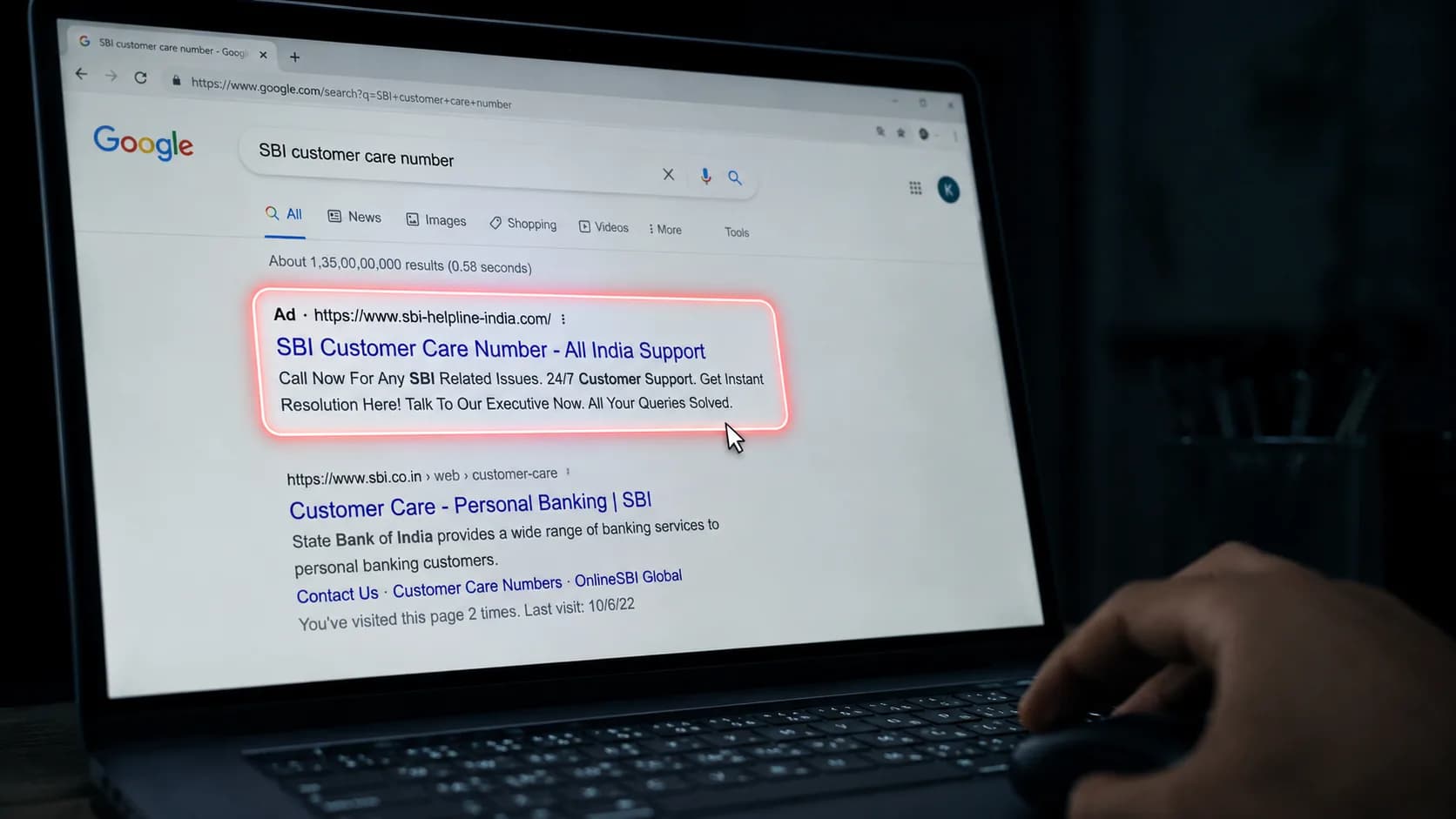
A real search for "SBI customer care number" the top result is a paid ad from scammers, not the bank. Millions of Indians click this every day.
You need to block your debit card. It is urgent. You search "SBI customer care number" on Google and the first result looks perfect a helpline number, a professional website, even an "Ad" label you barely notice. You call. Someone picks up immediately and sounds completely official.
Within ten minutes, they have your account number, your OTP, and your life savings.
This is India's most widespread financial scam in 2026, and it is powered by one thing: the top of Google search results. The number you called was never your bank. It was a criminal who paid Google to appear there.
How to find the real customer care number of a bank in India
- 1Type the bank's official URL directly (e.g., sbi.co.in) never trust search results
- 2Check the back of your debit or credit card the real number is printed there
- 3Open your bank's official app and go to Help / Contact Us
- 4Check your passbook's first page official helpline numbers are listed there
- 5Verify any unknown number on RakshaAI before calling
Never call a customer care number from Google Ads or any third-party website.
How Scammers Get to the Top of Google
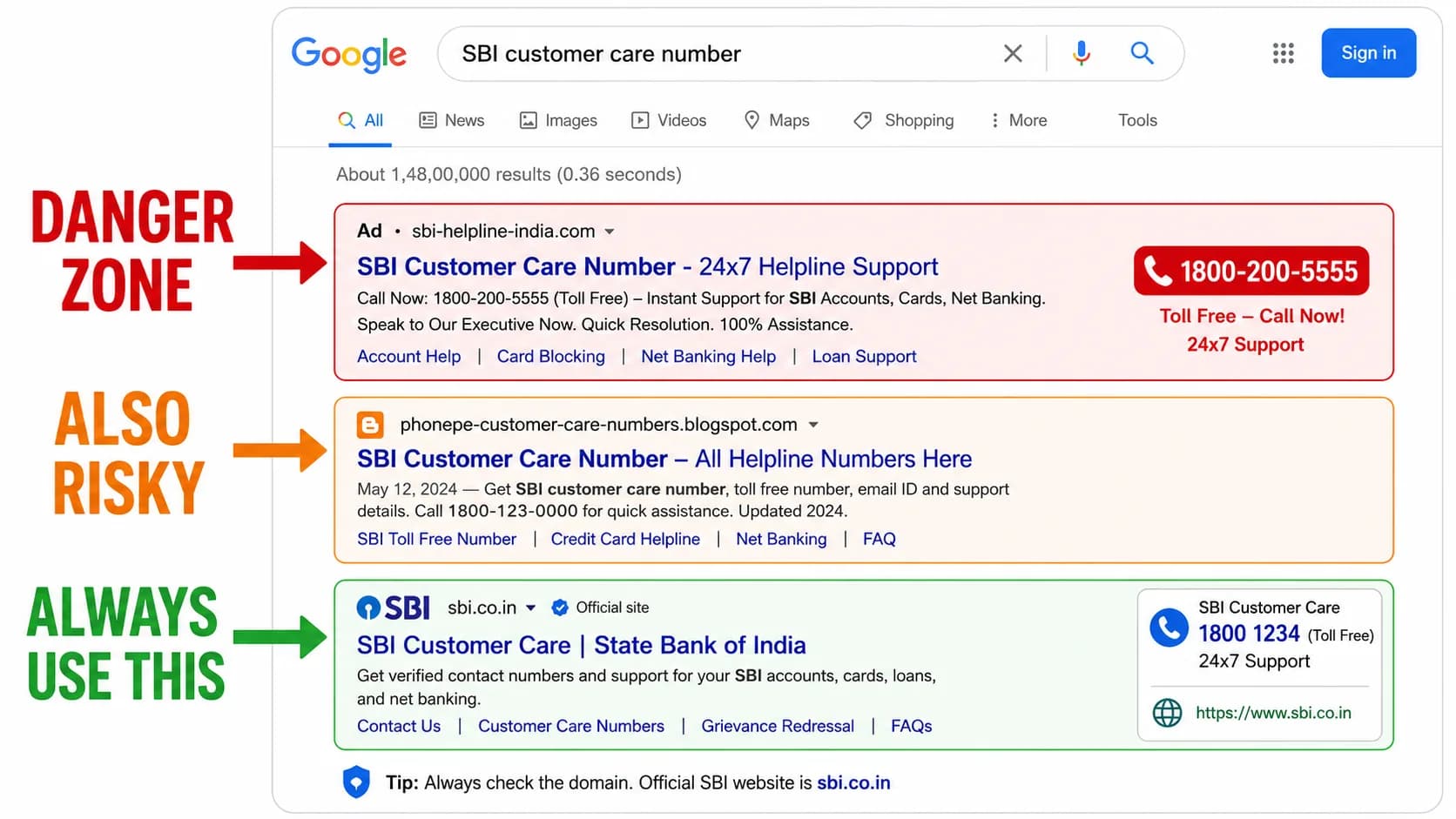
Only the official result (green border) is safe. Everything above it can be a trap.
Google Ads work on a bidding system. Anyone can pay to appear at the top of search results for any keyword including "SBI customer care number", "HDFC helpline", or "PhonePe customer support India". The ads look nearly identical to organic results. The small "Ad" or "Sponsored" label is easy to miss, especially on a mobile screen when you are already stressed about a financial problem.
Scammers invest ₹500–₹2,000 per day on these ads. A single successful call can net them ₹50,000 or more. The return on investment makes it one of the most profitable fraud operations in India today.
There is also a second tier of danger: third-party blogs and aggregator websites that publish lists of "customer care numbers" for dozens of banks and services. Many of these are either outdated (the numbers changed and a scammer now operates the old one) or deliberately planted by fraudsters to appear in organic search results. Even if the site looks legitimate, the number may lead to a scammer.
The only safe numbers are the ones that come directly from the institution itselfprinted on your card, in your app, or on the bank's own official domain.
The Fake Customer Care Script Word for Word
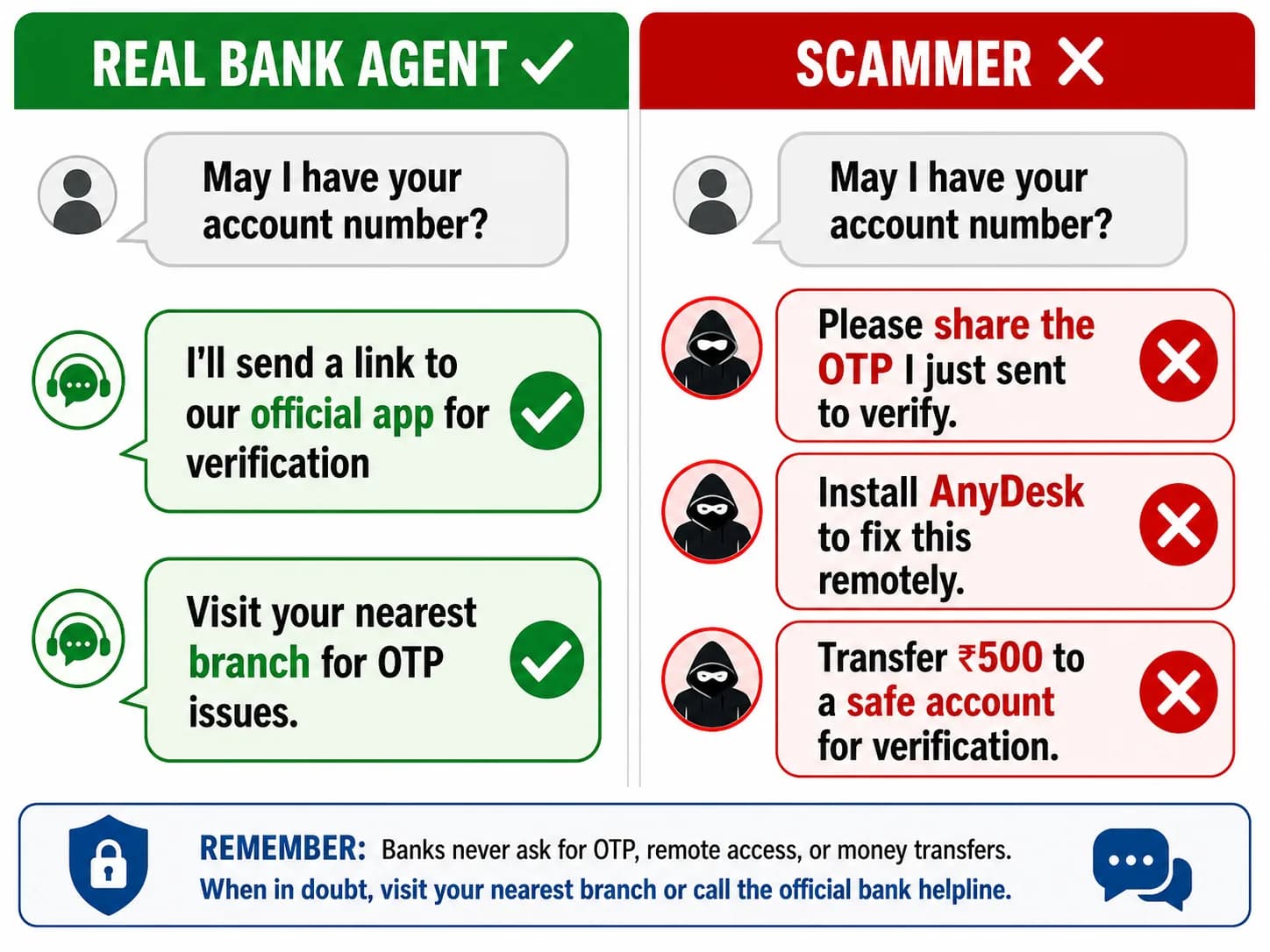
Spot the difference before you say a word.
Understanding exactly what a scammer says makes the fraud immediately recognisable. Here is the script they use, in roughly the order it unfolds:
- "Thank you for calling [Bank Name] customer care. How may I assist you today?"The opening sounds identical to a real call centre. The voice may even have a professional background noise of keyboard clicks and muffled voices.
- "For security, I need to verify your account. Please provide your account number and registered mobile number." This feels routine. Real agents do ask this. But a real agent stops here and verifies your identity through their own system they do not need to ask for anything else.
- "I've sent an OTP to your registered number. Please share it to confirm your identity." This is the line that ends with you being defrauded. A real bank agent never asks for your OTP. The OTP is your authorisation sharing it is the same as handing someone your ATM card and PIN together.
- "To fix this issue remotely, please install AnyDesk [or QuickSupport]."No legitimate bank operates remote support this way. Once AnyDesk is installed, the scammer has full visual and control access to your screen, including your banking app.
- "Your account has been compromised. Transfer ₹[amount] to this safe account for protection and we'll reverse it in 24 hours." There is no such thing as a "safe account" in Indian banking. Once transferred, the money moves through a chain of mule accounts in minutes and is gone.
Which Banks and Services Are Most Targeted
Every institution with a large customer base is a target. Scammers chase search volume the more people searching for a helpline, the higher their return. These are the most heavily targeted:
- Banks: SBI, HDFC Bank, ICICI Bank, Axis Bank, Bank of Baroda, Punjab National Bank, Canara Bank, Kotak Mahindra Bank
- UPI and payment apps: PayTM, PhonePe, Google Pay, BHIM, Amazon Pay
- Insurance and government: LIC, IRDAI grievance, EPFO, Aadhaar (UIDAI), PAN services (NSDL/UTIITSL)
- Services people urgently need: Gas cylinder booking (Indane, HP Gas, Bharat Gas), electricity board helplines, IRCTC refund support
The urgency matters. Scammers specifically target situations where you need help fast a blocked card, a failed transaction, a gas connection problem. Panic reduces the mental bandwidth needed to question whether the number is legitimate.
4 Safe Ways to Find the Real Customer Care Number
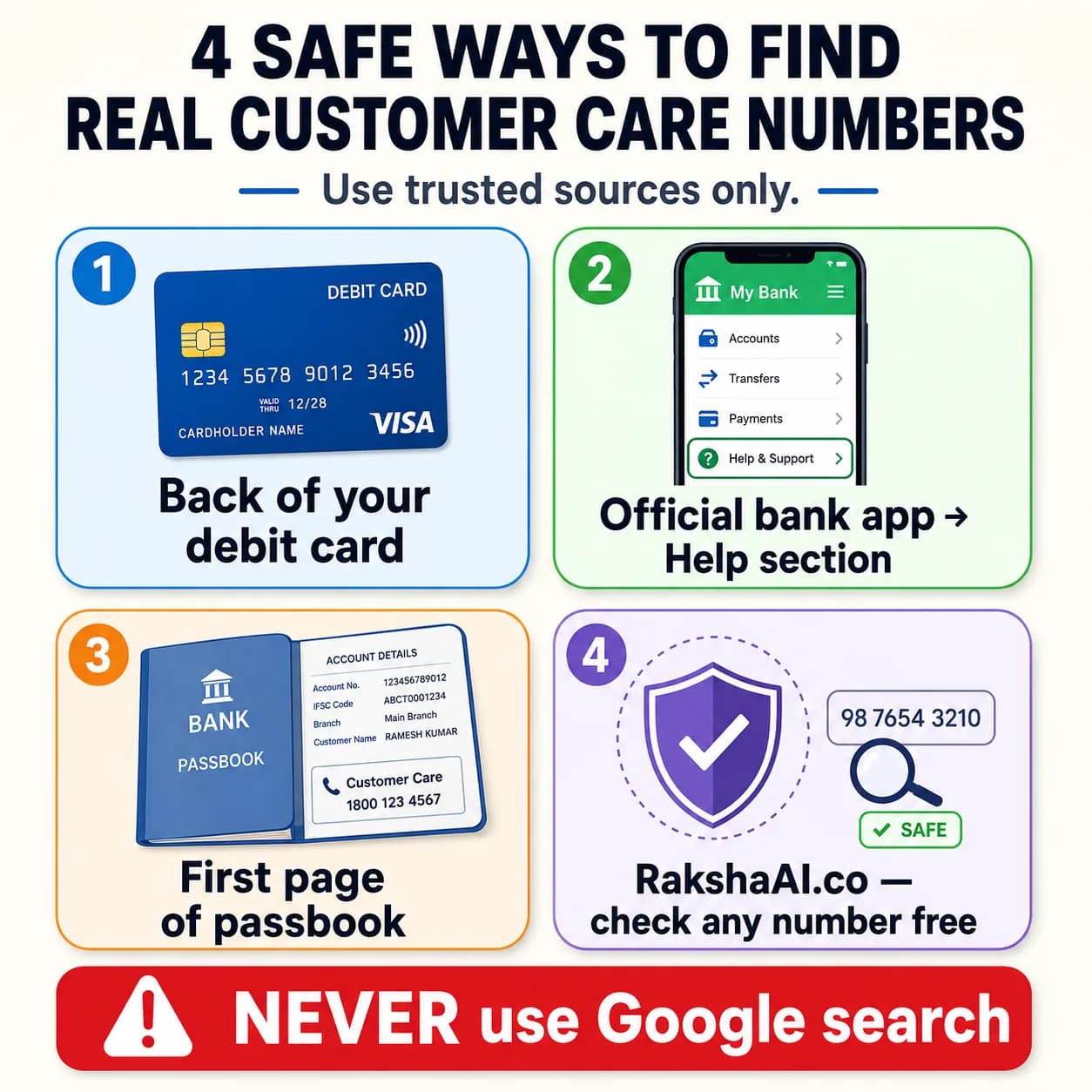
Four sources. All of them bypass Google entirely.
These four methods bypass Google entirely and connect you to numbers that are guaranteed to be correct. Build the habit of using them before every helpline call.
1. The Back of Your Debit or Credit Card
Every bank card has a customer care number printed on the reverse. This number is issued directly by the bank and printed at the time of card production. It cannot be manipulated by a Google Ad. For the majority of day-to-day needs blocking a card, reporting a failed transaction this is the fastest and safest option.
2. Your Bank's Official App → Help / Support
Every major Indian bank app (SBI YONO, HDFC Mobile Banking, ICICI iMobile, Axis Mobile, Kotak 811) has a Help or Contact Us section. The numbers listed there are sourced directly from the bank's server. Open the app you downloaded from the official Play Store or App Store, navigate to Help, and call from there. No Google search required.
3. First Page of Your Bank Passbook
If you have a savings account, the front pages of your passbook contain your branch address, IFSC code, and customer care number. These were printed by the bank at account opening. They are correct by definition.
4. RakshaAI Verify Before You Call
If you have already found a number and are unsure whether it is real, go to rakshaai.co/phone-number-checker and paste the number before you call. RakshaAI checks it against a database of reported scam numbers and known fraudulent helplines. A red or amber result means do not call.
What a Real Bank Agent Will Never Ask You
This is the most important rule in this entire article. Memorise it and share it with everyone in your family:
A real bank, UPI app, or government helpline will NEVER ask you for:
- ✕Your OTP (one-time password)
- ✕Your internet banking password or MPIN
- ✕Your ATM PIN
- ✕Your CVV (3-digit number on the back of your card)
- ✕To install AnyDesk, TeamViewer, or any remote access app
- ✕To transfer money to a "safe account" or "RBI-approved account"
- ✕A photo of your debit card (front or back)
The moment any caller asks for any of these, hang up. Then call your real bank using the number on your card.
What to Do If You Already Called a Fake Number
Speed determines how much you recover. Every minute you wait, the fraudsters move money further down a chain of mule accounts. Follow these steps in order:
- Call 1930 immediately. This is India's National Cybercrime Helpline. They can flag the destination account for freezing. This is time-critical do this before anything else if money has already moved.
- Call your real bank's fraud desk. Use the number on the back of your card or your bank's official app. Ask them to freeze all outgoing transactions on your account. Request a reversal if any unauthorised transaction has already gone through.
- Change your internet banking password and MPIN immediately if you shared any credentials. Log in from the official app and change everything.
- Uninstall any remote access apps (AnyDesk, TeamViewer, QuickSupport) if you installed them during the call.
- File a complaint at cybercrime.gov.in and save the complaint reference number. This creates an official record and triggers the banking fraud recovery process.
- Report the number on RakshaAI and TrueCaller to protect other Indians from calling the same number.
The Scale of Fake Customer Care Fraud in India: Official Data
India's cybercrime helpline (1930) and the National Cybercrime Reporting Portal (NCRP / I4C) have documented a dramatic rise in fake helpline and customer care fraud. Here is what official MHA and Parliamentary data reveals.
| Year | NCRP Cybercrime Complaints | YoY Growth | Total Reported Money Lost | Source |
|---|---|---|---|---|
| 2022 | 10.29 lakh | Not officially broken out | MHA / NCRB | |
| 2023 | 15.96 lakh | +55.15% | ₹7,465 crore | MHA Lok Sabha Dec 2025 |
| 2024 | 22.68 lakh | +42.08% | ₹22,845 crore | MHA Lok Sabha Dec 2025 |
| Cumulative (2019–Nov 2024) | 53.90 lakh total | ₹31,534 crore | MHA / I4C |
Fake Customer Care / Helpline Fraud I4C Aggregate Data
- • 1.73 lakh complaints specifically logged under fake customer care / fake helpline modus operandi (cumulative up to March 2026)
- • ₹2,100+ crore in cumulative losses from this category alone (I4C cited data)
- • Top 5 states account for 61% of incidents: Maharashtra, Karnataka, Telangana, Delhi-NCR, West Bengal
- • Fake customer care / refund fraud is consistently listed as one of the Top 5 sub-categories within all financial cybercrime
- • Voice/phone scams (which subsume most fake helpline fraud) nearly doubled in share from 15% to 35% of all fraud between Q1 and Q2 2024
Source: I4C / RTI Wiki aggregate data; MHA Lok Sabha response Dec 2025; DD News
Documented Fake Customer Care Scam Cases Reported by Indian News Outlets
Every case below was reported by verified Indian news outlets. Victims range from school teachers and retired officers to active police personnel no one is immune when urgency overrides caution.
SBI Yono KYC Gang 8,000+ Victims, 23 Arrested
A 6-module operation sent bulk SMS claiming "KYC expired," directed victims to a counterfeit Yono app. Credentials and OTPs were captured in real time. 820 pre-existing complaints were linked to the Surat-Kolkata-Jamtara gang. Delhi Police IFSO seized 202 SIM cards and 58 mobiles.
Fake PNB Google Ad + RustDesk Woman Loses ₹5.45 Lakh
Scammers ran Google Ads impersonating PNB customer care. When the victim called, she was told to download RustDesk (remote access tool). Fraudsters gained full phone control and drained accounts. Two men from Deoghar, Jharkhand were arrested police linked a ₹15 lakh money trail and 8 total complaints to the pair.
Retired Employee Loses ₹4 Lakh to Fake Medicine Delivery App Helpline
A retired employee searched Google for a medicine delivery app's customer care to update a delivery address. The fake agent said ₹2 was needed for the update, then instructed installation of a remote access app. Once installed, scammers accessed UPI PINs and banking OTPs and drained the account.
Teleperformance Insider + SBI Card Impersonation 350+ Victims, 18 Arrested
Insiders at Teleperformance (handling SBI's Card Protection Plan) leaked customer data. The gang called cardholders posing as SBI officials claiming card blockage. Victims shared OTPs and CVVs; fraudsters purchased e-gift cards and flight tickets worth crores. Delhi Police IFSO arrested 18 people across Delhi, Gurugram, Mathura and Jaipur.
Homemaker Loses ₹87,000 Trying to Get a ₹24 Refund from Zepto
After receiving wrong vegetables, a homemaker searched Google for Zepto customer support. Fraudsters had uploaded a fake helpline to Google Business listings. The "agent" sent a refund verification link. When she entered her banking details, multiple unauthorized transactions drained her account within minutes.
Chandigarh Police Officer Loses ₹3.9 Lakh in Fake Hotstar Customer Care Scam
An ASI with Chandigarh Police received a Hotstar subscription renewal pop-up. When his payment of ₹149 failed, he searched Google for Hotstar support and called a fake number. During a 37-minute call, scammers extracted his email, password, and banking credentials then purchased gold online. Imran Ansari from West Bengal was arrested after the cybercell traced the funds.
Complete Timeline: Major Fake Customer Care Scam Cases in India
| Date | City / State | Amount Lost | What Happened | Source |
|---|---|---|---|---|
| Mar 2022 | Delhi / Pan-India | ₹20 Crore | Fake SBI Yono KYC SMS gang bulk texts drove 8,000+ victims to counterfeit app; OTPs captured live. 23 arrested. | The Print |
| Oct 2023 | 11 States | Millions (USD) | Fake Amazon & Microsoft tech support pop-ups → remote access → fake repair charges. CBI raids shut 70+ call centers. | The Record |
| Jan 2024 | Delhi / Jharkhand | ₹5.45 Lakh | Fake PNB Google Ad → victim told to install RustDesk → full phone control → account drained. 2 arrested in Deoghar. | Business Today |
| 2024 | Delhi / Jharkhand | ₹10.8 Lakh | Spoofed SBI call claimed ₹588 fraud → fake KYC link deployed malicious APK → OTPs intercepted over 3 days. 3 arrested. | The420.in |
| Nov 2024 | Hyderabad | ₹4 Lakh | Fake medicine delivery app helpline asked ₹2 for address update → remote access app installed → UPI PIN stolen. | Deccan Chronicle |
| 2024–25 | Mumbai / Nationwide | ₹2.7 Cr+ | Fake Indane/HP/Bharat Gas LPG helplines panic disconnection SMS → cloned portal → malicious APK → UPI drain. 3 arrested in Jharkhand. | The420.in |
| Jun 2025 | Muzaffarpur, Bihar | Not disclosed | Fake electricity board helpline on Google → AnyDesk/TeamViewer install → banking credentials stolen. Multi-state syndicate traced. | The420.in |
| Aug 2025 | Delhi–Gurugram | ₹2.6 Crore | Teleperformance insider leaked SBI cardholder data → impersonation calls → OTP + CVV → e-gift cards & flights. 18 arrested. | The420.in |
| Sep 2025 | Delhi / Jharkhand | ₹13.86 Lakh | Fake payment app helpline → malicious app download → full account access. 2 arrested including mule account holder. | The Print |
| Dec 2025 | Ahmedabad | ₹87,000 | Fake Zepto helpline on Google Business listing ₹24 refund request → phishing link → multiple unauthorized transactions. | The420.in |
| Apr 2026 | Rudrapur, Uttarakhand | ₹1.99 Lakh | Failed Jio recharge → fake Google helpline → scammer asked Google Pay PIN "to process recharge" → 2 transactions drained. | The420.in |
| May 2026 | Deoghar, Jharkhand | Multiple victims | Gang impersonating Flipkart, Amazon, PhonePe, Airtel vishing for OTPs and UPI credentials. 6 arrested; 12 SIMs seized. | The420.in |
| May 2026 | Prayagraj, UP | ₹9 Lakh | Fake fan manufacturer helpline → trust built via WhatsApp → 4 RTGS/IMPS transfers executed in 40 minutes. | The420.in |
| 2025–26 | Chandigarh | ₹3.9 Lakh | Chandigarh Police ASI called fake Hotstar helpline after ₹149 renewal failed 37-min vishing → banking credentials → gold purchased online. | The420.in |
| Jun 2026 | Nagpur | ₹2 Lakh | Fake courier helpline via WhatsApp remote device access granted → 2 bank accounts drained. FIR registered. | The420.in |
Frequently Asked Questions
How do scammers get to the top of Google for bank helpline searches?
Scammers purchase Google Ads targeting keywords like "SBI customer care number" or "HDFC helpline India." These paid ads appear above even the bank's own official website in search results. The small "Ad" or "Sponsored" label is easy to miss, especially on a mobile screen.
Will my bank ever ask for my OTP over the phone?
Never. No bank, UPI app, government department, or legitimate company will ever ask for your OTP over a phone call. The OTP is your authorisation code sharing it is equivalent to handing someone your signed blank cheque. If anyone asks, hang up immediately.
Which banks are most targeted by fake customer care scams?
All major Indian banks are targeted SBI, HDFC, ICICI, Axis, Bank of Baroda. Also targeted: PayTM, PhonePe, Google Pay, LIC, EPFO, and gas cylinder booking services. Any institution with a large customer base running frequent Google searches for helplines is a target.
Is AnyDesk safe to install for bank support?
No. No legitimate bank or UPI company requires you to install AnyDesk, TeamViewer, QuickSupport, or any remote access tool. These apps give the installer full visibility and control of your screen. If a "support agent" asks you to install any of these, hang up immediately this is a scam in progress.
How can I verify a customer care number is real?
Go to rakshaai.co/phone-number-checker and paste the number before you call. RakshaAI checks it against a database of known scam numbers. Also compare it with the number printed on the back of your bank card or listed in your bank's official app those are guaranteed to be correct.
Final Thoughts
The fake customer care scam is uniquely dangerous because it exploits trust and urgency simultaneously. You are already in a stressful situation a blocked card, a failed payment and you are actively seeking help. That reduced mental guard is exactly what the scammer depends on.
The fix is simple but requires a habit change: never call a number from a Google search result. Use the back of your card. Use your bank's official app. If you have any doubt about a number, verify it on RakshaAI before you dial.
Share this guide with your parents, your domestic staff, your elderly relatives anyone who might one day urgently search for a bank helpline. The fraud succeeds most often on the people least likely to question whether the result they found is genuine.
Free Tool
Not sure if a number is real? Check it now.
Paste any customer care number into RakshaAI for an instant scam check. No sign-up. Free. Results in under 5 seconds.
Verify a Number Now →100% free · No sign-up required · Save 1930 in your contacts
More from RakshaAI Blog
Electricity Bill Scam India: That Disconnection Today SMS Is Always Fake

AI Scam India: How Artificial Intelligence Is Making Fraud More Dangerous in 2026
Credit Card Fraud India 2026: How Scammers Clone and Misuse Your Card
Stay Protected Online
Use RakshaAI to check websites, phone numbers, and UPI IDs for scams free, instant, no sign-up required.
RakshaAI is a private platform by Ehatech Services Pvt. Ltd. Not affiliated with any government body. Editorial policy