
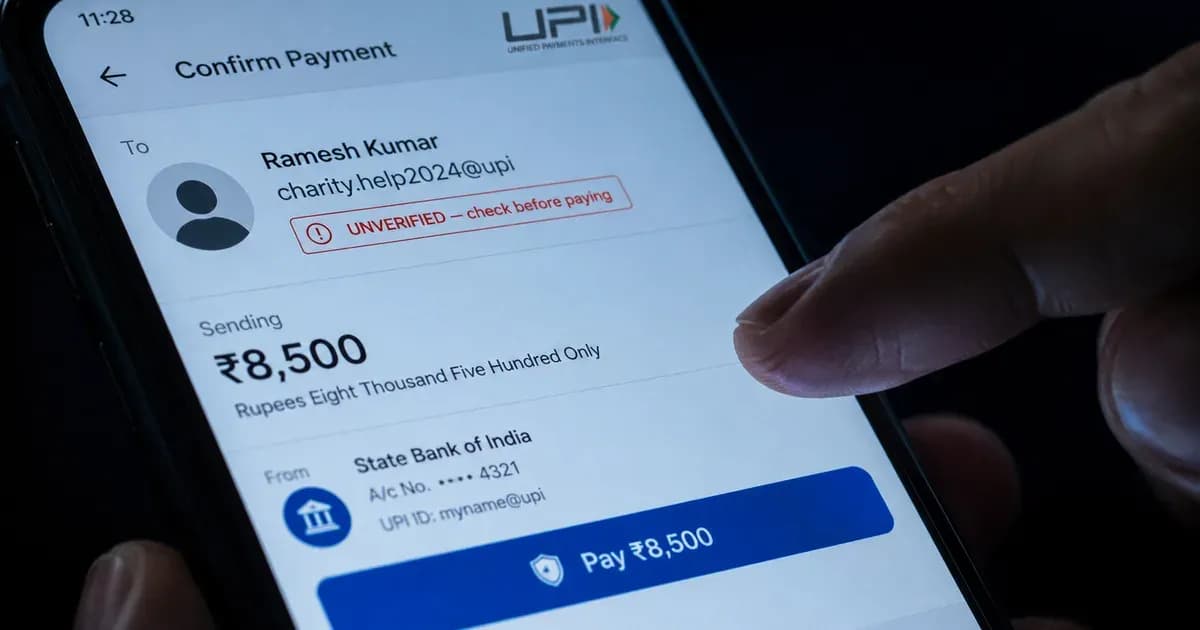
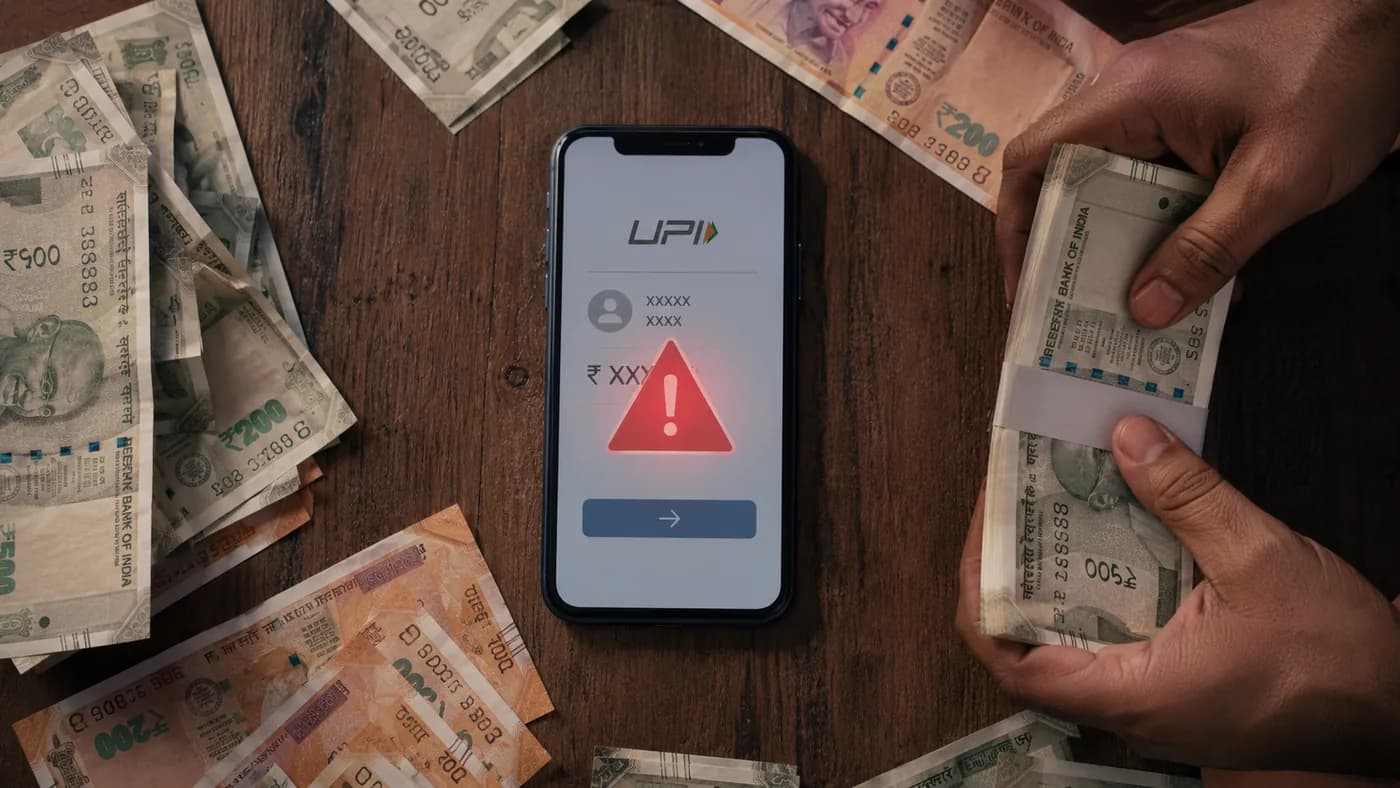
An unverified UPI ID before a payment is confirmed. The receiver name shown here does not match who the sender expected, the exact moment every UPI fraud depends on you not noticing.
A message arrives asking you to pay a UPI ID. Maybe it is a vendor you found online, a charity collecting for flood relief, a buyer on OLX sending a "deposit," or a freelancer asking for an advance. The ID looks plausible enough, name@upi, name@paytm, name@okaxis, and there is no obvious reason to doubt it. You pay. Within minutes, the account goes silent, the number stops responding, and the money is gone.
This is UPI ID fraud, and it is one of the fastest-growing categories of financial crime in India. Government data tabled in the Lok Sabha shows UPI-related fraud losses of Rs 981 crore across 12.64 lakh cases in FY 2024-25 alone, following Rs 1,087 crore across 13.42 lakh cases the year before (source: The420.in, citing Ministry of Finance data). A separate LocalCircles survey of over 32,000 UPI users across 365 districts found that one in five families with a UPI user had faced fraud at least once in the past three years, and 51% of victims never filed any complaint at all (source: Business Standard).
This guide covers the 5 ways scammers use fake UPI IDs right now, the exact steps to check any UPI ID before you pay, the red flags that expose fraud in seconds, and what to do if you have already paid a fraudulent ID.
Why Verifying a UPI ID Before Paying Matters
A UPI ID looks like an email address, name@bank, but unlike email there was, until recently, no reliable way to confirm who actually sat behind it before you paid. Most UPI apps used to display whatever name the payer had saved in their contacts, or a nickname pulled from a QR code, neither of which had to match the real, bank-registered account holder. Scammers exploited this gap directly, generating UPI IDs and QR codes with names that looked exactly like the vendor, charity, or person the victim expected to pay.
NPCI closed part of this gap in 2025. A circular dated April 24, 2025 mandated that every UPI app display only the ultimate beneficiary name pulled from the bank's Core Banking System, not a nickname, a QR label, or a name saved in the payer's contacts, with full enforcement required by June 30, 2025 (source: Business Standard). This is a meaningful protection, but it only works if you actually read the name shown before confirming a payment. The LocalCircles survey found that 40% of fraud victims said they clicked a payment link expecting to receive money, only to have their account debited instead, exactly the kind of mistake that reading the confirmation screen prevents (source: Business Standard).
Independent verification, checking the UPI ID against known fraud reports and confirming the name in your app, closes the rest of the gap. It takes under 5 seconds and stops every scam type described below.
The 5 Ways Scammers Use Fake UPI IDs in India
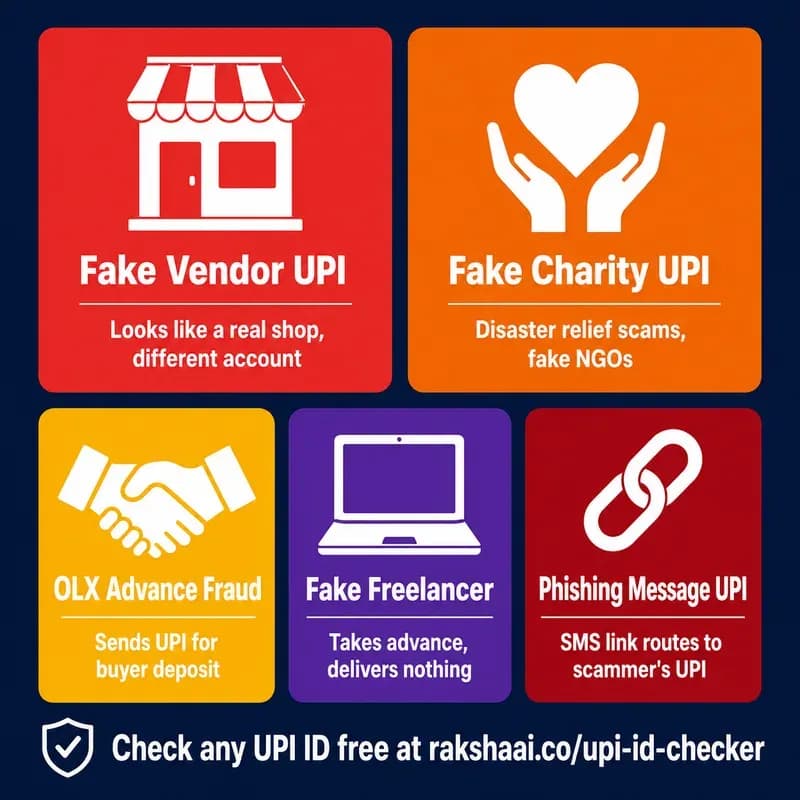
Five UPI ID fraud formats active in India right now. Each borrows credibility from something the victim already trusts, a shop, a cause, a marketplace, or a service.
Fake Vendor / Shop UPI IDs
A fraudster pastes a counterfeit QR sticker over a genuine one at a shop counter, petrol pump, parking booth, or even a roadside electricity pole, or shares a UPI ID over chat that looks like the real seller's. The buyer pays what looks like the correct vendor, but the money lands in the scammer's account instead. This pattern has scaled fast enough that it is now tracked at the national level by India's Cyber Crime Coordination Centre, with thousands of cases reported across Maharashtra, Delhi, Karnataka, and Uttar Pradesh (source: The420.in). The fix is built into every UPI app: before confirming payment, check that the registered name matches the shop you are standing in front of.
Fake Charity and Donation UPI Scams
Emotional appeals, a natural disaster, a sick child, a relief fund, spread fastest on WhatsApp family groups with a UPI ID attached and a request to "please forward." As far back as 2020, Delhi Police detected and blocked a fake UPI ID created specifically to intercept donations meant for the PM CARES Fund (source: Business Standard). More recently, in September 2025, three Uttar Pradesh men were arrested after running fraudulent Gaza relief crowdfunding campaigns on social media, using their own personal UPI IDs and bank accounts to collect crores of rupees in donations that never reached any genuine cause (source: The Week). A genuine charity's UPI ID will always be published on that charity's own official website, never only in a forwarded message.
OLX and Resale Advance Fraud UPI
A "buyer" contacts a seller on OLX or a similar marketplace, agrees on a price, then sends what looks like a payment request but is actually a UPI collect request. The seller, believing they are about to receive money, enters their UPI PIN and instead authorises an outgoing payment. A common escalation has the scammer claim the first transfer was a mistake and request double the amount back "to correct it," extracting money twice from the same victim (source: The420.in). For the full breakdown of this and other resale platform tricks, see our complete guide to OLX scams in India.
Fake Freelancer / Service Provider UPI
A "freelancer" offering design, development, or content work asks for an advance payment through a UPI ID before starting, then disappears once it is paid, or delivers work so poor it is unusable. The mirror version also happens: a client sends a doctored payment screenshot that mimics a genuine UPI confirmation, and a freelancer or small seller releases work or goods believing they have already been paid. In both directions, the rule is the same: a screenshot is not proof of payment, only your own bank balance or UPI app notification is.
UPI IDs in Phishing Messages
An SMS, email, or WhatsApp message claims a refund, cashback, or KYC update is pending and includes a link or QR code. Scanning it opens a fake payment page that closely mimics a real UPI app, and submitting your UPI PIN there hands scammers direct access to your account. For a full breakdown of every collect request and QR code trick currently active, see 7 UPI scam tricks draining Indian bank accounts in 2026.
How to Check Any UPI ID Before Paying
How to check any UPI ID before paying in India:
How to check any UPI ID before paying
- 1Go to rakshaai.co/upi-id-checker, free, no sign-up required
- 2Enter the complete UPI ID (e.g. name@upi, name@okaxis, name@paytm)
- 3Get an instant risk result, flagged UPI IDs show prior fraud reports
- 4In your UPI app, confirm the bank-registered name shown matches who you expect. If blank or unexpected, stop
- 5Search the UPI ID on Google with the word "scam" or "fraud" added
- 6Never pay a UPI ID sent only in an SMS, email, or WhatsApp link, go to the official app or website directly
This entire process takes under 5 seconds and stops every UPI ID scam type above.
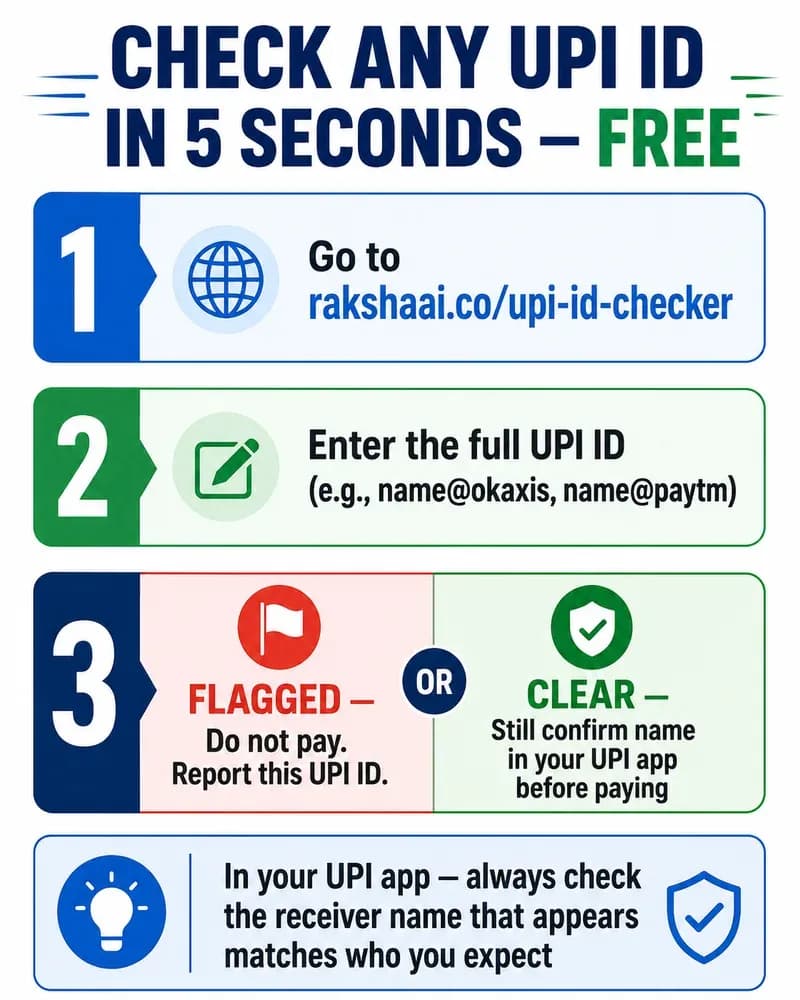
Save this. Run it before you scan a QR code or paste a UPI ID into your payment app, no matter how legitimate the request looks.
This process works alongside the other checks in our guide on how to check if a website is fake before you pay whenever a UPI ID appears on a page you are not fully sure about.
Real UPI ID Fraud Cases in India
These are not abstract warnings. Here are documented, sourced cases showing exactly how fake UPI IDs have been used against real victims and real causes in India.
Delhi Police, 2020
Fake UPI ID Created to Intercept PM CARES Fund Donations
During the national appeal for donations to the PM CARES Fund, Delhi Police detected a fake UPI ID designed to look like it belonged to the official fund. The ID was identified and blocked before it could be widely circulated, an early, clear example of how easily a trusted cause can be spoofed with nothing more than a convincing-looking UPI handle.
Source: Business StandardMaharashtra, September 2025
Fake Gaza Relief Crowdfunding Nets Crores Through Personal UPI IDs
Three Uttar Pradesh residents, Mohammed Ayan, Zaid Notiyar, and Abu Sufiyan, were arrested from Maharashtra for running fraudulent crowdfunding campaigns on social media citing Gaza relief. They used fabricated photos and videos and directed donations to their own personal UPI IDs and bank accounts, collecting crores of rupees that were never passed on to any relief effort.
Source: The WeekBoth cases share the same root cause as the vendor, OLX, and phishing scams described above: the victim had no independent way to confirm who was actually behind the UPI ID before the money moved. The checklist in the previous section closes exactly that gap.
Red Flags in a UPI ID
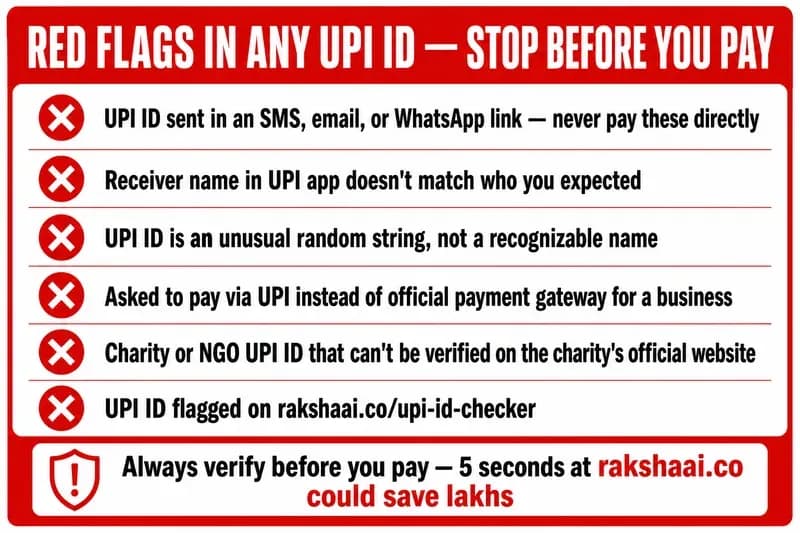
Screenshot this and check it before you confirm any UPI payment. Share it with everyone in your family who uses a phone to pay.
Fraudulent UPI IDs almost always share the same warning signs. Stop and verify before paying if you notice any of the following:
- The UPI ID was sent to you in an SMS, email, or WhatsApp link
- The receiver name shown in your UPI app does not match who you expected
- The UPI ID is an unusual random string, not a recognisable name
- You are asked to pay via UPI instead of a business's official payment gateway
- A charity or NGO UPI ID cannot be verified on that charity's own official website
- The UPI ID is flagged on rakshaai.co/upi-id-checker
This same pattern, a request routed away from an official channel toward a personal or unfamiliar UPI ID, is also the core mechanic behind wrong transfer refund scams. If a payment request feels rushed or routes you somewhere unofficial, that alone is reason enough to verify independently first.
What To Do If You Paid a Fraudulent UPI ID
Act immediately. The first 30 minutes after a fraudulent UPI payment give you the best chance of the transaction being frozen before the money is withdrawn.
- Call 1930 immediately. India's National Cybercrime Helpline can coordinate with banks and NPCI in real time to attempt to freeze the funds.
- Raise a dispute in your UPI app on the specific transaction, using the UPI transaction reference number.
- File a complaint at cybercrime.gov.in. Submit the UPI ID, transaction reference, amount, and any chat or call records.
- Contact your bank's official customer care using the number on your bank's website or the back of your card, never a number given to you by the person you paid.
- Report the UPI ID at RakshaAI. Submit it at rakshaai.co/upi-id-checker so the next person targeted by the same UPI ID can identify the fraud instantly.
For a full step-by-step recovery guide covering every type of online and offline fraud, see Got scammed online in India? Do these 5 things in 30 minutes.
Frequently Asked Questions
How can I verify a UPI ID is legitimate before sending money?
Check the UPI ID at rakshaai.co/upi-id-checker for free, it cross-references known fraud reports. Also, in your UPI app, enter the ID and check that the name shown matches who you expect. Since June 2025, every UPI app is required to show only the bank-registered name, not a nickname. If the name is blank, wrong, or unexpected, do not proceed.
Can a UPI ID be fake or spoofed in India?
Yes. Scammers create UPI IDs that closely mimic real merchant or individual IDs, and they also send fake UPI payment links and QR codes in SMS or WhatsApp messages that route to their own account. Always verify the ID in your official UPI app before paying.
Is there a free tool to check UPI IDs for fraud in India?
Yes, rakshaai.co/upi-id-checker lets you check any UPI ID instantly and for free. No sign-up needed. It cross-references user-submitted fraud reports and known scam patterns specific to Indian UPI fraud.
What should I do if I sent money to a fraudulent UPI ID in India?
Call 1930 immediately with the UPI transaction reference number and the recipient UPI ID. File at cybercrime.gov.in. Also raise a dispute in your UPI app on the specific transaction. Time is critical, the first 30 minutes have the highest recovery success rate.
Can I get money back from a wrong UPI payment in India?
For a genuinely wrong but unintended payment, contact the recipient's bank through the dispute mechanism in your UPI app. For fraud, call 1930 immediately. If the recipient is known and unresponsive, a formal complaint at cybercrime.gov.in is required to pursue a chargeback.
Final Thoughts
Every scam in this guide, fake vendors, fake charities, OLX advance fraud, fake freelancers, and phishing links, depends on the same single moment: a UPI ID that looks plausible enough that no one checks it. NPCI's 2025 rule requiring bank-verified names on every transaction closed part of that gap. The rest closes with one habit.
The rule that stops every version of this scam: check the UPI ID at rakshaai.co and confirm the bank-registered name in your app before you send a single rupee. That habit, taking under 5 seconds, makes every UPI ID scam in this guide impossible to execute against you.
Share this article with everyone in your family who pays through UPI, especially parents and anyone new to digital payments who is less likely to question a UPI ID that comes with a convincing story attached.
Sources and References
Every statistic and case referenced in this article is drawn from the following public sources. We link out directly so you can verify the original reporting and regulatory data yourself.
- UPI fraud data FY 2021-22 to FY 2025-26, Ministry of Finance via Lok Sabha, The420.in
- LocalCircles survey on UPI fraud and underreporting, Business Standard
- NPCI mandatory bank-registered name display rule, 2025, Business Standard
- Fake UPI ID targeting PM CARES Fund donations, 2020, Business Standard
- Fake Gaza relief crowdfunding arrests, September 2025, The Week
- UPI collect request and QR code fraud patterns in India, The420.in
Free Tool
Got a suspicious UPI ID?
Paste any UPI ID into RakshaAI before you pay. Instant result. No sign-up. No cost.
Check a UPI ID Now →100% free · No sign-up required · Save 1930 in your contacts
More from RakshaAI Blog
Stay Protected Online
Use RakshaAI to check websites, phone numbers, and UPI IDs for scams free, instant, no sign-up required.
RakshaAI is a private platform by Ehatech Services Pvt. Ltd. Not affiliated with any government body. Editorial policy