

Every second counts after an online scam. The first 30 minutes are critical here is exactly what to do.
You just realised you have been scammed online. Your hands are shaking. You are staring at a transaction you did not authorise, or a website that just took your money and vanished. The panic is real and completely understandable.
But here is the most important thing you can read right now: the next 30 minutes could determine whether you get your money back. India's cybercrime system has mechanisms to freeze fraudulent transactions but only if you act fast enough. This guide tells you exactly what to do, in what order, right now.
If you were just scammed online in India, do this immediately:
- 1Call 1930 National Cybercrime Helpline, available 24/7, free
- 2Call your bank and request a transaction hold or reversal
- 3File a complaint at cybercrime.gov.in with all transaction details
- 4Report the scammer's details at rakshaai.co to warn others
- 5Change all passwords and UPI PIN immediately
- 6Screenshot all conversations and transaction records
Act within 30 minutes recovery success drops significantly after 24 hours.
The 30-Minute Recovery Timeline That Could Save Your Money
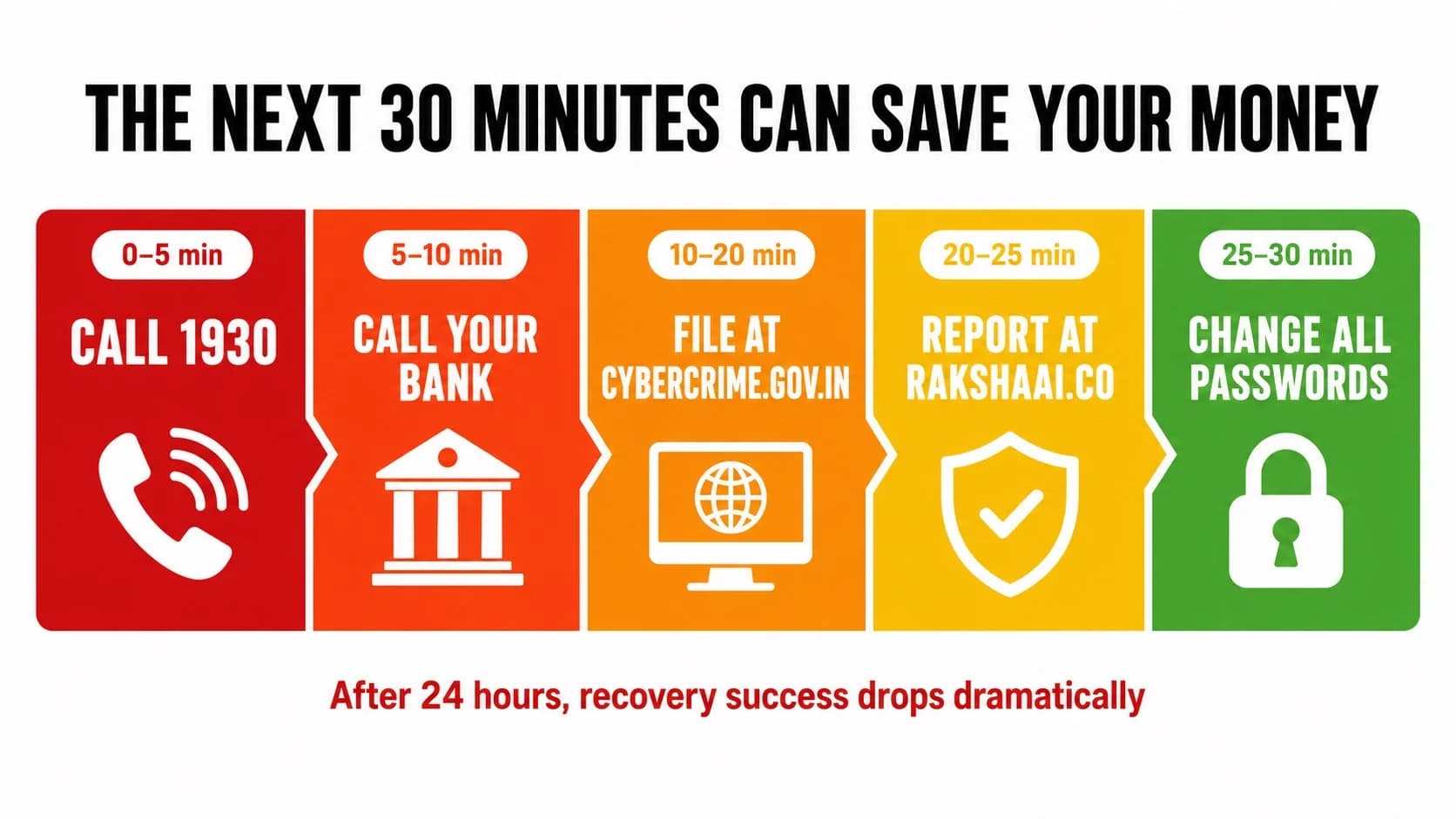
After 24 hours, recovery success drops dramatically. Every minute in this window matters.
When a cybercrime is reported within 30 minutes, the National Cybercrime Helpline (1930) can issue a lien on the receiving bank account effectively freezing the funds before they are withdrawn or transferred further. This is the mechanism that makes early reporting so critical.
After money moves through even one additional transfer, it becomes exponentially harder to trace. After 24 hours, most scammers have already moved funds through multiple mule accounts across different banks. The trail goes cold.
Step 1 (0–5 Minutes): Call 1930 Cybercrime Helpline
1930 is India's National Cybercrime Helpline. It is free, available 24 hours a day, 7 days a week, and specifically designed for exactly this situation. Call it before you do anything else before calling your bank, before filing a complaint, before anything.
When you call, be ready to provide:
- Your name and mobile number
- The amount lost and when it happened
- The scammer's phone number, UPI ID, or bank account (if you have it)
- The transaction reference number from your bank or UPI app
The helpline officer will log your complaint and can initiate a request to freeze the receiving account. You will receive a complaint number write it down or screenshot it. You will need it for follow-up.
Do not call any other number first. Searching for a "cybercrime help number" on Google can lead you to fake helplines run by scammers who target fraud victims a second time. 1930 is the only official number.
Step 2 (5–10 Minutes): Call Your Bank
While you or someone with you is calling 1930, start calling your bank. Use the number on the back of your debit or credit card never a number you find on Google at this moment. Tell them:
- You were a victim of online fraud
- The exact transaction amount, date, and time
- The transaction reference number
- You want to request a transaction hold or reversal
For UPI transactions: also open your UPI app (PhonePe, Google Pay, Paytm, or BHIM), find the fraudulent transaction, and tap the dispute or report option inside the app. This creates a parallel report with the UPI platform.
Step 3 (10–20 Minutes): File at cybercrime.gov.in
Go to cybercrime.gov.in and click "Report Cybercrime." Select the relevant category (financial fraud, online fraud, etc.) and fill in the form with:
- Your personal details (name, mobile, address)
- The scammer's phone number, UPI ID, email, or website
- Transaction reference numbers and amounts
- Screenshots of conversations and payment records
At the end you receive a formal complaint reference number. This creates a legal record and is required for your bank to process a chargeback or dispute claim. Keep this number safe.
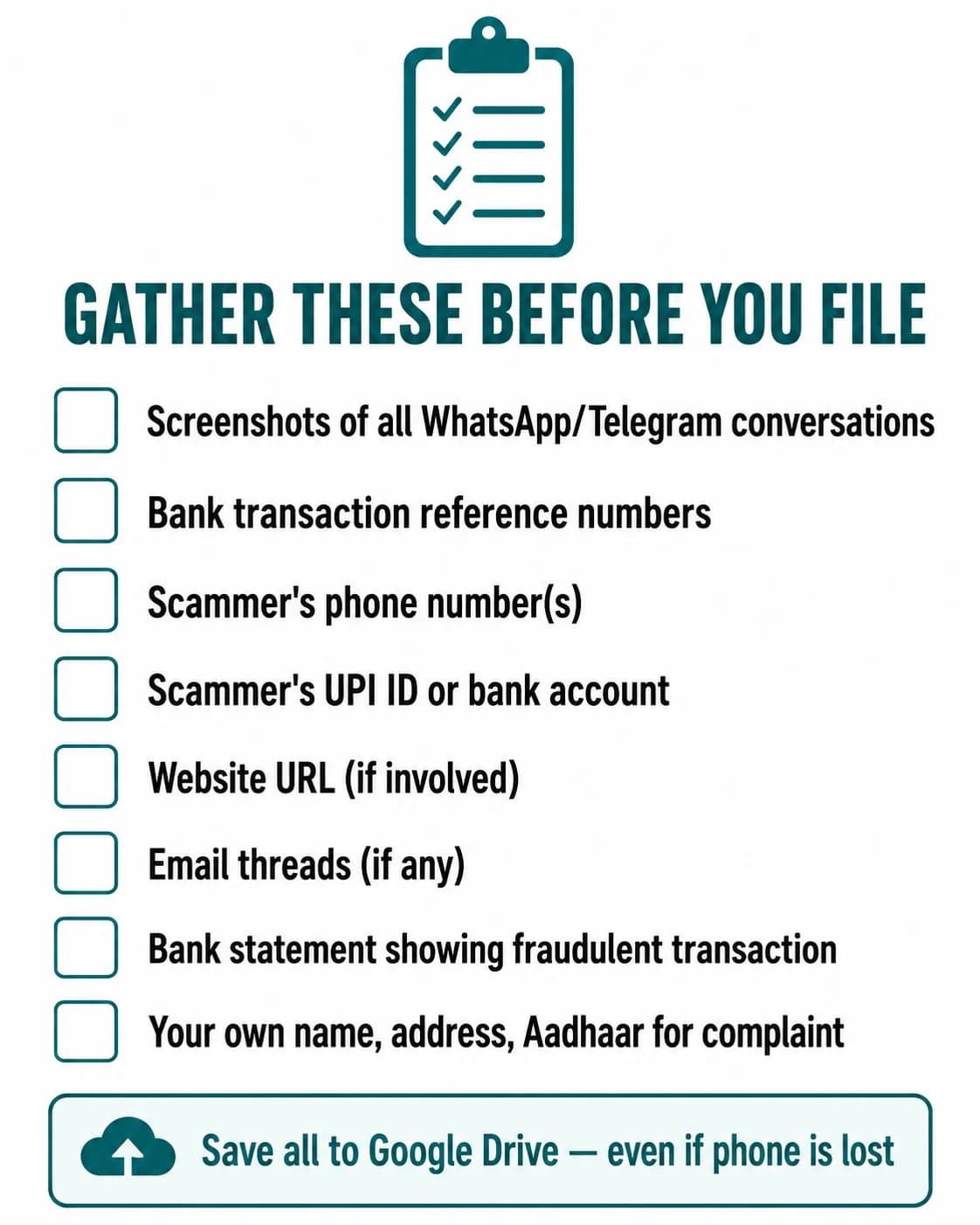
Save all evidence to Google Drive immediately even if your phone is lost, the complaint can still be filed.
Step 4 (20–25 Minutes): Report on RakshaAI to Warn Others
After handling the immediate recovery steps, report the scammer's details on RakshaAI. This serves two purposes:
- It adds the scammer's number, UPI ID, or website to our fraud database
- Other Indians checking that number or website will immediately see your report
Many scam victims check a number on RakshaAI before sending money and are saved because a previous victim reported it. Your report could prevent the same scammer from taking money from someone else's parent, sibling, or colleague.
Step 5 (25–30 Minutes): Secure Every Account the Scammer May Have Accessed
Once the immediate reporting is done, act on your own accounts before the scammer can do further damage:
- Change your UPI PIN (in your UPI app settings)
- Change your net banking password
- Change the password on any email account that was involved
- Enable two-factor authentication (2FA) everywhere it is available
- If you shared any OTP, inform your bank that your account may be compromised
Special Case: If You Shared Your Aadhaar with a Scammer
This requires an additional step that most guides miss. Call the UIDAI helpline 1947 immediately and ask them to lock your Aadhaar biometrics. You can also do this yourself at myaadhaar.uidai.gov.in under the "Lock/Unlock Biometrics" section.
Once biometrics are locked, no one can use your Aadhaar fingerprint or iris data to take a loan, open a SIM, or verify an account even if they have your Aadhaar number and a physical copy of the card. Also monitor your CIBIL report over the next 30 days for any unauthorized loan applications.
Save These Numbers Now Before You Need Them
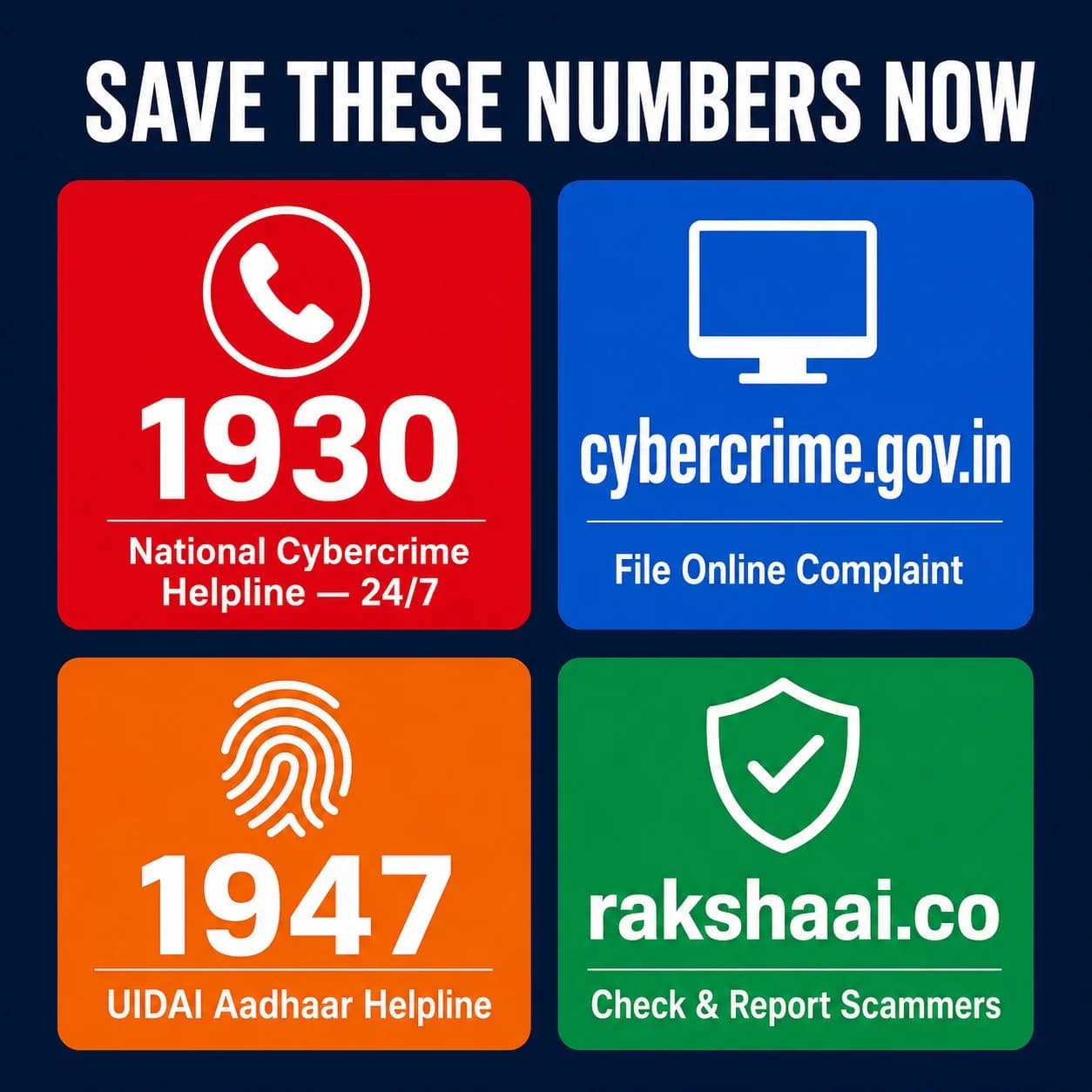
Save 1930 and 1947 in your contacts right now. You will be grateful you did.
Most people do not know these numbers until they need them urgently. By then, the panic of a scam makes it hard to think clearly. Save these in your phone contacts right now:
- 1930 National Cybercrime Helpline (24/7, free)
- 1947 UIDAI Aadhaar Helpline (lock biometrics, report misuse)
- 14448 RBI Ombudsman (banking and payment disputes)
- cybercrime.gov.in bookmark it now
Warning: Fake "Money Recovery" Services Will Target You Next
After a scam, many victims receive calls or messages from people claiming they can "recover" lost money for an upfront fee. These are almost always second scams targeting the same victims.
No legitimate agency charges an upfront fee for fraud recovery. The only pathways to recovering scammed money in India are:
- The 1930 helpline lien mechanism (free)
- Bank disputes and chargebacks (free)
- Formal cybercrime complaints via cybercrime.gov.in (free)
- Legal action through your local police or consumer courts (free for FIR)
If anyone contacts you offering to recover your money for a payment, hang up and report them at 1930.
Frequently Asked Questions
What is the cybercrime helpline number in India?
The National Cybercrime Helpline number is 1930. It is available 24 hours a day, 7 days a week, completely free of charge. Call immediately after any online fraud time is critical for recovery. Save it in your contacts right now.
Can I get my money back after a UPI scam?
Possibly, if you report within 30–60 minutes by calling 1930. The helpline can issue a lien on the receiving account before the money is withdrawn. After 24 hours, recovery success drops dramatically as scammers move funds through multiple mule accounts across different banks.
How do I file a cybercrime complaint online in India?
Go to cybercrime.gov.in and click "Report Cybercrime." You will need the scammer's phone number or UPI ID, transaction reference numbers, approximate amount, and screenshots of conversations. You receive a complaint reference number at the end keep it for all follow-up communications with your bank.
What should I do if I shared my Aadhaar with a scammer?
Call UIDAI helpline 1947 immediately and lock your Aadhaar biometrics at myaadhaar.uidai.gov.in. Also file a police complaint and monitor your CIBIL report for unauthorized loan applications over the next 30–60 days.
Are there fake "money recovery" services that target scam victims?
Yes, and they are extremely common. Companies or individuals that charge upfront fees to "recover" scammed money are almost always running a second scam targeting the same victims. Never pay anyone claiming they can recover your funds. Only use official channels: 1930, cybercrime.gov.in, and your local police station.
Final Thoughts
Getting scammed is not a reflection of your intelligence. India's online scammers are professional, organised, and use sophisticated psychological tactics that work on anyone. Millions of educated, careful people lose money every year.
What matters now is speed. The 30-minute window is real, the mechanisms exist, and the helpline is waiting. If you are reading this after being scammed stop reading and call 1930 right now. Come back and read the rest after.
And when you are ready, share this guide with your family. The person who most needs it is probably the one who would never think to search for it.
Free Tool
Report the scammer or check any number
Report the scammer's phone number, UPI ID, or website on RakshaAI to warn other Indians. Check any suspicious number before you engage. Free, no sign-up required.
Report or check a number →100% free · No sign-up required · Save 1930 in your contacts now
More from RakshaAI Blog
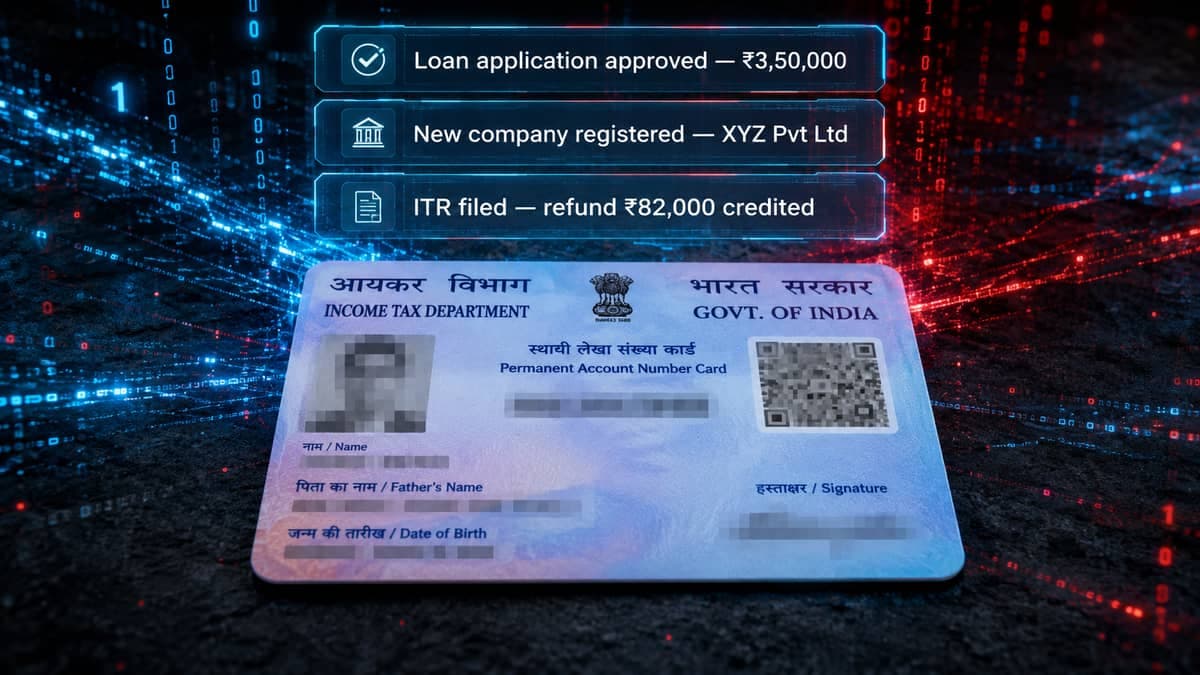
PAN Card Fraud India: How Scammers Are Misusing Your PAN in 2026
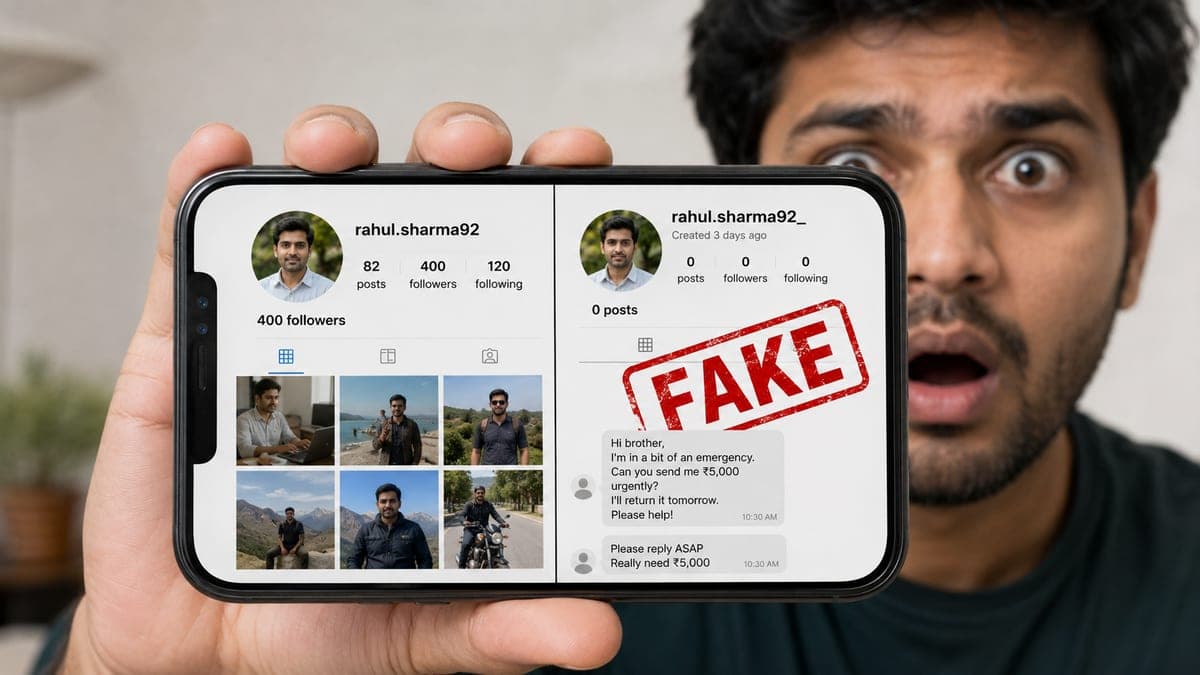
Social Media Account Cloning India: When Scammers Become You Online
Cyber Fraud Case Studies India 2026: Real Victims, Real Losses, Real Lessons
Stay Protected Online
Use RakshaAI to check websites, phone numbers, and UPI IDs for scams free, instant, no sign-up required.
RakshaAI is a private platform by Ehatech Services Pvt. Ltd. Not affiliated with any government body. Editorial policy