
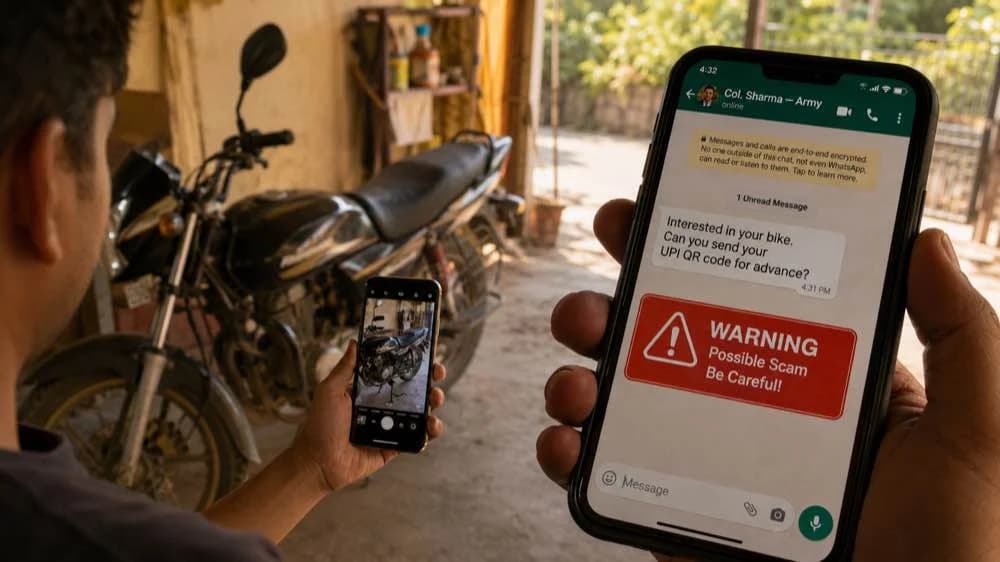
A buyer claiming to be in the military who cannot meet in person is one of the most common OLX scam profiles in India.
You post your old bike, phone, or furniture on OLX. Within hours, a buyer messages you. They are interested, willing to pay your asking price, and seem genuine. Then comes the first red flag: they cannot meet in person. They are an Army officer on posting, or a government employee stationed far away.
What follows is a precisely engineered trap. Indian sellers lose thousands to lakhs on OLX every month through a handful of recurring fraud patterns. Every single one of these scams is avoidable if you know what to look for. This article covers all six active methods.
How to sell safely on OLX India
- 1Never accept QR codes from buyers share your own UPI ID only
- 2Always verify payment in your own UPI app before handing over goods
- 3Never trust payment screenshots check your own bank balance
- 4Meet buyers in person in a public place never at home
- 5Be suspicious of all buyers claiming to be military or government officers
- 6Never refund an overpayment before verifying it actually arrived
- 7Check any unknown buyer number at rakshaai.co before proceeding
Already paid? Call 1930 immediately with the buyer number and UPI ID.
Why OLX Is a Prime Target for Scammers in 2026
OLX is India's largest peer-to-peer resale marketplace, with tens of millions of active listings at any given time. Unlike e-commerce platforms, OLX facilitates direct contact between strangers. There is no buyer protection, no escrow, and no transaction verification layer built into the platform itself.
This makes it structurally ideal for fraud. Scammers exploit the casual trust that comes with a local marketplace while conducting the entire transaction at a distance, which eliminates the in-person verification that would normally expose them. The same fraud patterns also operate on Facebook Marketplace and other resale platforms in India with identical techniques.
The six methods below represent the full current fraud playbook. Some are simple one-step traps. Others involve multiple stages designed to build trust before extracting money.
The 6 Most Active OLX Scam Methods
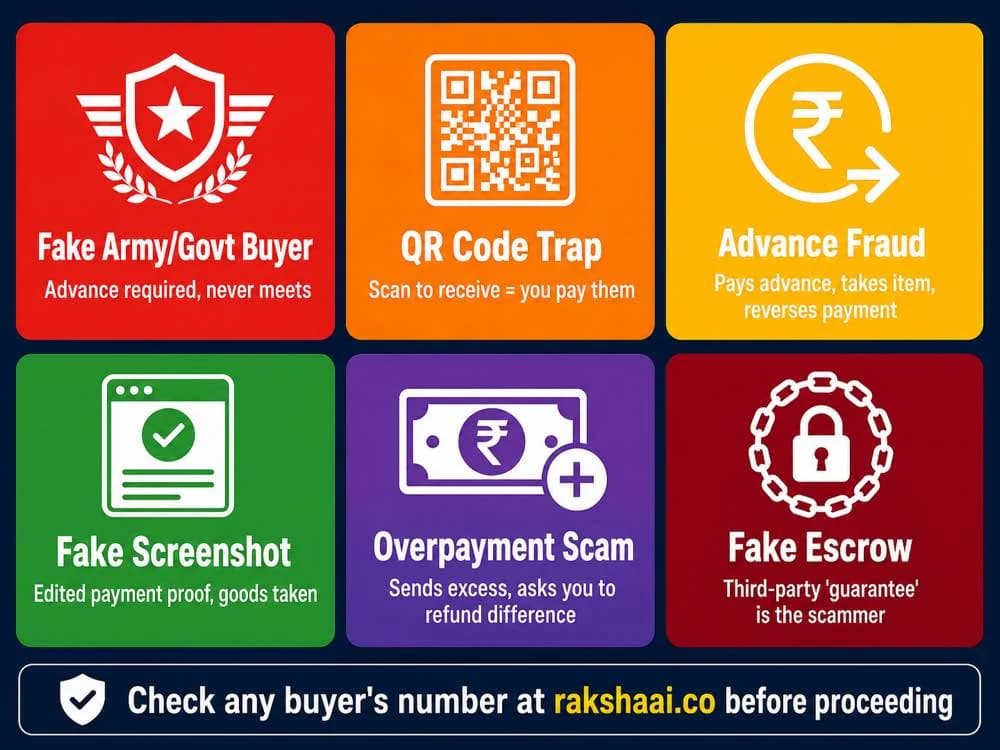
All six OLX scam methods active in India in 2026. Each uses a different technique to extract money from sellers.
Scam 1: The Fake Army or Government Buyer
This is the most common OLX fraud pattern in India. The buyer introduces themselves as an Army colonel, Air Force officer, or government official currently deployed or posted far from your city. They express strong interest in your item and agree to the asking price without negotiating.
The military or government identity serves a precise psychological function: it creates authority and institutional trust, and it provides a built-in explanation for why the buyer cannot meet you in person. Once in-person verification is off the table, every subsequent step of the fraud becomes easier.
What they want next is an advance payment from you to "confirm the booking", or they will send a "courier" to pick up the item with payment on delivery which never materialises. In some variants, they ask for your UPI ID to send you the advance, then attempt a UPI collect request fraud instead.
The rule: Any buyer who cannot meet in person, regardless of their stated reason, is a high-risk transaction. If the item has significant value, only complete the sale in person. Verify payment in your own banking app before releasing anything.
Scam 2: The QR Code "Send to Receive" Trap
This scam exploits a fundamental misunderstanding about how UPI works. The buyer tells you they want to send you the payment and shares a QR code with a message like "scan this to receive your money" or "use this for the advance transfer".
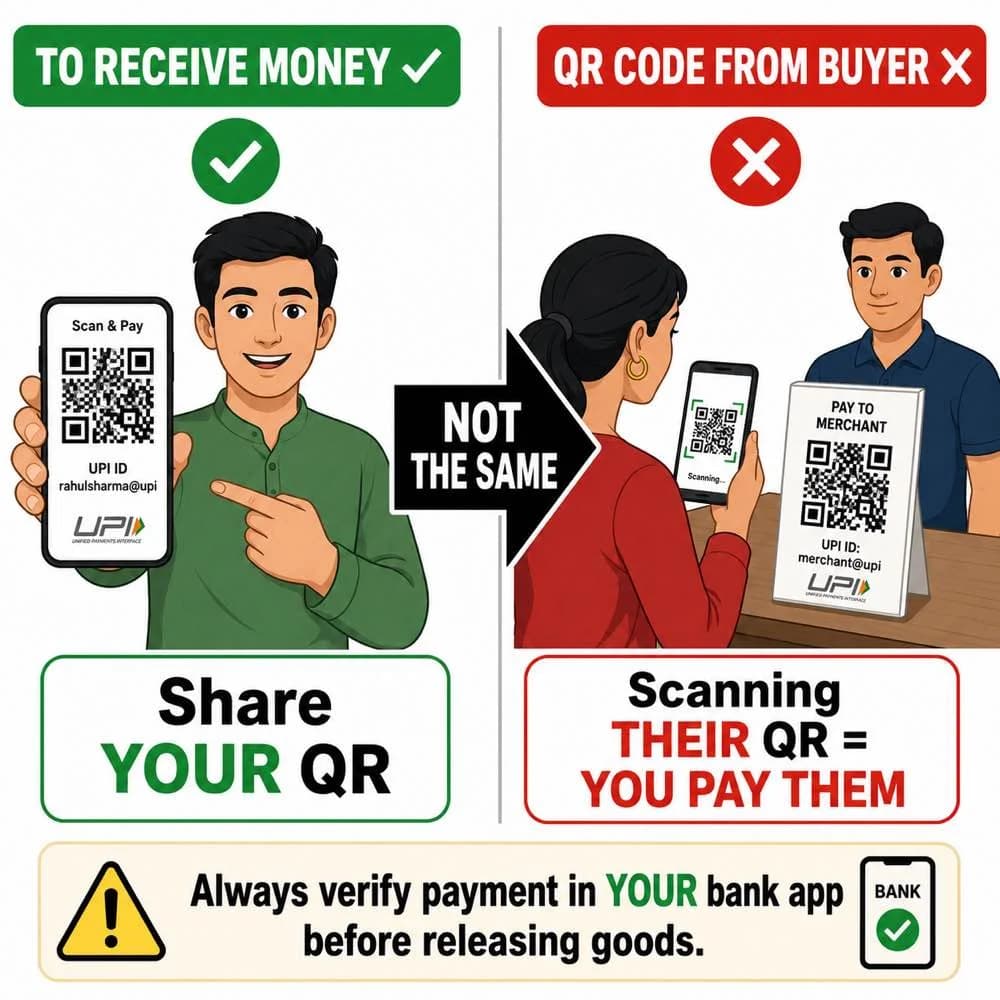
Scanning someone else's QR code initiates a payment FROM you, not TO you. To receive money, share your own QR code or UPI ID only.
In UPI, scanning a QR code means you are initiating a payment to the person who owns that QR code. You are not receiving anything. When you scan the buyer's QR code and enter your UPI PIN, money moves from your account to theirs. The buyer has just received a payment from a seller who believed they were being paid.
To receive a payment on UPI, you share your own UPI ID or your own QR code. You do not scan anything. You do not enter your PIN to receive money. Any instruction to "scan this to receive your advance" is a scam, without exception.
Also watch for the related UPI collect request scam, where the buyer sends a fake payment notification that requires your PIN to "confirm receipt". A PIN is only ever required when you are sending money, never when receiving it.
Scam 3: The Advance Payment Fraud
The buyer agrees to purchase your item and offers to send an advance payment to hold it. They send you a small amount ₹500 or ₹1,000 which may genuinely arrive in your account. This builds trust and demonstrates they are a "serious buyer".
The next step: they ask you to release the item to a courier or ask you to keep it ready while they arrange full payment. The full payment never arrives. The item gets collected by a fake courier, or the buyer goes silent. In some variants, the initial advance is reversed through a UPI dispute after the item is already gone.
The rule: An advance payment does not constitute a completed sale. Only hand over an item after the full payment has been confirmed in your own banking app. Small advances are a trust-building technique, not proof of legitimate intent.
Scam 4: The Fake Payment Screenshot
This is the simplest fraud on the list. The buyer shares a screenshot of a payment confirmation a BHIM UPI success screen, a Google Pay receipt, or a bank transfer notification and tells you the money has been sent and asks you to hand over the item.
Payment screenshots are trivially easy to fake. Scammers use screenshot editors or dedicated apps to fabricate realistic-looking payment confirmations in under a minute. The screenshot shows whatever amount and name the scammer chooses.
A screenshot proves nothing. It is not a bank record. It is an image that anyone with a smartphone can generate in seconds. The only proof of payment that matters is confirmation visible in your own UPI app or bank account. Open your banking app, check your balance or transaction history, and verify the exact amount has arrived before releasing any item.
For more detail on this pattern and related UPI fraud, see our guide on UPI scams targeting Indian bank accounts in 2026.
Scam 5: The Overpayment Refund Scam
The buyer sends you more money than the agreed price sometimes significantly more. They explain it was an accident or a system error and ask you to refund the difference immediately. The urgency they apply is deliberate: they want you to act before verifying the original payment.
In the most common version of this scam, the original payment was never real. The buyer used a UPI trick, a bank transfer that will be reversed, or a completely fake screenshot to make the "payment" appear to have been sent. You refund the "excess" out of your own pocket and the underlying payment never clears or gets reversed within days.
In a variant involving genuine bank transfers, the original payment may be fraudulently sourced funds that get frozen and reversed by the bank after you have already sent the refund. You lose the refund amount with no recourse.
The rule: Never refund any overpayment until the original payment has been in your account for at least 72 hours and your bank confirms it is fully cleared and irreversible. A genuine buyer who accidentally overpays will understand this delay.
Scam 6: The Fake Escrow Service
The buyer proposes using a "third-party escrow service" or "OLX buyer protection" to make the transaction safe for both parties. They share a link to what looks like an official escrow or protection service website with OLX branding.
The escrow service is the scammer. The website is fake. You are asked to ship the item first, after which the escrow service will release payment to you. The item ships, the fake escrow site requests more identity verification or fees before releasing funds, and eventually goes offline.
OLX does not operate an official escrow or buyer protection service for cash transactions. Any third-party escrow link shared by a buyer is fraudulent. Legitimate high-value transactions happen in person with payment verified before handover, or through a verified courier with cash-on-delivery never via a website a buyer introduces you to.
Safe Selling Rules for OLX and Resale Platforms
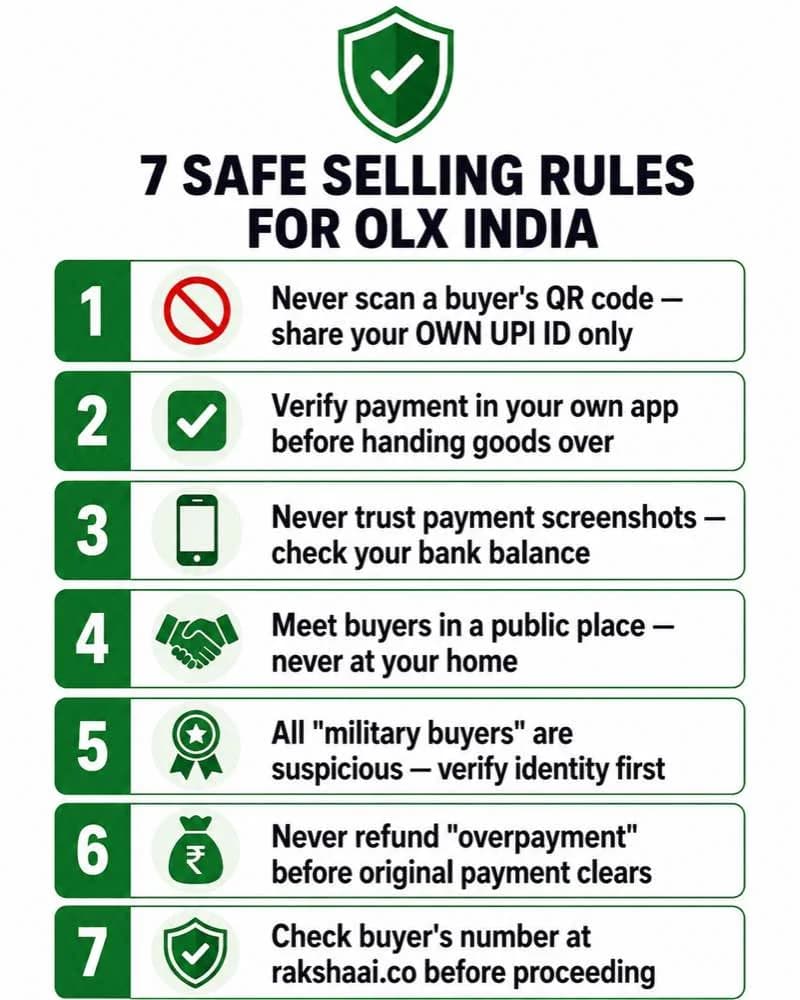
These seven rules protect you against every active OLX scam method in India.
- Share your own UPI ID only. Never scan a QR code sent by a buyer. To receive payment, give the buyer your UPI ID or display your own QR code. Scanning their QR sends money from your account, not to it.
- Verify payment in your own app before releasing anything. Open your banking app or UPI app, check your balance and transaction history, and confirm the exact amount from the correct sender has arrived. A screenshot is not verification.
- Meet buyers in person in a public place. Complete the handover at a police station, mall, or other public location. Bring someone with you for high-value items. Any buyer who refuses to meet in person for a local listing is a significant red flag.
- Treat all military or government buyers with extra caution. These identities are used specifically to bypass in-person verification. If a buyer claims to be an officer or official and cannot meet, require full payment verified in your bank before any item is released or decline the sale.
- Never refund an overpayment before it fully clears. Wait at least 72 hours and confirm with your bank that the original payment is irreversible before sending any portion back.
- Ignore all escrow or buyer protection links from buyers. OLX has no such service. Any escrow link a buyer shares is controlled by the scammer.
- Check the buyer number before responding. Run the buyer's phone number through rakshaai.co before engaging with any listing inquiry. Reported scammer numbers appear immediately.
Safe Buying Rules Before You Transfer Any Advance
Buyers on OLX face a different but equally real set of risks. Fake listings, non-existent sellers, and advance payment traps target buyers as frequently as sellers.
- Never pay advance for an item you have not seen. Listings with unusually low prices and sellers who request advance payment before letting you inspect the item are almost always fraudulent.
- Inspect the item in person before any payment. Meet the seller at their address or in a public place, verify the item works and matches the listing, then pay.
- Pay only via UPI or cash no wallet links or escrow sites. Use a standard UPI transfer directly to the seller's verified UPI ID. Do not send payments through links or third-party sites a seller introduces.
- Be cautious of items priced 40 percent below market value. Significantly underpriced listings are a classic bait technique. The goal is advance payment, not a genuine sale.
What To Do If You Have Been Scammed on OLX
Speed is everything. Call 1930 within 30 to 60 minutes of the fraud for the highest chance of account freezing.
- Stop all communication with the scammer. Do not send more money or respond to further messages. Every additional interaction may be used to extract more.
- Screenshot everything immediately. Save all WhatsApp and OLX messages, the scammer's phone number, any UPI IDs they used, and any payment screenshots they sent you.
- Call 1930 right now. India's National Cybercrime Helpline can flag the destination bank account in real time. The faster you call, the higher the chance of freezing the funds before they are moved. Save 1930 in your contacts before you need it.
- Contact your bank and UPI provider. Report the transaction as fraud and ask for a dispute to be raised with the transaction ID and receiving account details.
- File a complaint at cybercrime.gov.in. A formal complaint creates a legal record required for any recovery or court proceedings. Include all screenshots, transaction details, and the scammer's contact information.
- Report the number on RakshaAI. Submit the scammer's phone number at rakshaai.co so it is flagged for other sellers before they become the next victim.
For a full step-by-step emergency guide, see Got scammed online in India? Do these 5 things in 30 minutes.
Frequently Asked Questions
Why do OLX scammers claim to be Army or military officers?
Military buyers create a sense of urgency and authority. The scammer claims they cannot meet in person due to posting or deployment, which removes the in-person verification step. The military angle also creates emotional trust that makes victims less suspicious of advance payment requests.
What is the QR code scam on OLX India?
The scammer sends you a QR code claiming you will receive payment by scanning it. In UPI, scanning someone else's QR code means you are paying them, not the other way around. To receive payments, share only your own UPI ID or your own QR code.
Is it safe to accept advance payment on OLX India?
Only if verified directly in your bank or UPI app. Never trust screenshots. A common scam: buyer pays a small advance via screenshot, collects the item, and the advance was never real. Always confirm in your own banking app before handing over anything.
What should I do if I was scammed on OLX in India?
Call 1930 immediately with the scammer's phone number and UPI ID. File at cybercrime.gov.in with screenshots of conversations and transaction details. Also report the scammer's number at rakshaai.co to warn other sellers.
Is Facebook Marketplace safer than OLX in India?
Neither platform is inherently safer. The same scam tactics operate on both. The rules are identical: verify payment in your own app, meet in person for high-value items, never accept QR codes from buyers, and never refund overpayments before the original payment clears.
Final Thoughts
Every OLX scam in this article follows the same structural logic: remove in-person verification, establish trust through familiarity or small payments, and then exploit that trust with a payment trick. None of these scams require technical sophistication from the fraudster. They require only that you skip a basic verification step.
The single most reliable protection is this: never release an item until full payment is confirmed in your own banking app, and never complete a high-value sale with someone you have not met in person. Those two rules eliminate every scam method described here.
Share this article with anyone in your family or network who buys or sells on OLX or Facebook Marketplace. The scams are active, the volume is high, and the next seller they target could be someone you know.
Free Tool
Got a suspicious buyer inquiry on OLX?
Check any buyer phone number or UPI ID on RakshaAI before responding to your next listing. No sign-up. No cost. Results in under 5 seconds.
Check a Buyer Number now →100% free · No sign-up required · Save 1930 in your contacts
More from RakshaAI Blog
Stay Protected Online
Use RakshaAI to check websites, phone numbers, and UPI IDs for scams free, instant, no sign-up required.
RakshaAI is a private platform by Ehatech Services Pvt. Ltd. Not affiliated with any government body. Editorial policy