
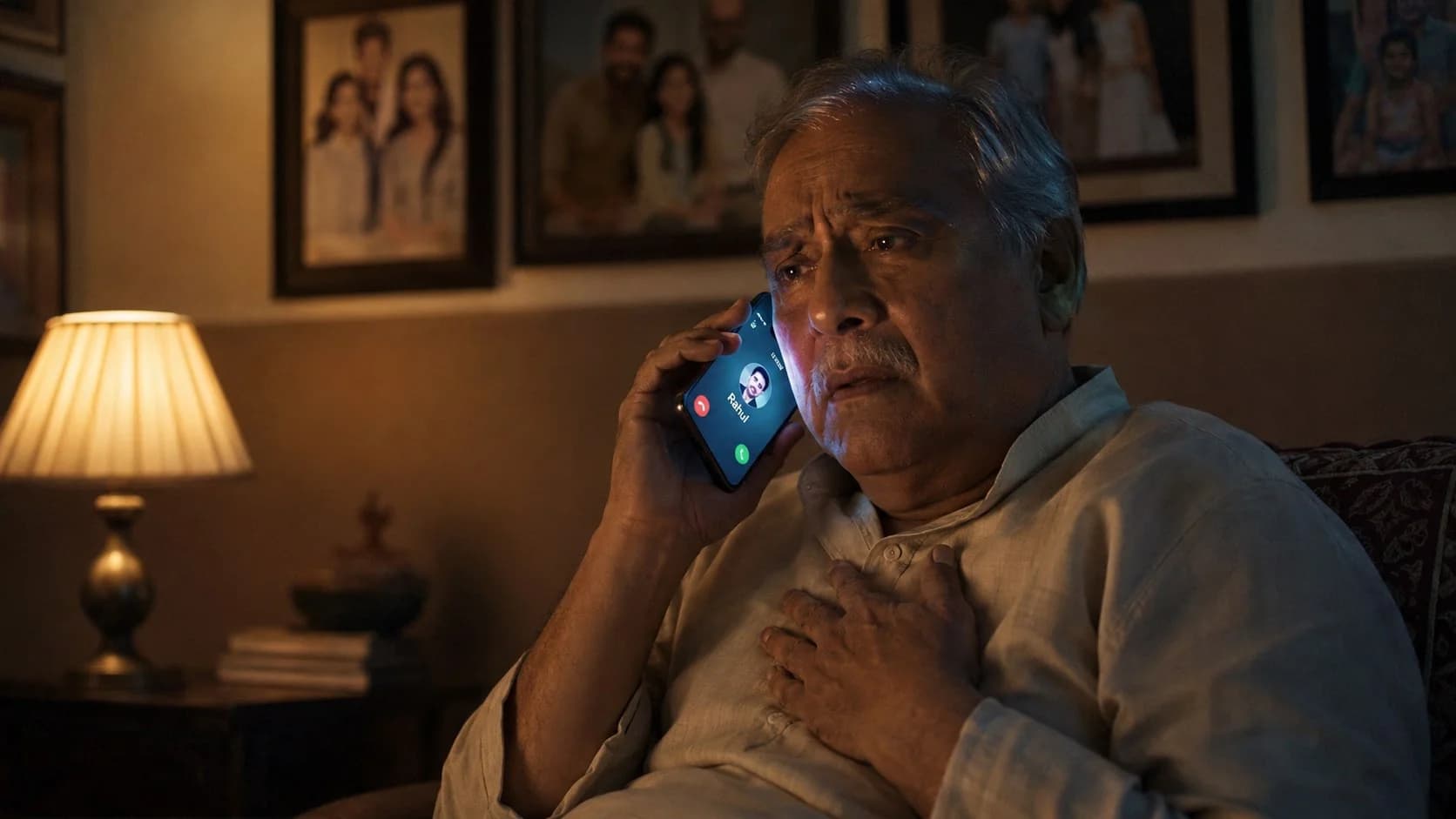
Scammers are calling Indian parents with a cloned version of their child's voice, demanding emergency money transfers. The call sounds exactly real.
The phone rings at 10 PM. It is your son's voice, shaking, whispering: "Papa, I'm in trouble. Don't tell Mummy. I need money right now." The voice is his. The fear sounds real. You transfer the money before you think twice.
Your son is fast asleep in his room. The voice on the phone was a clone built from three seconds of his Instagram Reel, processed by an AI tool that anyone can access for free in 2026. This is the AI voice cloning scam, and it is hitting Indian families right now.
How to detect an AI voice cloning scam call in India:
- 1Ask a personal question only the real person would know
- 2Request the pre-agreed family code word
- 3Listen for unnatural pauses or emotionally flat delivery
- 4Hang up and call the person back on their known saved number
- 5Insist on a live two-way video call before any money transfer
- 6"Don't tell anyone" is always the scam signal -- always tell someone
The call-back rule alone defeats voice cloning fraud 100% of the time.
What Is AI Voice Cloning and Why It Matters in 2026
Voice cloning is the process of training an AI model on a short audio sample to produce new speech in that person's voice, saying anything the operator types. What took specialist studios and hours of recorded audio in 2020 now takes three to five seconds of source audio and a free online tool in 2026.
The technology itself is legitimate. It is used for audiobooks, accessibility tools, and language dubbing. But scammers have weaponised it for a single purpose: convincing a parent, spouse, or elderly relative that a loved one is in urgent danger and needs money immediately.
Unlike phishing emails, which most people have learned to distrust, a voice call from someone who sounds exactly like your child bypasses every rational filter. The emotional response to hearing a loved one in distress overrides scepticism almost every time.
Why This Scam Is Exploding Right Now in India
Three factors have converged in 2026 to make deepfake voice fraud in India a fast-growing crime category:
- Voice cloning tools are free and widely available. Multiple platforms let anyone upload audio and generate a clone voice within seconds, with no technical knowledge required and no identity verification.
- Indians produce enormous amounts of public voice content. Instagram Reels, YouTube videos, WhatsApp status audio notes, podcast appearances, and LinkedIn video posts are all harvested. Most Indians do not consider their voice a piece of sensitive biometric data.
- The scam exploits a known family dynamic. The typical script targets elderly parents and plays on the fear of a child in danger, the taboo around discussing money problems openly, and the urgency language of "don't tell anyone."
How the AI Voice Cloning Scam Works: Step by Step
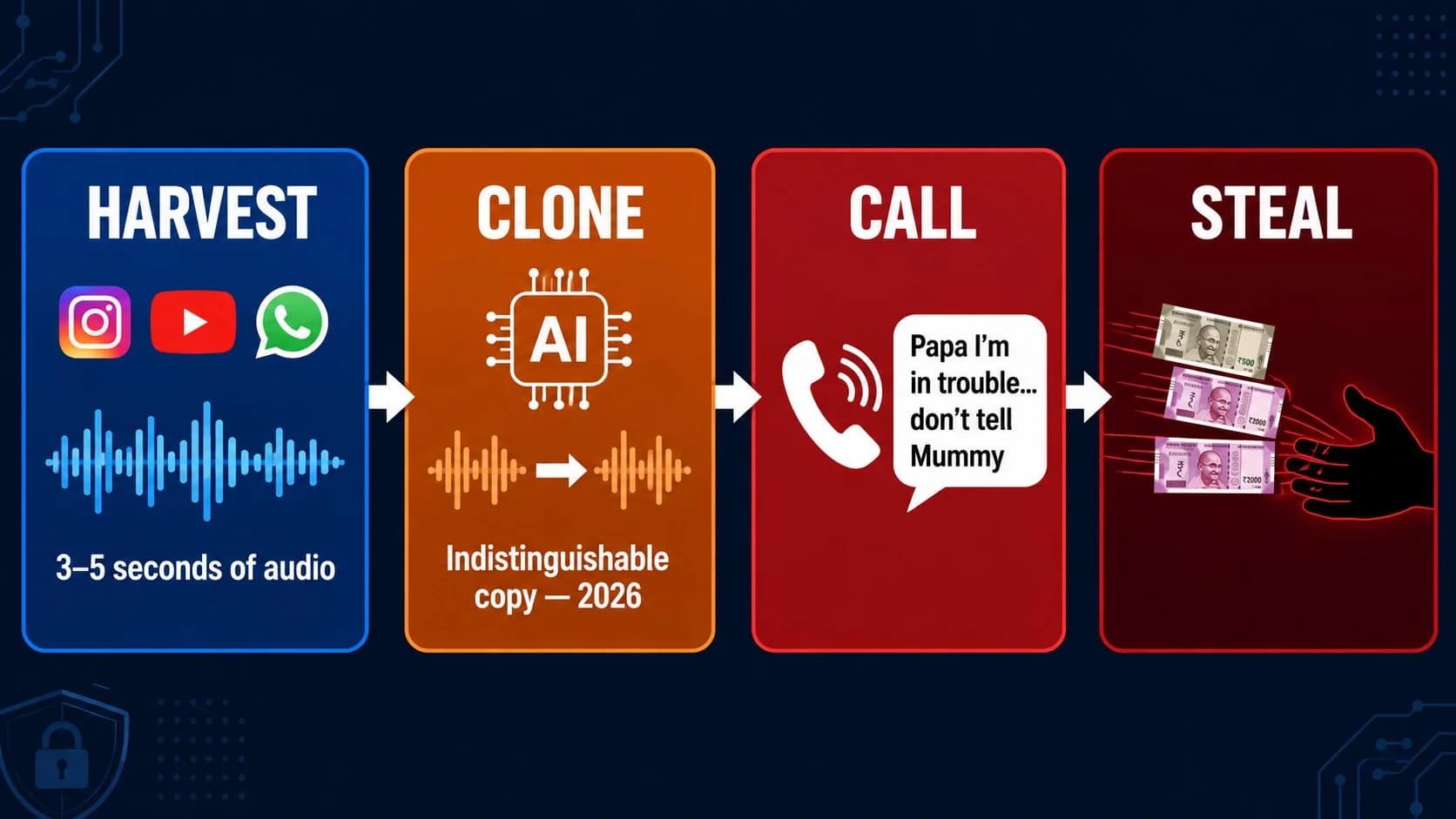
Harvest 3 seconds from Instagram. Clone the voice with AI. Call the parents. Steal money before anyone realises.
Step 1: Harvesting the Voice Sample
The scammer identifies a target family, usually by searching a city, profession, or university on Instagram or YouTube. They find a public Reel, video, or voice note from a young adult -- the future "victim" whose voice will be cloned. Three to five seconds is enough. They download it.
Step 2: Building the Emergency Script
The audio clip is uploaded to a voice cloning platform. Within seconds, the scammer can type any script and hear it spoken in the target's voice. They prepare a short, panicked message designed to trigger an immediate emotional response and prevent the parent from thinking clearly. Common scripts include a road accident, a police problem, a medical emergency, or an arrest.
Step 3: The Call
The scammer calls the parent from a spoofed number that may show the child's name or an unknown local number. The cloned voice speaks first, delivering the emergency script. Then the scammer or an accomplice takes over as a "doctor," "police officer," or "friend" explaining that money must be transferred immediately and privately. The phrase "please don't tell Mummy" or "don't involve anyone else" is almost always included to isolate the parent.
Step 4: The Transfer
The parent is directed to transfer money via UPI, bank transfer, or in some cases cryptocurrency. The urgency prevents them from pausing, calling back, or consulting another family member. By the time they realise what happened, the money is gone.
Real Cases From India
In documented cases reported to cybercrime.gov.in and covered by Indian media in 2025 and 2026:
- A retired government officer in Hyderabad transferred Rs 4.8 lakh after receiving a call in his son's voice claiming he had been in a road accident and needed money for hospital admission. His son was in Bengaluru and had not been in any accident.
- A mother in Pune received a tearful call in her daughter's voice saying she had been detained at an airport and needed Rs 2 lakh immediately. The daughter was at work.
- A family in Delhi lost Rs 6 lakh to a virtual kidnapping variant where the cloned voice of their son played in the background while a "kidnapper" demanded ransom. The son was unaware anything had happened until his parents called him in panic.
These are not isolated incidents. The virtual kidnapping scam in India using AI voice clones is one of the fastest-growing fraud categories tracked by cybercrime units in 2025 and 2026.
The Psychology Behind Why It Works
Voice is the most trusted channel humans have for identifying other people. We have evolved over hundreds of thousands of years to recognise the voices of those closest to us as a primary identity signal. No visual cue, no name, no caller ID carries the same weight as hearing a familiar voice.
Scammers exploit four psychological levers simultaneously:
- Fear: The child sounds distressed and in danger.
- Urgency: The situation requires immediate action with no time to verify.
- Secrecy: "Don't tell anyone" prevents a second opinion that would expose the scam.
- Authority: A fake doctor, officer, or lawyer takes over after the cloned voice to add credibility.
Even educated, digitally aware people have been deceived. The scam does not exploit ignorance. It exploits love.
How to Detect a Cloned Voice Call
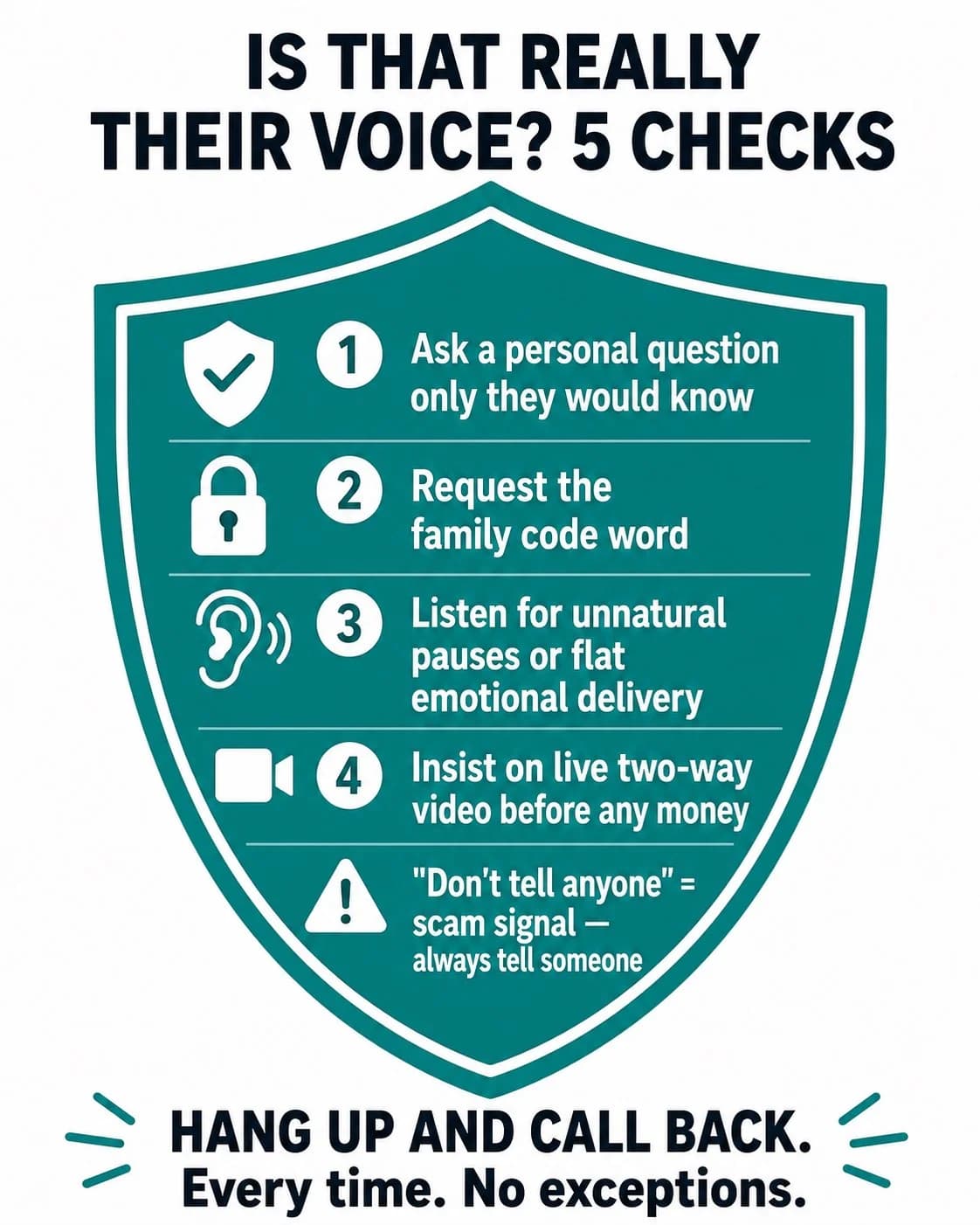
Print this and share with every family member over 50.
The good news: voice cloning fraud has a simple, absolute defence. The bad news: it requires preparation before the call comes, not during it.
Here are five checks that work in real time:
- Ask a personal question only the real person would know. Not their name or birthday -- scammers may know those. Ask the name of a childhood pet, a family inside joke, or something that happened last week.
- Request the family code word. This is the most reliable defence (explained in detail in the next section). If they cannot say it, hang up.
- Listen for unnatural pauses or emotionally flat delivery. Current AI clones struggle with authentic emotional range, especially distress layered with urgency. Real panic has irregular rhythm. Cloned voices often sound too even or have slight robotic gaps.
- Hang up and call back on the saved number. This alone defeats the scam 100% of the time. If the "family member" insists you must not hang up or call anyone else, that is the scam signal.
- Insist on live two-way video before any money transfer. Not a screenshot. Not a photo. A live video call where they must wave and respond to a question in real time.
And remember: "Don't tell anyone" is the single most reliable scam signal in any emergency call. A real emergency never requires secrecy. Always involve another family member before transferring money.
The Family Safety Protocol -- Set This Up Today
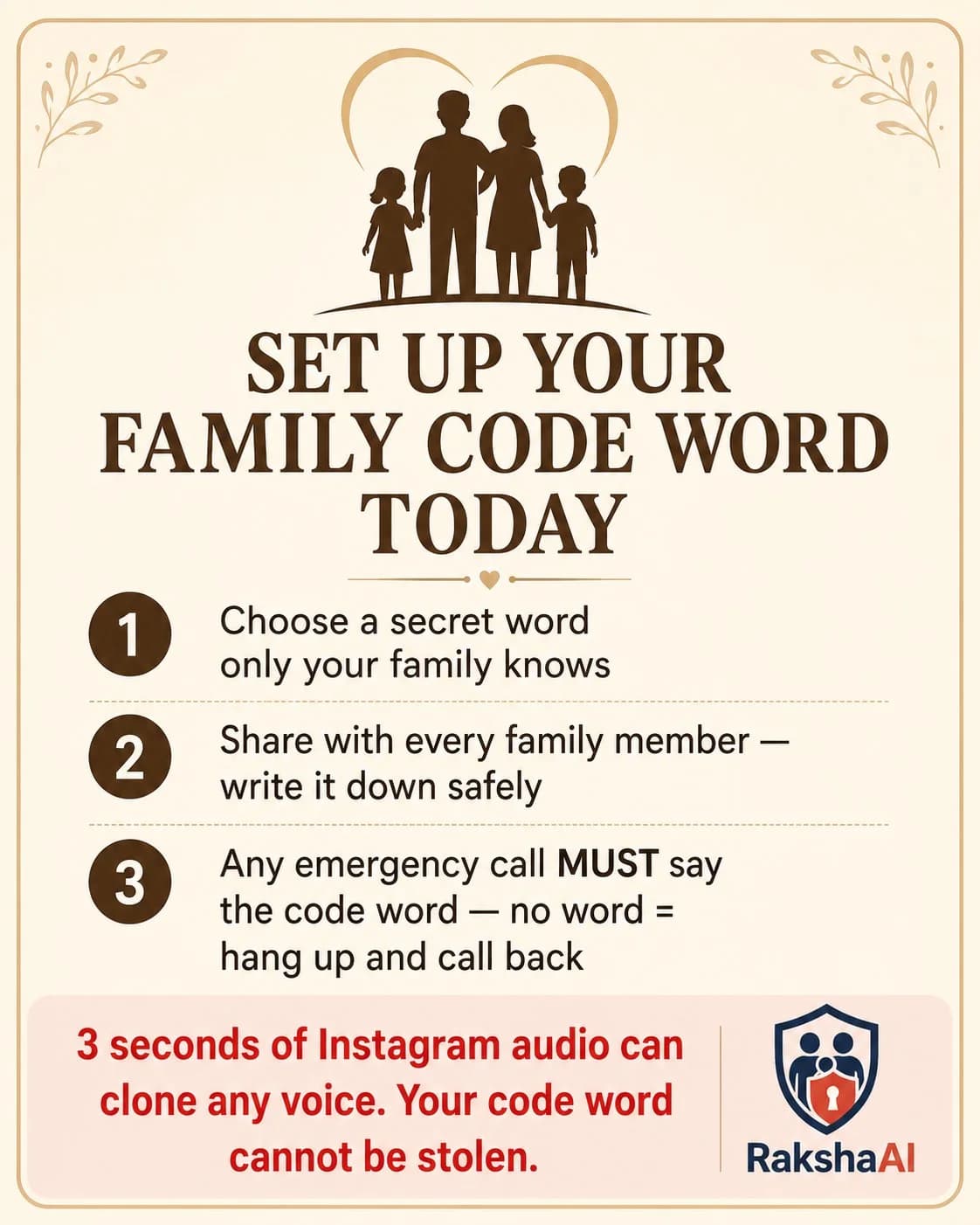
3 seconds of Instagram audio can clone any voice. Your code word cannot be stolen.
The following five steps take less than 15 minutes to set up as a family. Done once, they provide permanent protection against voice cloning scams regardless of how advanced the AI becomes.
Step 1: Create a Family Code Word
Agree on a secret word or short phrase that every family member knows. It must be something that has never appeared online, never been said in a video, and has no obvious connection to your family. Examples: the name of a street from your childhood, a made-up word, or a phrase from a private family moment.
The rule: any emergency call requesting money must include this code word unprompted. If it is not said, or if the caller hesitates when asked, hang up and call back.
Step 2: The Call-Back Rule
Agree as a family that no one will ever transfer money based on a phone call alone, no matter how urgent it sounds. Any emergency request must be verified by hanging up and calling back on the person's known saved number. This rule defeats voice cloning fraud completely because the scammer cannot receive calls on your son's real number.
Step 3: The One-More-Person Rule
Before any emergency money transfer, tell at least one other family member. A scammer's entire leverage depends on isolation. "Don't tell Mummy," "don't call anyone else," "there is no time" -- these phrases are the scam itself. Breaking the isolation ends it.
Step 4: Reduce Public Voice Content
This is a longer-term step. Review the privacy settings on your family's social media accounts. Instagram Reels set to "Friends only" are not harvestable by strangers. WhatsApp voice notes in groups with unknown members are a risk. Encourage family members who appear in public-facing video and audio content to restrict their audience where practical.
Step 5: Insist on Live Video for Any Emergency Transfer
Make this a family policy: any financial request in an emergency -- regardless of the amount -- requires a live two-way video call first. Not a photo. Not a voice message. A live call where you can see the person moving and responding in real time. AI deepfake video exists but is significantly harder to execute live, on demand, than audio cloning.
What To Do If You Already Transferred Money
Call 1930 immediately -- the first 30 minutes are the recovery window. Do not wait.
- Call 1930. India's National Cybercrime Helpline can flag the receiving account before the money is withdrawn. This is the most time-critical step.
- Call your bank. Request a transaction hold or reversal. Provide the transaction reference number and explain it was fraud.
- File at cybercrime.gov.in. Create a formal complaint record with the scammer's number, the spoofed number used, and the transaction details. You will receive a complaint reference number.
- Report the number on RakshaAI. Add the scammer's number to our fraud database at rakshaai.co/phone-number-checker so other Indian families are warned when they receive a call from the same number.
Frequently Asked Questions
Can AI really clone someone's voice from social media in India?
Yes. In 2026, voice cloning tools require only 3 to 5 seconds of audio to produce a convincing clone. Instagram Reels, YouTube videos, and WhatsApp voice notes are all used by scammers to harvest voice samples. The quality is high enough to fool most family members over a phone call.
What is the family code word for voice scam protection?
A family code word is a secret word or phrase agreed on in advance. In any emergency call requesting money, the caller must say the code word to confirm identity. A scammer with a cloned voice cannot know your private family code word because it has never been said publicly or stored anywhere online.
What is a virtual kidnapping scam in India?
Scammers call parents claiming their child has been kidnapped. A cloned version of the child's voice is played in the background as proof. Parents pay ransoms before realising the child is safe at home. Always call the child back on their known number before transferring any money. The call-back rule ends this scam immediately.
Is deepfake voice fraud covered under Indian law?
Yes. Voice fraud and impersonation by AI is covered under IT Act Section 66D (cheating by impersonation using communication devices) and related Bharatiya Nyaya Sanhita provisions. File a complaint at cybercrime.gov.in or call 1930 to initiate action.
How much audio does an AI need to clone someone's voice?
In 2026, consumer-grade cloning tools can produce convincing clones from as little as 3 to 5 seconds of audio. Any publicly available voice content -- Instagram, YouTube, WhatsApp status audio -- is at risk of being harvested without the person's knowledge.
Final Thoughts
Voice cloning scams are not a future threat. They are active in India today and the technology will only become more convincing over the next 12 months. The defence is not better AI detection -- it is a simple human protocol that you agree on with your family before the call comes.
Set up your family code word tonight. Tell your parents the call-back rule. The entire conversation takes five minutes. It could save your family lakhs.
Then share this article. The person who most needs to read it is the one who would never think to search for it.
Free Tool
Received a suspicious call? Check the number.
Check any phone number for fraud reports or add a scammer's number to warn other Indian families. Free, no sign-up needed.
Check or report a number →100% free · No sign-up required · Save 1930 in your contacts now
More from RakshaAI Blog
Electricity Bill Scam India: That Disconnection Today SMS Is Always Fake

AI Scam India: How Artificial Intelligence Is Making Fraud More Dangerous in 2026

Credit Card Fraud India 2026: How Scammers Clone and Misuse Your Card
Stay Protected Online
Use RakshaAI to check websites, phone numbers, and UPI IDs for scams free, instant, no sign-up required.
RakshaAI is a private platform by Ehatech Services Pvt. Ltd. Not affiliated with any government body. Editorial policy