
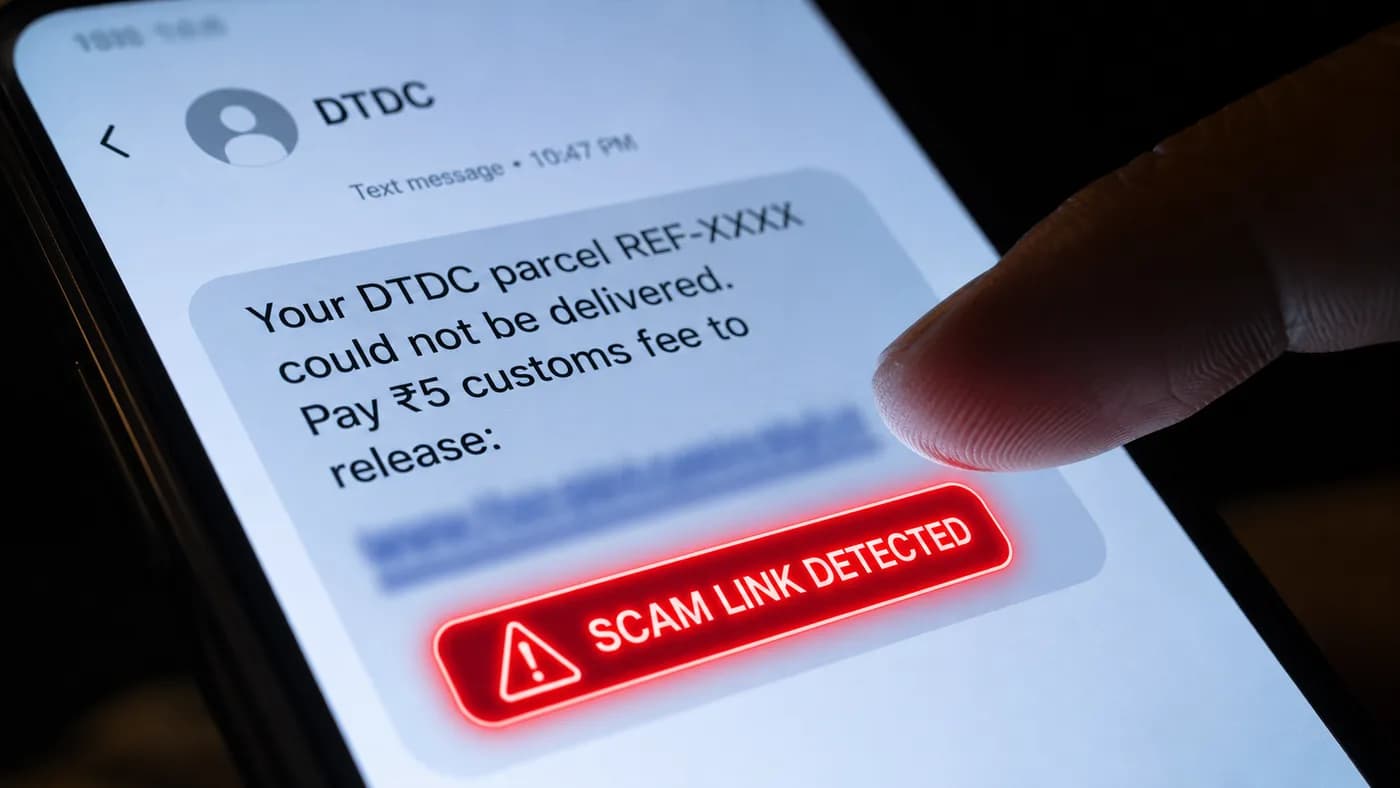
A fake DTDC SMS with a payment link. The ₹5 fee is bait. Entering card details on the linked page gives scammers full access to your account.
You are expecting a parcel. An SMS arrives from what looks like a courier company DTDC, Delhivery, India Post saying your package could not be delivered and you need to pay a small customs clearance fee of ₹5 to release it. The link looks plausible. The amount is trivial. You tap.
What happens next is not a ₹5 transaction. The page that loads is a phishing site designed to harvest your full card details including the CVV and expiry date. Within hours, those details are used to make transactions worth thousands or transferred to criminals abroad before your bank flags the fraud.
This parcel delivery scam India variant technically called smishing, or SMS phishing is one of the most widespread financial fraud patterns targeting Indian online shoppers in 2026. This guide covers every format it takes, how to verify any delivery notification in under 10 seconds, and what to do if you have already entered your details.
How to check if a delivery SMS is a scam in India
- 1Do NOT click the link open the courier's official website directly in your browser
- 2Find your tracking number in your original order confirmation email
- 3Track at the official site: delhivery.com, dtdc.com, or indiapost.gov.in
- 4Paste the SMS link into rakshaai.co before clicking fake sites are flagged instantly
- 5Legitimate couriers NEVER charge fees via SMS links
- 6Report spam SMS to 1909 (TRAI spam helpline)
Any "pay ₹5 to release your parcel" SMS is always a scam 100% of the time.
Why Every Online Shopper in India Is Targeted
India processed over 15 billion e-commerce shipments in 2025. Hundreds of millions of Indians receive delivery notifications from multiple courier companies every week. This creates a statistical advantage for scammers: if you send fake delivery SMS messages to enough numbers, a significant percentage of recipients will be expecting a package at that moment and will find the message entirely credible.
The ₹5 fee is calibrated specifically to lower your guard. A large charge would trigger suspicion. A trivial amount feels like a minor administrative nuisance rather than a threat. By the time you enter your 16-digit card number, CVV, and expiry date to pay it, you have handed over everything a fraudster needs to drain your account or sell your details on criminal marketplaces.
These messages impersonate every major courier operating in India: DTDC, Delhivery, BlueDart, India Post, Amazon Logistics, Ecom Express, and others. The fake sender names rotate constantly. The URLs use look-alike domains with minor spelling variations, hyphens, or extra words to appear legitimate at a glance.
The 5 Delivery Scam Formats Used in India in 2026
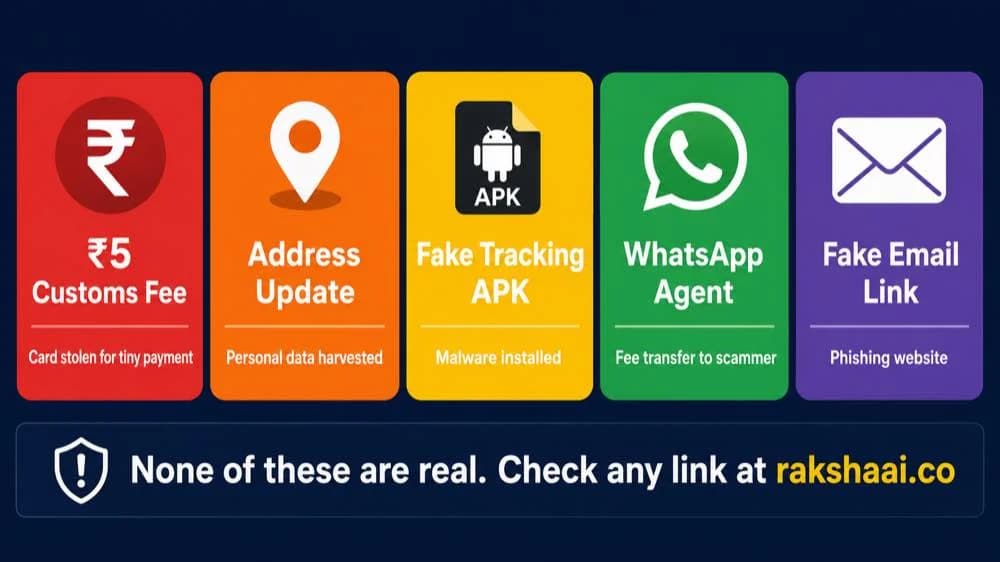
Five delivery scam formats active in India in 2026. All use different entry points but the same goal: your card details or money.
The ₹5 Customs Clearance Fee
The most common format. An SMS arrives claiming your imported parcel is held at customs and requires a small fee to clear. The amount is always low: ₹5, ₹10, or ₹25. The link leads to a professional-looking fake page mimicking the courier or customs authority. The card details you enter to pay the fee are the actual target.
The fact: Real customs duties are never charged via SMS links. Legitimate customs charges are either collected at the time of delivery by the courier agent or processed through official government portals never an SMS payment page.
The Address Update Data Harvest
A variation that avoids asking for payment. The SMS claims your delivery failed because the address on file is incomplete and asks you to click a link to update your delivery address within 24 hours or the package will be returned. The form asks for your full name, phone number, email, and physical address sometimes also Aadhaar or date of birth.
This harvested data is used for identity fraud, sold to other criminal operations, or used to make your next targeted scam more convincing by addressing you by name and referencing correct personal details. No courier company sends address update requests via unauthenticated SMS links. Your address is in the original order and is only updated through the e-commerce platform you ordered from.
The Fake Tracking App APK
An SMS or WhatsApp message asks you to download a tracking app to monitor your delivery in real time. The link does not go to the Google Play Store but directly downloads an APK file. Once installed, this app requests extensive permissions including SMS access, contact reading, and in some cases accessibility permissions that allow it to overlay your banking apps and capture login credentials.
Never install any app from a link in an SMS message. All legitimate courier tracking apps are available through the official Google Play Store or Apple App Store. If an SMS directs you outside these stores, the app is malicious.
The WhatsApp Delivery Agent
A WhatsApp message arrives from an unknown number claiming to be a delivery agent who needs to schedule your delivery. They ask you to confirm your address and then request a small fee transferred via UPI to "hold the delivery slot" or cover a handling charge. Once paid, the agent goes silent.
Delivery agents in India do not contact customers via personal WhatsApp numbers for fee collection. Any WhatsApp message asking for payment from an unknown contact claiming to be a courier is fraudulent. Contact your actual courier company through their official app or website to reschedule delivery at no charge.
The Fake Email Notification
An email arrives with professional courier branding correct logos, formatting, and colour schemes claiming a package is awaiting customs clearance. A button link in the email leads to a phishing page identical in appearance to the legitimate courier site. The email sender address, when examined closely, is a free email account or a domain that only superficially resembles the official one.
Before clicking any link in a delivery email, hover over it to see the actual destination URL. Check the sender address carefully against the courier's official domain. Any discrepancy indicates fraud. When in doubt, go to the courier's official website directly and enter your tracking number there.
How to Verify Any Delivery Notification in 10 Seconds
The entire vulnerability of this scam rests on one behaviour: clicking the link in the message. Remove that step and you are completely protected. Here is how to verify any delivery notification in under 10 seconds without clicking anything from the message itself.
- Go to your order confirmation email. Every legitimate e-commerce order comes with a confirmation email containing your tracking number and the name of the courier handling your delivery. This email is your source of truth.
- Open the courier's official website directly. Type the address in your browser yourself or use the link from your original order confirmation. Do not use any link from an SMS or WhatsApp message.
- Enter the tracking number from your email. If the package exists and has a status update, it will appear here. If the tracking number shows nothing, either the package is fine and the SMS was fake, or the package does not exist.
- If you want to check the SMS link first, use RakshaAI. Copy the URL from the SMS (without tapping it), paste it into rakshaai.co/website-safety-checker, and the result will tell you within seconds whether it is a known phishing domain.
This four-step process takes under 10 seconds and makes it impossible for any delivery SMS scam to succeed. The key insight is that your order confirmation email is always more reliable than any unsolicited SMS and you never need to click anything from a message to track a real parcel.
Official Courier Websites Go Here Directly, Always
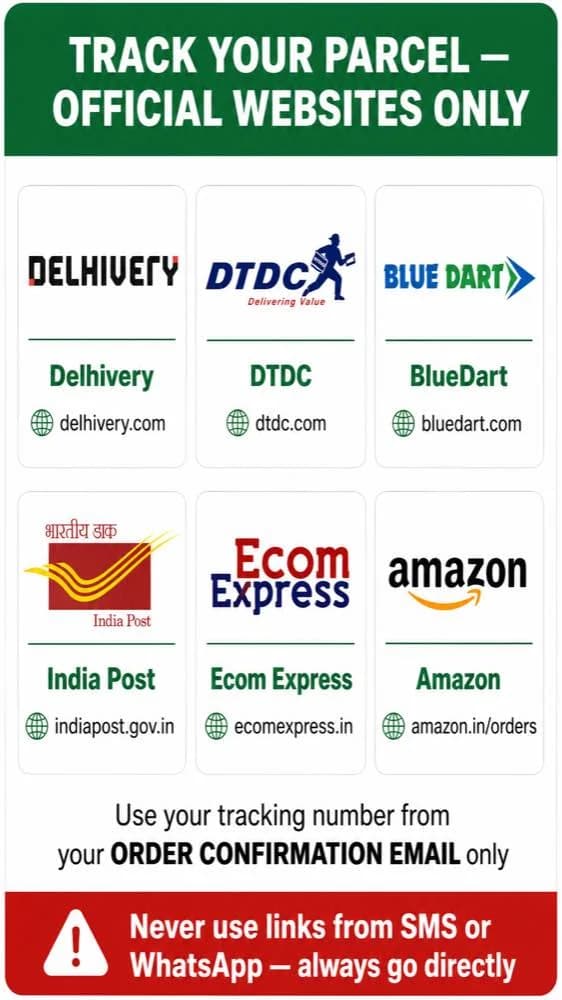
Save these official courier URLs. Use them directly with your order confirmation tracking number never links from SMS.
Bookmark these official tracking pages on your phone so you can access them directly whenever you receive a delivery notification. Never use a URL from an SMS, WhatsApp message, or email you did not explicitly request.
- Delhivery: delhivery.com
- DTDC: dtdc.com
- India Post: indiapost.gov.in
- BlueDart: bluedart.com
- Ecom Express: ecomexpress.in
- Amazon Logistics: Track directly at amazon.in under Your Orders
For fake website identification beyond delivery links, see our full guide on how to check if a website is fake before you pay.
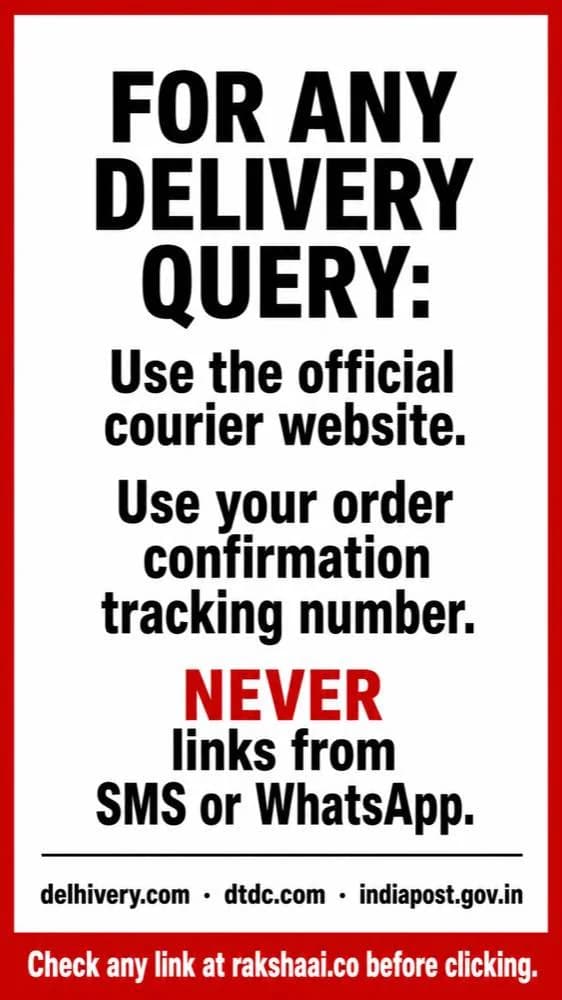
Screenshot this and save it to your phone. Share it with every online shopper you know.
If You Already Clicked and Entered Card Details
Act immediately. Card details entered on a phishing page are used within hours. Every minute matters.
- Call your bank right now from the number on the back of your card. Ask for emergency card blocking and report it as a phishing compromise. Do not wait until you see a fraudulent transaction block the card before they use the details.
- Call 1930 immediately. India's National Cybercrime Helpline records the incident and can coordinate with payment networks in real time to flag the compromised card details.
- File at cybercrime.gov.in. Submit the fake URL you visited, the full SMS content, and any transaction details. This creates a formal record required for any bank dispute or recovery process.
- Report the SMS to 1909. TRAI's spam reporting helpline. Forward the original SMS to 1909 so the sender's number is flagged and blocked at the telecom level.
- Report the fake URL at RakshaAI. Submit the phishing site at rakshaai.co so it is flagged for every other Indian shopper who receives the same SMS.
For a full step-by-step recovery guide after any online fraud, see Got scammed online in India? Do these 5 things in 30 minutes.
The same phishing technique is used in the KYC update SMS scam that targets bank account holders. If you received both types of SMS, your number may be on a targeted list.
Frequently Asked Questions
Is the "pay ₹5 to release your parcel" SMS real?
No. This is always a 100% scam. Legitimate couriers never charge release fees via SMS links. Real customs duties on imported packages are paid at delivery or through official government portals, never an SMS payment page. Delete the message and block the sender.
How do I track my real parcel without clicking suspicious SMS links?
Find the tracking number in your original order confirmation email, then go directly to the courier's official website: delhivery.com, dtdc.com, indiapost.gov.in, bluedart.com, or ecomexpress.in. Never use links from unsolicited SMS messages.
What is smishing and how common is it in India?
Smishing is SMS phishing scam text messages with malicious links to steal financial information. India is one of the most targeted countries globally for smishing in 2026. Delivery scams, KYC alerts, and prize notifications are the three most common variants used against Indian mobile users.
What should I do if I entered card details on a fake delivery website?
Call your bank immediately from the number on the back of your card and request emergency card blocking. Then call 1930 and file at cybercrime.gov.in with the fake URL and the SMS content as evidence.
How do I report a fake delivery SMS in India?
Forward the SMS to 1909 (TRAI spam reporting). Report the fake website URL at rakshaai.co to protect other shoppers. If you lost money, file at cybercrime.gov.in and call 1930.
Final Thoughts
The delivery SMS scam works because it exploits the specific context of online shopping a moment where receiving a message about a parcel feels routine and expected. The ₹5 fee eliminates the financial alarm that a larger charge would trigger. And the time pressure ("respond within 24 hours or your package is returned") prevents careful consideration.
The single rule that stops every version of this scam: never track a parcel using a link from an SMS or WhatsApp message. Always go directly to the official courier website using your original order tracking number. That one habit makes every delivery SMS scam impossible to execute against you, regardless of how convincing the message looks.
Share this article with every online shopper in your family. Parents and older relatives who shop online are disproportionately targeted by this scam because they are less likely to question a message that appears to come from a recognisable brand.
Free Tool
Got a suspicious delivery link?
Paste any delivery link from an SMS or WhatsApp message into RakshaAI before tapping it. Instant result. No sign-up. No cost.
Check a Delivery Link now →100% free · No sign-up required · Save 1930 in your contacts
More from RakshaAI Blog
Stay Protected Online
Use RakshaAI to check websites, phone numbers, and UPI IDs for scams free, instant, no sign-up required.
RakshaAI is a private platform by Ehatech Services Pvt. Ltd. Not affiliated with any government body. Editorial policy