

The same retail investor: excited by a Telegram stock tip, then left holding a worthless position after the scammer exits at the peak.
A Telegram group with 50,000 members. A profile picture showing a SEBI registration certificate. Stock tips arriving every morning: "BUY NOW. 500% returns. SEBI Certified." The chart surges exactly as predicted. Members post profit screenshots. You invest. The stock keeps climbing.
Then the crash. The advisor is gone. The group is deleted. Your investment is worth almost nothing.
This is India's fastest-growing investment fraud in 2026. With over 15 crore demat account holders and a sharp rise in retail participation since 2020, India's stock market has attracted a parallel industry of fake SEBI advisors running coordinated pump-and-dump operations through Telegram, WhatsApp, and YouTube.
This guide explains exactly how these scams work, the 5 stock scam variants active in 2026, and the single SEBI verification step that stops every one of them cold.
How to verify a SEBI registered advisor in India (5 minutes)
- 1Get their SEBI Registration Number (format: INH000XXXXXX)
- 2Go to sebi.gov.in, then Intermediaries, then Research Analyst
- 3Search by registration number or firm name
- 4Verify name, address, and contact details match exactly
- 5Confirm registration status is currently Active, not Expired or Cancelled
No matching registration means an illegal operator under SEBI Act Section 12. Report at cybercrime.gov.in or scores.gov.in.
Why India's Retail Investors Are the Perfect Target
Three forces converged after 2020 to create the ideal conditions for stock tip fraud in India:
- Explosive demat account growth. India crossed 15 crore demat accounts in 2024, up from 4 crore in 2020. Tens of millions of first-time investors entered the market with real savings and limited experience, making them highly susceptible to persuasive tips.
- Telegram and WhatsApp as unregulated broadcast channels. Both platforms allow anyone to create a group or channel with hundreds of thousands of followers. There is no verification of the creator's credentials, no minimum qualification, and no regulatory oversight of what financial advice is published.
- The credibility of SEBI branding. Most retail investors know that SEBI registration means something. Scammers exploit this by displaying fake certificates, fake registration numbers, and fake compliance disclaimers that look identical to the real thing.
The result is a fraud ecosystem that is cheap to operate, difficult to trace, and devastatingly effective against investors who have never learned what a real SEBI registration looks like.
How the Pump and Dump Scam Works
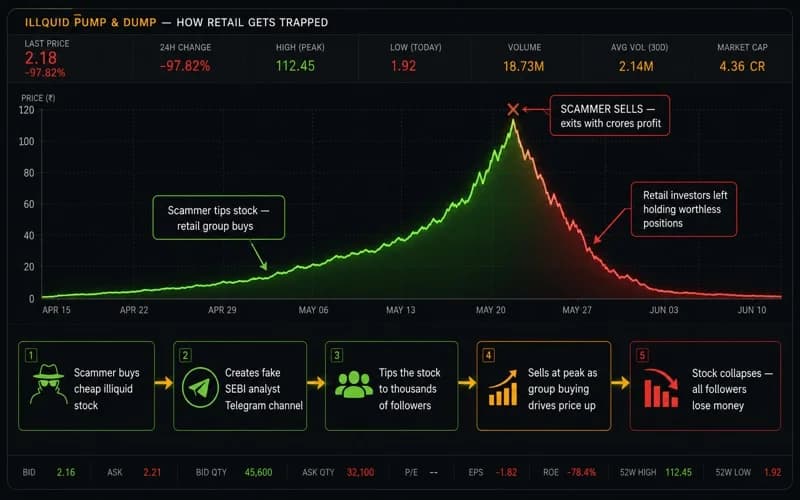
The scammer exits at the peak with crores in profit. All followers are left holding worthless positions.
Pump and dump is a market manipulation scheme that has existed in financial markets for over a century. In India's digital age, it has been industrialised through social media. Here is the exact playbook:
The Pump
The scammer first identifies a small-cap or micro-cap stock with low daily trading volume. Low volume is critical: it means even a relatively small coordinated buy-in will push the price dramatically upward.
Once the scammer has accumulated a large position at a cheap price, they begin tipping the stock across their Telegram channels, WhatsApp groups, and YouTube videos. The tip arrives with false urgency: "This stock will hit the upper circuit tomorrow. Buy before 9:15 AM."
Thousands of retail followers buy simultaneously. Because the stock has low liquidity, this coordinated demand drives the price sharply higher. The chart looks exactly like the advisor predicted. Other members post screenshots of their gains. Trust in the group deepens.
The Dump
At the moment of peak price, the scammer sells their entire position. Because they bought cheap and are now selling into high demand driven by their own followers, they exit with massive profit. The moment this sell pressure hits the market, the price collapses.
Every retail investor who bought during the pump is now holding a position worth a fraction of what they paid. Many cannot exit because the stock hits the lower circuit, locking them in as the price continues to fall over the following days.
The Fake SEBI Certificate
To maintain legitimacy between pump cycles, the advisor displays a SEBI Research Analyst registration number prominently in their bio and channel description. This number is either completely fabricated, stolen from a real registered analyst, or an expired registration that was never renewed. The format (INH000XXXXXX) looks authentic to anyone who has never verified one.
The critical point: verifying this number takes exactly 90 seconds on sebi.gov.in and reveals the fraud immediately. Most victims never check.
The 5 Stock Scam Variants in 2026
The pump-and-dump core is consistent, but scammers have developed several variations targeting different investor profiles:
Variant 1: Telegram SEBI Analyst Channel
The most common format. A channel with a verified-looking profile, regular stock tips, and public profit screenshots. Free access to build a following, then paid "premium tips" that are simply the stocks the scammer already owns.
Variant 2: F&O Tips Scam
Futures and Options (F&O) traders are targeted with tips about weekly expiry trades. The leverage in F&O means losses can exceed the original investment. Fake advisors charge monthly subscription fees ranging from ₹5,000 to ₹50,000 for "algorithmic F&O signals" that are worthless or deliberately wrong.
Variant 3: Fake IPO Allotment Scam
During high-demand IPO seasons, scammers contact investors claiming to guarantee IPO allotment in oversubscribed issues. They collect an "advance booking fee" via UPI. No legitimate entity can guarantee IPO allotment it is determined by SEBI-regulated lottery, not advisors.
Variant 4: Fake Portfolio Management Service
Investors with larger capital are approached with offers to manage their portfolio for a percentage of profits. The scammer transfers small amounts initially to build trust, then asks for a larger "managed fund" transfer that disappears.
Variant 5: Fake Demat Account Transfer Scam
Victims are told their demat account has been "flagged" by SEBI for compliance issues. A fake SEBI officer offers to resolve it for a fee. This is a variant of the digital arrest scam applied specifically to stock market investors.
How to Verify Any SEBI Registered Advisor in 5 Minutes
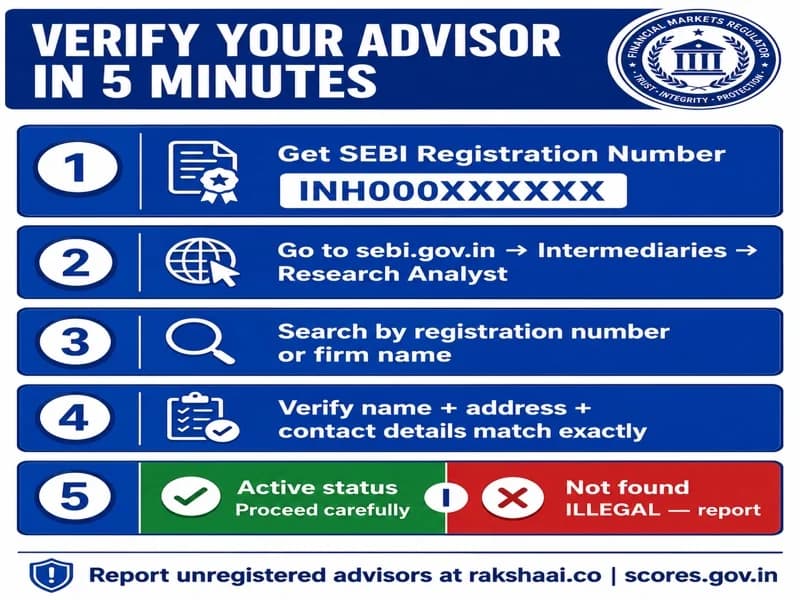
Active status at sebi.gov.in is the only verification that matters.
This is the single most important action any retail investor can take before paying for stock advice. It takes under 5 minutes and is definitive.
- Get their SEBI Registration Number. A legitimate research analyst will provide a registration number in the format INH000XXXXXX (for individuals) or INH000XXXXXX (for firms). If they refuse or claim it is confidential, stop immediately.
- Go to sebi.gov.in. Navigate to the Intermediaries section, then select Research Analyst from the list of intermediary types.
- Search by registration number or firm name. Enter the number or name exactly as the advisor provided it.
- Verify every detail matches. The registered name, address, and contact details must match exactly what the advisor claims. A scammer may use a real registration number but a different name or location.
- Confirm the registration status is Active. An Expired or Cancelled registration is not valid. An advisor operating on a lapsed registration is breaking the law exactly like an unregistered one.
No matching registration entry means the operator is illegal under SEBI Act Section 12. Report at cybercrime.gov.in or SEBI's SCORES portal at scores.gov.in.
Red Flags of Stock Market Tip Scams
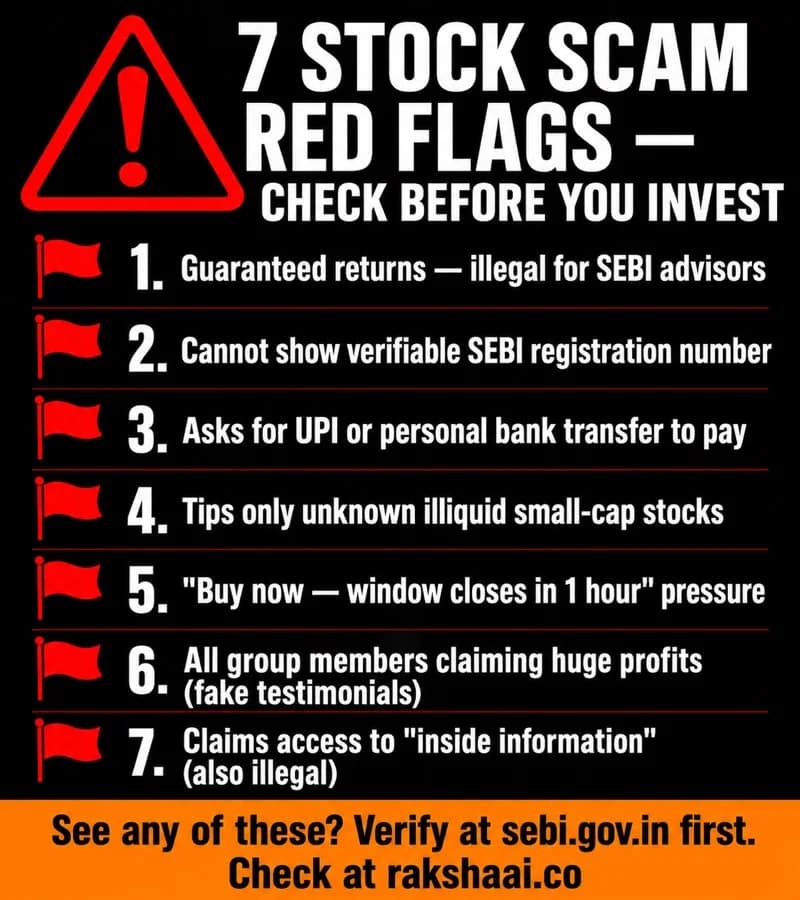
See any of these? Verify at sebi.gov.in before paying a single rupee.
Each of these red flags is present in virtually every fake stock advisory operation in India. Recognising even one should end the relationship immediately:
- Guaranteed returns. SEBI-registered research analysts are legally prohibited from guaranteeing returns. Any advisor claiming "100% accuracy" or "guaranteed 30% monthly" is operating illegally, regardless of how convincing their past tips looked.
- Cannot show a verifiable SEBI registration number. Deflection, vague claims, or an unverifiable certificate image are all red flags. The INH number is public and searchable in under 30 seconds.
- Asks for UPI or personal bank transfer. Registered advisors collect fees through proper business accounts with GST invoices. Any advisor asking for payment to a personal UPI ID or personal bank account is operating outside legal frameworks.
- Tips only unknown illiquid small-cap stocks. The stocks recommended are always obscure, low-volume companies where small coordinated buying can drive price action. No legitimate research analyst focuses exclusively on penny stocks.
- Time pressure tactics. "Buy before 9:15 AM or the window closes" is designed to prevent you from pausing to verify. Real investment opportunities do not expire in minutes.
- All group members claiming huge profits. In pump-and-dump groups, the scammer controls multiple accounts that post fake profit screenshots. These testimonials are fabricated to build social proof and encourage others to buy.
- Claims of inside information. Any advisor claiming access to non-public information about a company is describing insider trading, which is a criminal offence under SEBI regulations. Even if the claim were true, acting on it would expose you to criminal prosecution.
If You Have Already Lost Money
If you have already paid a fake advisor or lost money on pump-and-dump stocks, act immediately. Funds move quickly and recovery chances drop with every hour of delay.
Act in the next 30 minutes
- 1Stop all payments to the advisor immediately, even if they promise to recover your losses
- 2Screenshot every conversation, payment receipt, group post, and the advisor's SEBI certificate claim
- 3Call 1930, India's National Cybercrime Helpline, and report the bank account or UPI ID you paid
- 4File at SEBI SCORES (scores.gov.in) for the securities fraud specifically
- 5File at cybercrime.gov.in with all screenshots and transaction details
- 6Report the Telegram group or phone number at rakshaai.co to protect other investors
SEBI's SCORES portal is specifically designed for investor complaints about securities fraud and has authority to investigate registered intermediaries. Cybercrime.gov.in handles the fraud and cheating angle. Filing on both maximises the chance of action being taken.
If the scammer used a crypto investment component alongside the stock tips, also read the crypto investment scam guide. If you need a full recovery roadmap, the step-by-step scam recovery guide covers every action to take within 30 minutes of realising you have been scammed.
Frequently Asked Questions
How do I check if a stock advisor is SEBI registered in India?
Go to sebi.gov.in, navigate to Intermediaries, select Research Analyst, and search for the advisor's SEBI Registration Number (format INH000XXXXXX). Verify the registered name, status, and address match exactly what the advisor claims. An Active status entry is the only verification that matters.
What is pump and dump scam in Indian stock market?
Pump and dump is a scheme where scammers buy low-liquidity small-cap stocks, recommend them via Telegram or WhatsApp to large groups of retail investors, wait for the price to rise as the group buys, then sell at the peak leaving all followers with heavy losses. The stock typically collapses within days, and the advisor's group is deleted.
Can a SEBI advisor guarantee stock returns in India?
No. SEBI-registered research analysts are legally prohibited from guaranteeing returns. Any advisor claiming "guaranteed returns" or "100% accuracy" is either operating illegally or is a complete fraud. Report such claims at scores.gov.in.
Where do I complain about a fake stock tip group in India?
File at SEBI's SCORES portal (scores.gov.in) for securities fraud, at cybercrime.gov.in for online fraud, and at your local police station for criminal cheating under IPC. Also report at rakshaai.co to warn other investors from the same group or advisor.
What is the SEBI investor helpline number?
SEBI's toll-free investor helpline is 1800-266-7575, available Monday to Friday 9:30 AM to 5:30 PM. For online complaints use scores.gov.in, SEBI's dedicated investor grievance redressal system. For immediate cybercrime reporting, call 1930.
Free Tool
Received a suspicious stock tip or number? Check it now.
Paste any phone number or Telegram group link into RakshaAI for an instant fraud check. No sign-up. No cost. Results in under 5 seconds.
Check a Number Now →100% free · No sign-up required · Save 1930 in your contacts
More from RakshaAI Blog

Health Insurance Fraud India: Fake Mediclaim Policies and Hospital Scams
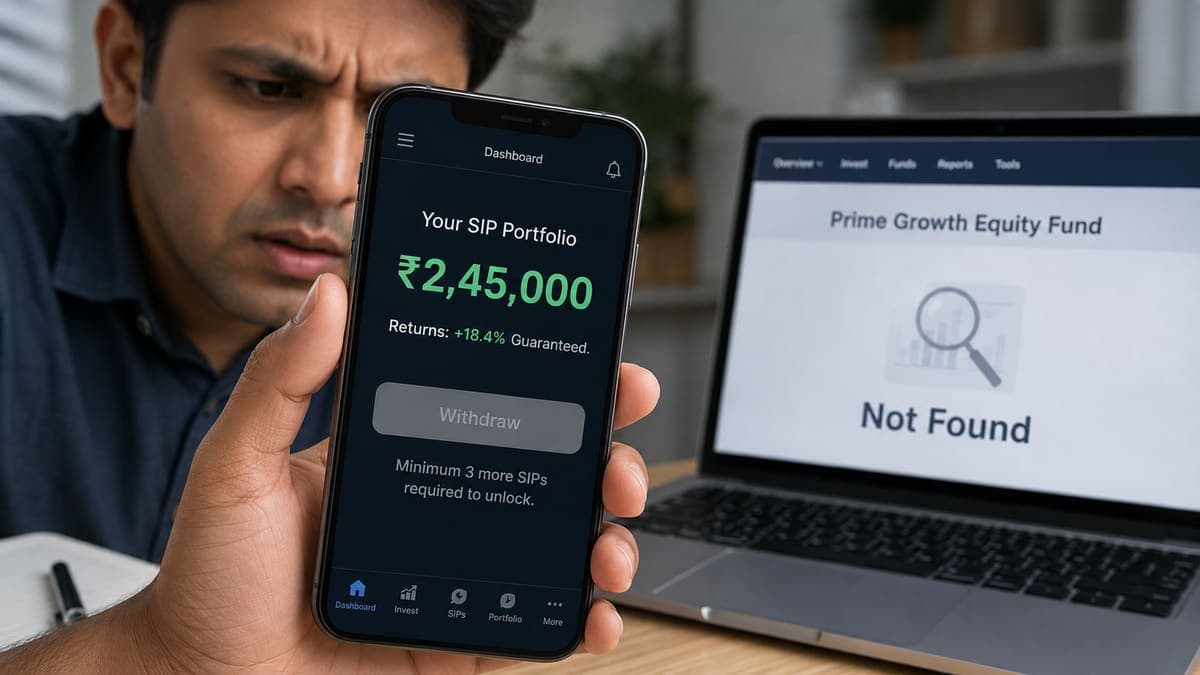
Mutual Fund Scam India: Fake SIP Offers and Investment App Fraud in 2026
Deepfake Celebrity Scam India: Ambani, Tata, and Kohli Never Said That
Stay Protected Online
Use RakshaAI to check websites, phone numbers, and UPI IDs for scams free, instant, no sign-up required.
RakshaAI is a private platform by Ehatech Services Pvt. Ltd. Not affiliated with any government body. Editorial policy