
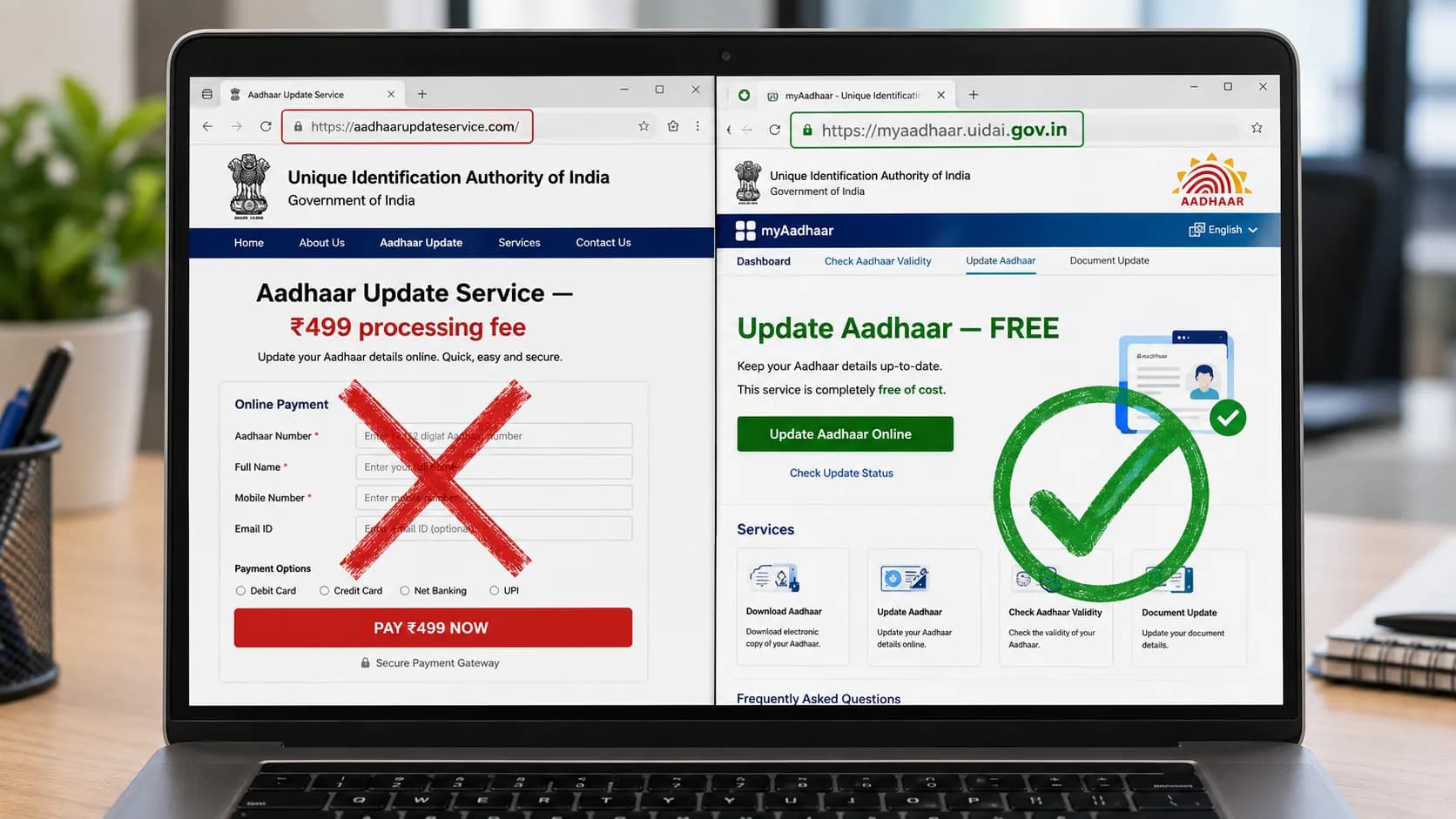
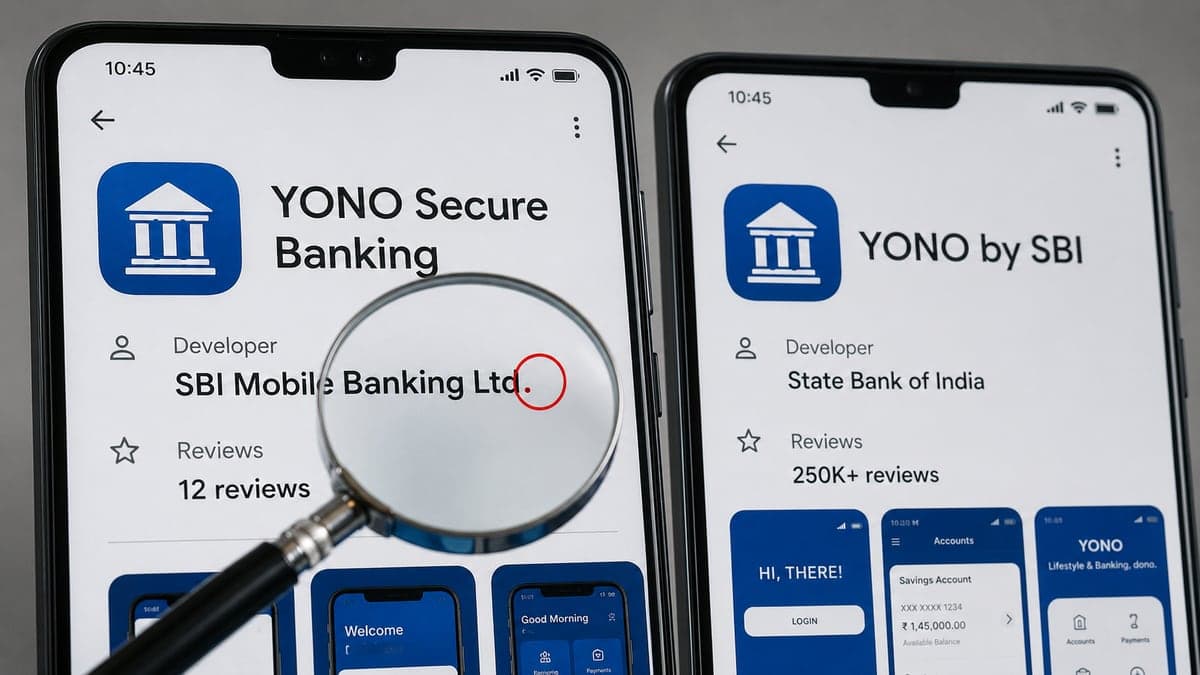
Left: a fake Aadhaar portal charging ₹499. Right: the real UIDAI portal Aadhaar update is completely free. The fake site looks nearly identical, but the URL gives it away.
Your mother needs to update her Aadhaar address. She searches "Aadhaar update online" on Google. The first result looks professional. Government emblem. Familiar blue-and-white design. It asks for her Aadhaar number, her mobile number, and a processing fee of ₹499.
She pays. Nothing happens. The site disappears or shows a fake confirmation. The real Aadhaar update was always 100% free at myaadhaar.uidai.gov.in. She was just charged by a criminal for a government service that costs nothing.
This is India's most under-reported cyber fraud category in 2026. Tens of thousands of Indians every month pay between ₹299 and ₹5,000 for government services that are legally free. The victims are not careless they are people who trusted a search result that looked completely official.
How to identify a fake government website in India
- 1Real Indian government websites ALWAYS end in .gov.in or .nic.in
- 2Any government-claiming site ending in .com, .net, .org, or plain .in is not official
- 3Real services are always free any site charging for Aadhaar, PAN, or licence update is fake
- 4Check the URL for typos: sarkar.gov.in is real, sarkar-gov.in is a clone
- 5Avoid clicking Google Ads claiming to be government portals they are often fake
- 6Paste any suspicious URL into rakshaai.co/website-safety-checker before proceeding
Real government sites end in .gov.in or .nic.in. No exceptions.
The Scale of the Problem: Free Services Being Sold for ₹500 to ₹5,000
The government's own cybercrime data reveals how serious this problem has become. Between 2021 and 2024, CERT-In received reports of over 3,900 fake government websites. The Ministry of Electronics and IT (MeitY) has proactively blocked thousands of fraudulent portals through NIXI and the Sanchar Saathi portal but new clones appear within days of each takedown.
| Government Service | Real Portal | Real Cost | Fake Sites Charge |
|---|---|---|---|
| Aadhaar Address Update | myaadhaar.uidai.gov.in | Free | ₹299 – ₹999 |
| Instant PAN Card | incometax.gov.in | Free | ₹500 – ₹2,000 |
| Driving Licence Renewal | parivahan.gov.in | ₹200 (official fee) | ₹800 – ₹3,500 |
| EPFO / PF Balance Check | epfindia.gov.in | Free | ₹299 – ₹999 |
| Passport Application Status | passportindia.gov.in | Free | ₹500 – ₹1,500 |
| Voter ID Correction | voters.eci.gov.in | Free | ₹200 – ₹500 |
| Income Tax e-Filing | incometax.gov.in | Free | ₹500 – ₹5,000 |
| Birth Certificate | crsorgi.gov.in | Minimal official fee | ₹500 – ₹2,000 |
The 6 Most Cloned Government Portals in India
Fake Aadhaar Update and UIDAI Portals
The UIDAI (Unique Identification Authority of India) portal at myaadhaar.uidai.gov.in is the most cloned government website in India. Scammers register domains like aadhaarupdateservice.com, uidai-update.in, or myaadhaarpro.comand copy the official design, including the government emblem. They charge ₹299 to ₹999 for an address update that is entirely free. Many also collect the victim's Aadhaar number, mobile number, and date of birth data that can be used for identity theft.
Fake PAN Card Application Websites
PAN card application and correction on incometax.gov.in is free for most citizens. The Instant PAN feature (via Aadhaar) takes under 10 minutes at zero cost. Fake portals with names like pancardapply.in or pan-update-india.com charge ₹500 to ₹2,000. In many cases, after collecting payment, the fraudsters also harvest the victim's Aadhaar and PAN details for resale to financial fraudsters.
Fake Driving Licence and RTO Portals
Parivahan.gov.in is the official portal for all driving licence services. While some services do carry an official government fee (typically ₹200 to ₹500), fake RTO portals charge 3x to 10x the official amount and often do not process the application at all. Victims sometimes only discover the fraud when they fail their physical slot booking and find no record of their application.
Fake EPFO and PF Withdrawal Portals
The EPFO (Employees' Provident Fund Organisation) portal at epfindia.gov.in and the Member e-Sewa portal are free for all PF-related services including balance check, passbook download, and withdrawal claims. Fake portals posing as EPFO claim to "fast-track" PF withdrawals for a processing fee of ₹299 to ₹999. Some ask for the UAN and password giving fraudsters complete access to the victim's PF account.
Fake Income Tax e-Filing Portals
The Income Tax Department's e-filing portal at incometax.gov.in is free for filing returns, checking refunds, and linking PAN with Aadhaar. Fake portals offer "CA-assisted" filing for ₹1,500 to ₹5,000 services that a qualified CA does provide, but these portals have no real CA and simply pocket the money or misuse the tax credentials submitted.
Fake Passport Seva Portals
Passportindia.gov.in is the only official passport portal. The official application fee for a standard fresh passport is ₹1,500 a fixed government fee paid exclusively through the official portal's payment gateway. Fake portals like passportserviceindia.com or passport-seva-india.in collect this amount plus an additional "agent fee" ranging from ₹500 to ₹3,000, provide no service, and often misuse the passport-related documents uploaded.
How Fake Government Websites Appear on Google
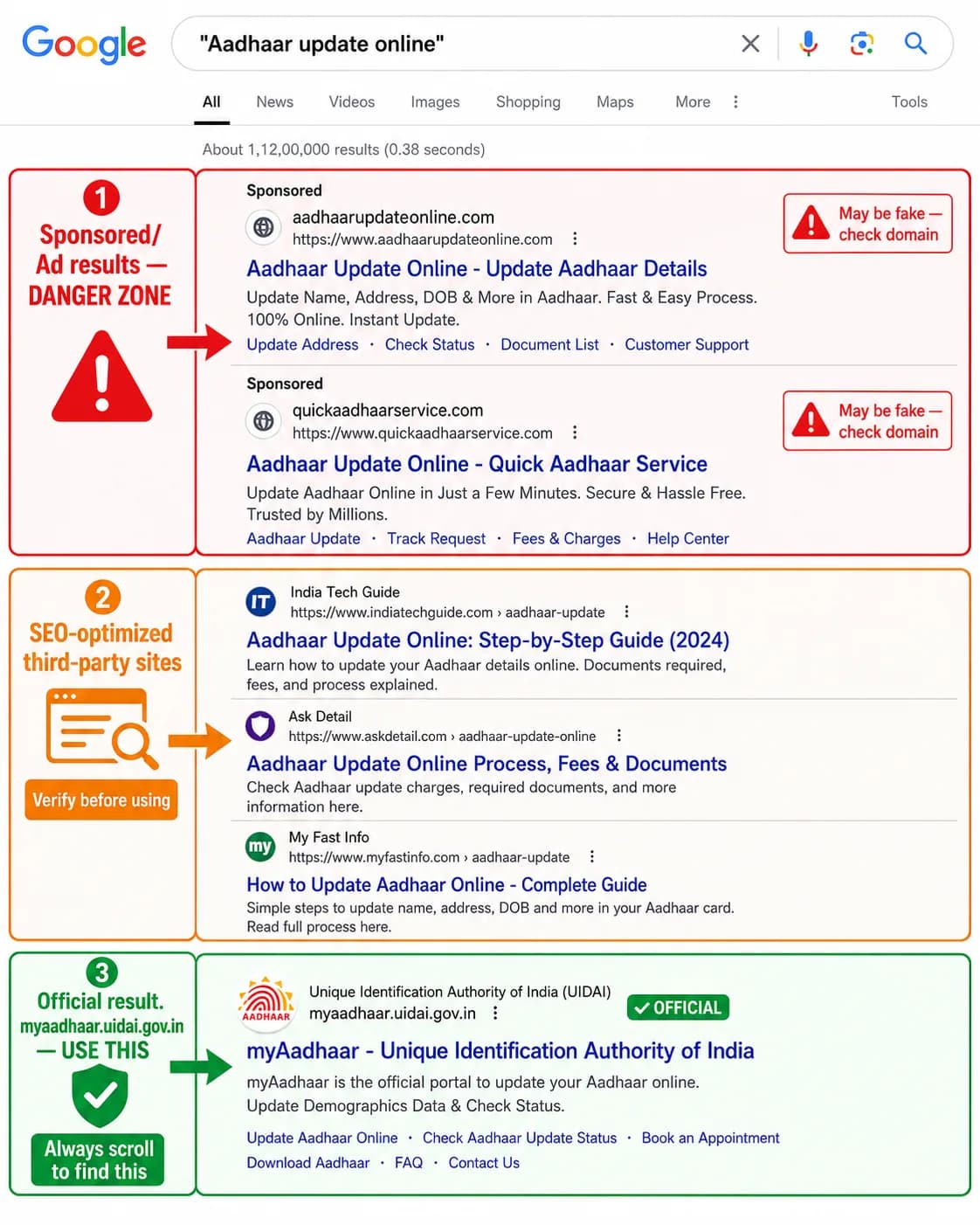
Only the green-highlighted official result is safe. Sponsored ads at the top can link to fake portals.
There are three ways fake government portals reach the top of search results and each exploits a different weakness in how people search.
Google Ads (Sponsored results): Just like fake bank helplines, scammers buy Google Ads targeting searches like "Aadhaar update online" or "PAN card apply online". These paid results appear above the real UIDAI or Income Tax portal. The small "Sponsored" label is easy to miss on mobile screens.
SEO-optimised clones: Some fake portals invest months in search engine optimisation publishing blog posts, getting backlinks, and targeting long-tail keywords like "how to update Aadhaar address from home 2026." These appear in the organic (non-paid) section and look like legitimate government help sites before redirecting to a payment page.
Google Maps and Business listings: Scammers create fake Google Business profiles claiming to be "Aadhaar Service Center" or "PAN Card Seva Kendra" at real addresses. People searching for nearby government service centres call the listed phone number, which connects to a fraud operator who collects payment remotely.
The Real Official URLs Bookmark These Today
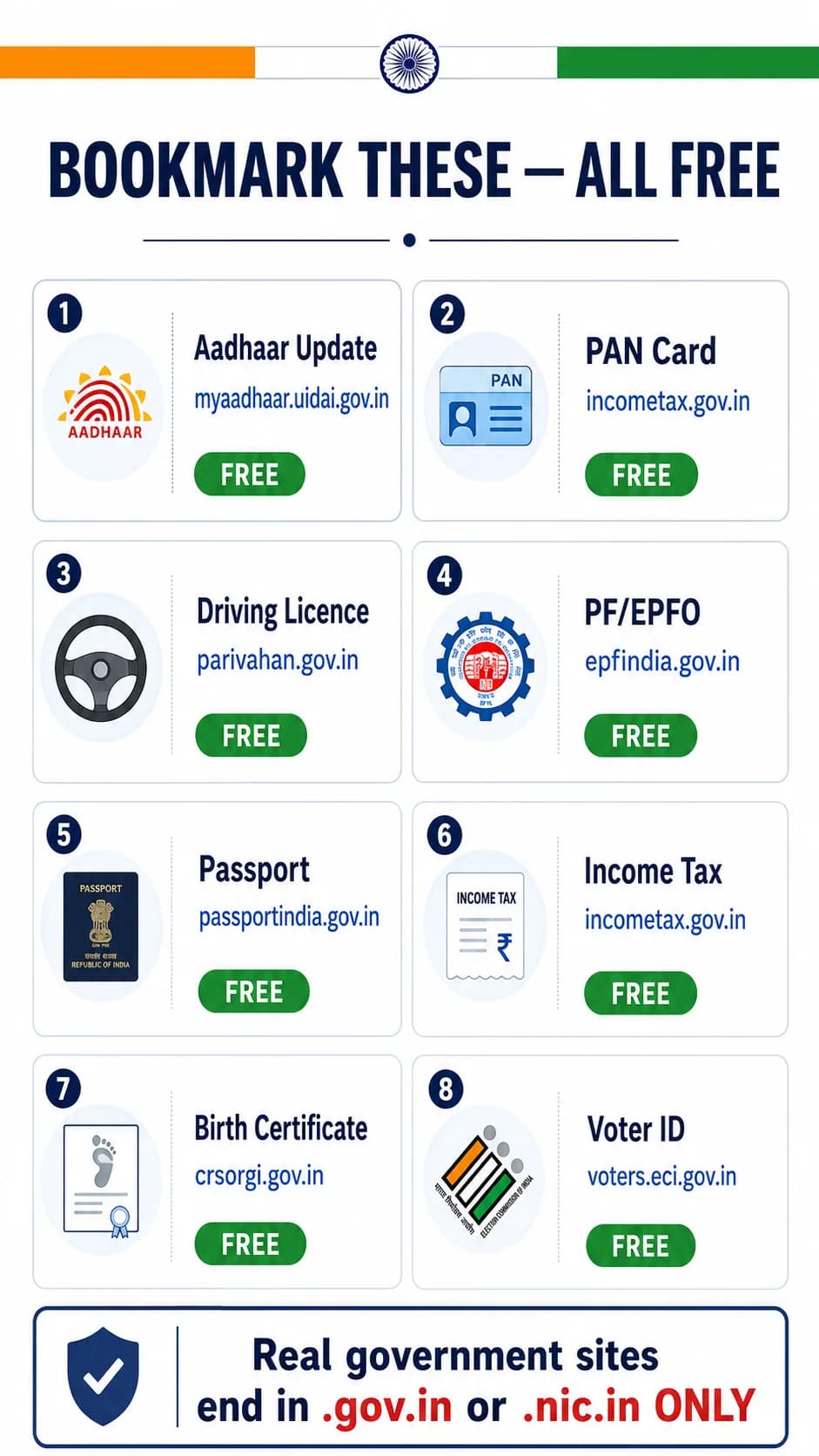
Save this card. All 8 services on the right are completely free on their official .gov.in portals.
The golden rule: real Indian government services end in .gov.in or .nic.in.No exceptions. Here are the verified official URLs for the most commonly cloned services.
How to Verify Any Government Website in 30 Seconds
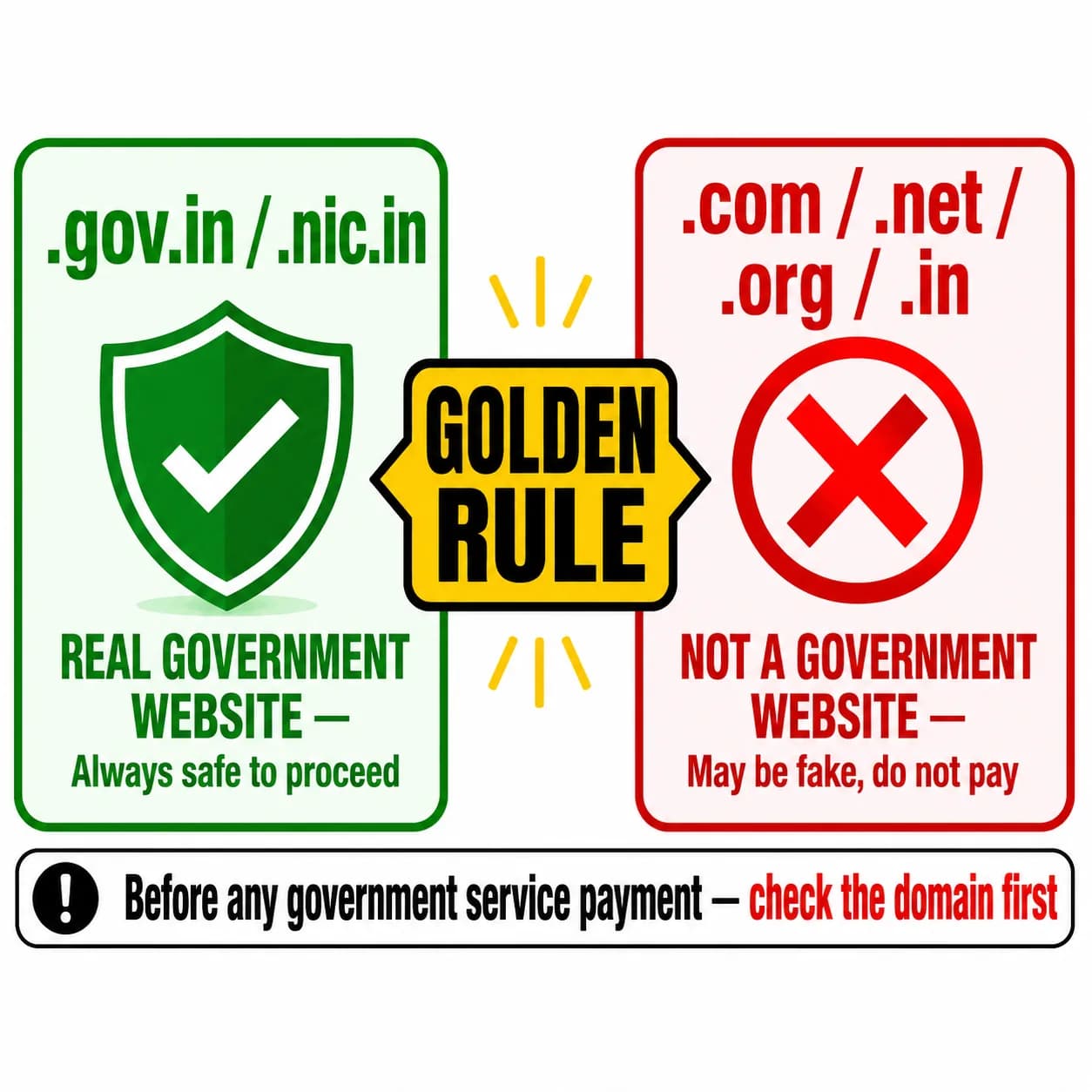
The simplest rule: .gov.in = real government. Everything else is potentially fake.
You do not need to be technically savvy to verify a government site. One check takes under 10 seconds and is foolproof:
Look at the domain, not the design. Scammers copy government logos, emblems, colour schemes, and even entire page layouts perfectly. What they cannot copy is the domain: real government sites always end in .gov.in or .nic.in.
Here is the complete verification process, step by step:
- Check the URL first: Before clicking, hover over any link (or tap and hold on mobile) to see the full address. If it does not end in .gov.in or .nic.in, it is not an official government portal regardless of how it looks.
- Go directly, never via search: Always type the official URL directly in the browser address bar. For Aadhaar: type myaadhaar.uidai.gov.in directly. Do not click the first search result.
- Verify via india.gov.in: The National Portal of India at india.gov.in links to every official government portal. If you cannot find a service there, it may not have an official online option yet.
- Check payment method: Official government portals process payments through their own secure gateway never via UPI to a personal phone number, gift cards, or third-party accounts. Any such payment demand is fraud.
- Paste the URL in RakshaAI: If you are unsure, paste the website address into rakshaai.co/website-safety-checker before submitting any document or payment.
The Scale of Fake Government Website Fraud in India: Official Data
Fake government website fraud is not a fringe issue. Official data, parliamentary answers, and cybercrime court records show a systematic and growing industry targeting Indian citizens.
| Year | Cybercrime Complaints (NCRP) | Fake Sites Taken Down | Source |
|---|---|---|---|
| 2021 | 4.52 lakh total | 941 fake govt-related domains | MeitY / CERT-In |
| 2022 | 10.29 lakh total | 1,200+ phishing/fake sites | MHA / CERT-In Annual Report |
| 2023 | 15.96 lakh (+55%) | 310 malicious domains via NIXI (Oct-May alone) | MHA Lok Sabha Dec 2025 |
| 2024 | 22.68 lakh (+42%) | 7.81 lakh SIM cards blocked; 2.08 lakh IMEIs blocked | MHA / PIB Feb 2025 |
| 2019-2024 (cumulative) | 53.9 lakh total | ₹31,534 crore reported defrauded | MHA / I4C Parliament Data |
Documented Fake Government Website Scam Cases in India
These are real cases reported by verified Indian news outlets and police departments. Each involves a citizen who paid for a government service on a fake portal.
Delhi Fake Ration Card Website Charges for a Free Service, FIR Registered
A fake website rationcardagent.co.in/digital-ration-card-application offered digital ration cards to Delhi residents and charged ₹407 per application for a service that is completely free under the National Food Security Act. The Delhi Government's Food, Supplies and Consumer Affairs Department filed a complaint. An FIR was registered under Section 420 IPC and Section 66D of the IT Act (cheating by impersonation using a computer resource).
MEA Issues Advisory Against 5+ Fake Passport Seva Clones Charging Thousands
The Ministry of External Affairs (MEA) issued a formal advisory warning citizens against fake passport portals including indiapassport.org, passportindiaportal.in, passport-india.in, passport-seva.in, and applypassport.org. These cloned the official passportindia.gov.in interface and charged ₹4,000+ per renewal. The issue was raised in Parliament (Rajya Sabha Question No. 82 on "Fraudulent Online Passport Services").
CSP Operator Clones Aadhaar Fingerprints, Drains 165 Bank Accounts
Ahagir Sheikh, operating a Customer Service Point (CSP) centre, cloned the fingerprints of 165 people using rubber/polymer moulds and withdrew money from their Aadhaar-linked bank accounts via AePS (Aadhaar-Enabled Payment System). One victim, Ghaffar Khan, had ₹2 lakh withdrawn without his knowledge. Total estimated withdrawals: ₹15–20 lakh across 165 victims. Ahagir Sheikh was arrested by Azamgarh Police.
CBI Arrests Gang for Draining 11 EPFO Accounts via Fake Aadhaar Identity Swap
Mastermind Priyanshu Kumar and his gang obtained Aadhaar cards with identical victim names and dates of birth by submitting forged documents to modify existing Aadhaar records. These "altered Aadhaar" cards were used to register 39 fraudulent EPFO withdrawal claims against 11 EPF members, siphoning ₹1.83 crore. CBI registered the FIR in February 2022 and arrested Priyanshu Kumar in June 2023 after searches at 8 locations across Bihar, Jharkhand, and Delhi.
Surat Gang Sells 2 Lakh Fake Aadhaar, PAN, Voter ID Documents via Website
Two accused operated a three-year-old fake website selling forged Aadhaar cards, PAN cards, and Voter IDs for ₹15 to ₹200 per document. Approximately 2 lakh fake identity documents were sold, primarily to buyers in Gujarat. The fake IDs were used to obtain bank loans and purchase SIM cards for fraud. Surat Police arrested both accused and froze ₹25 lakh in their accounts. Police called it "a serious national security issue."
UP STF Arrests Man Who Created 18,000+ Fake Aadhaar Cards Using Forged CSC Access
Pramod Kumar Nishad (28) obtained a legitimate CSC licence, then sourced illegal access to forged Aadhaar enrollment and update portals via Telegram contact Aqeel Saifi. He illegally created or modified 18,000+ Aadhaar cards. He was arrested by UP Special Task Force while attempting to flee to Nepal. The case was referred to UIDAI for a full technical security audit.
Complete Timeline: Major Fake Government Website Scam Cases in India
Fake ration card site (rationcardagent.co.in) charged for a free NFSA service. Delhi Government filed complaint; FIR under IPC 420 and IT Act 66D.
Source: Business Standard →5+ fake passport portals (indiapassport.org, passportindiaportal.in etc.) cloned MEA interface. Issue raised in Parliament Rajya Sabha Q.82. MEA advisory issued.
Source: India TV News →CSP operator Ahagir Sheikh cloned fingerprints of 165 people using polymer moulds and drained AePS-linked bank accounts. Arrested by Azamgarh Police.
Source: MediaNama →Fake site digitalportal.in sold counterfeit Aadhaar and PAN cards at Rs 21–50 each. 10+ lakh templates downloaded, mostly from Gujarat. Pankaj Kumar Yadav + 8 others arrested.
Source: The420.in →CBI case: gang forged Aadhaar records, filed 39 fake EPFO withdrawal claims draining 11 accounts. Mastermind Priyanshu Kumar arrested after 8-location raid.
Source: Business Standard →Inter-state gang cloned AePS fingerprints from 1 lakh harvested Aadhaar biometrics. Linked to 128 fraud cases across multiple states. Seshnath Viswakarma arrested in Gorakhpur.
Source: MediaNama →3-year fake website sold forged Aadhaar, PAN, Voter IDs for Rs 15–200 each. Used for bank loans and SIM fraud. 2 arrested; Rs 25 lakh frozen. Police: "national security issue."
Source: ETV Bharat →I4C and NIXI made 310 malicious/phishing government portal clones non-functional. Government separately blocked 7.81 lakh SIM cards linked to cyber fraud.
Source: MHA / PIB →Pramod Kumar Nishad used a legit CSC licence + forged portal access via Telegram to create 18,000+ fake Aadhaar cards. UP STF arrested him fleeing to Nepal.
Source: The420.in →Army Intelligence tip led SOG to "Aastha Janseva Kendra." Seized: 67 Aadhaar cards, laptops, fingerprint scanner, rubber fingerprint clones. 3 arrested.
Source: The420.in →2 unregistered Jan Seva Kendra operators exploited UIDAI platform vulnerabilities to generate 5,000+ fake Aadhaar IDs in 6 months. Welfare funds diverted. 2 arrested; 47 centres audited.
Source: The420.in →PAN 2.0 announcement triggered mass phishing: fake Income Tax clones harvested PAN, Aadhaar, OTP, banking credentials. Government alert issued; activity continued into 2025.
Source: The420.in →Rajasthan DBT fraud: 29,000 fake beneficiary accounts created under PM-Kisan, state pension, and disaster relief. Operation Shutterdown: 51 arrests including government insiders.
Source: National Herald India →If You Already Paid a Fake Government Website
If you have paid a fake government portal, act immediately. The faster you move, the higher the chance of recovering your money and protecting your data.
- Screenshot everything: The website, the payment confirmation, the transaction ID, the fake receipt. You will need this for the police complaint.
- Call 1930 right now: India's National Cybercrime Helpline can freeze mule bank accounts before the money is withdrawn. Speed matters the window is usually 24 to 48 hours.
- File at cybercrime.gov.in: Submit a formal complaint with screenshots, the fraudulent URL, and your payment receipt.
- Contact your bank immediately: Request a chargeback or reversal of the UPI/card payment. Provide the cybercrime complaint number for faster processing.
- Change passwords for linked accounts: If you submitted your Aadhaar OTP, UAN login, or PAN details to the fake site, change your UIDAI/EPFO/Income Tax portal password immediately and enable two-factor authentication.
- Report the URL at rakshaai.co: This adds the fraudulent website to our scam database, protecting other Indians who might search for the same government service.
Frequently Asked Questions
What is the real website to update Aadhaar details in India?
The only official Aadhaar portal is myaadhaar.uidai.gov.in. Aadhaar updates for address, mobile number, and name are done here. Basic updates are free. Any other website claiming to update your Aadhaar for a fee is a fake portal.
What is the real website for PAN card in India?
PAN card services are available at incometax.gov.in. Instant PAN via Aadhaar is entirely free and takes under 10 minutes. New PAN applications are processed through NSDL at tin.tin.nsdl.com and UTIITSL at myutiitsl.com. Any other site charging large fees for PAN services is likely fraudulent.
How do I report a fake government website in India?
Report at cybercrime.gov.in. You can also report the fake website URL at rakshaai.co to immediately warn other Indians searching for the same service. Forward details to the relevant ministry's official cybercrime or fraud reporting contact.
Is it safe to pay for government services on third-party websites?
Only if they are officially empaneled service providers listed on the government portal itself. For core services (Aadhaar, PAN, driving licence, passport), always use the official .gov.in portal directly. Middlemen who charge a "convenience fee" for free government services may be operating illegally.
How do real Indian government websites look different from fake ones?
Real government sites end in .gov.in or .nic.in, load securely (https), and never ask for payment via UPI to personal numbers or gift cards. Fake sites may look nearly identical in design but charge fees the real portal does not charge. The only reliable check is the domain ending.
What does a fake government website URL look like?
Common patterns include: aadhaar-update.com, uidai-service.in, parivahan-dl.com, epf-claim-india.com, passportserviceindia.com. The tell-tale signs are: no .gov.in ending, hyphens in the domain, extra words like "service," "update," "apply," or "india" in the domain name.
Final Thoughts
The fake government website scam is designed to exploit one specific emotion: the trust Indians have in government institutions. When a website shows the Ashoka emblem and uses the colours of an official portal, the brain automatically grants it legitimacy.
The fraudsters know this. They invest heavily in design and Google Ads, while investing nothing in actually delivering the service. The result is a near-perfect trap for anyone who searches instead of typing the official URL directly.
The defence is simple and once learned, permanent: real Indian government services end in .gov.in or .nic.in. Bookmark the official URLs in this article. Share this page with your parents, your staff, and anyone who might one day search for a government service. The scam only works on people who do not know this rule.
Free Tool
Not sure if a government website is real?
Paste any website URL into RakshaAI for an instant safety check. No sign-up. Results in under 5 seconds.
Check a Website Now →100% free · No sign-up required · Real .gov.in links always safe
More from RakshaAI Blog
Stay Protected Online
Use RakshaAI to check websites, phone numbers, and UPI IDs for scams free, instant, no sign-up required.
RakshaAI is a private platform by Ehatech Services Pvt. Ltd. Not affiliated with any government body. Editorial policy