
How to Check If a Website is Safe: Complete Guide + Free Checker Tool
Every day, thousands of Indians lose money to fake websites. Before you enter your credit card details, share your UPI PIN, or click that "90% off iPhone" deal, take 5 seconds to verify the website's safety.
Our free website safety checker helps you spot scam sites instantly. Whether you're shopping online, checking out a new loan app, or investigating a suspicious link someone sent you on WhatsApp we've got you covered.
Enter any website URL for an instant safety report
✓ Trust score (0–10) · ✓ SSL & domain age · ✓ Malware & phishing check
Your data is secure. We never store or share the URLs you check.
How to check if a website is safe in India
- 1Paste the full URL into RakshaAI never click a suspicious link without checking first
- 2Check the domain name carefully scammers use look-alike domains like "hdfc-bank-login.com"
- 3Look at the trust score 8 to 10 is safe, 5 to 7 is caution, 0 to 4 is high risk
- 4Verify the SSL certificate exists AND the domain matches HTTPS alone does not mean safe
- 5Check domain age scam sites are usually less than 6 months old
- 6Never enter OTP, UPI PIN, or Aadhaar on any site before verifying it here
Report any scam website: cybercrime.gov.in | Cybercrime helpline: 1930
What is Website Safety and Why Does It Matter?
Website safety isn't just about viruses anymore. It's about protecting your money, your identity, and your personal information from sophisticated scammers who've perfected the art of creating fake websites that look exactly like the real thing.
₹22,845 Cr
Lost to cyber fraud in 2024
83,000+
Fake e-commerce websites
67%
Indians never check safety
₹45,000
Average loss per victim
Real Scam: Diwali 2024
amaz0n-india-sale.com ran for 14 days and 1,247 people lost ₹3.2 crore.
Our Checker Catches This
5-second automated check would have flagged all red flags instantly.
What Our Free Checker Verifies
15+ comprehensive security tests in under 5 seconds
SSL/HTTPS Certificate
Valid, expired, or missing?
Malware Detection
Scans against virus databases
Phishing Analysis
URL pattern matching
Domain Age
When was it registered?
Trust Score
0-10 rating based on 15+ factors
User Reports
100K+ Indian users' scam reports
Contact Verification
Does the site provide legit contact info?
Payment Security
PCI DSS compliance check
What is Website Safety and Why Does It Matter?
Website safety isn't just about viruses anymore. It's about protecting your money, your identity, and your personal information from sophisticated scammers who've perfected the art of creating fake websites that look exactly like the real thing.
Think about it: when was the last time you actually checked if a website was legitimate before entering your card details? Most of us don't. We see a professional-looking site, familiar logos, and we trust it. That's exactly what scammers count on.
Online fraud is a major and growing problem in India. Most victims are tricked by fake websites designed to look legitimate. Checking first costs nothing. Not checking can cost everything.
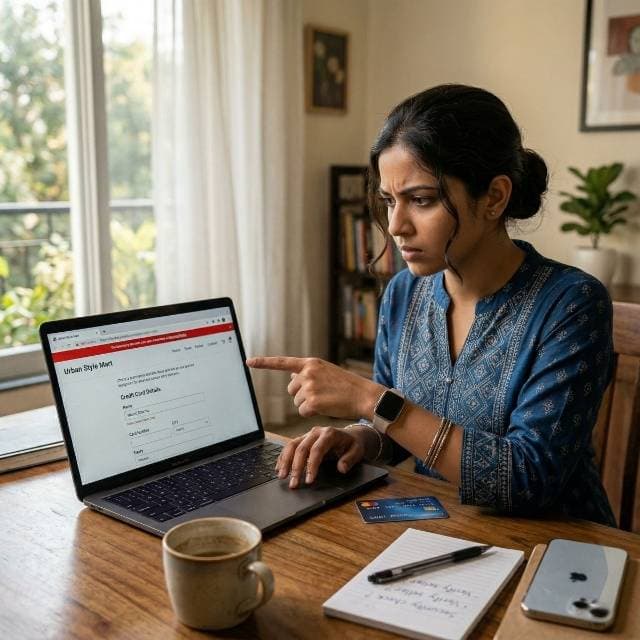
Why You Should Check Every Website Before Sharing Data
During Diwali 2024, a website called amaz0n-india-sale.com (notice the zero instead of 'o') ran for exactly 14 days. In those two weeks, 1,247 people lost a combined ₹3.2 crore. The site looked identical to Amazon same logo, same layout, same product images.
Typosquatting domains let scammers clone any brand in hours. Free SSL certificates mean even fake sites show the "padlock" symbol. WhatsApp forwarding spreads malicious links to millions within minutes.
Low digital literacy in Tier 2 and Tier 3 cities means first-time internet users are unfamiliar with website fraud tactics making a free website safety checker like RakshaAI essential for every Indian.
Common Website Scam Types in India
Online fraud through fake websites is a significant and growing problem in India. Before you dismiss that suspicious link, understand what you're dealing with.
Fake E-commerce Sites
Most reportedClones of Amazon, Flipkart, and Meesho offering iPhone at ₹4,999. Professional design, working cart, no fulfilment. Victims pay and receive nothing or receive counterfeits.
Phishing Banking Sites
Very commonPixel-perfect replicas of SBI, HDFC, ICICI login pages. URLs like 'sbi-secure-login.com' instead of 'onlinesbi.sbi'. Goal: steal net banking credentials for instant fund transfer.
Fake Loan Apps
High volumeSites offering 'instant RBI-approved loans' with Aadhaar-only verification. Collect KYC data and processing fees, disburse nothing. Data used for ongoing identity fraud.
UPI Payment Phishing
Very commonFake 'payment failed' or 'cashback pending' pages that ask you to re-enter your UPI PIN. The moment you submit, the fraudster completes an outgoing transfer from your account.
Job & Investment Scams
Fastest growingFake work-from-home portals and 'guaranteed returns' investment platforms. Ask for registration fees or initial investment. Disappear after collecting funds.
Fake Government Portals
CommonFraudulent sites mimicking IRCTC, income tax, passport, and Aadhaar portals. Collect fees, personal data, and OTPs under the guise of official government services.
Unlike basic URL checkers that only verify SSL, RakshaAI's website safety checker combines community reports with AI-based fraud pattern detection trained specifically on Indian scam tactics. This means we catch newly registered fake sites and phishing domains that other tools miss.
What To Do If You Entered Data on a Scam Website
Identifying a scam website is only step one. Acting fast protects you. Reporting it protects every other Indian who receives the same link.
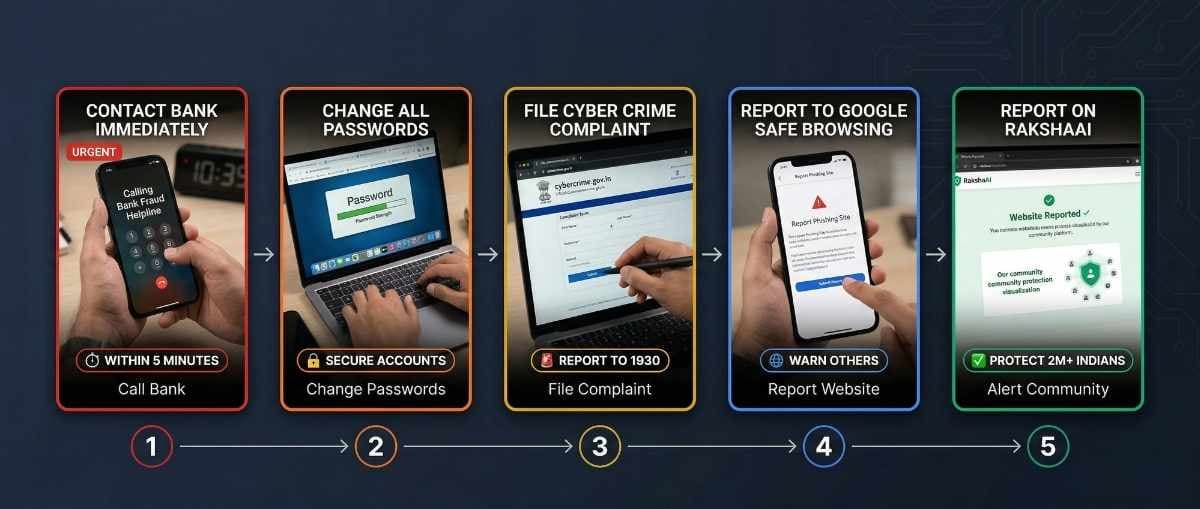
Contact your bank's fraud helpline immediately
Call your bank's 24x7 toll-free number to block your card and freeze transactions (SBI: 1800-11-2211, HDFC: 1800-202-6161, ICICI: 1800-102-4242, Kotak: 1860-266-0811). Speed matters every minute counts. If you shared UPI PIN or OTP, ask for an account freeze or PIN reset immediately.
Change all associated passwords from a secure device
From a clean device (not the one you used on the scam site), change your banking passwords, UPI PIN, and email password. Scam websites may have installed tracking scripts. Use a different browser or incognito mode on a trusted device.
File a complaint at the Cyber Crime Portal
File a complaint at cybercrime.gov.in or call the National Cyber Crime Helpline: 1930. You can also report to CERT-In at incident@cert-in.org.in. Include the URL, screenshots, and any transaction IDs if money was lost. Speed is critical for recovering funds.
Report the phishing site to Google Safe Browsing
Report the site at safebrowsing.google.com/safebrowsing/report_phish/ this gets it blacklisted for all Chrome users globally within hours. Also report to PhishTank.org for broader protection.
Report the scam website on RakshaAI
After handling the emergency, report the scam site on our platform. Your report is processed within 4–6 hours and immediately begins protecting other Indians from the same URL. Include what type of scam it was and how you discovered it so our AI can correlate with active fraud campaigns.
10 Red Flags: How to Spot a Fake Website Instantly
Before you use our automated checker, know the warning signs you can spot with your own eyes. Think of these as flashing red lights that should make you close that browser tab immediately.
Missing HTTPS or SSL Certificate
Look at your browser's address bar. If a website starts with 'http://' (no 's'), your data travels in plain text anyone can intercept it. If a website asks for ANY personal information or payment details without HTTPS, close it immediately. No legitimate business operates without SSL certificates in 2025.
Brand New Domain (Less Than 6 Months Old)
Scammers often create disposable domains and abandon them after a campaign. A recently registered store paired with unrealistic discounts deserves additional verification, but domain age alone does not prove fraud.
Suspicious Domain Names
Scammers use typosquatting: amaz0n.com (zero instead of 'o'), fllipkart.com (double 'l'), paytmm.in (extra 'm'), sbi-secure-login.com (adding words to real brand names). Always read the full URL character by character. One wrong character means you're on a fake site.
Deals That Are Too Good to Be True
iPhone 15 for ₹4,999. MacBook at ₹8,000. Gold jewellery at 90% off. If a price defies logic, it's a scam. Legitimate retailers cannot offer products at 90% below market price. The 'deal' is the trap, designed to override your rational judgment.
No Legitimate Contact Information
Scam sites either have no contact page at all, or list a Gmail address and a mobile number with no physical address, CIN, or GST number. A legitimate Indian business will have a registered address and verifiable contact details. Try calling the listed number scam sites often use fake or disconnected numbers.
Suspicious Payment Methods Only
If the only payment options are direct UPI ID transfer, Paytm wallet-to-wallet, or cryptocurrency walk away. Legitimate e-commerce platforms offer card payments with chargeback protection. Scammers demand untraceable payment methods because they cannot be reversed once stolen.
Poor Website Quality
Broken images, spelling mistakes in product descriptions, misaligned layouts, inconsistent fonts, and placeholder text are dead giveaways. Scam sites are built quickly and cheaply. Most legitimate Indian brands have professional UI/UX standards. If a site looks like it was made in an afternoon, it probably was.
Requests for Unnecessary Personal Information
A shopping site asking for your Aadhaar number, a loan comparison site asking for your banking password, a ticket booking site asking for your UPI PIN none of these are normal. Legitimate services request only what they need. If a site asks for information with no logical connection to the service, it's harvesting data for fraud.
No Social Media Presence
Search the brand name on Facebook, Instagram, and Twitter/X. A legitimate business selling products worth thousands of rupees will have an active social media presence with real customer interactions. Zero presence, or a presence created in the last 30 days with only promotional posts, is a strong signal the 'brand' was created purely for fraud.
Negative Reviews and Scam Complaints
Search '[site name] review scam complaints' on Google. Check Reddit India, consumer complaint sites, and Google Maps reviews. Even one month of complaints from victims who 'paid and received nothing' is enough to walk away. Our tool also surfaces community-submitted scam reports.
How to Check If a Website is Safe
Four simple steps takes less than 30 seconds to know if a site is safe.
Enter the Full Number
Include the country code for international numbers (e.g., +1 for USA, +44 for UK). Our reverse phone lookup supports all country codes.
Click "Check Now"
Our tool checks community fraud reports and public blacklists results in under 5 seconds.
Read Your Result
You see a trust score (0–10), domain age, SSL status, malware checks, and community reports from the website safety lookup.
Take Action & Report
If the site scores below 5, do not enter any data. Report new scam sites to protect the next Indian from the same fraud website.
What Our Website Checker Actually Looks At
We don't just check SSL. We run 8 parallel checks and combine the signals into a single trust score (0–10).
SSL/HTTPS Certificate
Valid, expired, or missing? Full certificate authority and encryption strength analysis.
Malware & Blacklists
Scans against Google Safe Browsing, VirusTotal, and Indian security databases.
Domain Age & WHOIS
Registration date, ownership transparency, and hidden registrant detection.
Phishing Pattern Analysis
URL pattern matching against known phishing templates and community-reported scam domains.
Community Scam Reports
Community-submitted fraud reports from Indian users who reported this website.
Contact Verification
Does the site provide a legitimate, verifiable Indian business address?
Typosquatting Detection
Detects domains designed to look like trusted brands (amaz0n, fllipkart, etc.).
Report Velocity
How quickly this site is being newly reported a spike = active fraud campaign.
Red Flags: Signs of a Scam Website
You don't always have time to run a website check before clicking. Train yourself to spot these warning signs on any suspicious site each is a reason to close the tab immediately.
Domain less than 6 months old with professional-looking site
Treat a recently registered domain as one risk signal, especially when it is paired with unrealistic discounts or impersonation.
Missing HTTPS or SSL certificate
Any site asking for personal data or payments without valid HTTPS is immediately dangerous close it.
Price too good to be true
iPhone 15 at ₹4,999? MacBook at ₹8,000? If the price defies logic, the site is the trap.
Only UPI or crypto as payment methods
Scammers demand untraceable payment methods. Legitimate Indian e-commerce always offers card payments with chargeback protection.
Site asks for Aadhaar, UPI PIN, or OTP
No legitimate shopping or loan site needs your OTP or PIN. This is the hallmark of phishing leave immediately.
Suspicious domain name with slight brand misspelling
Read every character of the URL. One zero instead of 'o', one extra letter, or a hyphen = a fake site designed to deceive.
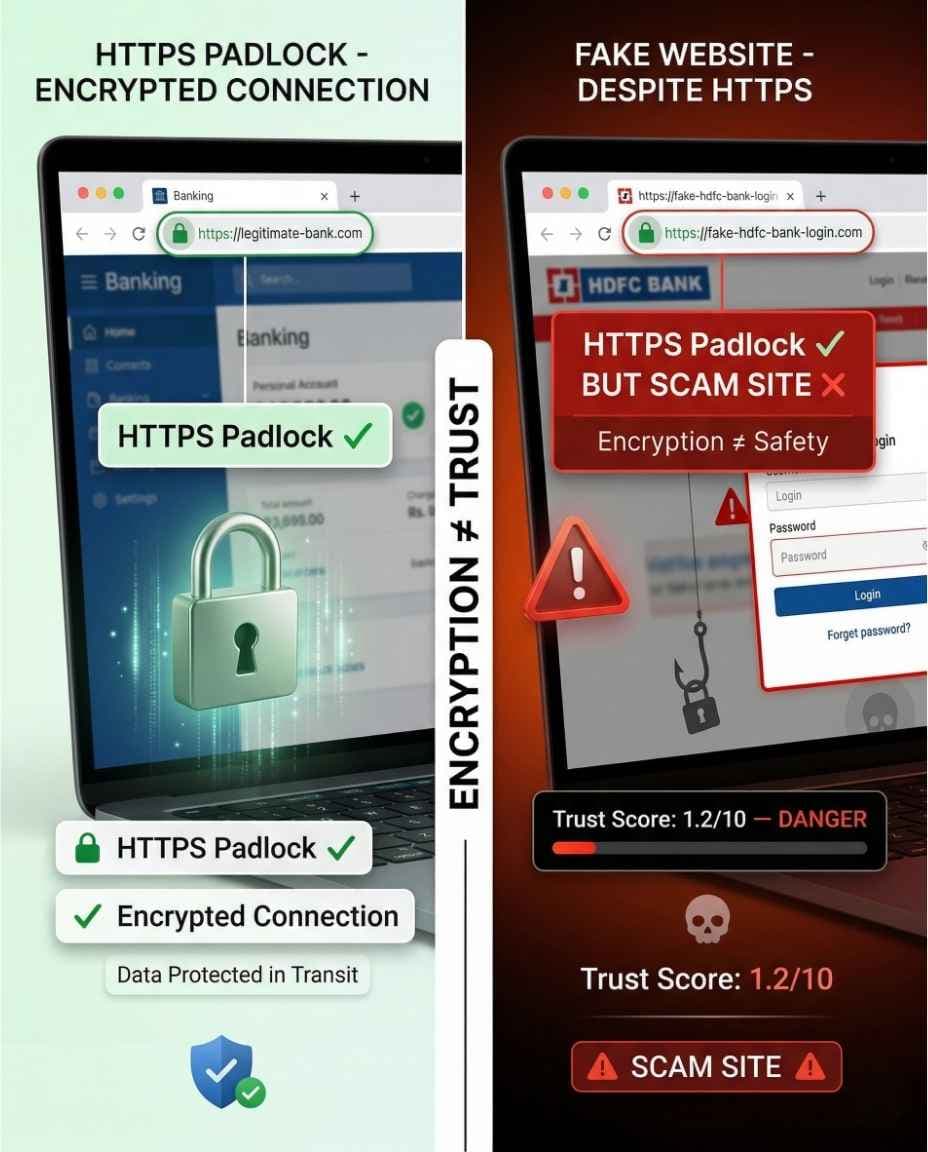
HTTPS Padlock vs Website Safety Know the Difference
The padlock icon only means your connection is encrypted. It says absolutely nothing about whether the website owner is honest. In 2025, over 80% of phishing sites use HTTPS always check the trust score before entering data.
HTTPS Padlock What It Means
- ✓ Your connection to the site is encrypted
- ✓ Data cannot be intercepted in transit
- ✓ Free to get any site can have it in minutes
HTTPS Padlock What It Does NOT Mean
- ✗ The site owner is legitimate or trustworthy
- ✗ The site won't steal your card or UPI details
- ✗ The site is registered, real, or safe to buy from
The Golden Rule याद रखें
A padlock means your data is encrypted not that the recipient is honest. Always check the trust score before entering your card, UPI, or personal details on any website.
SSL Certificates, Domain Age & Phishing: What to Check
These three signals SSL status, domain age, and phishing patterns give you the fastest read on whether a website is legitimate before you enter any data.
Check HTTPS before entering data
Non-negotiable rule
If the URL starts with http:// (no 's'), never enter a password, card number, or OTP. HTTPS encrypts your data in transit. Without it, anyone on the same Wi-Fi can intercept it.
Domain under 6 months = danger
Most reliable scam signal
Our checker can surface available domain-registration context. Treat a recently launched site with aggressive discounts as higher risk and verify it independently before paying.
Read the full URL character by character
Typosquatting defence
Look for zero instead of 'o', extra hyphens, added words before or after the brand name, or a different TLD (.net instead of .com). One character difference = confirmed fake site.
Never enter OTP on any website
UPI phishing defence
UPI and banking OTPs are for SMS verification only. No legitimate website should ever ask you to type your OTP into a web form. This is always phishing close the tab.
Verify payment gateway before checkout
Safe payment check
Legitimate Indian e-commerce uses Razorpay, PayU, CCAvenue, or Stripe. If checkout redirects to a random bank transfer page or only offers UPI to an individual ID it's a scam.
Educate your family
Senior citizens most at risk
Senior citizens are disproportionately targeted by fake website scammers. Share this page and the RakshaAI website checker with your parents and grandparents before their next online purchase.
Real Scam Website Examples: Learn from Others' Mistakes
In March–June 2024, a website called 'instant-loan-india.com' promised RBI-licensed instant loans up to ₹5 lakhs with 'Aadhaar only no credit check required.'
The damage: 847 victims, ₹1.8 crore stolen, plus massive identity theft.
How it worked
- 1Users downloaded an app from the site (not from Play Store)
- 2Entered Aadhaar, PAN, and bank details for 'verification'
- 3App showed 'loan approved' money never arrived
- 4Scammers used stolen data for ongoing identity fraud
What our checker revealed
- ✗Domain age: 3 months
- ✗WHOIS privacy enabled (hidden owner)
- ✗Registered in Cyprus (not India)
- ✗23 user scam reports in our database
- ✗Blacklisted by Indian CERT
The lesson:
Before downloading ANY app or entering personal information, paste the website URL into our checker. Those 5 seconds could save you ₹45,000 and years of identity theft headaches.
Frequently Asked Questions
How accurate is the website safety checker?
Is this really free forever?
Can I check shortened URLs (bit.ly, t.co, etc.)?
What does the trust score mean?
How often is your database updated?
Does HTTPS (the padlock icon) mean a website is safe?
What is domain spoofing and how do I spot it?
Can fake websites steal my information even if I don't type anything?
What should I do if my bank account was compromised through a fake website?
How do I report a suspicious website I found?
Check Another Safety Tool
Fake websites are just one part of India's cyber fraud problem. Use RakshaAI's full safety suite for comprehensive protection:
Phone Number Checker
Check phone numbers against community scam reports. Detect fraud callers before you call back.
UPI ID Checker
Verify UPI IDs before sending money. Checks registration status, account age, and scam reports.
Link Safety Checker
Paste any suspicious link to see where it actually goes and whether it has been reported as a scam redirect.
Live Scam Alerts
Latest alerts about active scam websites and fraud links targeting Indians updated daily.
Report a Scam Website
Every scam website you report protects thousands of other Indians. If you've found a fraudulent site that isn't flagged in our checker, take 30 seconds to report it. Your report goes live within 4–6 hours after verification.
Report a Scam WebsiteTogether, Indian users are building a community scam database that helps warn others before they fall victim.
Got a Suspicious Website?
Don't enter your data without checking first. Paste the URL below and get an instant safety report. Free. No sign-up. Always.
🇮🇳 Free, no login, built for India · Multiple threat data sources · Community-powered reports