
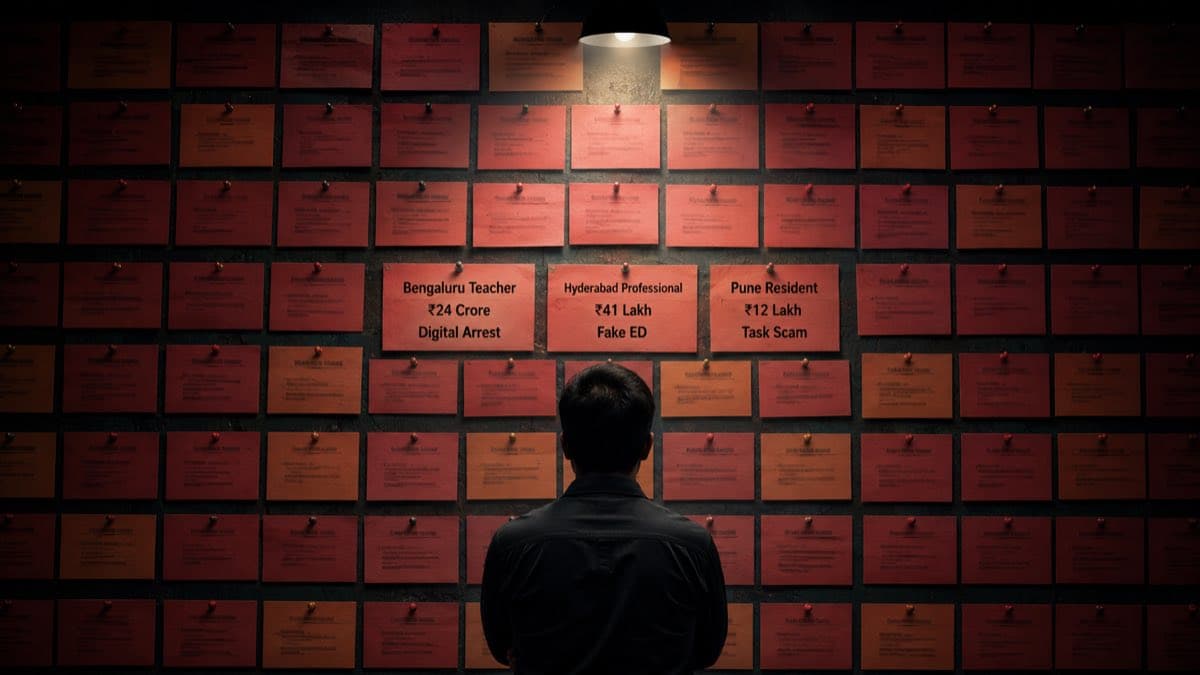
On 24 April 2026, a manager at a private bank in Bengaluru noticed a pattern in one customer account that did not fit. The customer was a 74 year old retired teacher. Over the previous ten weeks she had moved nearly Rs 24 crore out of her account in 26 separate transfers, into 23 different accounts spread across roughly 10 banks in several states. The manager alerted the Karnataka State Cyber Command. Officers reached her, sat her down, and told her what she had spent two and a half months refusing to believe: there was no CBI case, there was no ED investigation, and the officers who had held her under continuous video surveillance were not officers at all.
That is the biggest cyber fraud India 2026 has documented against a single individual, and it is the first of five real cases in this guide. Every one of them is drawn from a police complaint or a court reported investigation. No composites, no illustrative examples, no rounded numbers invented to make a point.
Reading a cyber fraud case study India 2026 does something a warning list cannot. It shows you the exact sequence, the exact moment the victim stopped thinking clearly, and the exact sentence that could have ended it. India lost an estimated Rs 22,495 crore to cyber crime in 2025 across more than 28 lakh cases, a 24 percent rise on the previous year. That number is unreadable. Five people are not.
If this is happening to you right now
- 1Hang up. No real agency conducts an investigation over a video call you cannot end
- 2Tell one person immediately, the instruction to stay silent is the fraud, not the law
- 3Do not transfer anything more, not even to prove your innocence or unlock your own money
- 4Call 1930 now if any money has already moved, the first hour decides whether it comes back
- 5File at cybercrime.gov.in the same day and keep every screenshot, UTR and phone number
- 6There is no such thing as a digital arrest in Indian law. It does not exist
Why Case Studies Matter More Than Warnings
Everybody already knows the warnings. Do not share your OTP. Do not click unknown links. Verify before you pay. Those sentences have been on television, on bank websites and in caller tunes for years, and Indians still lost Rs 22,495 crore in 2025.
The reason is that warnings describe a category and fraud arrives as a specific situation. Nobody thinks they are about to fall for a scam. They think they are being investigated for money laundering. They think their SIM is about to be disconnected. They think they found a side income that pays Rs 2,500 a day for rating hotels. The warning never fires because the victim never files what is happening under the heading the warning used.
A case study works differently. It gives you the pattern in the shape you will actually meet it: the specific opening line, the document that looked official, the small payout that arrived on time and made everything else believable. That is why the answer to how cyber fraud happens India is better told through five people than through fifty rules.
One more thing worth saying before the cases begin. Every person in this guide is educated, and several are professionally successful. That is not a coincidence and it is not irony. These frauds are engineered for people with savings to move, enough understanding of the law to fear a CBI notice, and enough standing in their community to dread the disgrace. Being intelligent is not protection here. It is part of the targeting criteria.
The Five Cases at a Glance
Five documented Indian cases, five different mechanisms, one shared psychology.
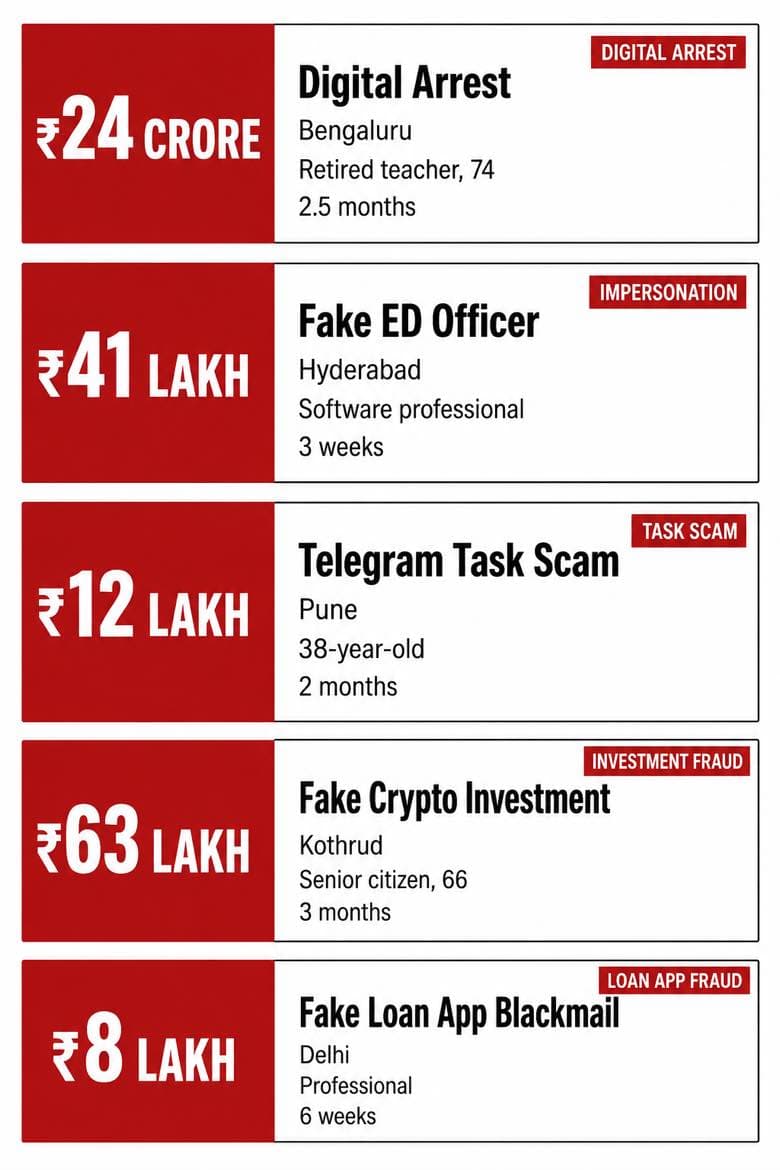
Case Study 1: The Rs 24 Crore Digital Arrest, Bengaluru Retired Teacher
Case file 01, digital arrest
Rs 24 crore
- Victim
- Retired teacher, 74, Bengaluru
- Duration
- 10 February to 24 April 2026
- Method
- CBI and ED impersonation
- Transfers
- 26 transactions, 23 mule accounts
- Banks
- Around 10 banks, multiple states
- Outcome
- Rs 4 crore blocked, Rs 1.46 crore recovered, six arrested
The call opened the way almost every digital arrest victim India case opens. Callers identifying themselves as senior officers of the Central Bureau of Investigation told her that her identity documents had surfaced in a money laundering investigation. There was a warrant. There was a parcel. There were accounts in her name she had never opened.
What followed was not a single call but a régime. She was kept under what the fraudsters called digital arrest, on continuous video contact, for weeks. She was told that the investigation was confidential under national security provisions and that speaking to her family or to the police would itself be an offence. Officers of the Enforcement Directorate were introduced into the calls to add weight. Over ten weeks she made 26 transfers totalling close to Rs 24 crore into 23 accounts held at around 10 banks, spread across Gujarat, Tamil Nadu, Maharashtra, Delhi and Bihar.
She did not stop because she realised. She stopped because a bank manager did. Karnataka State Cyber Command was alerted to the transaction pattern on 24 April, officers reached her and counselled her, and roughly Rs 4 crore of further transfers was blocked at that point. Rs 1.46 crore has since been recovered. Six accused have been arrested from five states, and investigators are working through call detail records and banking trails to map the wider network.
The moment that could have ended it. The first call. One search for the local CBI office number, one call placed to it by her, and the entire operation collapses. No investigating agency in India conducts questioning by video call, freezes your money into a private account, or asks you to keep an investigation secret from your own family. Our digital arrest scam guide sets out what a genuine summons actually looks like.
The lesson. Duration is a weapon. Two and a half months of daily contact is long enough to rewire someone entirely, which is why the fraud does not need her to be foolish on any single day. It only needs her to be frightened on the first one.
Case Study 2: The Fake ED Officer Call, Hyderabad Engineer
Case file 02, agency impersonation
Rs 15 lakh
- Victim
- BHEL employee, 56, Hyderabad
- Started
- March 2026
- Method
- TRAI, police, CBI, RBI and ED impersonation
- Entry point
- Automated SIM deactivation warning call
- Escalation
- WhatsApp video call from a fake police officer
- Status
- Under investigation by Cyberabad Cyber Crime Unit
This case matters because of how ordinary the opening is. It did not begin with a person at all. It began with a recorded message saying his mobile number was about to be deactivated, the kind of automated call that lands on Indian phones dozens of times a week. Press a key to speak to an officer, and the recording hands you to a human being.
From there the escalation was fast and deliberately vertical. TRAI led to the police. The police led to a WhatsApp video call in which one of the accused appeared in the role of a police officer. The police led to the CBI, the CBI to the RBI, and the RBI to the Enforcement Directorate. At each step, forged notices arrived carrying the names, logos and formats of the real agencies, designed to look like official government communication, telling him that a serious financial crime investigation was already running in his name. He transferred Rs 15 lakh before he became suspicious enough to stop.
The layering is the technique. A single caller claiming to be from the ED is easy to doubt. A chain of agencies, each apparently escalating the matter to the next, produces the impression of an institutional machine already in motion, and it also means no single claim has to carry the whole weight of the lie. Cyberabad police are now working through bank accounts, mobile numbers, WhatsApp records, IP logs and transaction trails.
The moment that could have ended it. The transfer of the WhatsApp call. No agency in India moves an investigation to WhatsApp. Ever. Agencies serve notice in writing, at your address, with a case number you can verify at a physical office. Our guide to checking a suspicious number covers the 30 second check that would have flagged the caller.
The lesson. An investment scam victim India case usually starts with a promise. An impersonation case starts with a threat about something boring and administrative, a SIM card, a parcel, a KYC form. The boring opening is what gets past your defences, because you are braced for a scam and this feels like paperwork.
Case Study 3: The Rs 12.30 Lakh Telegram Task Trap, Pune
Case file 03, task fraud
Rs 12.30 lakh
- Victim
- 38 year old, Pune
- Duration
- 11 December 2025 to 12 January 2026
- Method
- Telegram task and prepaid fee fraud
- Hook
- Small tasks with real payouts to build trust
- Reported
- Ambegaon police station, May 2026
- Outcome
- Communication ceased, investigation ongoing
The Telegram message offered money for completing simple online tasks. The first tasks were small and the payments were real. That is the entire mechanism, and it is why the task scam victim India profile is so wide: this fraud does not require fear, greed or gullibility to work, only the ordinary human response to being paid what you were promised.
Once trust was established, the tasks changed shape. Higher value assignments required a transfer first, described as a prepaid task fee, a level unlock, or working capital, against a larger payout on completion. He kept transferring. Between 11 December 2025 and 12 January 2026 he sent Rs 12.30 lakh across a series of accounts. Then the messages stopped.
Inspector Sharad Zine of Ambegaon police station described the pattern plainly when the case was registered: task based scams begin with small payments to gain confidence before larger deposits are demanded. The same month, Pune police recorded two further cases in this family, a 39 year old in Bibvewadi who lost Rs 32.47 lakh to a fake share trading operation, and the Kothrud case that follows. Three victims, over Rs 1.08 crore, one city.
Note the reporting date. The fraud ran until January. The complaint was registered in May. That four month gap is where recovery goes to die, and the reason for the gap is almost never confusion. It is embarrassment.
The moment that could have ended it. The first request to send money. There is one rule that eliminates this entire category with no judgement required: no legitimate job, anywhere, ever asks you to pay in order to earn. Our Telegram task scam guide covers the escalation ladder in detail.
The lesson. The early payouts are not generosity and they are not a loss leader. They are the purchase price of your trust, and the scammers have calculated exactly what it is worth.
Case Study 4: The Rs 63.56 Lakh Fake Investment App, Kothrud Senior
Case file 04, investment fraud
Rs 63.56 lakh
- Victim
- 66 year old, Kothrud, Pune
- Method
- Fraudulent investment application
- Hook
- Dashboard showing steadily growing returns
- Escalation
- Fees demanded to release withdrawals
- Reported
- Pune City Police, 2026
- Context
- Rs 1.08 crore lost across three Pune cases in the same period
A 66 year old resident of Kothrud lost Rs 63.56 lakh to a fraudulent investment application, the largest of the three Pune cases registered together. The mechanism is the one that runs under every fake investment platform operating in India, and it is worth understanding precisely because it does not feel like a scam while it is happening. It feels like a good decision that is working.
You deposit. A dashboard shows a return. You deposit more, and the dashboard keeps climbing. Some platforms permit an early withdrawal, which converts the last doubt into confidence and usually triggers a much larger deposit. Then you try to take out a meaningful amount, and a charge appears: a processing fee, a tax clearance, a compliance deposit, a conversion charge. You pay it, because the balance on screen is far larger than the fee. Another charge appears.
Nothing on that dashboard was ever real. There was no portfolio, no trading, no wallet. The number was a display value the operators typed in, engineered to grow at a rate fast enough to excite and slow enough to be believable. The same structure appeared in a documented Kothrud crypto case where the victim was shown profits above Rs 80 lakh and asked for Rs 29 lakh in processing charges before any withdrawal would release. The withdrawal fee is not a step in the fraud. The withdrawal fee is the fraud.
The moment that could have ended it. The first fee to release your own money. Legitimate platforms deduct charges from the withdrawal. They never ask you to send fresh money in order to receive money you already own. Our crypto investment scam guide and stock tip scam guide cover the SEBI and RBI checks that verify a platform in five minutes.
The lesson. Senior citizens are targeted for a specific reason: retirement corpus in one place, real anxiety about outliving it, and often nobody in the room to say wait. Hyderabad alone recorded Rs 102 crore lost by senior citizens over 19 months. If your parents have savings and a smartphone, this case is the one to send them.
Case Study 5: The Loan App Blackmail Spiral
Case file 05, loan app extortion
Rs 36.16 lakh net loss
- Victim
- 46 year old borrower, Sanath Nagar
- Started
- August 2025, harassment from day six
- Apps
- Loan Radar and Quick Funds
- Disbursed
- Around Rs 29 lakh
- Repaid under pressure
- Rs 64.16 lakh
- Method
- Morphed obscene images threatened against contacts
This is the case in the set where the money is not the worst part. A 46 year old resident installed two lending applications in August 2025. Both requested access to the phone gallery and the full contact list during installation, and both were granted it, because that is what installation screens train everyone to do.
The threatening calls began on the sixth day. Agents used the harvested photographs to create morphed pornographic images of the borrower and threatened to circulate them to every contact on the phone. Under that pressure, repayment stopped being a debt and became ransom. Against roughly Rs 29 lakh actually disbursed, Rs 64.16 lakh was repaid between September 2025 and February 2026, a net loss of Rs 36.16 lakh. Each payment bought a few days of quiet, and then the demands resumed.
This is not an isolated operator. Delhi Police IFSO found more than 100 such applications running as a coordinated extortion racket, with proceeds moved out of the country by hawala and crypto, and investigators have linked around 60 suicides across the country to this pattern of blackmail. The Reserve Bank of India working group on digital lending identified more than 600 illegal lending apps operating in India. A Bengaluru lecturer paid Rs 5.69 lakh against a Rs 50,000 loan across three months of harassment. A Bengaluru woman was threatened with morphed images over Rs 2,000.
The moment that could have ended it. The permission screen. A lender needs your identity documents and your bank details. It has no legitimate use for your photo gallery or your contact list, and an app that demands both is not building a credit file, it is building a hostage list. Our fake loan app guide and mobile app safety guide cover which permissions are never acceptable.
The lesson, and this one is the most important in the guide. Loan app harassment is not a debt collection dispute. Extortion, criminal intimidation and circulating obscene material are criminal offences under Indian law, and they remain offences whether or not you actually owe money. Paying does not end it, and it never has. Filing an FIR does. If you are in this situation right now, stop paying, keep every message, and go to the police today.
What Every Case Has in Common
Five entirely different mechanisms. One identical architecture underneath.
What every cyber fraud case in India has in common:
- 1The scammer created intense urgency, act now or face consequences
- 2The victim was isolated, told not to contact family, friends or police
- 3The scammer held some real personal information, which made them seem credible
- 4The victim rational thinking was bypassed by fear, greed or love
- 5Every case involved a moment where pausing 10 minutes could have changed everything
- 6Victims who recovered reported within 30 to 60 minutes of the last transfer
- 7Victims who did not recover waited hours or days before reporting, out of shame
The single universal lesson: pause, verify independently, and tell someone.
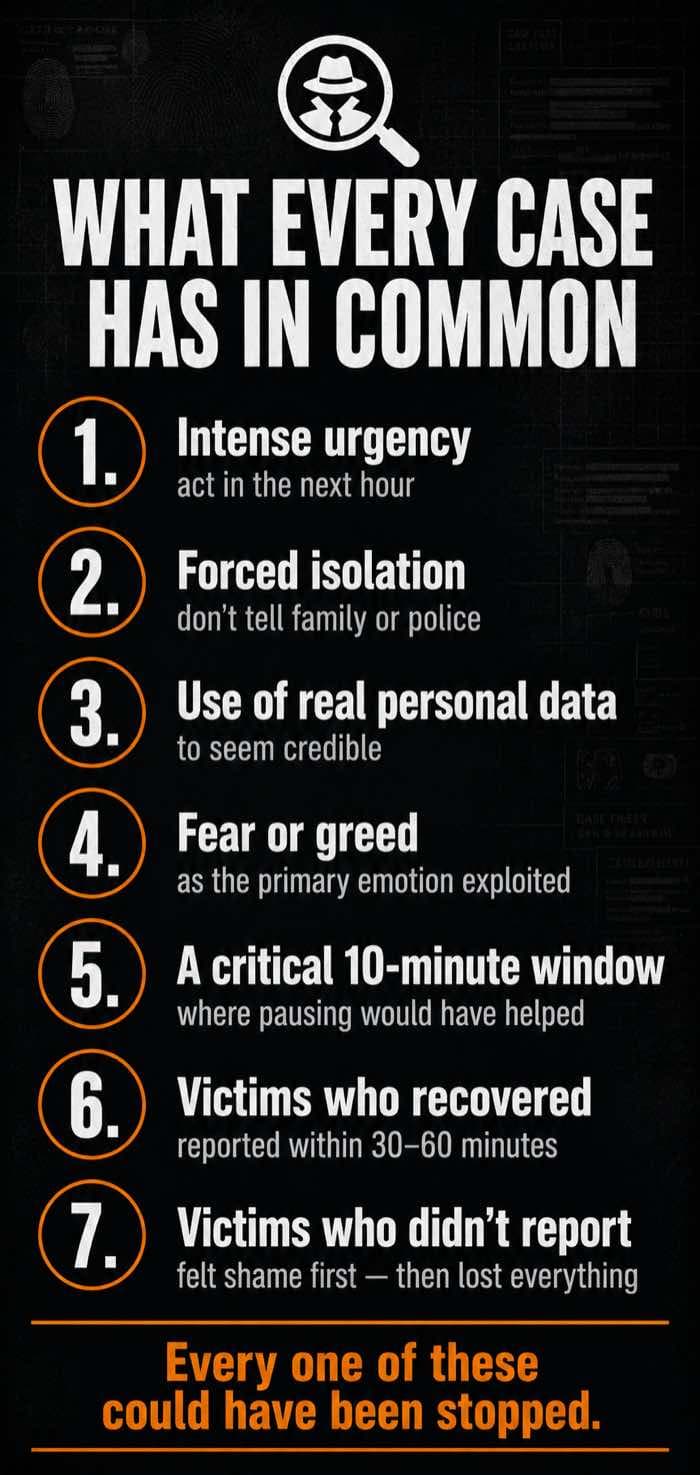
Three of those seven are worth pulling apart, because they are the ones people underestimate.
Isolation is the load bearing wall. Notice that it appears in every case, dressed differently each time. Confidential national security investigation. Do not alert the suspects. Do not tell your family until the profits are withdrawn. Do not let anyone see these photographs. Remove isolation and every one of these frauds fails within a day, because the second person in the room is never under the spell. This is exactly why any instruction to keep a financial matter secret from your own family should be treated as proof of fraud in itself, regardless of how convincing the reason sounds.
Real personal data is cheap and it is not proof of anything. Knowing your name, your address, the last four digits of a card or your employer costs a scammer almost nothing after years of Indian data breaches. It is the credibility down payment, and it is the single most effective one they have, because it triggers a reasonable inference: only an official body would have this. That inference is wrong. Our data breach guide covers where the information actually comes from.
The ten minute window is real and it closes. In every one of these cases there was a point, usually before the first transfer, where ten minutes and one independent phone call would have ended it. The scripts are built specifically to prevent those ten minutes from existing, which is why urgency is never incidental. If someone is working to stop you from pausing, the pause is the correct move.
The Difference Between Victims Who Recovered and Those Who Did Not
The uncomfortable finding across every cyber fraud recovery India real case is that the difference was almost never intelligence, income, education or the size of the loss. It was elapsed time.
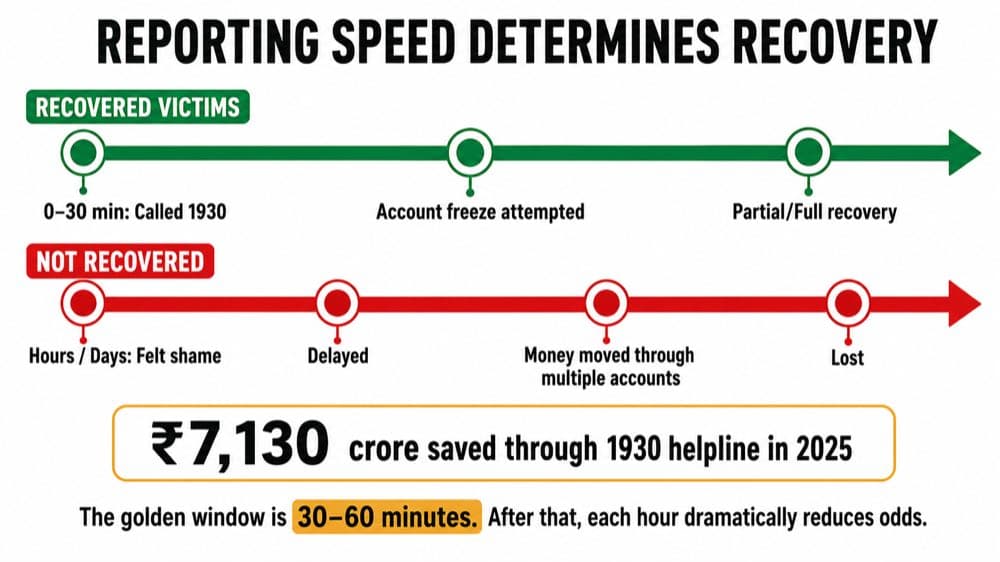
A retired professor in Indore was told by a fake Delhi Police cyber crime officer that his Aadhaar had been linked to accounts used for laundering crores. He transferred Rs 33 lakh. He then reported it fast, police blocked transactions across 49 bank accounts, and Rs 26.45 lakh came back. He used it for a liver transplant in Pune. Reported slowly, that is a story with a very different ending.
The institutional numbers say the same thing. Mumbai Police returned Rs 3.97 crore to 6,096 victims in a two month period of 2026 through the 1930 helpline and the Money Restoration Module, and attributed the recoveries specifically to complaints made during the golden hour. Uttar Pradesh recovered Rs 11.38 crore in six months on the same basis. Nationally, more than Rs 7,130 crore has been saved across more than 23.02 lakh complaints up to 31 October 2025, according to figures placed before Parliament by the Ministry of Home Affairs.
The mechanism behind the golden hour is worth understanding, because it explains why the window is so unforgiving. When you call 1930, the system can request a lien on the beneficiary account. That only works while the money is still sitting in it. Mule networks are built to move funds onward within minutes, splitting them across further accounts in a process called layering. Once layering has happened, there is no single account left to freeze. The Bengaluru case involved 23 mule accounts across 10 banks precisely to make tracing slow and freezing impractical.
Which brings this back to shame, because shame is the actual cause of most delay. The Pune task scam victim reported four months after the last transfer. That is not a person who was confused. That is a person who did not want to say out loud what had happened. The scammers are counting on that response, and it is worth being blunt about the arithmetic: an hour of embarrassment is cheaper than a permanent loss, every single time. Our money recovery guide sets out exactly what to do in the first hour, and our victim rights guide covers what banks and police are legally obliged to do once you report.
30 Second Instagram Reel Script
Format: open on the wall of case cards, cut through the five losses, land on the seven patterns, close on 1930. Shoot vertical 9:16, burn in Hindi and English captions.
On-screen caption: There is no such thing as a digital arrest in Indian law. Nobody official will ever tell you to hide a case from your family. If money has moved, call 1930 in the first hour and file at cybercrime.gov.in the same day.
Frequently Asked Questions
What is the biggest cyber fraud case in India in 2026?
The largest individual digital arrest loss documented so far in 2026 is that of a 74 year old retired teacher in Bengaluru who was defrauded of nearly Rs 24 crore between 10 February and 24 April 2026. Fraudsters impersonating senior officers of the CBI and the Enforcement Directorate told her that her name had surfaced in a money laundering investigation, then held her under continuous psychological pressure while she made 26 transfers into 23 mule accounts spread across roughly 10 banks in different states. Karnataka State Cyber Command has called it the largest digital arrest case in the state. Six accused from Tamil Nadu, Gujarat, Maharashtra, Delhi and Bihar have been arrested, around Rs 4 crore was blocked and Rs 1.46 crore has been recovered so far.
How much do digital arrest victims typically lose in India?
The range is enormous, from under a lakh to more than Rs 24 crore, so the average is a poor guide. What the I4C data does show is the total shape of the problem. Digital arrest cases peaked in 2024 at 1,23,672 reported cases and Rs 1,918 crore in losses, then fell sharply in 2025 to 17,264 cases and Rs 644 crore after a sustained government awareness campaign. The cases that make the news sit between Rs 10 lakh and Rs 1 crore, and victims are overwhelmingly educated professionals and retirees, because the scam needs a target who has savings, understands the seriousness of a CBI notice, and has a reputation to protect. That last part is the point. The fraud is engineered for people who have something to lose.
Did any fraud victims in India recover their money?
Yes, and the pattern is consistent. A retired professor in Indore lost Rs 33 lakh to a fake Delhi Police cyber crime officer and got Rs 26.45 lakh back after police blocked transactions across 49 bank accounts. Mumbai Police returned Rs 3.97 crore to 6,096 victims in a two month stretch of 2026 through the 1930 helpline and the Money Restoration Module. Uttar Pradesh recovered Rs 11.38 crore in six months, and police there attribute it directly to victims calling during the golden hour. Nationally, more than Rs 7,130 crore has been saved across more than 23.02 lakh complaints up to 31 October 2025. In almost every recovery the victim reported fast enough for a lien to be placed before the money was layered.
What psychological technique do scammers use in Indian fraud cases?
Every major Indian fraud case runs the same four step sequence. First, credibility, built from real details the scammer already holds, a genuine looking ED or RBI notice, or a video call with a police uniform and a station backdrop. Second, a powerful emotion, either fear of arrest or the pull of a return that is just plausible enough. Third, urgency, a deadline measured in hours so there is no time to check anything. Fourth, isolation, an explicit instruction not to tell family, colleagues or police, usually justified as an official secrecy requirement. The order matters. Credibility opens the door, emotion removes judgement, urgency removes verification and isolation removes the one person who would have said stop.
Should fraud victims feel ashamed in India?
No, and the shame is the most expensive part of the whole fraud. These are rehearsed operations run by organised networks with scripts, fake documents, call centres and mule account infrastructure spanning several states. The documented victims include a retired teacher, a BHEL engineer, university professors, a vice chancellor, a retired Army colonel, doctors and software engineers. Feeling ashamed delays the call to 1930, and that delay is precisely what turns a recoverable loss into a permanent one. Reporting inside the first hour is both the brave choice and the practical one.
How do I report a cyber fraud in India and how fast do I need to be?
Call 1930 immediately, before you do anything else, and file the complaint at cybercrime.gov.in the same day. Speed is the single variable you still control. The first 60 minutes is the window in which the helpline can request a lien on the beneficiary account before the money is withdrawn or split across further accounts. Keep every screenshot, UTR number, phone number and app link. Tell your bank in writing the same day. If the fraud involved a phone number or WhatsApp account, also report it on Sanchar Saathi so the connection can be disconnected. If a lending app is harassing you, an FIR is the correct route, and the harassment itself is a criminal offence regardless of whether any loan is outstanding.
Sources and Credits
- The420.in, Six Arrested After Elderly Victim Loses Rs 24 Crore in Psychological Cyber Fraud: the 74 year old retired teacher, the 26 transactions into 23 mule accounts across roughly 10 banks, the CBI and ED impersonation, the private bank manager who flagged the transaction pattern, the Rs 4 crore blocked and Rs 1.46 crore recovered.
- The Logical Indian, 74 Year Old Bengaluru Woman Allegedly Duped of Rs 24 Crore in Digital Arrest Scam, 6 Arrested: the 10 February to 24 April 2026 timeline, the identities and home states of the six arrested accused, and the Rs 3 crore saved when Cyber Command intervened.
- The Federal, Bengaluru Digital Arrest Scam, Elderly Woman Loses Rs 24 Crore, Six Held: Karnataka State Cyber Command describing this as the largest digital arrest case in the state, and the four month period of continuous psychological duress.
- The420.in, CBI, RBI and Police Impersonation Used in Digital Arrest Scam Targeting BHEL Employee: the 56 year old BHEL employee in Hyderabad, the Rs 15 lakh loss from March 2026, the automated SIM deactivation warning as the entry point, the WhatsApp video call from a fake police officer, the forged ED and RBI notices, and the Cyberabad Cyber Crime Unit investigation.
- The420.in, Pune Cyber Fraud Victims Lose Over Rs 1.08 Crore in Investment and Telegram Scams: the 38 year old who lost Rs 12.30 lakh in the Telegram task scam between 11 December 2025 and 12 January 2026, Inspector Sharad Zine of Ambegaon police station on the small payment confidence build, the 66 year old Kothrud victim who lost Rs 63.56 lakh to a fake investment app, and the 39 year old Bibvewadi victim who lost Rs 32.47 lakh.
- The420.in, Three Pune Residents Lose Lakhs to Sophisticated Online Task Fraud Scams: the prepaid task fee mechanism, the fake dashboards showing accumulated profits, and the tax clearance demand at the withdrawal stage.
- The Bridge Chronicle, Pune Cyber Fraud Surge, 42 Online Cheating Cases in a Day: the Kothrud crypto case in which the victim was shown profits above Rs 80 lakh and asked for Rs 29 lakh in processing charges before any withdrawal would release.
- ANI, From Small Loans to Massive Loss, Victim Loses Rs 36.16 Lakh After Using Illegal Lending Apps Loan Radar and Quick Funds: the 46 year old Sanath Nagar borrower, the gallery and contact permissions granted at installation, the threatening calls from day six, the morphed pornographic images, the Rs 29 lakh disbursed against Rs 64.16 lakh repaid between September 2025 and February 2026, and the net loss of Rs 36.16 lakh.
- India.com, Delhi Police Busts Major Extortion Racket Involving Over 100 Chinese Loan Apps: the Delhi Police IFSO investigation identifying more than 100 lending apps in a coordinated extortion racket, the roughly 60 suicides linked to the blackmail, and the movement of proceeds abroad through hawala and crypto.
- Deccan Herald, Harassed for 3 Months, Bengaluru Lecturer Pays Rs 5.69 Lakh for Rs 50k Loan to App Agents: the scale of repayment demanded against a small principal under sustained harassment.
- ThePrint, Indore Retired Professor Loses Rs 33 Lakh in Digital Arrest Scam, Gets Back Rs 26.45 Lakh: the fake Delhi Police cyber crime officer, the Aadhaar linked money laundering claim, the Rs 26.45 lakh recovered after transactions across 49 bank accounts were blocked, and the liver transplant funded with the recovered money.
- Free Press Journal, Mumbai Police Cybercrime Crackdown, Rs 3.97 Crore Returned to 6,096 Victims in 2 Months: the Money Restoration Module results and the attribution of recoveries to complaints made during the golden hour.
- The420.in, UP Sets New Benchmark in Cyber Fraud Recovery, Rs 11.38 Crore Recovered in 6 Months: the golden hour mechanism, the lien request on the beneficiary account inside the first 60 minutes, and the effect of layering on recovery odds.
- Press Information Bureau, Cyber Security and Financial Fraud Combat: more than Rs 7,130 crore saved in more than 23.02 lakh complaints up to 31 October 2025 through the Citizen Financial Cyber Fraud Reporting and Management System and the 1930 helpline.
- ThePrint, After 465 Percent Spike in 2024, MHA Data Shows Digital Arrest Scams Are on a Decline in India: I4C figures showing 1,23,672 digital arrest cases and Rs 1,918 crore lost in 2024, falling to 17,264 cases and Rs 644 crore in 2025.
- TechStory, India Loses Rs 22,495 Crore to Cyber Crimes in 2025 as Cases Surge Past 28 Lakh: the national loss total for 2025 and the 24 percent year on year rise, drawn from Ministry of Home Affairs and I4C data.
- Telangana Today, Hyderabad Cybercrime, Senior Citizens Lose Rs 102 Crore in 19 Months: the concentration of losses among senior citizens in a single city.
- National Cybercrime Reporting Portal: the official complaint route, and India national cybercrime helpline, 1930.
- Indian Cyber Crime Coordination Centre, Ministry of Home Affairs: the national body that operates the 1930 helpline and publishes the fraud statistics cited throughout this guide.
Every case here had one moment where checking would have ended it.
A number you do not recognise. A link you were told to open urgently. An app you were told to install right now. Check it on RakshaAI first. It takes less time than the pause the scammer is trying to deny you.
Check for freeMore from RakshaAI Blog
PAN Card Fraud India: How Scammers Are Misusing Your PAN in 2026
Social Media Account Cloning India: When Scammers Become You Online
Public WiFi Safety India: How Scammers Use Free WiFi to Steal Your Data in 2026
Stay Protected Online
Use RakshaAI to check websites, phone numbers, and UPI IDs for scams free, instant, no sign-up required.
RakshaAI is a private platform by Ehatech Services Pvt. Ltd. Not affiliated with any government body. Editorial policy