
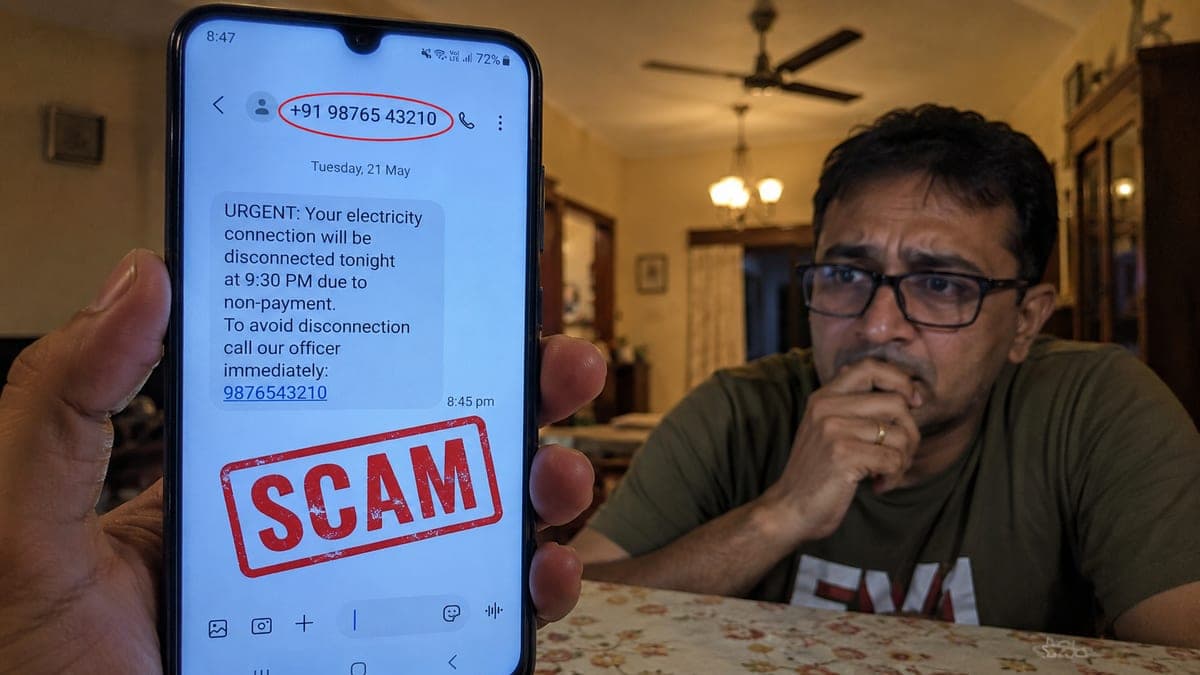
It arrives at 8:45 in the evening. Dinner is on the table, the fan is running, the lights are on, and the phone buzzes.
URGENT: Your electricity connection will be disconnected tonight at 9:30 PM due to non-payment. To avoid disconnection call our officer immediately.
Forty five minutes. A number to call. And a house full of people who have no idea whether the last bill was paid or not.
Utility bill fraud India 2026 runs on that gap between the threat and the deadline, and the electricity bill scam India 2026 is its highest volume format by a wide margin. It is not clever. It does not need to be. It only needs forty five minutes in which you do not stop to check, because the moment you check, the whole thing collapses.
This guide covers the three variants operating across India, the documented police cases behind each one, the single legal fact that makes every version of this message impossible, and the thirty second check that settles it. Read it once and you will never fall for it, and more usefully, you will be able to explain it to your parents in one sentence.
The 30 second version
- 1No electricity board in India can disconnect you tonight, the law requires 15 clear days of written notice
- 2A real board texts from a registered header like VM-MSEDCL, never from a 10 digit mobile number
- 3A real board publishes one helpline, usually 1912, it never asks you to call an officer on a personal number
- 4A real board never asks you to install AnyDesk, QuickSupport, TeamViewer or an APK file to pay
- 5A real board never collects into a personal UPI ID, only its own portal or Bharat BillPay
- 6Open your board official app and read your actual bill, that takes 30 seconds and ends the question
- 7Already paid? Call 1930 in the first hour, then file at cybercrime.gov.in and forward the SMS to 1909
Why the Electricity Scam Works on Almost Everyone
Most scams have to find a victim who wants something. This one does not, and that is what makes it different.
Every household in India has an electricity connection. Every household has, at some point, been genuinely late on a bill. So the message does not have to be convincing in the way a lottery win or a job offer has to be convincing. It only has to be plausible, and it is plausible to almost everybody, almost all the time.
The second thing it exploits is that most people genuinely do not know their own billing cycle. Ask an average person what date their electricity bill is due and how much the last one was, and you will get a shrug. That uncertainty is the whole opening. The scammer does not need you to believe the bill is unpaid. He only needs you to be unsure.
The third is the size of the consequence relative to the size of the ask. Losing power for a night, with a child studying for exams or an elderly parent on a nebuliser or medicine in the fridge, feels catastrophic. Paying Rs 850 to avoid it feels trivial. The mind does that arithmetic in about two seconds and reaches for the phone. And the payment is rarely where the loss ends, because the payment page is usually just the way in.
The scale of the surrounding problem is not in dispute. India lost Rs 22,495 crore to cyber fraud in 2025 across 28.15 lakh reported cases, a 24 percent rise on the year before, according to Ministry of Home Affairs data. In the same year 1,03,488 senior citizens and 4,63,114 women filed cyber fraud complaints worth Rs 7,769.63 crore. The disconnection SMS is one of the most reliable ways into that population, because it targets a fear that is universal, and because it arrives on the one device everybody now carries.
How the Electricity Bill Scam Works, 3 Variants
The electricity disconnection SMS scam India runs in three formats. They are usually stages of the same operation rather than separate gangs, and a single victim often meets all three in the space of twenty minutes.
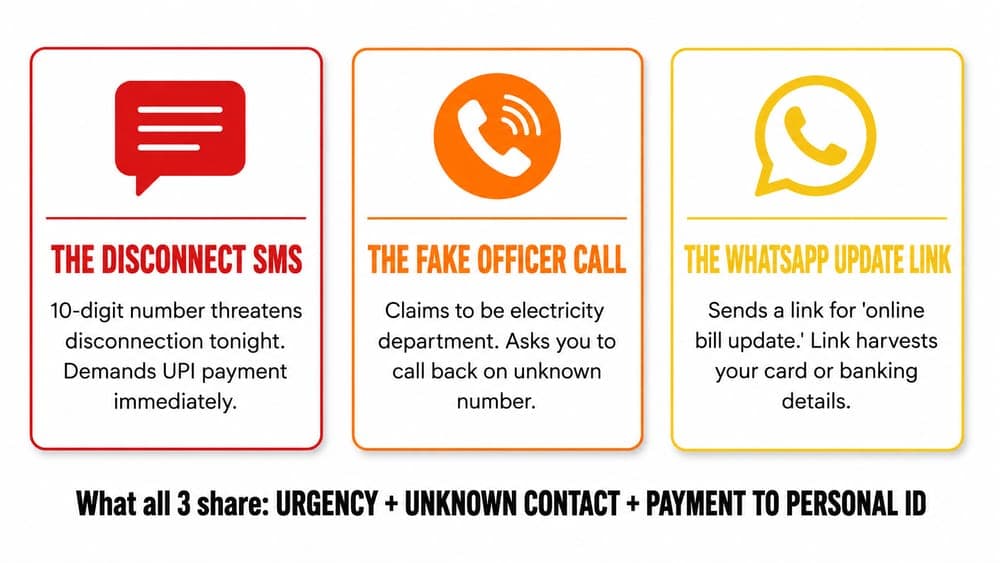
Three variants, one machine
What each stage looks like, and what it is actually trying to take
1The disconnect SMS
A 10 digit number sends a message threatening disconnection tonight for an unpaid bill, and demands immediate UPI payment or a call back to an officer. The urgency is the entire mechanism.
2The fake electricity department call
A caller claiming to be from the electricity department, often as a lineman or junior engineer, asks you to call back on an unknown number or to install a screen sharing app so they can help process the payment.
3The WhatsApp update link
A link arrives for an online bill update or a meter KYC update. It opens a cloned portal that harvests your card or net banking details, or it pushes an APK file that reads your incoming SMS.
What all three share: urgency, an unknown contact, and payment to a personal ID.
Variant 1: The Pay Now or Disconnect Tonight SMS
This is the opening move and the one almost every Indian has now received. The wording barely changes between states. Your electricity will be disconnected tonight at 9:30 PM as your previous month bill was not updated. Contact our officer immediately on this number.
Haryana Police flagged the exact phrasing in a public advisory, noting the messages tell recipients their electricity will be disconnected because the previous month bill was not updated, and push them to call a number or click a link that installs malware to steal banking details. The same template has been in continuous circulation since, which tells you how well it converts.
The construction is worth reading closely because the two most useful tells are visible without leaving the message. The sender is a 10 digit mobile number, which no electricity board in India uses for consumer messaging. And the deadline is measured in hours, which Indian electricity law does not permit under any circumstances. Both are visible before you call anybody.
The word updated is doing quiet work too. It is vague enough to survive the case where you have actually paid, because a person who paid last week can still believe that something failed to update on the system. It is a small piece of social engineering that widens the target from people with dues to everybody. Our guide to the wider SMS scam landscape in India covers the same template applied to parcels, banks and KYC.
Variant 2: The Fake Electricity Department Phone Call
You call the number, and this is where the actual theft is set up. The fake electricity department call India is the most practised part of the operation, and the people running it are good at it.
The person who answers identifies as a lineman, a junior engineer or a billing officer. They are calm and slightly bored, which is exactly how a real government official sounds. They confirm dues that sound about right for your area. Then they offer to help, and the help is the trap. Either a small verification payment to confirm the account, or an app to install so they can process the payment for you.
The verification payment sounds harmless because it is designed to. Delhi Shahdara district cyber police documented a case that opened with a request for a nominal verification payment of just Rs 13 through a digital payment app. That single transaction was the door. Fraudsters then obtained remote access to the victim phone and moved Rs 20,26,035 out in phases. Dhananjay Gond, 30, from Ghazipur in Uttar Pradesh was arrested, following earlier arrests of two others, and the investigation found the gang misusing Common Service Centre login credentials to route stolen money through channels that looked legitimate.
The app request is the other route, and it is the older one. AnyDesk, TeamViewer and QuickSupport are the names that recur. Once the caller can see your screen, they do not need your password, because you will type it for them and read out the OTP yourself. Anything you can see, they can see.
The defence is a single rule with no exceptions: hang up, and call the number on your printed bill or on the official website you typed yourself. Not the number in the message, and not the number the caller gives you for the supervisor. If you want to check a caller before you engage at all, run it through the phone number checker, and our guide on how to check a scam phone number covers the full pattern.
Variant 3: The WhatsApp Electricity Update Link
The third variant skips the phone call. A link arrives on WhatsApp for an online bill update or a meter KYC update, and it goes to one of two places.
The first is a cloned payment portal. It carries the board logo, the right colours and a form asking for your consumer number, phone number and card details. This is ordinary credential harvesting dressed as a utility page, and it works because nobody scrutinises a domain name when they believe they have twenty minutes of power left. Our guide on how fake government websites are built in India covers what these clones get wrong and how to spot it.
The second is worse. The link pushes an APK file, an Android installer sent outside the Play Store, described as the official bill payment app. Installing it grants permissions to read incoming SMS, which means every OTP your bank sends is delivered straight to the fraudster. At that point they no longer need you on the phone at all. Delhi Police documented this variant in a case where fraudsters posing as gas company officials persuaded a victim to install a malicious APK, enabling unauthorised transactions of over Rs 2.24 lakh from his credit card. The same playbook is run under an electricity board name.
One rule handles both. Never open a payment link that arrived in a message, and never install an Android app from outside the Play Store, whoever appears to have sent it. If you want to know what a link is before you touch it, paste it into the website safety checker.
The One Fact That Exposes Every Electricity Scam
Everything above collapses into one sentence, and it is worth memorising because it works on every variant, in every state, forever.
No electricity board in India can disconnect your supply tonight.
This is not a policy or a courtesy. It is Section 56 of the Electricity Act, 2003, which states that where a person neglects to pay any charge for electricity, the licensee may cut off supply only after giving not less than fifteen clear days notice in writing. The same section requires supply to be restored once the charge and the reconnection expenses are paid, gives you the right to pay under protest while a billing dispute is pending, and sets a two year limitation on recovering dues from the date they first became due. State electricity regulatory commission supply codes add further procedural steps on top of that floor.
Fifteen clear days, in writing. There is no provision anywhere in Indian electricity law for a same night cut announced by text message, which means a message threatening one is not a warning about your bill. It is the confession that it is fake.
How to identify a fake electricity disconnection SMS in India:
- 1
Check the sender, a real board uses a registered header and never a 10 digit mobile number
MSEDCL publishes VM-MSEDCL, VK-MSEDCL, AM-MSEDCL and JM-MSEDCL as its only legitimate headers. Since 6 May 2025 every Indian header also carries a TRAI category suffix, so a genuine service message ends in -S or -G.
- 2
Check the deadline, no real board demands payment tonight or within 2 hours
Section 56 of the Electricity Act, 2003 requires not less than fifteen clear days of written notice before supply can be cut for non payment. A same night cut announced by SMS does not exist in Indian law.
- 3
Check the contact, real boards do not route you to a personal number
A genuine board publishes one helpline, 1912 in most states, on the printed bill and on its official website. A message that names an officer and a mobile number has already failed the test.
- 4
Check the payment route, never a personal UPI ID and never a link in a message
A board collects into a corporate account through its own portal or through Bharat BillPay. Payment to an individual UPI handle or a bank account in a person name is conclusive.
- 5
Check what it asks you to install, no board needs an app to take a payment
AnyDesk, TeamViewer, QuickSupport and any APK file sent over WhatsApp are the tools of the fraud, not the payment. This request alone ends the conversation.
- 6
Open your board official app or type the website address yourself
Log in with your consumer number and read the actual bill and due date there. This takes about thirty seconds and it settles the question completely, whatever the message claims.
- 7
Paste any suspicious link into the RakshaAI website safety checker before you click it
The link is the attack surface. Checking it costs nothing, and opening it to see what it looks like is how most people are compromised.
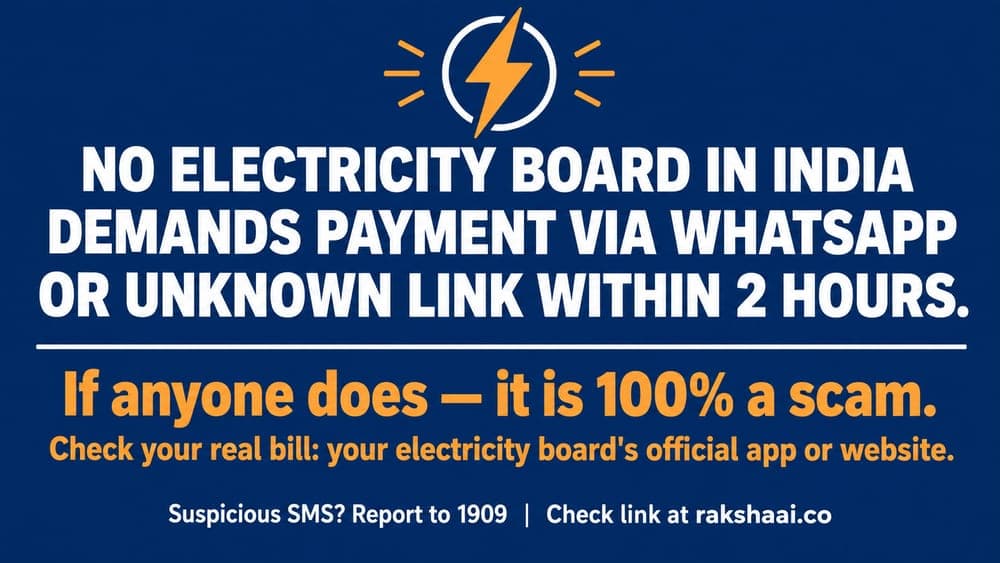
If anyone demands electricity payment through WhatsApp UPI or an unknown link, it is always a scam. There is no exception to this and there never has been.
The sender check deserves one more line because the rules changed recently and most people missed it. Every commercial SMS in India travels through a registered header on the DLT system, and since 6 May 2025 TRAI has required each header to carry a category suffix, so a genuine message reads as a header ending in -T for transactional, -S for service, -P for promotional or -G for government. A message from a 10 digit personal number has not passed through that system at all. MSEDCL made the same point in plain language when it warned consumers on 14 April 2026, publishing VM-MSEDCL, VK-MSEDCL, AM-MSEDCL and JM-MSEDCL as its only legitimate headers and stating that it does not send bill related messages from personal mobile numbers, does not ask consumers to contact officials on personal numbers, and does not ask anyone to download third party applications for bill payments.
Documented Indian Cases
Three cases show the range of this fraud, from the household loss to the laundering infrastructure behind it.
Documented case, Delhi
A Rs 13 verification payment became a Rs 20.26 lakh loss
- Investigating unit
- Shahdara district cyber police, Delhi
- Victim location
- Mansarovar Park, Shahdara
- Pretext
- electricity meter update, callers posing as department officials
- Opening move
- a nominal verification payment of Rs 13 through a digital payment app
- Method
- remote access to the victim phone obtained after that transaction
- Total loss
- Rs 20,26,035, withdrawn in phases
- Arrest
- Dhananjay Gond, 30, of village Churamanpur, Ghazipur, Uttar Pradesh
- Earlier arrests
- Shivkumar and Anshu Kumar, in judicial custody
- Infrastructure
- Common Service Centre login credentials supplied to fraud groups to route stolen money
Documented case, 7 August 2026
Cyber fraud proceeds laundered through other people electricity bills
- Investigating unit
- East Delhi police
- Arrests
- Phool Singh, 30, and Sushil Kumar, 40
- Victim loss in the linked case
- Rs 2.24 lakh
- Traced to electricity bill payments
- Rs 1.82 lakh
- Method
- paying the genuine electricity bills of real consumers using fraud proceeds
- Cash out
- collecting the bill amount back in cash from those consumers
- Commission retained
- 5 to 10 percent before routing the rest onward
- Original fraud
- a malicious APK installed by a victim after a fake gas company official call
- Suspected links
- cyber fraud cases in Mumbai and Karnataka, two phones seized
Documented case, Jalandhar
A 66 year old retired officer lost Rs 1.2 lakh in three transactions
- Victim
- J R Jassal, 66, a retired officer in Jalandhar
- Message
- a WhatsApp notification saying his connection would be cut at 9:30 pm for an unpaid bill
- Contact given
- a 10 digit mobile number in the message
- App installed
- QuickSupport, presented as the power corporation application
- Loss
- Rs 1.2 lakh, taken as Rs 3,230, then Rs 49,000, then Rs 50,000
- Police action
- complaint filed with city police, referred to the cyber cell
- Utility position
- Punjab State Power Corporation confirmed it never sends such SMS or WhatsApp messages about pending bills
The second case is the one worth pausing on, because it shows what happens after the money leaves. The pair were not the people sending the messages. They were the cash out layer, paying the real electricity bills of ordinary consumers with stolen money, collecting the cash equivalent back from those consumers, and keeping 5 to 10 percent. Every one of those consumers got a discounted bill and a receipt that looked entirely normal, and most probably had no idea what had happened. That is how this money becomes clean, and it is why speed matters so much when you report. Our guide to mule accounts and how stolen money is moved in India covers the wider machinery.
How to Check Your Real Electricity Bill and Due Date
This is the part that takes thirty seconds and settles everything, and the whole discipline is contained in one word: yourself.
- Open your board official app, or type the website address yourself. Not a link from the message, not a link from a search advertisement, and not a link a caller reads out to you. Type it, or open the app already on your phone.
- Log in with your consumer number and read the actual bill. Your consumer number is printed on every past bill. The portal shows the current amount, the due date and the payment history. If there are no dues, you already have your answer.
- If you want confirmation by voice, call the published helpline. That is 1912 in most Indian states, or the number printed on your bill. MSEDCL also publishes 1800-212-3435 and 1800-233-3435. Never the number in the message.
- Pay only through the official portal or Bharat BillPay. BBPS, reached through your own bank app or a mainstream UPI app, verifies the biller inside the network, which is why it is a safe route even when you are in a hurry.
- If a link is involved at any point, check it first. Paste it into the RakshaAI website safety checker. Opening it to see what it looks like is how most people are compromised.
Do this once, today, while nothing is urgent. Find your consumer number, log into the portal, note the billing date. The whole reason this scam works is the ten seconds of uncertainty when the message arrives. Removing that uncertainty in advance is the actual defence.
Official Electricity Board Portals, Bookmark These
Bookmark yours now, and put the same bookmark on your parents phone while you are at it.
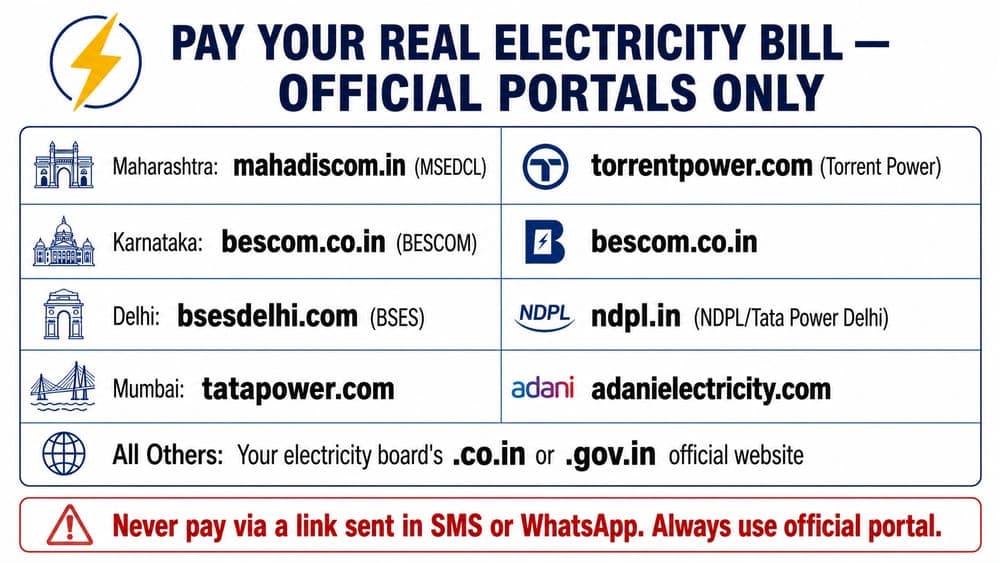
Pay your real electricity bill
Official portals only, typed by you, never reached through a message
- Maharashtramahadiscom.inMSEDCL, Mahavitaran
- Karnatakabescom.co.inBESCOM
- Delhibsesdelhi.com and ndpl.inBSES and Tata Power Delhi
- Mumbaitatapower.com and adanielectricity.comTata Power and Adani Electricity
- Torrent licence areastorrentpower.comTorrent Power
- Everywhere elseyour board .co.in or .gov.in siteOr pay through Bharat BillPay in your own bank or UPI app
Never pay through a link sent in an SMS or on WhatsApp. Always open the official portal yourself.
A note on search results, because this is the other way people land on a fake page. Searching for your electricity board and clicking the first result is not safe, because paid advertisements and search engine optimised clones both sit above the real site regularly. A Muzaffarpur case ran exactly this way: the victim found what looked like a helpline number online, called it, was talked into installing remote access software, and lost money from his bank account. Bookmark the real address once, and stop searching for it.
What To Do If You Already Paid the Scammer
Speed is the only variable you control now, so work down this list in order and do not stop to feel foolish about it. This happens to careful people every day.
- Call 1930 within the first hour with the UPI ID, the amount and the exact time. The golden hour is when a beneficiary account can still realistically be held. The national system has frozen more than Rs 11,158 crore across 32.80 lakh complaints by acting inside that window.
- Put the phone in aeroplane mode and uninstall anything the caller told you to install. A screen sharing app or an APK gives continuing access. Cut the connection before you touch your banking apps, because the attacker may still be watching the screen.
- Change your net banking, UPI and email passwords from a different device. Use a phone or laptop that was never connected to the caller. Enable two factor authentication and check for any new payee or new UPI mandate you did not create.
- File a complaint at cybercrime.gov.in under Financial Fraud the same day. Attach the SMS screenshot, the caller number, the payment reference and the bank statement line. The acknowledgement number is what your bank needs in order to act on a chargeback or a dispute.
- Report the number to 1909, to Chakshu on Sanchar Saathi, and at RakshaAI. Forward the message to 1909, report the sender at sancharsaathi.gov.in, and log the number at rakshaai.co so the next person who checks it sees a warning.
The first hour genuinely matters. The national Citizen Financial Cyber Fraud Reporting and Management System, which sits behind the 1930 helpline, had saved more than Rs 11,158 crore across 32.80 lakh complaints as of 30 June 2026, and almost all of that comes from freezing a beneficiary account before the money is moved on. The Delhi laundering case above shows what you are racing: within hours, that money is paying somebody else electricity bill and coming back as cash.
Reporting the number matters too, even when your own money is gone. The Department of Telecommunications told the Rajya Sabha on 5 February 2026 that the Chakshu facility on Sanchar Saathi received 5.19 lakh fraud reports in 2025, with impersonation of government agencies among the top categories, and that citizen reports had contributed to 39.43 lakh mobile connections being disconnected, 2.27 lakh handsets blacklisted and 1.31 lakh SMS templates blocked. Forwarding the message to 1909 and reporting the sender at sancharsaathi.gov.in takes under a minute and it is what removes the number from circulation.
For the full sequence, including what to say to your bank and how to preserve evidence properly, our guide on what to do in the first 30 minutes after an online scam covers it step by step, and your rights as a cyber fraud victim under Indian law covers what you can compel a bank to do.
30 Second Instagram Reel Script
Format: open on the message and the countdown, kill it with the law, run the three variants fast, land on the thirty second check. Shoot vertical 9:16, burn in Hindi and English captions for sound off viewers.
On-screen caption: No electricity board in India can cut your power tonight. Section 56 of the Electricity Act, 2003 requires 15 clear days of written notice. Real boards text from headers like VM-MSEDCL, never from a 10 digit number, and never ask you to install an app or pay a personal UPI ID. Check your real bill in your board official app. Report the SMS to 1909, the number at sancharsaathi.gov.in, and the link at rakshaai.co. Already paid? Call 1930 in the first hour.
Frequently Asked Questions
Does BESCOM, MSEDCL or any Indian electricity board send disconnection SMS warnings?
Electricity boards do send SMS reminders for overdue bills, but they arrive from a registered alphanumeric sender header, not from a 10 digit mobile number. MSEDCL published its own list when it warned consumers on 14 April 2026, naming VM-MSEDCL, VK-MSEDCL, AM-MSEDCL and JM-MSEDCL as its only legitimate headers, and stating plainly that it does not send bill related messages from personal mobile numbers. Since 6 May 2025 every registered header in India also carries a category suffix under TRAI rules, so a genuine service message from a board reads as a header ending in -S or -G, and a promotional one as -P. A legitimate notice also never asks you to contact an officer on a personal number, never asks you to download an application to make a payment, and never routes payment to an individual UPI ID. Any message that does any of those three things is a scam regardless of how official the wording sounds.
What happens if I do not pay my electricity bill on time in India?
Your board sends reminder notices, and if the dues remain unpaid it must serve a formal written disconnection notice before cutting supply. Section 56 of the Electricity Act, 2003 is explicit about this: a licensee may cut off supply only after giving not less than fifteen clear days notice in writing, and must restore supply once the charges and the reconnection expenses are paid. The same section gives you the right to pay under protest while a billing dispute is pending, and sets a two year limitation on recovering dues from the date they first became due. What no board in India can do is send a single SMS at 8:45 pm threatening a cut at 9:30 pm the same night and demand immediate payment to an unknown number. That timeline does not exist in law, which is precisely why it is the clearest tell in the entire scam.
How do I find my real electricity bill amount in India?
Open your electricity board official app or type its website address yourself, log in with your consumer number, and read the bill there. Do not reach a payment page through a link in an SMS or a WhatsApp message, because the link is the whole attack. The major official portals are mahadiscom.in for MSEDCL in Maharashtra, bescom.co.in for BESCOM in Karnataka, bsesdelhi.com for BSES and ndpl.in for Tata Power Delhi, tatapower.com and adanielectricity.com in Mumbai, and torrentpower.com in the Torrent Power licence areas. Every other state board publishes on a .co.in or .gov.in address. Bharat BillPay, reached through your own bank or UPI app, is also a safe route because the biller is verified inside the network. If you are unsure whether you actually have dues, call the published helpline, which is 1912 in most states, taken from the bill or the official website rather than from any message.
I already sent money to an electricity scammer, what should I do?
Call 1930 immediately and give the UPI ID or the phone number you paid, the amount and the exact time. The first hour is when a beneficiary account can still realistically be frozen, and the Citizen Financial Cyber Fraud Reporting and Management System has held more than Rs 11,158 crore across 32.80 lakh complaints by working inside that window. File in parallel at cybercrime.gov.in under Financial Fraud. If you installed anything the caller told you to install, whether AnyDesk, QuickSupport, TeamViewer or an APK file sent on WhatsApp, put the phone into aeroplane mode first, uninstall it, and change your net banking and UPI credentials from a different device, because the attacker may still be watching the screen. Then report the number at rakshaai.co so the next person who checks it sees a warning rather than a sales pitch.
How do I report a fake electricity bill SMS in India?
Forward the message to 1909, which is the TRAI spam reporting number, and report the sender at the Chakshu facility on the Sanchar Saathi portal, sancharsaathi.gov.in. Those reports do produce action: the Department of Telecommunications told the Rajya Sabha on 5 February 2026 that 5.19 lakh reports came through Chakshu in 2025 alone, and that citizen inputs had led to 39.43 lakh mobile connections being disconnected, 2.27 lakh handsets blacklisted and 1.31 lakh SMS templates blocked. Report the number at rakshaai.co as well. If the message carried a link, run it through rakshaai.co/website-safety-checker before you do anything else, and never to see what it looks like. If money was lost, file at cybercrime.gov.in and call 1930.
How can I tell a fake electricity disconnection SMS from a real one in India?
Five checks separate them and every one of them can be done in seconds. Look at the sender: a real board texts from a registered header such as VM-MSEDCL, a scam texts from a 10 digit mobile number. Look at the deadline: a real notice cannot demand payment tonight or within two hours, because Section 56 of the Electricity Act requires fifteen clear days of written notice. Look at the contact: a real board publishes a single helpline such as 1912, it does not ask you to ring an officer on a personal number. Look at the payment route: a real board collects through its own portal or Bharat BillPay, never into a personal UPI ID. And look at what it asks you to install: no electricity board in India has ever needed you to install a screen sharing app or an APK file to pay a bill. If any one of those five is wrong, stop there. You do not need the other four.
Can an electricity board really disconnect my power in 2 hours?
No. Section 56 of the Electricity Act, 2003 requires not less than fifteen clear days of notice in writing before supply is cut for non payment, and state electricity regulatory commission supply codes build further procedural steps on top of that. In practice this means a genuine disconnection is preceded by a written notice you can hold, delivered well in advance, usually after several reminders. There is no provision anywhere in Indian electricity law for a same night cut announced by text message. Scammers use tonight and two hours precisely because the urgency stops you from checking, and the entire scam depends on you not having ten seconds to think. Knowing that one legal fact is enough to defeat every version of this fraud.
Why do these fake electricity SMS messages ask me to install AnyDesk or an APK file?
Because the payment is not the point, access is. Screen sharing tools such as AnyDesk, TeamViewer and QuickSupport let the caller watch your screen while you open your banking app, which hands them your credentials and every OTP as it arrives. An APK file sent over WhatsApp goes further and installs malware that can read incoming SMS directly, so the fraudster no longer needs you present at all. The pattern is documented across Indian cases. A 66 year old retired officer in Jalandhar was told to install an app called QuickSupport and lost Rs 1.2 lakh in three transactions. In Delhi, Shahdara cyber police traced a case where a Rs 13 verification payment through a digital payment app opened the door to remote access and more than Rs 20 lakh taken in phases. The rule is absolute: no electricity board, bank or government department in India will ever ask you to install an application in order to make a payment.
Sources and Credits
- Section 56 of the Electricity Act, 2003, on Indian Kanoon and the bare text of Section 56, Disconnection of supply in default of payment: the requirement of not less than fifteen clear days notice in writing before supply may be cut off for non payment, the restoration of supply once charges and reconnection expenses are paid, the right to pay under protest during a billing dispute, and the two year limitation on recovery of dues.
- ThePrint, Cybercrime Saw 24 Percent Spike in 2025, Indians Lost Rs 22,495 Crore, reporting Ministry of Home Affairs data: the Rs 22,495 crore lost to cyber fraud in 2025, the 28.15 lakh cases recorded against 22.68 lakh in 2024, the 24 percent rise, and the Rs 8,031.56 crore of fraudulent transactions blocked by the Indian Cyber Crime Coordination Centre.
- The News Mill, Over 1 Lakh Senior Citizens and 4.63 Lakh Women Report Rs 7,769 Crore Cyber Fraud in 2025: the 1,03,488 senior citizens and 4,63,114 women who filed cyber fraud complaints in 2025, and the split of Rs 4,005.12 crore and Rs 3,764.51 crore in reported losses.
- The Free Press Journal, MSEDCL Warns of Spike in Fake Power Disconnection Messages, 14 April 2026 and Lokmat Times, Electricity Bill Fraud: MSEDCL Warns Consumers Against Fake Messages: the MSEDCL statement that it does not send bill related messages from personal mobile numbers, the legitimate sender headers VM-MSEDCL, VK-MSEDCL, AM-MSEDCL and JM-MSEDCL, the official helplines 1912, 1800-212-3435 and 1800-233-3435, and the confirmation that genuine messages never ask consumers to contact officials on personal numbers or to download third party applications for bill payments.
- The420.in, From Rs 13 to Rs 20 Lakh: Electricity Update Scam Leads to Arrest: the Shahdara district cyber police case in Delhi, the Rs 13 verification payment that opened the fraud, the total loss of Rs 20,26,035, the arrest of Dhananjay Gond of Churamanpur village in Ghazipur, the earlier arrests of Shivkumar and Anshu Kumar, and the misuse of Common Service Centre login credentials to route stolen money.
- The Pioneer, Delhi: Two Held for Routing Cyber Fraud Money Through Electricity Bill Payments, 7 August 2026: the East Delhi arrests of Phool Singh, 30, and Sushil Kumar, 40, the Rs 2.24 lakh victim loss with Rs 1.82 lakh traced to electricity bill payments, the method of paying genuine consumer bills with fraud proceeds and collecting cash back at a 5 to 10 percent commission, the malicious APK installed after a fake gas company official call, and the suspected links to cases in Mumbai and Karnataka.
- The Tribune, Senior Citizen Loses Rs 1.2 Lakh in Electricity Bill Scam: the 66 year old retired officer in Jalandhar, the WhatsApp message threatening disconnection at 9:30 pm, the QuickSupport application he was told to install, the loss of Rs 1.2 lakh across transactions of Rs 3,230, Rs 49,000 and Rs 50,000, and the confirmation from Punjab State Power Corporation that it never sends such messages about pending bills.
- The Tribune, Fake Bill Messages Being Sent, Say Cops: the Haryana Police advisory on the template message stating that electricity will be disconnected because the previous month bill was not updated, and the warning that the links in these messages install malware to steal personal and banking details.
- The420.in, Electricity Bill Scam Shocks Muzaffarpur: the case of a resident who found a fake helpline number online, was guided into installing remote access software, and lost money through unauthorised bank transactions traced to multiple accounts across states.
- Moneylife, Fraud Alert: Beware of Electricity Bill Scam: the original template of the disconnection message threatening a cut at 9:30 pm from an ordinary mobile number rather than an official header, and the AnyDesk screen sharing method used to capture banking credentials while the victim attempts to pay.
- The Tribune, Chakshu Facility of Sanchar Saathi Enables Citizens to Report Suspected Fraud Communications: the written reply of Pemmasani Chandra Sekhar, Minister of State for Communications, in the Rajya Sabha on 5 February 2026, covering the 5.19 lakh Chakshu reports received in 2025, the top categories including impersonation of government agencies, the 39.43 lakh mobile connections disconnected, 2.27 lakh handsets blacklisted and 1.31 lakh SMS templates blocked, and the 7.7 lakh suspected fraud communications reported since launch.
- TRAI, Telecom Commercial Communications Customer Preference Regulations amendment, 12 February 2025 and India SMS regulations, DLT registration and TRAI compliance guide: the registered header framework, the category suffixes -T, -S, -P and -G that became mandatory from 6 May 2025, the requirement that URLs and APK links inside templates be pre whitelisted on the DLT portal, and the extension of the spam complaint window from three days to seven days.
- Chakshu, Sanchar Saathi, Department of Telecommunications: the official route for reporting a suspected fraud call, SMS or WhatsApp message in India.
- National Cybercrime Reporting Portal: the official complaint route for online financial fraud in India, and the national cybercrime helpline, 1930.
- Telecom Regulatory Authority of India: the spam reporting framework behind the 1909 short code for forwarding unsolicited and fraudulent commercial messages.
- MSEDCL, Mahavitaran, BESCOM, BSES Delhi, Tata Power, Adani Electricity and Torrent Power: the official consumer portals and published helplines for the boards named in this article.
More from RakshaAI Blog

AI Scam India: How Artificial Intelligence Is Making Fraud More Dangerous in 2026
Credit Card Fraud India 2026: How Scammers Clone and Misuse Your Card
Bank Account Fraud India 2026: How Scammers Access and Empty Your Account
Stay Protected Online
Use RakshaAI to check websites, phone numbers, and UPI IDs for scams free, instant, no sign-up required.
RakshaAI is a private platform by Ehatech Services Pvt. Ltd. Not affiliated with any government body. Editorial policy