
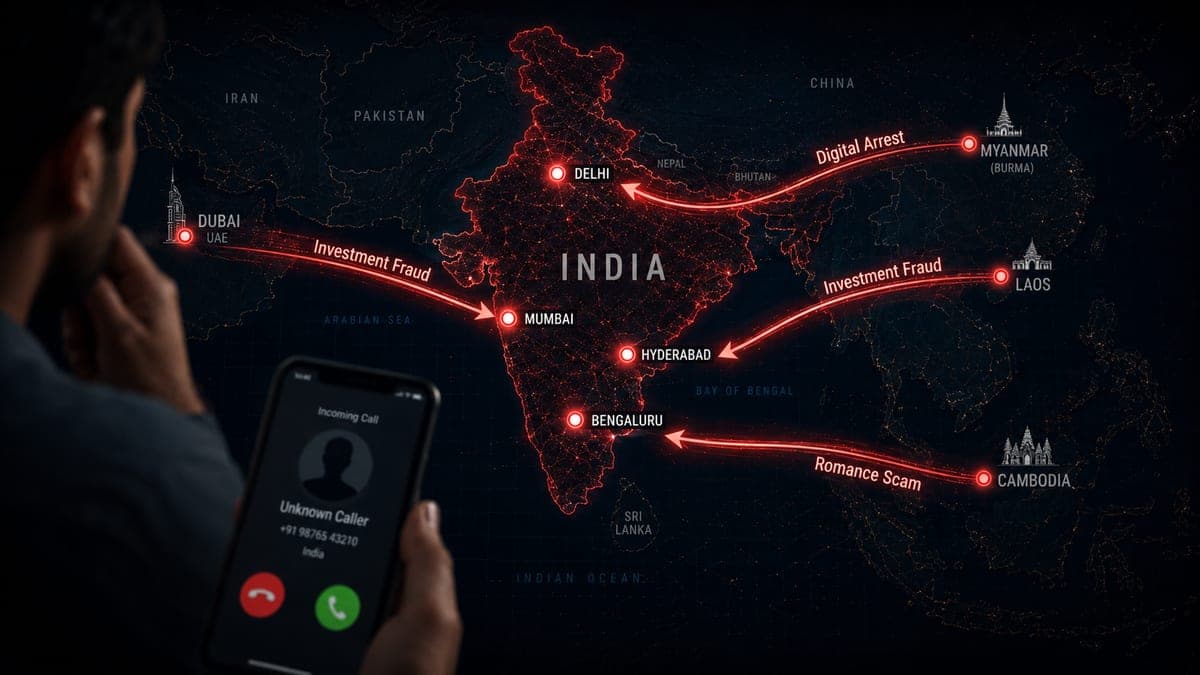
In February 2026, Cambodian officials walked a group of reporters through a raided compound in Kampot province. Inside they found rows of computer stations, desks covered in printed instructions for scamming victims, and studio booths built for phone calls. In one room there was a fake Indian police station. Boards carried the emblem of the Central Bureau of Investigation. Posters of the Greater Mumbai Police were fixed to the walls. Portraits of Mahatma Gandhi and B R Ambedkar hung behind the desk, positioned so they would sit in frame on a video call.
That room is the answer to a question thousands of Indian families have asked after losing money. The officer looked real, the office looked real, the seal looked real. It was a set, built four thousand kilometres away, by people whose full time job is defrauding Indians.
Overseas cyber fraud India 2026 is no longer a fringe category. Ministry of Home Affairs and I4C assessments now place more than half of the cyber fraud targeting Indians inside high security compounds in Cambodia, Myanmar and Laos, with Vietnam and Thailand also in the picture. This guide covers the scale, the compound model stage by stage, the recruitment pipeline that pulls Indian youth into those buildings, the money trail out, and the two defences that matter most: verifying an overseas job before anyone flies, and recognising the script before you transfer anything.
The 60 second version
- 1More than half of India's cyber fraud in 2025 was run from compounds in Cambodia, Myanmar and Laos
- 2The same buildings run digital arrest, investment fraud, romance scams and task scams
- 3Many of the workers are trafficked Indians, recruited with fake data entry jobs in Thailand or Dubai
- 4They know your PAN and address because Indian breach data is bought in bulk, not because they are officials
- 5Verify any overseas job at emigrate.gov.in before anyone books a ticket
- 6If money has moved, call 1930 the same hour and file at cybercrime.gov.in
- 7If a person is trapped, call the MEA on 1800 118 797 and file at madad.gov.in
The Scale, Over Half of Indian Cyber Fraud Now Originates Abroad
The MHA I4C transnational fraud India picture has changed shape in two years. Cyber fraud used to be described in India as a problem of specific domestic districts, and that framing produced a whole genre of reporting about Jamtara and Mewat. It is now, in volume terms, largely a foreign run industry aimed at India from outside it.
Ministry of Home Affairs assessments reported through 2025 and 2026 place more than half of the cyber frauds targeting Indians in 2025 inside high security compounds in Cambodia, Myanmar, Laos, Vietnam and Thailand, operated under handlers with Chinese syndicate links. A narrower I4C figure, cited specifically for digital arrest fraud, puts nearly 46 percent of those operations in Cambodia, Myanmar and Laos alone. Indian intelligence assessments referenced in policy briefings identified roughly 45 scam centres in Cambodia, five in Laos and one in Myanmar as active against Indian targets.
The Indian loss side matches. MHA figures put cyber fraud losses at about Rs 22,495 crore in 2025 across roughly 2.81 million reported cases, up from about 2.26 million cases in 2024, a rise of around 24 percent. The National Human Rights Commission has cited a six year cumulative figure of Rs 52,976 crore. Set against that, the enforcement conversion is the number that should worry you most: of roughly 2.81 million complaints in 2025, only 55,484 became FIRs, under two percent.
Zoom out one level and the regional total dwarfs the Indian one. A United Nations Office on Drugs and Crime report released in July 2026 estimated that victims across East Asia, Southeast Asia, Australia and New Zealand lost between 88.3 billion and 114.1 billion US dollars to transnational online scams in 2025, at least three times the 18 to 37 billion dollar range estimated for 2023. UNODC described organised crime in the region as moving away from fragmented local syndicates and towards an integrated, transnational and technologically sophisticated criminal economy. India is one of the largest single victim pools inside that economy.
Documented case, February 2026
A fake Indian police station inside a Cambodian compound
- Location
- Kampot province, Cambodia
- Found inside
- CBI emblem boards, Greater Mumbai Police posters, Gandhi and Ambedkar portraits
- Purpose
- video call sets for digital arrest scripts aimed at Indian victims
- Crackdown scale
- about 190 locations sealed, 173 arrested, roughly 11,000 workers deported
- Also recovered
- printed scripts instructing workers on how to defraud Thai victims
- Reported by
- Reuters and Indian outlets during a supervised media visit
How the Scam Compound Model Works
A scam compound Southeast Asia India operation is not a gang. It is a factory with a hiring pipeline, a supply chain, shift supervisors, performance quotas and a treasury function. Understanding it as a business is what makes the defences obvious, because every stage has a point where an outsider can break the chain.
The model runs in six stages. The first three build the workforce. The last three extract and move the money.
How a compound operates against India
Recruitment to laundering, the six stages behind transnational cyber fraud targeting India
1Recruit
A social media or Telegram advertisement offers data entry or customer support work in Thailand, Cambodia, Laos or Dubai at a salary well above the Indian market rate, placed by a sub agent or travel agent operating inside India.
2Move
The victim flies out on a tourist visa or a visa on arrival, is received by a handler, and is driven across a land border into a jurisdiction where the Indian mission has limited reach.
3Trap
The passport is confiscated on arrival, a debt is declared for travel and accommodation, and the victim is placed inside a guarded compound. Refusal is met with confinement, beatings or electric shocks on the record of NIA investigations.
4Operate
The worker is assigned a script, a target country and a daily quota, and runs digital arrest, investment, romance or task fraud in Indian languages against Indian victims, using Indian SIM cards and purchased identity data.
5Collect
Victim money lands in Indian mule accounts and shell company accounts, is fragmented across hundreds of beneficiaries, and is pulled out through cash withdrawals, payment gateways and bulk note deposits.
6Launder
The proceeds are converted into stablecoins and layered through wallets and underground banking channels across multiple jurisdictions, which is where the Indian trail usually goes cold.
The Recruitment Trap, Fake Jobs in Thailand, Cambodia and Dubai
The fake job Cambodia India pitch is deliberately unremarkable. An advertisement appears on Facebook, Instagram or Telegram, or comes through a sub agent or travel agent operating inside India, offering data entry, customer support or a back office role in Thailand, Cambodia, Laos or Dubai. The salary is well above the Indian market rate for the same work but not absurd. The employer sounds like a BPO. The process is fast, friendly and entirely on chat.
The target profile is specific. These operations want English speaking, computer literate young Indians, which is why the MEA has repeatedly warned that IT skilled graduates are the group being duped in the name of lucrative data entry jobs in Thailand, through social media advertisements and through Dubai based and India based agents. The skill that makes someone employable in an Indian BPO is the same skill the compound is buying.
Travel is where the trap closes. The victim flies out on a tourist visa or a visa on arrival, is received by a handler, and is then driven across a land border into Myanmar, Cambodia or Laos, into a jurisdiction where the Indian mission has limited reach and local enforcement is compromised or absent. Nothing about that journey looks like employment paperwork, and that is precisely the point at which a family member reading this guide could have stopped it.
Chargesheeted case, May 2026
NIA names five in a Cambodia cyber slavery trafficking network
- Alleged kingpin
- Anand Kumar Singh alias Munna Singh, absconding
- Co-accused
- Abhay Nath Dubey, Abhiranjan Kumar, Rohit Yadav, Prahlad Kumar Singh
- Rate
- 2,000 to 3,000 US dollars charged per youth sold to a fake company
- Method
- recruitment through sub agents and travel agents inside India
- On arrival
- passports seized, victims forced to work for scam companies
- Punishment for refusal
- electric shocks, forced confinement, denial of food and water
- Arrests
- three accused held in February 2026 on arrival in Delhi from Cambodia
- Follow up
- NIA raided six locations in Bihar, Uttar Pradesh and Delhi in July 2026
Inside the Compound, Forced to Run Scams Under Threat
The compounds are large. KK Park in Myanmar, on the Thai border near Myawaddy, runs to roughly 250 buildings including warehouses and call centres, and has been used for illegal gambling, fake investment and romance fraud. When the Myanmar military cleared it on 21 October 2025 it detained 2,198 people, among them 445 women, 1,645 men and 98 security guards, and seized 30 Starlink satellite terminals. That figure understates the connectivity: satellite imagery and drone photography had shown close to 80 dishes on the roof of a single building, and SpaceX separately disabled more than 2,500 Starlink devices tied to scam operations in Myanmar in October 2025.
What life inside looks like is now documented from multiple directions. Rescued workers describe passport confiscation on arrival, a manufactured debt for travel and accommodation, 14 hour shifts, quotas, and punishment cells. The NIA case record describes electric shocks, confinement and withholding of food and water. Investigators have also documented cases in which trafficked Indians were forced to call their own families in India to demand ransom money for their release, which turns the victim into another revenue line.
Indian trafficking cyber scam cases therefore produce a genuinely difficult category of person: someone who is simultaneously a trafficking victim and, on paper, a participant in fraud against other Indians. The Indian state has largely treated them as victims for repatriation purposes, which is the correct call, and the prosecutions have concentrated on the recruiters and the money handlers on the India side of the chain.
The Scripts They Use, Why These Calls Sound So Convincing
Three things make a compound call more convincing than a local one, and none of them is intelligence.
The first is production. The caller is working from a built set, in uniform, with a backdrop, on a script refined across thousands of attempts, often with a supervisor listening in. The Kampot compound had studio booths for calls and a fake Indian police station. This is theatre with a budget.
The second is data. Indian identity data circulates in bulk on dark web markets and Telegram channels, sourced from breaches at utilities, lenders, brokers and app developers. The worker opens a record, reads your name, PAN and address back to you, and you conclude that only an official could know that. Our dark web India guide covers how those markets are priced and structured, and the PAN card fraud guide covers what happens to those documents afterwards.
The third is infrastructure. Indian SIM cards are trafficked into these compounds so that caller ID reads as a domestic number, which is why India deactivated 1.2 million SIM cards in 2025 and why I4C and MHA have blocked about 7.81 lakh SIM cards, more than 2 lakh IMEI numbers, 83,668 WhatsApp accounts and 3,962 Skype IDs tied to these operations. The Skype blocks in particular were aimed squarely at digital arrest video call fraud.
Underneath the production values, the scripts are simple and there are only a few of them.
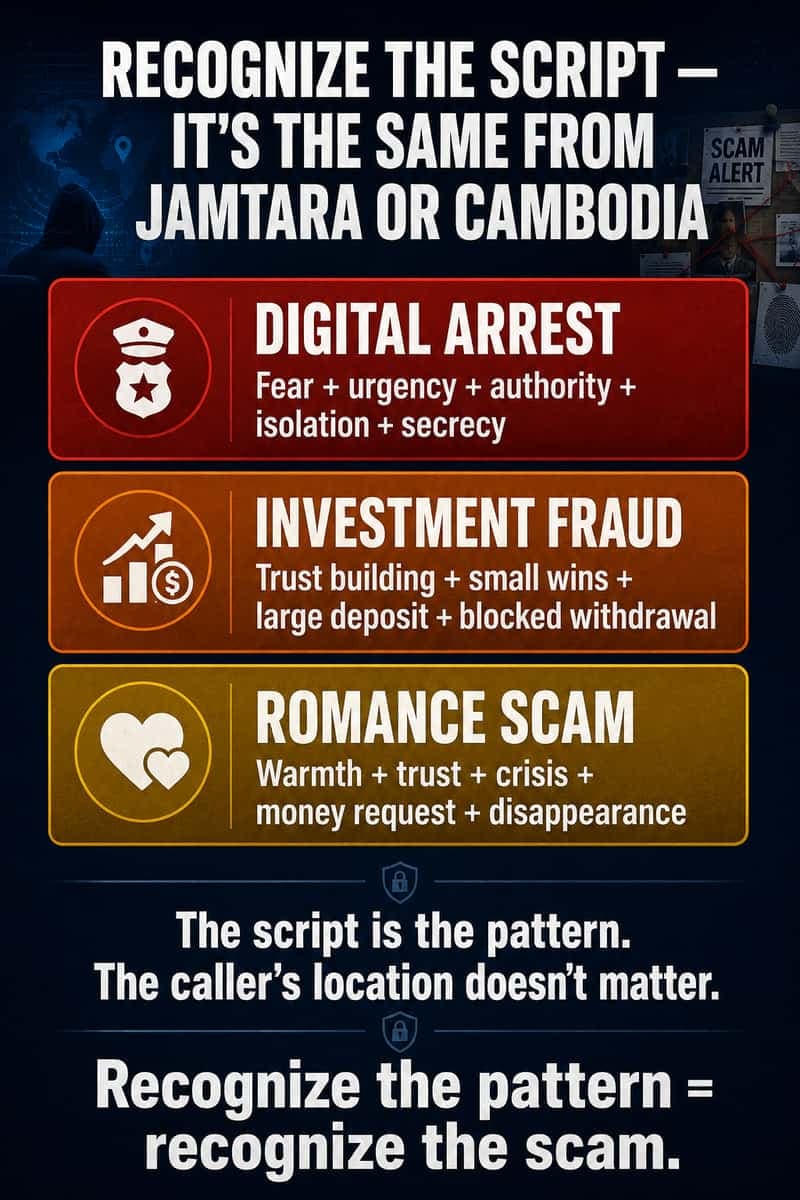
The digital arrest script runs on fear, urgency, authority, isolation and secrecy. A parcel with contraband, a SIM registered in your name, a money laundering case, and then a video call from a fake police station where you are told not to hang up and not to tell your family. The investment fraud script runs on trust building, small wins that are allowed to withdraw, a large deposit, and then a blocked withdrawal with a tax or fee demanded to release it. The romance script runs on warmth, sustained attention, a manufactured crisis, a money request and disappearance, and it very often converts into the investment script halfway through. The task scam script pays you small amounts for trivial work to establish that payouts are real, then requires a deposit you never see again.
All four run out of the same buildings. That is the practical point of this article. If you learn the shape of one, you can recognise all four, and the caller's country code stops being relevant.
The Money Trail, Mule Accounts, Crypto and Cross Border Laundering
Money does not leave India in a suitcase. It leaves through Indian bank accounts opened in the names of Indians, which is why the mule account economy is inseparable from transnational fraud. The Enforcement Directorate case that unfolded through August 2026 shows the full architecture better than any description.
ED investigation, August 2026
One Rs 2.60 crore digital arrest leads to a Rs 27,850 crore money trail
- Origin
- a Goa resident defrauded of Rs 2.60 crore between 21 May and 2 June 2025
- Method
- digital arrest, held under surveillance on video call
- Money traced
- Rs 27,850 crore moved through interconnected entities
- Cash deposits
- Rs 2,904 crore, including Rs 584.70 crore via 61,448 bulk note transactions
- Accounts
- more than 400 beneficiary accounts used as a common pool for layering
- Fronts
- commodity trading, travel and forex firms holding RBI money changer licences
- Proxy directors
- drivers, employees and tenement residents used as paper directors
- Linked complaints
- 163 FIRs across 20 states and union territories, 330 victims, Rs 417.49 crore reported losses
- Arrests
- two accused held on 23 August 2026 under the PMLA
- Seized
- Rs 3.25 crore in cash and more than Rs 30 crore in frozen balances
Read that case as a diagram. A single victim in Goa loses Rs 2.60 crore. Following that money leads to a pool of more than 400 accounts, licensed forex and travel companies used as fronts, proxy directors recruited from the poorest available pool, bulk cash deposits at note acceptance machines in fragments small enough to avoid attention, and eventually to 163 FIRs across 20 states. The compound in Cambodia or Myanmar generates the fraud. The laundering layer is Indian, licensed, and sitting in Indian cities.
From there, the standard route is conversion into stablecoins and layering through wallets and underground banking channels across several jurisdictions, which is where the trail usually goes cold for Indian investigators. UNODC has documented the same underground banking and illicit marketplace layer as the connective tissue of the entire regional criminal economy.
This is also why the golden hour matters so much. In 2025 India froze 1.33 million mule accounts and recovered Rs 5,489 crore, and almost all successful recovery happens in the window before the money is fragmented and converted. Our recovery guide sets out what to do in the first hour.
Who Is Being Recruited Into These Operations
The numbers are on the parliamentary record. In December 2025 the government told Parliament that more than 6,700 Indians had been rescued from fake job rackets in Cambodia, Myanmar and Lao PDR, and that 16,127 complaints had been received from Indian nationals abroad between 1 January 2024 and 30 November 2025. A separate figure of 6,998 covers Indian nationals rescued between 2022 and 2025.
The profile that emerges from those cases is consistent and, for most Indian families, uncomfortably familiar. English speaking. Between roughly 20 and 35. Computer literate, often with an IT or commerce background. Under financial pressure or facing a slow domestic job market. Recruited through a social media advertisement or a local agent, sometimes a relative or an acquaintance, which is what makes the offer credible enough to act on.
Individual cases show the geographic spread. Three young men from Belagavi in Karnataka were rescued from cyber slavery in Cambodia. Three hundred and sixty Indians were freed from compounds in Sihanoukville after being tricked into travelling there, with their passports confiscated on arrival and their days spent running fraud against people in India. The CBI has conducted searches connected to this trafficking chain across Delhi NCR, Haryana, Rajasthan, Gujarat, Kerala and West Bengal, and at locations in Mumbai, Delhi, Lucknow, Kashipur, Gonda and Saharanpur. This is not a regional problem inside India any more than it is a regional problem outside it.
One consequence deserves stating plainly. The person who calls your parent pretending to be a CBI officer may themselves be a twenty four year old from Uttar Pradesh who answered a data entry advertisement, had his passport taken, and is being beaten for missing a quota. That does not make the fraud less real or the loss less painful. It does explain why the enforcement answer cannot only be to arrest callers, and why the useful defences for you sit at the two ends of the chain: verify the job before someone flies, and recognise the script before you transfer.
How to Protect Yourself From Cross Border Scams
How to protect yourself from cross border scam operations targeting India:
- Verify any overseas job offer at emigrate.gov.in before accepting, which is the MEA official emigration portal for checking registered recruiting agents and employers
- Never travel abroad for a job that was offered entirely over WhatsApp or Telegram with no video interview, no company domain and no written contract
- Recognise the scripts, because urgency plus authority plus secrecy is always a scam regardless of the caller's accent or country code
- These operations use your real data from Indian breaches, so personal details recited by a caller do not prove legitimacy and should raise suspicion rather than lower it
- Digital arrest scripts, investment fraud, romance scams and task scams all originate from the same compounds, so learning one pattern protects you against all four
- Check any unknown number at rakshaai.co before you call back, because compound linked numbers are increasingly flagged in the database
- If you suspect a cross border scam, call 1930 and file at cybercrime.gov.in for the money, and report to the MEA at madad.gov.in if a person is involved
The scam script is the same whether it comes from Jamtara or Cambodia. Recognise the pattern and the location stops mattering.
Two of those deserve expansion. On the job side, the single strongest predictor of a trafficking route is an unregistered recruiting agent, and eMigrate is where that is checked in two minutes. Add three refusals to it: refuse a tourist visa or a visa on arrival for a salaried role, refuse to pay an agent, and refuse to fly before a written contract naming a registered company with a physical address. Before departure, leave the passport copy, ticket, offer letter and agent number with two people at home, and agree a daily check in message with a code word that means something has gone wrong.
On the call side, the defence is behavioural rather than technical. No Indian agency conducts arrest, custody or interrogation over a video call. No agency asks you to move money to a verification account. No bank asks for an OTP. If a caller demands secrecy from your own family, that instruction alone identifies the call. Our cyber fraud hotspots guide covers the domestic side of the same industry, and the job scam guide covers the offers that never involve a flight at all.
If Someone You Know Was Recruited Into a Scam Compound
Act on the same day you suspect it. Repatriation from these compounds has worked repeatedly, but it works through consular channels that need a documented case, and the practical difference between a case opened this week and one opened next month is significant.
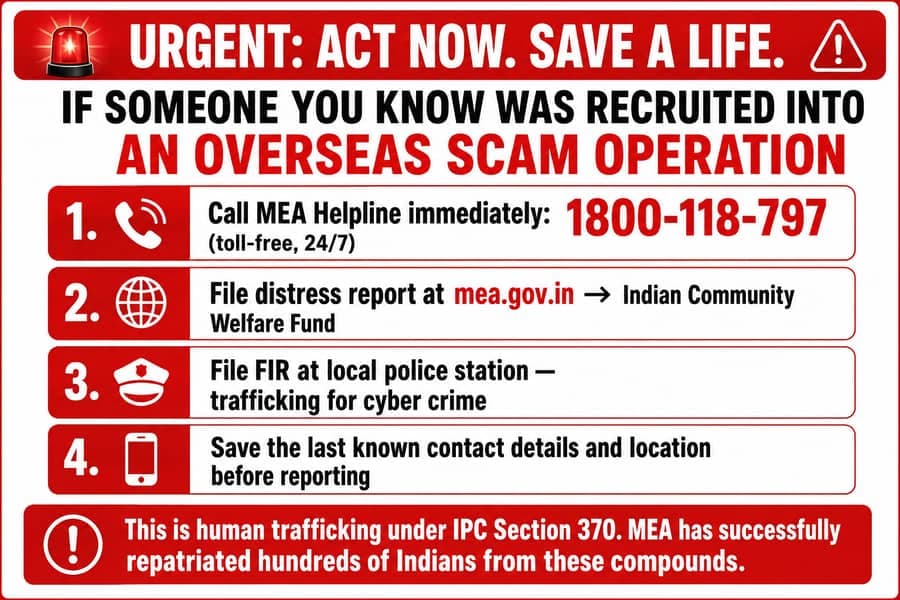
The reporting sequence, in order
- 1
Call the MEA 24x7 helpline immediately on 1800 118 797
Toll free from India. The Overseas Workers Resource Centre helpline on 1800 11 3090 is the second route. Say clearly that the person is held in a scam compound and cannot leave.
- 2
File a distress report at madad.gov.in
MADAD is the MEA consular grievance system that routes the case to the Indian mission with jurisdiction. Register it in the family member's name and keep the reference number.
- 3
Contact the Indian mission in the country directly
The embassies in Phnom Penh, Yangon, Vientiane and Bangkok have run repatriations from these compounds and publish emergency numbers. Send the passport copy and the last known location.
- 4
File an FIR at the local police station as trafficking, not as a job dispute
Insist that it is recorded as human trafficking for cyber crime. The relevant provisions are BNS Section 143 on trafficking of persons with BNS Section 146 on bonded labour, alongside the Emigration Act where an unregistered agent was involved.
- 5
Save every trace before you report
The agent's phone number and chats, the advertisement, the offer letter, the ticket, the passport copy, the last known location and any photograph of the building. Investigators build the network from the agent, not from the compound.
- 6
Report the recruiting agent separately
File at cybercrime.gov.in and with the state police cyber cell naming the agent. The CBI and NIA cases that have produced arrests were built on the India side of the chain, which is the side Indian agencies can actually reach.
Two points on framing. First, insist that the police record it as trafficking for cyber crime rather than as a job dispute or a missing person case, because the classification determines which agency picks it up and whether it can reach the NIA or the CBI. Second, do not let the family pay a release demand quietly. Trafficked workers are routinely forced to call home and ask for ransom money, the payment rarely secures release, and it funds the operation while destroying the evidence trail. Report it instead.
It is also worth knowing that this route works. The MEA and the Indian Air Force brought roughly 1,500 Indians home via Thailand from Myanmar scam centres in the year to late 2025, including 270 people, among them 26 women, flown into Hindon Air Base in early November 2025, and a further 125 repatriated on 20 November 2025. Those flights happened because cases were registered and missions were pushed.
India's Response, MHA, MEA and International Cooperation
India's response operates on four tracks, and it is worth being honest about which ones are working.
Repatriation is the strongest. The MEA, the missions in Bangkok, Yangon, Phnom Penh and Vientiane, and the Indian Air Force have moved thousands of Indians out of these compounds, with 6,700 plus rescued from Cambodia, Myanmar and Lao PDR on the December 2025 parliamentary record. Indian missions have also issued repeated advisories warning job seekers to verify recruiting agents and companies before accepting overseas employment.
Prosecution of the India side is improving. The NIA chargesheeted five accused in a Cambodia linked cyber slavery case in May 2026 and raided further locations in Bihar, Uttar Pradesh and Delhi in July 2026. The CBI has run searches under Operation Chakra V across six states in a transnational digital arrest fraud probe, arrested agents including one in Hisar and one in Lucknow, and used cryptocurrency transaction tracing to map the trafficking network. The ED has attacked the laundering layer under the PMLA, as the Rs 27,850 crore trail above shows.
Infrastructure disruption is substantial in volume. I4C and MHA have blocked 83,668 WhatsApp accounts, 3,962 Skype IDs, about 7.81 lakh SIM cards and more than 2 lakh IMEI numbers linked to these operations. In 2025, 1.2 million SIM cards were deactivated, 1.33 million mule accounts frozen and Rs 5,489 crore recovered. I4C also worked with Microsoft on Skype identities used in digital arrest operations. Host country action has helped: Myanmar's military cleared KK Park in October 2025, and Cambodia had sealed around 190 locations, arrested 173 people and deported roughly 11,000 workers by February 2026.
Domestic follow through is the weak track, and the figure that shows it is the FIR conversion rate. Roughly 2.81 million complaints in 2025 produced 55,484 FIRs, under two percent. For a victim, the operational lesson is not to rely on the complaint alone. File at cybercrime.gov.in, save the acknowledgement number, and then follow it into an FIR at your local cyber cell, because the acknowledgement is what every bank and every later dispute hangs on. Our victim rights guide covers what banks and police are obliged to do once you file.
30 Second Instagram Reel Script
Format: open on the fake police station, reveal the location, show the four scripts, land on the two defences. Shoot vertical 9:16, burn in Hindi and English captions for sound off viewers.
On-screen caption: Over half of India's cyber fraud in 2025 came from scam compounds in Cambodia, Myanmar and Laos. Many of the callers are trafficked Indians. Verify every overseas job at emigrate.gov.in before anyone flies. If money has moved, call 1930 today. If a person is trapped, call the MEA on 1800 118 797 and file at madad.gov.in.
Frequently Asked Questions
How much of India's cyber fraud originates from abroad?
Ministry of Home Affairs and I4C assessments reported through 2025 and 2026 place more than half of the cyber fraud targeting Indians inside scam compounds in Southeast Asia, principally Cambodia, Myanmar and Laos, with Vietnam and Thailand also featuring. A narrower I4C figure cited for digital arrest fraud specifically puts nearly 46 percent of those operations in the same three countries. Indian intelligence assessments referenced in policy briefings identified roughly 45 scam centres in Cambodia, five in Laos and one in Myanmar as active against Indian targets. The financial scale on the Indian side is in the same order. MHA data showed cyber fraud losses of about Rs 22,495 crore in 2025 against roughly 2.81 million reported cases, up from about 2.26 million cases the year before, and the National Human Rights Commission has cited a six year cumulative loss figure of Rs 52,976 crore. These operations are industrialised. Digital arrest calls, fake investment platforms, romance approaches and task scams all come off the same floors.
What is a scam compound in Southeast Asia and how does it target India?
A scam compound is a large, guarded facility, often a converted casino, hotel or purpose built office park, usually sited near a border where law enforcement is weak or absent. Cambodia, Myanmar and Laos host the largest concentrations. KK Park in Myanmar, raided by the Myanmar military on 21 October 2025, runs to roughly 250 buildings. Inside, workers sit at rows of computers running fraud shifts against foreign targets under quotas. The India facing floors use Indian language scripts, Indian SIM cards and Indian personal data bought from breach markets, which is what makes the calls convincing. In February 2026 Cambodian authorities took reporters through a compound in Kampot that contained a fake Indian police station set built for video calls, boards carrying the Central Bureau of Investigation emblem, Greater Mumbai Police posters and portraits of Mahatma Gandhi and B R Ambedkar, all props for defrauding Indians through digital arrest scripts. Many of the workers on those floors were themselves trafficked and are working under threat.
Are Indians being trafficked into scam compounds?
Yes, and the numbers are now on the parliamentary record. In December 2025 the government told Parliament that more than 6,700 Indians had been rescued from fake job rackets in Cambodia, Myanmar and Lao PDR, and that 16,127 complaints had been received from Indian nationals abroad between 1 January 2024 and 30 November 2025. A separate figure put at 6,998 covers Indian nationals rescued between 2022 and 2025. The pattern documented by the NIA and the CBI is consistent. IT literate young Indians answer social media advertisements for data entry or customer support work in Thailand, Cambodia, Laos or Dubai, are moved onward across a land border, have their passports seized on arrival, and are then forced to run fraud against other Indians. The NIA chargesheet filed in May 2026 in a Cambodia linked case records a rate of 2,000 to 3,000 US dollars paid per youth sold to a fake company, and describes electric shocks, forced confinement and denial of food and water for those who refused to work. If you or someone you know has received such an offer, report it to the MEA through madad.gov.in or call the MEA 24x7 helpline on 1800 118 797.
Why do scam callers from abroad know my personal details?
Because your details were sold before the call was made. Indian identity data, PAN and Aadhaar numbers, mobile numbers, addresses, bank and employer details, circulates in bulk on dark web marketplaces and Telegram channels, sourced from breaches at utilities, lenders, brokers and app developers. A compound worker opens a spreadsheet, and the person on the other end hears their own PAN read back to them and concludes the caller must be official. That inference is the entire trick. Knowing your real details proves only that someone bought a database. No genuine Indian police officer, tax officer or bank official establishes their identity by reciting your data at you over an unsolicited call. Treat a caller who recites correct personal details and then asks for money, an OTP or a screen share as more dangerous, not more credible.
What is India doing to shut down these cross border scam operations?
Several things at once, with uneven results. On repatriation, the MEA and the Indian Air Force brought roughly 1,500 Indians home via Thailand from Myanmar scam centres in the year to late 2025, including 270 flown into Hindon Air Base in early November 2025 and 125 more on 20 November 2025. On prosecution, the NIA chargesheeted five accused in a Cambodia linked trafficking case in May 2026 and raided further locations in Bihar, Uttar Pradesh and Delhi in July 2026, while the CBI has run searches under Operation Chakra V across Delhi NCR, Haryana, Rajasthan, Gujarat, Kerala and West Bengal. On infrastructure, I4C and MHA have blocked 83,668 WhatsApp accounts, 3,962 Skype IDs, about 7.81 lakh SIM cards and more than 2 lakh IMEI numbers linked to these operations, and in 2025 alone 1.2 million SIM cards were deactivated, 1.33 million mule accounts frozen and Rs 5,489 crore recovered. Host countries have moved too, with Myanmar's military clearing KK Park in October 2025 and Cambodia sealing around 190 locations by February 2026. The weak link is domestic follow through. Of roughly 2.81 million complaints in 2025, only 55,484 became FIRs, under two percent.
Is a digital arrest call from abroad different from a local one?
Operationally yes, practically no. A compound run call has better production values, since it is delivered from a built set with a uniform, a backdrop and a fake police station, on a script tested across thousands of calls, often with a supervisor listening. It may also route through an Indian number, because Indian SIM cards are trafficked into these compounds precisely so the caller ID looks domestic. None of that changes what you do. There is no provision in Indian law for arrest, custody or interrogation over a video call. No agency freezes your money into a verification account. The defence is identical whether the caller is in Jamtara or Myawaddy: end the call, do not transfer anything, do not stay on video, call 1930, and file at cybercrime.gov.in. Our digital arrest guide covers the script line by line.
How do I check whether an overseas job offer is genuine?
Start at emigrate.gov.in, the Ministry of External Affairs emigration portal, and confirm that the recruiting agent holds a valid registration certificate and that the foreign employer is registered. A genuine overseas employer produces a written contract with a named company, a registered address, a defined role and a visa appropriate to employment. Three signals should end the conversation on their own. First, an entire hiring process conducted on WhatsApp or Telegram with no video interview, no company email domain and no office. Second, travel on a tourist visa or a visa on arrival for what is described as a salaried job, which is the mechanism used to move victims across the Thai and Cambodian borders. Third, any request that you pay the agent, or that you fly first and sign later. Before departure, leave a copy of the passport, ticket, offer letter and agent details with two people at home and agree a daily check in. Our job scam guide covers the domestic versions of the same pitch.
Sources and Credits
- United Nations Office on Drugs and Crime, July 2026, New UNODC Report Reveals Scale of South East Asia's Ever More Interconnected Criminal Economy: the estimate that victims across East Asia, Southeast Asia, Australia and New Zealand lost between 88.3 billion and 114.1 billion US dollars to transnational online scams in 2025, at least three times the 2023 range, and the finding that regional syndicates are consolidating into an integrated transnational criminal economy built on underground banking and illicit online marketplaces.
- Observer Research Foundation, Digital Arrest Scams and the Limits of Domestic Enforcement: the I4C figure that nearly 46 percent of digital arrest operations originate in Cambodia, Myanmar and Laos, the 2025 loss figure of Rs 22,495 crore, the NHRC six year cumulative figure of Rs 52,976 crore, the 55,484 FIRs against roughly 2.81 million complaints, the 2025 enforcement totals of 1.2 million SIM cards deactivated, 1.33 million mule accounts frozen and Rs 5,489 crore recovered, and the blocking totals of 83,668 WhatsApp accounts, 3,962 Skype IDs, about 7.81 lakh SIM cards and more than 2 lakh IMEI numbers.
- Drishti IAS, Rising Cyber Frauds in India: the assessment that over 50 percent of cyber frauds targeting Indians in 2025 originated from Southeast Asian countries including Cambodia, Myanmar, Vietnam, Laos and Thailand, operated from high security compounds under Chinese linked handlers, and the intelligence count of 45 scam centres in Cambodia, five in Laos and one in Myanmar.
- Insights on India, Cybercrime in India 2025, 24 Percent Spike and Rs 22,495 Crore Lost: the MHA reported rise in cybercrime cases from about 2.26 million in 2024 to about 2.81 million in 2025 and the associated loss figure.
- Business Standard, Cambodia Crackdown Exposes Digital Arrest Scam Centre Targeting Indians: the February 2026 media visit to the raided Kampot compound, the fake Indian police station, the CBI emblem boards, the Greater Mumbai Police posters, the portraits of Mahatma Gandhi and B R Ambedkar, the studio booths for calls and the printed scam instructions found on the desks.
- All India Radio News, Cambodia Government Comes Down Heavily on 200 Suspected Scam Centres and The Business Standard, Cambodia Says It Has Closed Almost 200 Scam Centers in Fraud Crackdown: the February 2026 statement by Chhay Sinarith, head of the Commission for Combating Online Scams, that 190 locations had been sealed, 173 people arrested and about 11,000 workers deported since the campaign began in late 2025.
- Al Jazeera, Myanmar Military Arrests More Than 2,000 People at Infamous Scam Centre: the 21 October 2025 clearing of KK Park, the 2,198 people detained including 445 women, 1,645 men and 98 security guards, and the seizure of 30 Starlink satellite terminals.
- CNN, SpaceX Disables Thousands of Starlink Devices Being Used by Myanmar Scam Centers: the disabling of more than 2,500 Starlink devices tied to Myanmar scam operations in October 2025, and the satellite and drone imagery showing close to 80 dishes on the roof of a single KK Park building.
- KK Park, background reference: the roughly 250 buildings on the site, the mix of warehouses and call centres, and the use of the compound for illegal gambling, fake investment and romance fraud.
- Business Standard, Over 6,700 Indians Rescued From Fake Job Rackets in Southeast Asia and ETV Bharat, Over 6,700 Duped by Fake Job Firms Rescued From Cambodia, Myanmar and Lao PDR: the December 2025 parliamentary statement on Indians rescued from Cambodia, Myanmar and Lao PDR, and the 16,127 complaints received from Indian nationals abroad between 1 January 2024 and 30 November 2025.
- The420.in, Over 6,700 Indians Rescued From Cybercrime Scam Centres in Cambodia, Laos and Myanmar: the MEA account of IT skilled youth duped with lucrative data entry jobs in Thailand through social media advertisements and Dubai based and India based agents, and the physical punishments including torture and electrocution reported by those who refused to comply.
- NIA chargesheets five in the Cambodia cyber slavery trafficking case, May 2026: the naming of absconding alleged kingpin Anand Kumar Singh alias Munna Singh with co-accused Abhay Nath Dubey, Abhiranjan Kumar, Rohit Yadav and Prahlad Kumar Singh, the 2,000 to 3,000 US dollars charged per youth sold to a fake company, the seizure of passports on arrival, and the electric shocks, forced confinement and denial of food and water used against those who resisted.
- ANI, NIA Raids Six Places in Bihar, UP and Delhi in Cambodia Linked Human Trafficking and Cyber Slavery Case: the July 2026 searches continuing the same investigation.
- All India Radio News, CBI Conducts Raids Across Six States in Transnational Cyber Fraud Probe: the Operation Chakra V searches at nearly 40 locations across Delhi NCR, Haryana, Rajasthan, Gujarat, Kerala and West Bengal in a transnational cyber enabled digital arrest fraud case.
- Moneylife, CBI Busts Cyber Slavery Trafficking Network Sending Indians to Myanmar and Cambodia Scam Compounds and Moneylife, CBI Arrests Hisar Agent in Cyber Slavery Network: the coordinated searches at nine locations including Mumbai, Delhi, Lucknow, Kashipur, Gonda and Saharanpur, the arrests of recruiting agents, the cryptocurrency transaction tracing used to map the network, and the accounts of victims forced to ask their families in India for money to secure release.
- Moneylife, Rs 2.60 Crore Digital Arrest Fraud Leads ED to Rs 27,850 Crore Money Trail Linked to 163 FIRs Across India: the Goa victim defrauded of Rs 2.60 crore between 21 May and 2 June 2025, the Rs 27,850 crore traced through interconnected entities, the Rs 2,904 crore in cash deposits including Rs 584.70 crore across 61,448 bulk note transactions, the more than 400 beneficiary accounts, the commodity trading, travel and forex companies holding RBI money changer licences, the proxy directors drawn from drivers and employees, the 163 FIRs across 20 states and union territories with 330 complaints and Rs 417.49 crore in reported losses, the arrests of Fahim Moin Hussain Sayed and Naim Mueen Sayyed on 23 August 2026 under the PMLA, and the Rs 3.25 crore in cash seized with more than Rs 30 crore frozen.
- The Tribune, Indians Rescued From Myanmar Job Scam Repatriated to India and Malay Mail, India to Repatriate Nationals Fleeing Myanmar's Cyber Scam Hub: the November 2025 Indian Air Force flights carrying 270 Indians including 26 women from Myawaddy into Hindon Air Base, the further 125 repatriated on 20 November 2025, and the running total of roughly 1,500 Indians returned via Thailand since March 2025.
- The Record, India Says It Has Rescued Citizens From Cambodian Cyber Slavery and Business and Human Rights Resource Centre, 360 Indians Rescued From Cambodian Scam Compounds: the Sihanoukville rescues, the confiscation of passports on arrival, and the forcing of rescued workers to run scams against people in India.
- Deccan Herald, Three Belagavi Youth Forced Into Cyber Slavery in Cambodia Rescued: an individual Indian case showing the recruitment to rescue arc.
- The Conversation, Inside Southeast Asia's Scam Compounds, a Trafficked Worker Tells of Fraud, Coercion and Torture: first hand interview material from rescued workers in Phnom Penh describing 14 hour workdays, electric shocks and dark room confinement, and compounds tipped off before raids.
- Ministry of External Affairs, Consular Complaints and Grievances: the MADAD consular grievance system at madad.gov.in, the MEA 24x7 helpline on 1800 118 797, and the Overseas Workers Resource Centre toll free helpline on 1800 11 3090.
- eMigrate, Ministry of External Affairs: the official portal for verifying registered recruiting agents and foreign employers before accepting an overseas job offer.
- National Cybercrime Reporting Portal: the official complaint route for online financial fraud and identity theft, and India's national cybercrime helpline, 1930.
Figures in this article are drawn from Ministry of Home Affairs and I4C data reported through 2025 and 2026, Ministry of External Affairs parliamentary statements, NIA, CBI and Enforcement Directorate case records, and the July 2026 UNODC regional assessment. Where estimates differ between sources, the article states the source alongside the number. Cases involving accused persons are reported at the stage they have reached, and naming an accused is not a finding of guilt.
More from RakshaAI Blog
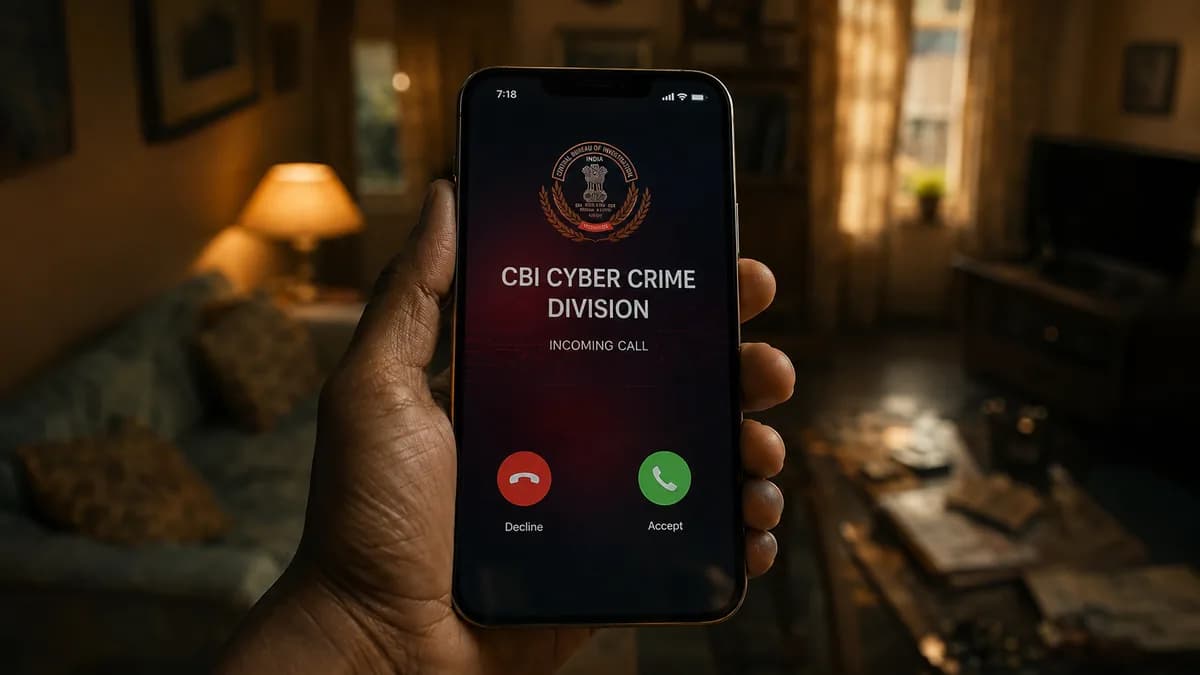
Digital Arrest Scam: What To Do If You Get That Call in 2026
Electricity Bill Scam India: That Disconnection Today SMS Is Always Fake
Health Insurance Fraud India: Fake Mediclaim Policies and Hospital Scams
Stay Protected Online
Use RakshaAI to check websites, phone numbers, and UPI IDs for scams free, instant, no sign-up required.
RakshaAI is a private platform by Ehatech Services Pvt. Ltd. Not affiliated with any government body. Editorial policy