
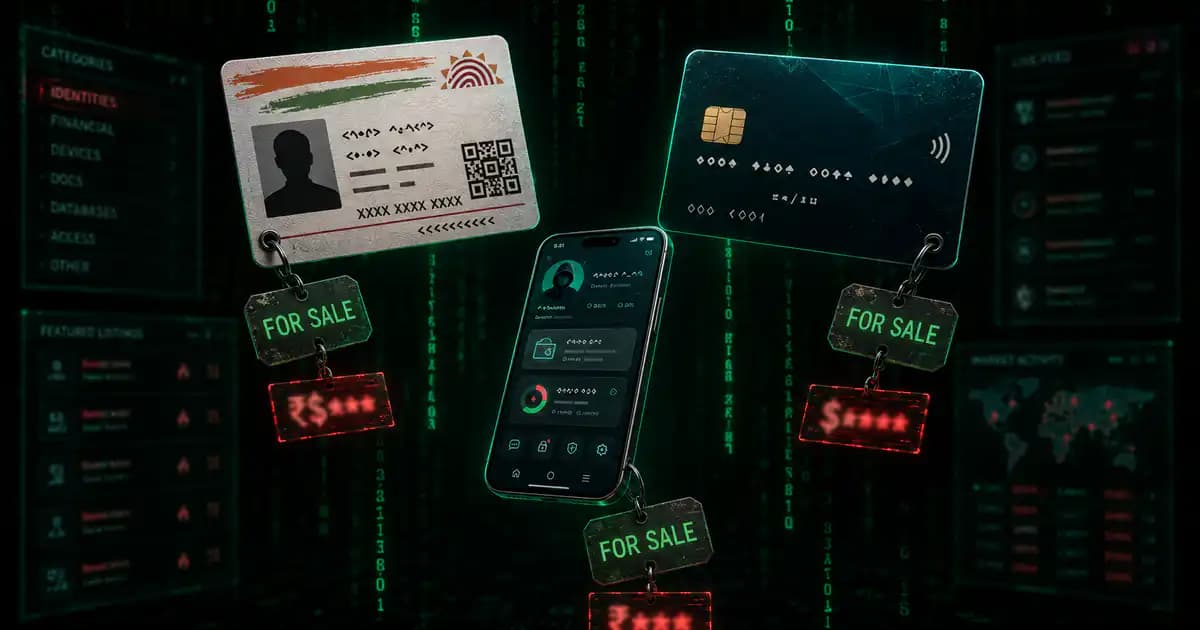
A dark web listing can expose identity and financial context even when it does not provide direct access to a bank account. No real personal data appears in this illustration.
Dark web India 2026 became an urgent search after Bank of Baroda confirmed a cybersecurity incident on 27 July. A criminal listing was reported to advertise more than 700 GB of customer and internal material. The bank confirmed unauthorized access through a compromised employee email account, said its core banking system remained secure, and started a forensic review.
That distinction matters. A breach claim is not proof that every advertised file is genuine, and leaked identity data does not automatically let a stranger move money. But names, phone numbers, addresses, loan papers, email addresses, and identity documents can make a fake bank, courier, police, or KYC call frighteningly convincing.
This investigation separates confirmed facts from criminal claims, explains what Indian personal data looks like when traded, and gives you a free personal data breach check India routine. No consumer tool can search every private criminal forum. The goal is to find known breaches and downstream warning signs before they become financial loss.
What Is the Dark Web and Why India Is a Top Target
The web has three practical layers. The surface web is indexed by normal search engines. The deep web includes ordinary private services such as email inboxes, banking portals, and company databases. The dark web is a small part of the internet reached through special anonymity software. It supports legitimate privacy uses, but criminals also use hidden forums and leak sites to advertise stolen data, malware, credentials, and access to organizations.
India is attractive because one digital identity is connected to many daily systems. A phone number may be tied to banking alerts, UPI, email recovery, shopping, delivery, employment, credit, and government services. A criminal does not need one perfect database. They can combine an old password leak with a marketing list, a public social profile, and a forged identity document.
CYFIRMA's 2025 annual industries report recorded about 242,000 data leak and breach posts in underground and dark web sources during 2025. Its analysis described data leaks and breaches as the largest category of observed chatter and identified heightened activity across several Asian countries, including India. The figures are global telemetry, not a count of Indian victims, but they show a mature market built around stolen information.
Recent Indian Data Breaches and Indian Data Dark Web Reports
The phrase Indian data dark web covers very different situations: a company-confirmed incident, a researcher-validated sample, an exposed public website, or an anonymous seller making an unverified claim. Treating them as identical creates panic. The cases below state what was reported, who confirmed it, and what remains unknown.
Bank of Baroda: More Than 700 GB Advertised in July 2026
In the most recent Bank of Baroda data leak 2026 report, the bank confirmed that an employee email account was compromised and certain data was accessed without authorization. The Indian Express, citing the bank and Reuters, reported that material appeared on a dark web site on 25 July and was advertised as more than 700 GB. Reports said samples appeared to include customer information, identity documents, loan records, and internal material.
What remains unconfirmed is equally important. As of 3 August 2026, the bank had not publicly identified every affected customer or confirmed the full advertised volume and contents. Its core banking system was not breached, according to the bank. Customers should take precautions without trusting anyone who calls to "secure" the account or asks for an OTP, PIN, screen share, or transfer.
CoWIN Vaccination Portal Disclosure in 2023
In June 2023, a Telegram bot reportedly returned vaccination-linked personal details when queried with a phone number. Reports described names, dates of birth, phone numbers, and identity document details. The government did not confirm a direct CoWIN database breach. A Rajya Sabha response dated 21 July 2023 said CERT-In had taken cognizance of the incident and that the bot did not appear to be directly accessing CoWIN APIs.
This is why "CoWIN leak" needs careful wording. Personal information was reportedly retrievable, but the exact source and route were disputed. A dataset can contain fields that resemble one service while actually being assembled from earlier leaks or several sources.
CYFIRMA's Ongoing Dark Web India Reports
CYFIRMA India dark web 2026 research provides current examples without claiming that every listing is authentic. In May 2026, CYFIRMA reported a threat actor's claim involving an Indian school search and admissions platform. Its assessment explains how exposed student records can support phishing, account takeover, fraudulent applications, and mule-account recruitment.
CYFIRMA's broader telemetry also shows why an old leak stays dangerous. Information can be copied, enriched with new details, repackaged for a different fraud group, and discussed again long after the original organization fixes its systems.
Telecom SIM Registration Records
Telecom claims illustrate why criminal listings require skepticism. In July 2024, a seller claimed to offer data for about 375 million Airtel users, including phone and identity details. Airtel said its investigation found no breach of its systems. TechCrunch found discrepancies in the sample and quoted CloudSEK's assessment that it appeared to be an aggregate of multiple databases rather than an Airtel database. The forum reportedly removed the post and blocked the seller as a suspected scammer.
The lesson is not that telecom-linked data is harmless. It is that a dark web advertisement proves only that someone made a claim. Verification requires sample analysis, provenance work, an affected organization's findings, and sometimes a regulatory or police investigation.
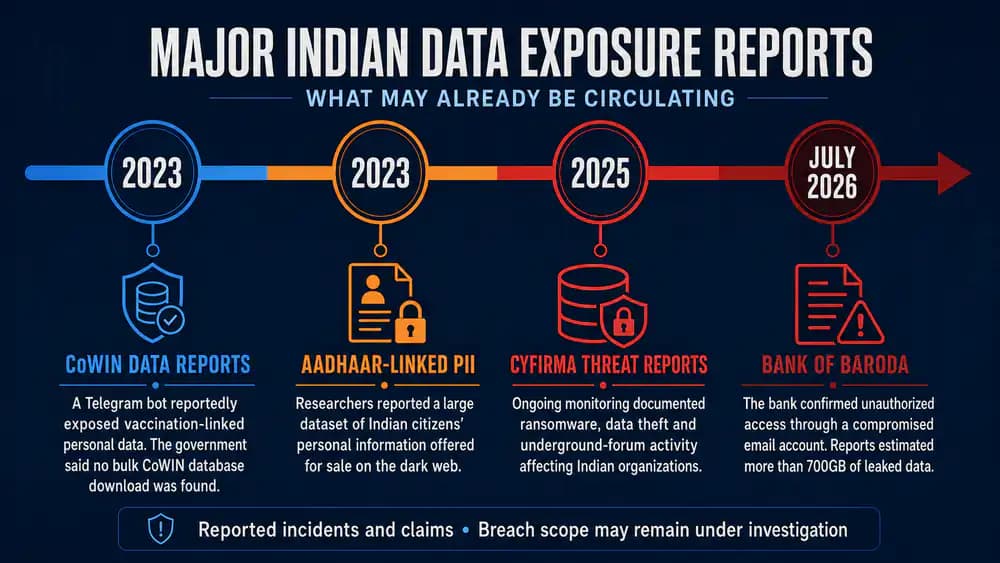
The timeline labels reported incidents and claims. Scope and source can remain disputed even when some exposed records appear genuine.
What Indian Data Looks Like When Sold on the Dark Web
A seller may advertise a downloadable database, access to a company system, screenshots, or a sample of several records. Packages can contain email and password combinations, names and mobile numbers, home addresses, dates of birth, PAN or Aadhaar details, passport information, loan documents, transaction records, or company files. The data may be fresh, years old, duplicated, fabricated, or combined from several leaks.
The combination is more dangerous than one field. Your Aadhaar number is not a password and does not, by itself, unlock a bank account. But a caller who knows your name, lender, address, and last four identity digits can sound authoritative. A reused email password can enable account takeover. A phone number plus forged KYC can support a SIM swap using leaked data. Real identity details can strengthen a digital arrest using real details.
In September 2024, MeitY said it blocked websites exposing Aadhaar and PAN details and that CERT-In found security flaws in the affected sites. The government also stated in December 2025 that no breach had occurred from UIDAI's central database. Both facts can be true: Aadhaar-linked information can leak from organizations that collected it even when the central identity repository was not breached. Read RakshaAI's deeper Aadhaar data breach guide.
How to Check If Your Data Is on the Dark Web in India for Free
How to check if your data is on the dark web in India for free:
- Go to haveibeenpwned.com and enter your email address to check known breach datasets.
- Check your phone number at rakshaai.co for available scam reports and public risk signals. This does not confirm a dark web leak.
- Search your email or phone number in quotation marks on Google. An appearance on an unknown public page may indicate exposure, but no result does not prove safety and Google does not search the dark web.
- Open myaadhaar.uidai.gov.in and review Authentication History for activity you do not recognize.
- Get your free annual report at cibil.com and look for unfamiliar loan or credit enquiries.
- Watch for unexpected OTPs, password reset messages, SIM service loss, and login alerts. These can indicate an attempted account access.
None of these checks every dark web forum directly. They reveal known breach records, public exposure, scam signals, identity use, credit activity, and attempted access. A paid "dark web scan" also cannot guarantee complete coverage.
For haveibeenpwned India searches, enter only an email address on the genuine domain. Do not type a password into a breach-check page. Have I Been Pwned's separate password tool accepts a password check, but a password manager's built-in compromised-password warning is easier and reduces the chance of landing on an imitation site.
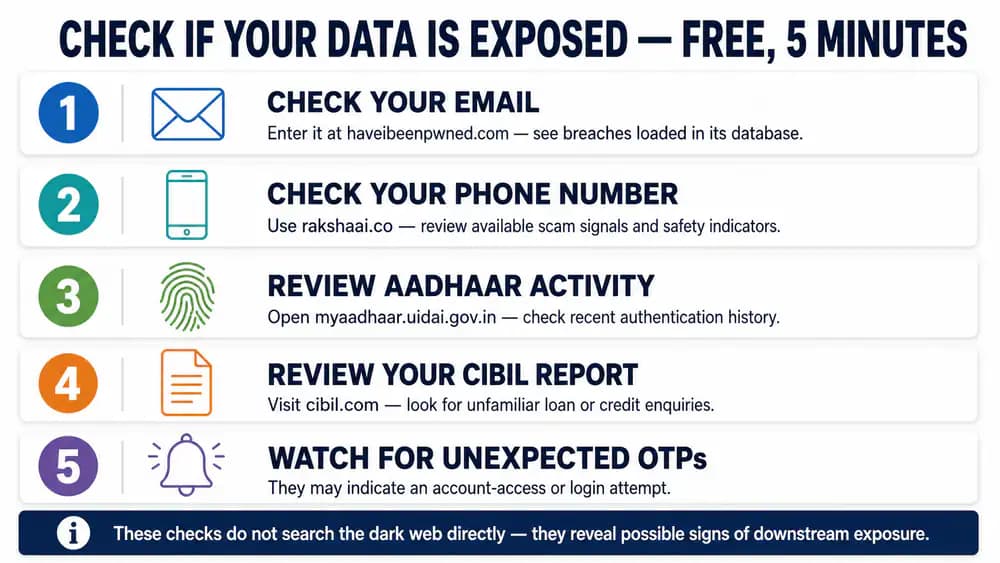
Save these five core checks. The full list above adds a public web search and explains what each result can and cannot prove.
Real Indian Cases Show How Stolen Data Becomes Financial Fraud
Data exposure is not only a privacy problem. The following police and court-linked reports show how identity details can move into fraud. Allegations remain allegations unless proved in court.
- Dark web banking data broker, October 2025: Hindustan Times reported a Delhi Police arrest involving a suspect accused of obtaining confidential personal and banking details from the dark web and selling them to fraudsters through a Telegram channel. This is a direct reported link between underground data and downstream scam operations.
- AI-enabled identity and loan fraud, May 2026: NDTV reported that Ahmedabad cybercrime police arrested members of an alleged interstate gang. Police said a data broker sourced Aadhaar numbers and photographs, other members used PAN and credit information, and deepfake video was used in attempts to open accounts and obtain loans.
- Digital arrest case, June 2026: The Indian Express reported details from a CBI chargesheet in a case where a Delhi executive allegedly lost ₹48.56 lakh after callers claimed his Aadhaar was linked to an illegal parcel. The story shows why hearing a real identity number or name on a call must never be treated as proof of authority.
- Noida SIM swap loss, July 2025: Hindustan Times reported a police investigation after a Noida resident allegedly lost ₹15.5 lakh in a SIM swap fraud. Sudden loss of mobile service should be treated as an emergency because the number may receive banking and account-recovery messages.
What to Do If Your Data Has Been Exposed
- Change exposed and reused passwords. Start with email, banking, cloud storage, and any account that can reset other accounts. Use a different password for every service.
- Turn on two-factor authentication. Prefer an authenticator app or security key where available. SMS verification is still better than no second factor, but it can be affected by SIM swap fraud.
- Review and lock Aadhaar biometrics. UIDAI provides authentication history and biometric lock services through myAadhaar. A lock can be temporarily removed when you need a legitimate biometric authentication.
- Enable bank alerts for every amount. Review beneficiaries, standing instructions, cards, devices, and recent transactions. Call the bank using the number on its official site or the back of your card.
- Review credit enquiries. CIBIL states that one free report is available each calendar year and lets consumers dispute an enquiry or account they do not recognize.
- Report financial cyber fraud immediately. Call 1930, contact the bank or payment provider, and complete the complaint at cybercrime.gov.in. Save transaction IDs, phone numbers, URLs, chats, and timestamps.
Do not pay a person who promises to delete your records from the dark web. Copies usually cannot be retrieved reliably, and "data removal" offers can become recovery scams. Your practical objective is to close account access, reduce identity misuse, and detect financial activity early.
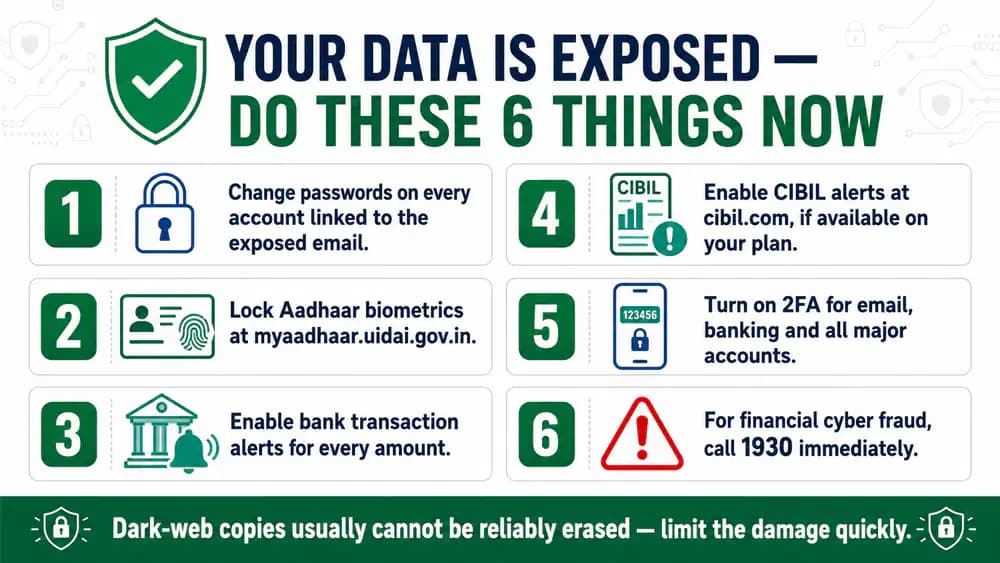
Damage limitation works best before a caller, login attempt, or unauthorized credit enquiry turns the exposure into loss.
Frequently Asked Questions
Was my data leaked in the Bank of Baroda breach in India in 2026?
Bank of Baroda confirmed on 27 July 2026 that a compromised employee email account led to unauthorized access to certain data. The bank said its core banking system remained secure and began a forensic review. Reports described a dark web listing of more than 700 GB, but the bank had not publicly confirmed the full contents or which customers were affected as of 3 August 2026. Customers should reset banking passwords, enable transaction alerts, monitor statements, and distrust callers who cite the incident.
Is it illegal to access the dark web in India?
India does not have a blanket law that makes privacy tools or dark web access illegal by themselves. Illegal conduct remains illegal regardless of the technology used. Buying stolen data, trafficking prohibited goods, distributing illegal material, committing fraud, or gaining unauthorized access can attract criminal liability. Ordinary users do not need to visit underground forums to check exposure and face substantial malware, fraud, and privacy risks if they do.
How do scammers use Indian data bought from the dark web?
Scammers combine names, phone numbers, addresses, identity details, and financial context to create convincing bank, courier, police, loan, or KYC stories. The data can support targeted phishing, password reset attempts, SIM swap fraud, unauthorized credit applications, and digital arrest calls that appear credible because the caller knows real details. Possessing your Aadhaar number alone does not give someone access to your bank account, but combined data and social engineering create greater risk.
Can I remove my data from the dark web?
Usually not completely. A copied dataset can be duplicated, repackaged, and resold across many services. A legitimate breached company can close the original exposure, but it cannot reliably retrieve every copy. Focus on damage limitation by changing reused passwords, enabling two-factor authentication, reviewing Aadhaar history, monitoring credit enquiries and bank alerts, and reporting fraud quickly.
What is the most sensitive Indian data being sold on the dark web?
Reported listings have included combinations of names, mobile numbers, email addresses, dates of birth, residential addresses, passwords, Aadhaar or PAN details, passport details, loan documents, and banking records. Dark web advertisements are not automatically true, and the stated source or record count may be false. Biometric templates, authentication credentials, one-time passwords, and account access are especially sensitive, but no public listing should be treated as verified until independent analysis or the affected organization confirms it.
30 Second Instagram Reel Script
0 to 4 seconds: hook
"Your Aadhaar, phone, or bank data could already be in a criminal data dump."
4 to 10 seconds: proof and context
"Bank of Baroda confirmed unauthorized access in July, while the bank said core banking stayed secure."
10 to 21 seconds: rapid checks
"Check your email on Have I Been Pwned. Review Aadhaar authentication history and your CIBIL report. Unexpected OTPs or sudden SIM loss are warning signs."
21 to 30 seconds: response and CTA
"Change reused passwords, enable two-factor authentication, and turn on bank alerts. If money moves, call 1930 immediately. Save this and share it with your family."
On-screen text: CHECK EMAIL | REVIEW AADHAAR HISTORY | CHECK CIBIL | ENABLE 2FA | CALL 1930
Sources, Credits, and Research Methodology
- The Indian Express, 27 July 2026: Bank of Baroda's confirmation, the compromised employee email, core banking statement, forensic review, and reported listing of more than 700 GB.
- Rajya Sabha Unstarred Question 239, 21 July 2023: official government response concerning the CoWIN Telegram bot and CERT-In investigation.
- MeitY and PIB, 26 September 2024: official notice that websites exposing Aadhaar and PAN details were blocked after CERT-In found security flaws.
- MeitY and PIB, 17 December 2025: the government's statement that no breach had occurred from UIDAI's central database.
- CYFIRMA Annual Industries Report 2025, Part 1: underground and dark web telemetry, data leak and breach post volume, ransomware trends, and regional activity.
- CYFIRMA Indian student data research, 2026: current India-specific observations and downstream fraud risks.
- TechCrunch, 5 July 2024: the disputed Airtel listing, company denial, sample discrepancies, and CloudSEK analysis.
- UIDAI online-services guidance, CIBIL consumer guidance, and National Cyber Crime Reporting Portal: official steps for identity, credit, and fraud response.
- Individual cases are credited in the real-cases section to police-linked reporting by The Indian Express, Hindustan Times, and NDTV. Reported claims, arrests, and charges are not presented as convictions.
Research was checked against sources available on 3 August 2026. RakshaAI distinguishes confirmed incidents, government responses, researcher assessments, anonymous threat-actor claims, and alleged criminal cases. The four supplied PNG files were between 1.2 MB and 1.7 MB. They were converted to WebP at 34 KB, 50 KB, 45 KB, and 46 KB for this page.
Real details do not prove the caller is real
A scammer may know your name, address, bank, or Aadhaar digits. Pause, end the call, and verify the number through an independent channel before sharing an OTP, installing an app, or moving money.
Open RakshaAI Free CheckersMore from RakshaAI Blog
PAN Card Fraud India: How Scammers Are Misusing Your PAN in 2026
Social Media Account Cloning India: When Scammers Become You Online
Cyber Fraud Case Studies India 2026: Real Victims, Real Losses, Real Lessons
Stay Protected Online
Use RakshaAI to check websites, phone numbers, and UPI IDs for scams free, instant, no sign-up required.
RakshaAI is a private platform by Ehatech Services Pvt. Ltd. Not affiliated with any government body. Editorial policy