
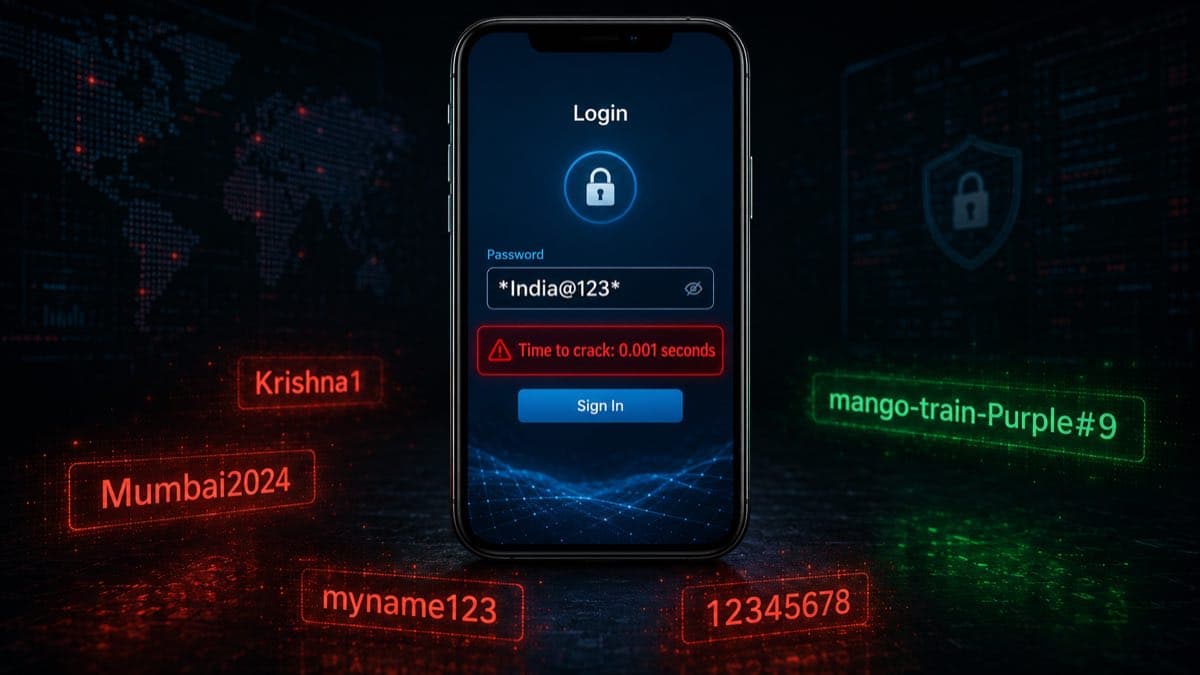
Illustrative examples only. Actual crack time changes with password length, hashing, hardware, rate limits and whether an attacker has stolen the password database.
Password safety India 2026 is not simply about adding @123 to a name. A short, predictable or reused password can expose email, shopping, social media, cloud storage and any other account that accepts the same login. Once the email account falls, a criminal may use password-reset links to reach several more services.
The national financial damage is enormous, although it would be inaccurate to attribute all of it to passwords. The Ministry of Home Affairs reported that more than ₹55,050 crore was associated with financial cyberfraud complaints on the national systems from 2021 to 2025. Those complaints cover many methods, including investment fraud, impersonation and phishing. Weak or stolen credentials are one important entry route within that much larger problem.
The Password Problem in India: By the Numbers
In the 2024 NordPass country analysis reported by The Indian Express, 123456 ranked first in India, followed by admin and 12345678. These passwords were reported as crackable in under one second. The data source was a commercial study of exposed password material, not a census of every Indian account, but it confirms the pattern attackers already exploit: users choose sequences and defaults that appear near the top of automated guessing lists.
The risk is wider than guessing. A March 2025 parliamentary answer recorded 38,295 profile hacking or identity theft complaints in 2024, up from 10,419 in 2020. That category does not identify the password as the cause in every complaint, but it shows how frequently account control and identity are reported as compromised.
A strong password India habit therefore needs three parts: a long unique password, a safe place to store it and a second authentication factor. Changing just one character in a reused password does not solve the breach risk.
The Most Common Indian Passwords Hackers Target First
Attackers begin with what is likely, not with random science-fiction strings. Their lists include number sequences such as 123456, keyboard walks such as qwerty, factory defaults such as admin, and millions of passwords exposed in earlier breaches. They also build targeted guesses from information visible on social media.
Common Indian Passwords Hacked Through Predictable Patterns
- Simple sequences such as
123456,12345678and repeated digits - Default credentials such as
admin,admin123or a device model - A first name, surname, deity, city, cricket team or company followed by a year
- A date of birth, anniversary, vehicle number or mobile number
- One base password reused everywhere with only the site name changed
Examples such as India@123, Krishna123 and Mumbai2026 are useful warnings because they follow guessable rules. They should not be presented as the official top three for India without a supporting dataset. The verified 2024 ranking begins with 123456, admin and 12345678.
How Scammers Crack or Steal Passwords in India
Method 1: Dictionary and Common Password Attacks
Software can try known passwords and predictable mutations at speed. Online services may slow or block repeated attempts, but a leaked password database lets attackers guess offline without those login limits. Adding a capital letter and a symbol to a familiar word may satisfy a form while remaining predictable.
Method 2: Data Breach Credential Stuffing
Credential stuffing takes an email and password leaked from one service and tries them automatically on other services. This is why a unique password matters even when it is long. Visit Have I Been Pwned to check whether an email address appears in known breach data. A match does not prove that the current password is public, but it means you should review that account and every reused login.
Method 3: Phishing Login Pages
A fake bank, courier, tax, social-media or workplace page can collect a perfectly strong password because the victim types it directly into the attacker's form. Open important services from a saved bookmark or official app. If an account is hacked through phishing, change the password from a clean device, sign out other sessions and review recovery details immediately.
Method 4: Malware Keyloggers
A malicious APK, cracked program, browser extension or remote-access tool can record keystrokes, steal browser sessions or copy saved credentials. A strong password cannot protect a device already controlled by malware. Remove suspicious software, update the operating system, run a reputable security scan and change important passwords from another trusted device.
Real Indian Cases: What Weak or Stolen Credentials Enabled
Rajkot hospital CCTV breach: A June 2026 Indian Express investigation reported that the default CCTV password admin@123 had not been changed at a maternity hospital. Gujarat's Home Minister had told the Assembly in February 2025 that hackers had accessed more than 50,000 CCTV cameras across India in the preceding eight months. Police alleged that sensitive footage was stolen and sold. The case shows that a default password can expose people who never created or controlled the account themselves.
Nainital Bank credential misuse: Hindustan Times reported in July 2024 that unidentified accused allegedly used a bank manager's credential to siphon ₹16.71 crore through 84 RTGS transactions. Police said ₹1.90 crore was frozen and 80 recipient accounts were identified. Public reporting did not establish whether the credential was guessed, phished, shared or otherwise compromised, so the lesson is about privileged-login protection: unique credentials, MFA, transaction controls and rapid monitoring must work together.
Why the crores claim needs context: These cases prove that weak or compromised credentials can cause severe financial and privacy harm. They do not prove that weak passwords alone caused India's entire reported cyberfraud loss. Good security writing separates a documented link from a broad national total.
What a Strong Password Actually Looks Like
How to create a strong password in India:
- Use at least 15 characters where the service allows it because length is the most important factor
- Use uppercase letters, lowercase letters, numbers and symbols when a site requires them, but do not substitute complexity for length
- Never use your name, date of birth, city, mobile number or other personal information
- Never use common or predictable patterns such as India@123, Krishna1 or Mumbai2026
- Use a different password for every account, especially email, banking and the password manager itself
- Use a passphrase made from at least four unrelated random words, not a quote or familiar saying
- Use a reputable password manager such as Bitwarden, Google Password Manager or Apple Passwords to generate and store unique passwords
- Enable two-factor authentication on every important account as a separate backup
NIST's current public guidance recommends at least 15 characters and says length matters more than mandatory composition rules. CERT-In guidance also recommends strong long passwords, avoiding dictionary words, using unique passwords and enabling MFA. If a site still requires mixed character types, meet that rule inside a password generated by your manager.
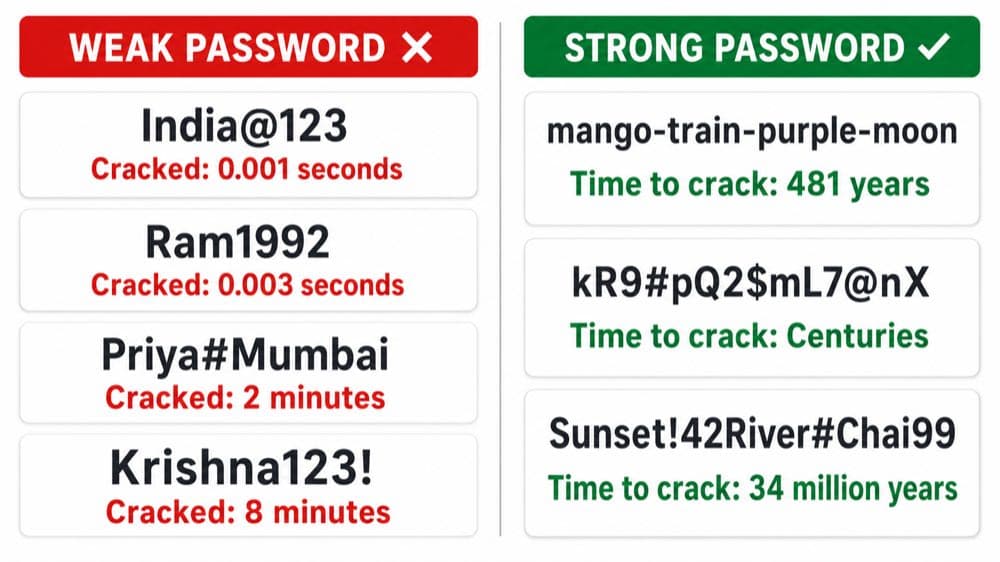
The visual is illustrative. Crack-time estimates vary widely and should not be treated as a guarantee. Never copy a published example for a real account.
Two-Factor Authentication: The Upgrade Every Indian Needs
Two factor authentication India users often know as 2FA, two-step verification or an OTP step. It requires something beyond the password. If the password is phished or appears in a breach, the second factor can stop an attacker from completing the login.
OTP vs Password India Security
A password is a reusable secret. An OTP is short-lived and should be an additional factor, not a password replacement that you share with a caller. SMS OTP is better than password-only access, but it can be phished and may be exposed by SIM-swap or mobile-network attacks. Prefer a passkey, physical security key or authenticator app where the service supports one. Never approve a prompt or read out an OTP for a login you did not start.
Secure email first because it receives reset links for many other accounts. Then protect the password manager, banking, WhatsApp and social media. Save recovery codes offline in a secure place and keep account recovery details current.
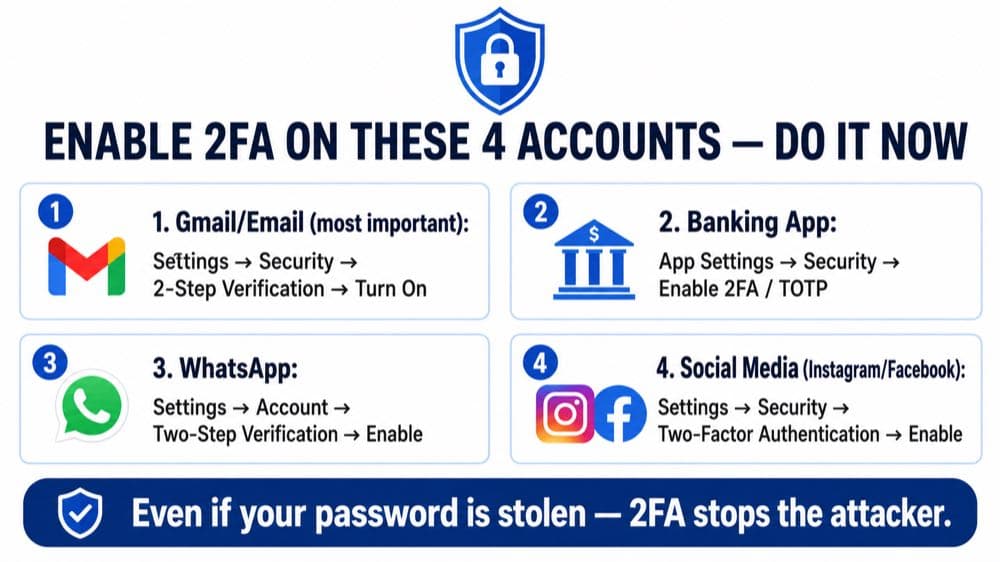
Menu names vary by app and version. Use the official app and choose the strongest available second factor.
Free Password Managers: Stop Remembering Passwords
A password manager India free search should lead to a tool that generates one random password per account, stores it in an encrypted vault and fills it only on the matching site. This defeats password reuse and can help expose phishing because the manager will not automatically fill a password on a lookalike domain.
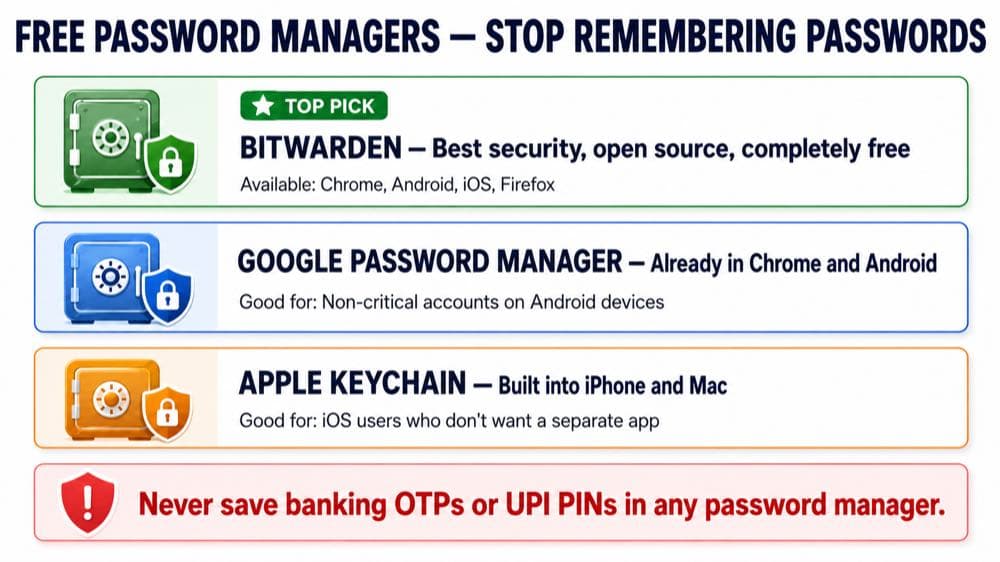
Bitwarden provides a free plan across major devices and browsers. Google Password Manager is integrated with Chrome and Android. Apple Passwords is built into current Apple platforms. No product makes unsafe behaviour impossible, so download only from the official publisher, use a long unique master passphrase, enable 2FA on the vault and keep recovery material secure.
Do not store UPI PINs, ATM PINs or one-time OTPs as ordinary vault notes. Do not send a master password through chat or email. A support agent should never need it.
Account Hacked in India: What to Do Now
- Use a clean trusted device and change the affected account password
- Sign out every other session and remove unknown devices, forwarding rules and recovery methods
- Change every account that reused the password, starting with email and finance
- Enable 2FA and save new recovery codes securely
- Check recent transactions, messages, posts and security alerts for misuse
- Tell contacts if the attacker sent messages from your identity
- For financial cyberfraud, call 1930 immediately and report at cybercrime.gov.in
If bank access or money is affected, follow the bank account fraud response guide. If breach data may have enabled the takeover, review RakshaAI's dark web data breach guide.
30 Second Instagram Reel Script
0 to 4 seconds
Visual: Type 123456, India@123 and a birth date. Voice: "If your password looks like this, an attacker may try it first."
5 to 11 seconds
Visual: One leaked key opens several account icons. Voice: "Reuse it once, and one data breach can unlock your email, shopping and social accounts."
12 to 20 seconds
Visual: Four random words enter a password manager. Voice: "Use a long unique password for every account. Let a trusted password manager create and remember it."
21 to 27 seconds
Visual: Turn on an authenticator app or passkey. Voice: "Then enable 2FA, preferably an authenticator app or passkey."
28 to 30 seconds
Visual: RakshaAI shield and Share button. Voice: "Secure your email first. Save this and send it to your family."
On-screen caption: Long. Unique. Managed. 2FA protected.
Frequently Asked Questions
What are the most common Indian passwords hackers target?
The 2024 NordPass country list reported 123456 as the most common password in India, followed by admin and 12345678. Other weak patterns include password, qwerty, names, birth years, mobile numbers and predictable combinations such as a name followed by 123. Attackers test leaked and common-password lists automatically, so any personal or widely used pattern is unsafe.
Is it safe to use Google to save passwords in India?
Google Password Manager can generate, store and check unique passwords and is a practical option for Chrome and Android users. Protect the Google account itself with a long unique password, two-factor authentication and current recovery details. A reputable dedicated manager such as Bitwarden is another option. Your email and password-vault accounts deserve the strongest protection because they can reset other accounts.
What is two-factor authentication and why do I need it in India?
Two-factor authentication adds another login proof after the password, such as an authenticator-app code, security key, passkey, push approval or SMS OTP. If a password is stolen, the second factor can block a login. Prefer a passkey, security key or authenticator app where available because SMS OTPs can be phished or affected by SIM-swap attacks.
What is a password manager and which is best for India?
A password manager creates and stores a different long password for every account, then fills it on the correct site. Bitwarden offers a free plan and works across major browsers and mobile platforms. Google Password Manager and Apple Passwords are convenient built-in choices. Choose a reputable product, secure the vault with a unique master passphrase and enable 2FA. Never store UPI PINs or OTPs in the vault.
Can scammers access my accounts if my password is leaked in a data breach?
Yes. Credential stuffing automatically tries a leaked email and password on other services. Reusing one password can therefore turn one breach into several account takeovers. Change the exposed password everywhere it was used, replace reused passwords with unique ones, enable 2FA and check your email at Have I Been Pwned.
How to make a strong password in India?
Use at least 15 characters where the service permits it, make every password unique and avoid names, dates, cities and familiar phrases. A password manager can generate random passwords. If you must remember one, combine at least four unrelated random words into a long passphrase. Enable two-factor authentication as a separate safety layer.
Sources and Credits
- Ministry of Home Affairs reply published by PIB, 21 July 2026: national financial cyberfraud complaint totals from 2021 to 2025 and funds saved through CFCFRMS.
- Ministry of Home Affairs Lok Sabha answer, 18 March 2025: profile hacking, identity theft and other NCRP complaint categories through 2024.
- The Indian Express, 14 November 2024: NordPass 2024 India password ranking and reported crack-time classifications.
- The Indian Express, 2 June 2026: investigation into the Rajkot hospital CCTV case, default credential and Gujarat Assembly figures.
- Hindustan Times, 27 July 2024: police account of credential misuse and ₹16.71 crore siphoned from Nainital Bank.
- CERT-In advisory on password management and security: unique passwords, password policy and MFA guidance.
- NIST password guidance, updated 20 August 2025: password length, passphrases, password managers and MFA.
- Have I Been Pwned and Bitwarden: breach lookup and official free password-manager plan information.
Protect the account that protects everything else
Start with email: replace reused passwords, turn on 2FA and check any unexpected login link before entering credentials.
Open RakshaAIMore from RakshaAI Blog
PAN Card Fraud India: How Scammers Are Misusing Your PAN in 2026
Social Media Account Cloning India: When Scammers Become You Online
Cyber Fraud Case Studies India 2026: Real Victims, Real Losses, Real Lessons
Stay Protected Online
Use RakshaAI to check websites, phone numbers, and UPI IDs for scams free, instant, no sign-up required.
RakshaAI is a private platform by Ehatech Services Pvt. Ltd. Not affiliated with any government body. Editorial policy