
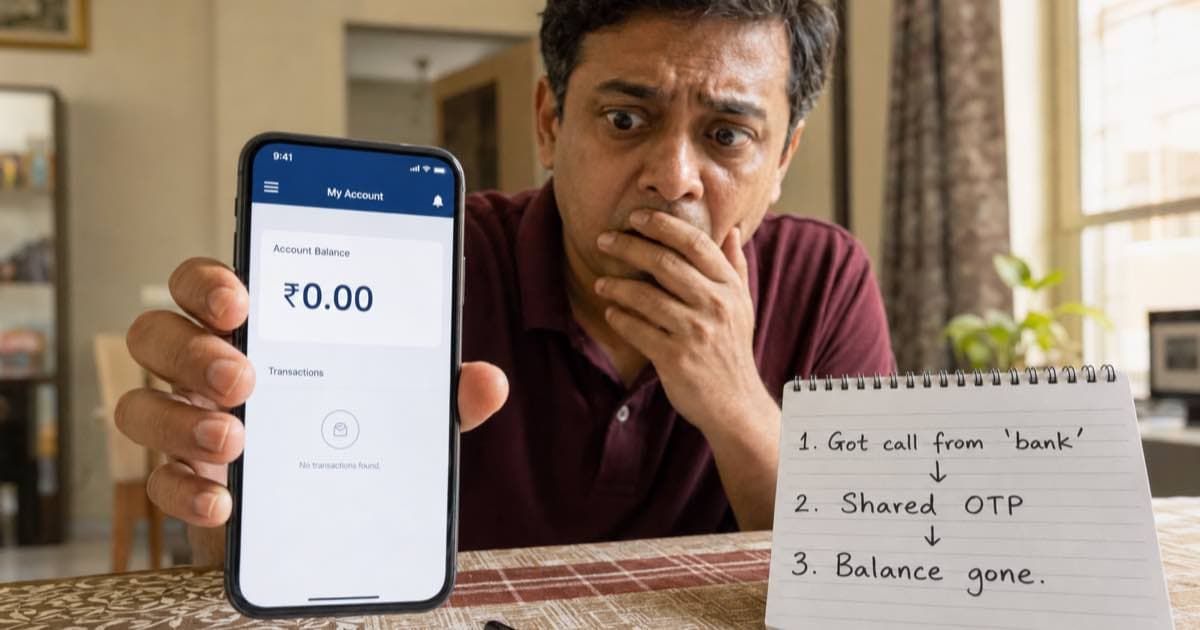
A caller who sounds like bank support can turn one rushed decision into an account takeover. Stop the call and verify independently.
Bank account fraud India 2026 rarely begins with a criminal breaking directly into a bank server. It usually begins with stolen trust. A fake customer care agent asks for an OTP, a duplicate SIM redirects security messages, a cloned login page records credentials, or a malicious app watches the phone on which banking happens.
The attack is often a chain, not a single trick. Personal information makes the call believable. A phishing page captures a login. An OTP or device permission completes access. A new beneficiary or mule account then moves the money quickly. Understanding that sequence is the best way to interrupt it.
Why Indian Bank Accounts Are Under Attack in 2026
India's enormous digital payment ecosystem gives criminals speed and reach. The RBI Annual Report 2024 to 2025 recorded 13,516 card and internet frauds of ₹1 lakh or more, involving ₹520 crore. That category represented 56.5% of the fraud cases in RBI's table. RBI warns that cases reported in a year may have occurred earlier, the amount involved is not the same as the final loss, and the table excludes cases below ₹1 lakh.
The response system is also stopping large sums when victims report quickly. A Ministry of Home Affairs update published in 2026 said the Citizen Financial Cyber Fraud Reporting and Management System had saved more than ₹8,690 crore across more than 24.65 lakh complaints by 31 January 2026. It also said the I4C suspect registry had shared 27.37 lakh first-layer mule accounts with participating entities.
Those numbers measure different things and should not be combined into one loss estimate. Together, they show why RBI bank fraud India controls now connect banks, payment firms, telecom operators, and law enforcement. For a victim, however, the decisive action remains simple: contact the bank and 1930 before the money travels through more accounts.
How Scammers Access a Bank Account in India: The 6 Methods
How scammers access bank account India: they obtain approval or control through OTP phishing, SIM replacement, fake net banking pages, remote access, phone malware, or insider abuse. More than one method may be used in the same attack.
Method 1: OTP Phishing via Fake Customer Care
A bank OTP scam India call begins with authority and urgency. The caller may know your name, bank, card type, or a recent complaint. They claim KYC has expired, a card payment must be cancelled, reward points will lapse, or an account is about to be blocked. The requested OTP actually approves a login, password reset, card transaction, or new device.
Read the complete OTP message. Never dictate, forward, or type a code into a page opened from a caller's link. A genuine employee does not need your OTP, PIN, CVV, password, or UPI PIN. The related KYC OTP scam guide explains why an account-block threat should always be checked inside the official app or at the branch.
Method 2: SIM Swap, When Your Number Moves to Another Device
In a SIM swap, a criminal obtains a replacement SIM or fraudulently transfers control of the registered number. Your phone unexpectedly shows no service while calls, SMS alerts, and OTP messages reach the other SIM. The attacker can then attempt password resets and account access without the usual warning reaching you.
Signal loss is not always fraud, but unexplained loss during OTP activity is an emergency. Call the telecom operator from another phone, ask whether a replacement or port request was made, and contact every bank linked to that number.
Method 3: Net Banking Phishing Through Fake Login Pages
Net banking fraud India 2026 pages copy the bank's colors, logo, login fields, and security language. They arrive through KYC messages, search ads, email alerts, fake refund pages, or customer care chats. The fake page may collect a customer ID and password, then ask for the real OTP while the criminal uses those details on the genuine site.
A padlock only shows that the connection to that website is encrypted. It does not prove the site belongs to the bank. Type the bank address yourself, use a saved trusted bookmark, or open the official app. Never use a sponsored search result or message link to reach net banking.
Method 4: Remote Access Through AnyDesk or Screen Sharing
AnyDesk and other remote support tools are legitimate products, but criminals abuse them. A fake support agent asks you to install an app, share a code, enable screen capture, or grant accessibility permissions. The scammer can then watch sensitive information, guide actions, or interact with the device, depending on the permissions given.
CERT-In's remote access fraud advisory warns that a fraudster may gain remote control after the target downloads a screen-sharing app and grants access. A bank does not need remote control of your phone to process a refund or fix KYC.
Method 5: Malware Through Malicious Links or APK Files
A malicious Android APK may be disguised as a wedding invitation, traffic challan, electricity bill, courier notice, bank update, or government service. Once installed and granted permissions, it may read notifications, intercept SMS messages, display overlays, capture keystrokes, or abuse accessibility services. The exact capability depends on the malware and permissions.
Install banking and service apps only from the Play Store or App Store after checking the developer. A file ending in .apk sent through WhatsApp or SMS is not an official app update. iPhone users are also exposed to phishing and credential theft even though this APK delivery route is primarily an Android risk.
Method 6: Insider Fraud Through Compromised Bank Employees
Insider fraud is less common than social engineering, but it is real. A rogue employee may misuse access, alter registered contact details, open unauthorized accounts, break fixed deposits, or work with outside account suppliers. Customers cannot prevent every internal control failure, which is why independent alerts, regular statement checks, and prompt written complaints matter.
Do not assume every bank employee or branch problem is fraudulent. Preserve statements, deposit receipts, complaint numbers, and written instructions. If a transaction or profile change is unexplained, raise it through the bank's official grievance process and escalate unresolved complaints through RBI CMS.
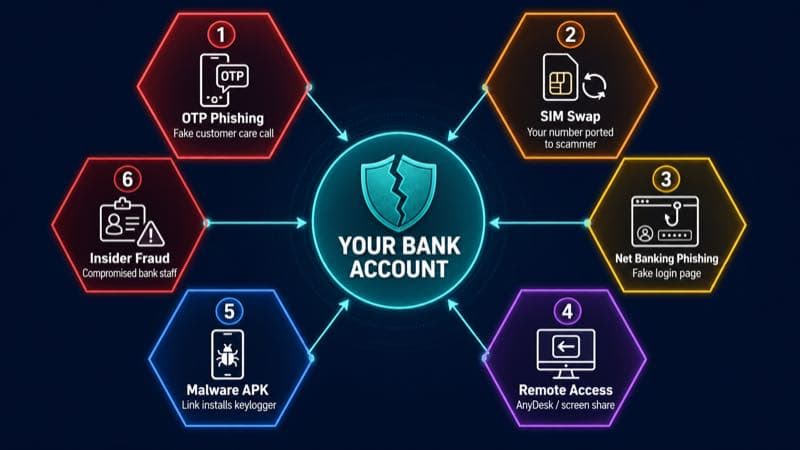
Six access routes can converge on one target. Never approve a banking action initiated by an unexpected caller or message.
Real Bank Account Fraud Cases Reported in India
Recent police reports and court proceedings show how these methods cause real losses. Allegations in active police cases remain allegations unless proved in court.
- Duplicate SIM and net banking, Karnataka: The Indian Express reported on 5 June 2026 that the Karnataka High Court directed BSNL to pay about ₹55.5 lakh in compensation and consequential damages to a cooperative bank. Fraudsters had obtained a duplicate SIM and made seven unauthorized NEFT and RTGS transfers totaling ₹87.7 lakh in 2019. The victim bank had recovered part of the amount through reversals and police action.
- Fake bank support app, Ahmedabad: The Times of India reported on 9 July 2026 that a 76-year-old retired banker allegedly lost ₹11.4 lakh after a caller posing as a bank manager sent a fake customer-support application through WhatsApp. The victim then began receiving multiple OTP messages.
- Invitation APK, Chandigarh: The Indian Express reported on 26 February 2026 that the CBI registered an FIR after two unauthorized transactions totaling ₹69,598 were allegedly made from a Bank of India account. The complainant said a WhatsApp invitation APK had arrived from a saved contact days earlier.
- Employee access abuse, Kota: The Indian Express reported on 7 June 2025 that police arrested an ICICI Bank relationship manager accused of withdrawing about ₹4.6 crore from 110 accounts belonging to 41 customers. Police alleged that registered mobile numbers were changed and fixed deposits were closed early. ICICI Bank said it suspended the employee and settled genuine claims.
These cases are not proof that every lost signal, app failure, or employee mistake is fraud. They show why a sudden change should be verified through a second channel before the attacker gains more time.
Bank Account Hacked India: Warning Signs Your Account May Be Compromised
Warning signs your Indian bank account may be compromised:
- SMS alerts for transactions you did not make
- Your phone suddenly loses signal, which may indicate a SIM swap in progress
- You receive OTPs for logins you did not initiate
- Your net banking password stops working unexpectedly
- New payee names appear in your beneficiary list that you did not add
- Your bank's app shows a login from an unknown device or location
- Email alerts arrive for password reset requests you did not make
If you notice any of these, call your bank immediately through its official number and call 1930. One sign may have an innocent explanation. Several signs together, especially signal loss plus OTP or password activity, require urgent action.
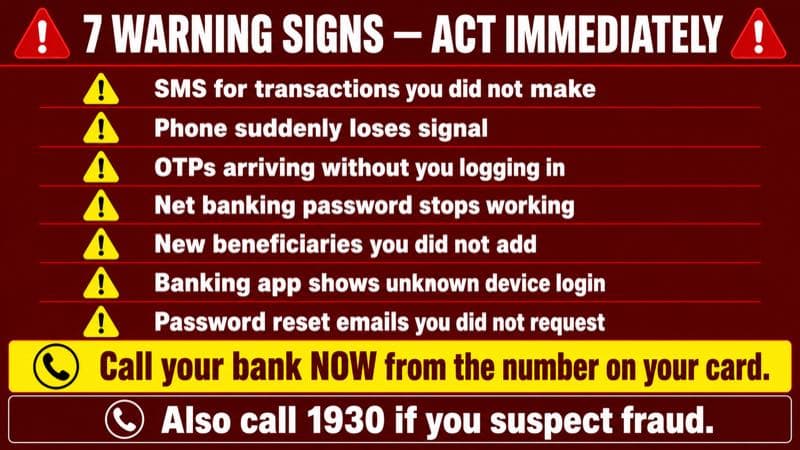
Save these seven warning signs. Use the number on your card, not a number supplied by the caller.
How to Secure Your Bank Account in India in 60 Seconds
These bank account safety tips India checks reduce exposure, but no checklist guarantees that an account is secure. Use the bank's official app or website only.
- 10 seconds: confirm SMS and email alerts are enabled for every transaction.
- 10 seconds: open the beneficiary or payee list and flag anything you do not recognize. Remove it only after preserving evidence if fraud is suspected.
- 15 seconds: review the last login, active devices, or recent sessions where your bank provides that information. Change the password from a clean device if anything is unfamiliar.
- 10 seconds: enable biometric or app lock for the banking app and keep the phone's screen lock active.
- 10 seconds: confirm the mobile number registered with the bank is your current SIM.
- 5 seconds: save the fraud number printed on the back of your bank card.
For stronger protection, use a unique bank password, keep the phone operating system updated, disable unused banking channels where available, set sensible transaction limits, and review statements every week. Never store a PIN or password in notes, messages, screenshots, or contacts.
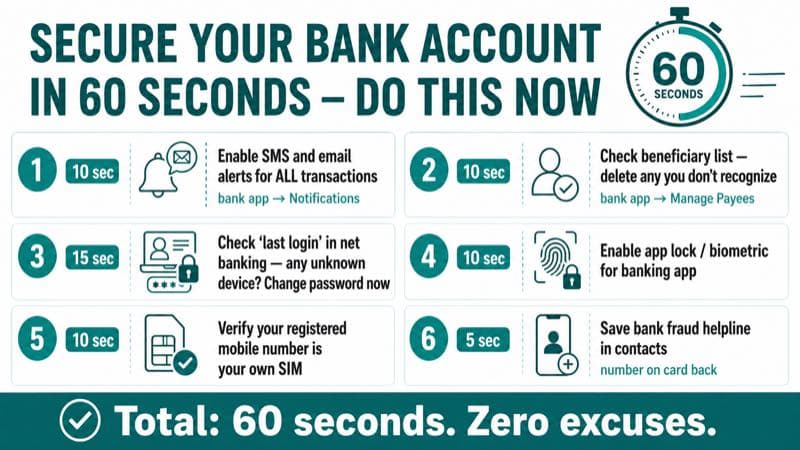
A one-minute review can reveal an unknown payee, session, contact change, or missing alert before a transfer occurs.
What to Do If Your Account Has Already Been Accessed
- Use a clean phone to call the bank now: use the number printed on the card or shown in the official app. Ask the bank to block the relevant cards, mobile banking, net banking, UPI, and outgoing transfers, and request a complaint number.
- Call 1930 immediately: give the transaction references, amount, time, beneficiary details, and bank complaint number. Speed can help the reporting system trace and hold funds.
- Complete the cybercrime complaint: file at cybercrime.gov.in and keep the acknowledgement. Follow any direction to submit documents to the local cyber police.
- Isolate a compromised phone: disconnect it from mobile data and Wi-Fi. Do not continue banking on it. From a clean device, change the primary email password first, then bank and payment passwords.
- Contact the telecom operator: if the SIM lost service, ask whether a replacement, eSIM, or port request occurred and secure the number.
- Preserve evidence: keep SMS messages, emails, call logs, phone numbers, links, APK names, screenshots, statements, beneficiary details, and every complaint reference. Do not factory reset the device until police or the bank confirms whether it is needed for evidence.
- Escalate in writing: use the bank's grievance and nodal officer process. If the response is unsatisfactory or the bank does not reply within the applicable period, use RBI CMS.
Read the full RakshaAI guide on how to recover money after online fraud for the bank, 1930, cybercrime portal, and RBI escalation sequence. Recovery is possible, but it is never guaranteed.
Frequently Asked Questions
How do I know if my bank account has been hacked in India?
Key signs include transaction alerts you do not recognize, OTPs arriving when you did not attempt a login, a net banking password that suddenly fails, unknown beneficiaries, an unfamiliar device login, or your phone losing signal without explanation. Call your bank immediately through the number on your card and call 1930 if money may be at risk.
How do I lock my bank account immediately in India?
Call the bank fraud number printed on your card or shown inside its official app and ask it to block digital banking, cards, and outgoing transactions as appropriate. Available controls differ by bank, so do not assume one app switch freezes every channel. Do not call a number in the suspicious message or use a link sent by the caller.
Can a scammer access my bank account without my OTP?
Yes. A SIM swap can redirect OTP messages, malware can read messages or capture credentials, and remote access can expose the screen and actions. A scammer may also trick a victim into approving a payment directly. OTP is one control, not proof that the person authorizing an action understands or intends it.
Is it safe to use net banking on a mobile phone in India?
Yes, when you use the bank’s official app or type its verified address yourself, keep the phone and app updated, use mobile data or a trusted private network, and never install an APK or remote access tool on a caller’s instruction. Avoid links in SMS, email, search ads, and chat messages.
What is the RBI liability rule for unauthorized bank transactions in India?
As of 30 July 2026, the 2017 RBI framework gives zero customer liability for bank negligence, or for a third-party breach reported within three working days when the fault lies neither with the bank nor the customer. If a customer shared payment credentials, the customer can bear the loss until the bank is notified. RBI issued revised directions in June 2026, but they apply to transactions from 1 January 2027. Liability depends on the facts, so report immediately and preserve evidence.
30 Second Instagram Reel Script
0 to 4 seconds: Hook
"Aapke phone mein signal gaya, aur bank balance zero? Yeh sirf network problem nahi, SIM swap ho sakta hai."
4 to 13 seconds: Six methods
"Fake bank call, OTP phishing, fake net banking page, AnyDesk screen share, dangerous APK, ya insider access. Scammer ko sirf ek opening chahiye."
13 to 23 seconds: Warning and action
"Unknown debit, bina login ke OTP, naya beneficiary, ya sudden no service dikhe? Card ke back wala official bank number call karo. Message wala number nahi."
23 to 30 seconds: Emergency CTA
"Paisa gaya hai toh 1930 abhi call karo. Is reel ko save karo, family ko share karo, aur suspicious caller ko RakshaAI par check karo."
On-screen text: 6 ACCESS METHODS | 7 WARNING SIGNS | CALL BANK | CALL 1930
Sources, Credits, and Research Methodology
- Reserve Bank of India Annual Report 2024 to 2025: bank fraud totals, card and internet fraud counts, values, scope, and reporting limitations.
- RBI customer protection circular dated 6 July 2017: the customer-liability framework applicable on the article's publication date.
- RBI press release dated 24 June 2026: revised customer-protection directions that apply to transactions from 1 January 2027.
- RBI Financial Awareness Messages: official precautions for online banking, alerts, passwords, OTPs, official bank addresses, and public Wi-Fi.
- CERT-In remote access scam advisory: how screen-sharing tools are abused and the precautions users should take.
- Ministry of Home Affairs and I4C update: 1930, CFCFRMS, saved funds, complaints, and suspect-registry figures through 31 January 2026.
- The Indian Express, 5 June 2026: Karnataka High Court duplicate-SIM case and compensation order.
- The Times of India, 9 July 2026: Ahmedabad fake bank-support application case.
- The Indian Express, 26 February 2026: CBI FIR concerning an invitation APK and unauthorized bank transactions.
- The Indian Express, 7 June 2025: Kota relationship-manager case and the bank's response.
Research was checked on 30 July 2026. Official sources are used for rules, reporting systems, and national or banking statistics. News reports are credited for individual cases. Active police allegations are not presented as convictions, and reported amounts are not generalized into a national loss estimate.
A bank logo does not prove a caller is from your bank
Check the phone number for public fraud reports before you trust an unexpected customer-care call. Never share an OTP, PIN, password, or screen.
Open Phone Number CheckerMore from RakshaAI Blog
Electricity Bill Scam India: That Disconnection Today SMS Is Always Fake

AI Scam India: How Artificial Intelligence Is Making Fraud More Dangerous in 2026
Credit Card Fraud India 2026: How Scammers Clone and Misuse Your Card
Stay Protected Online
Use RakshaAI to check websites, phone numbers, and UPI IDs for scams free, instant, no sign-up required.
RakshaAI is a private platform by Ehatech Services Pvt. Ltd. Not affiliated with any government body. Editorial policy