
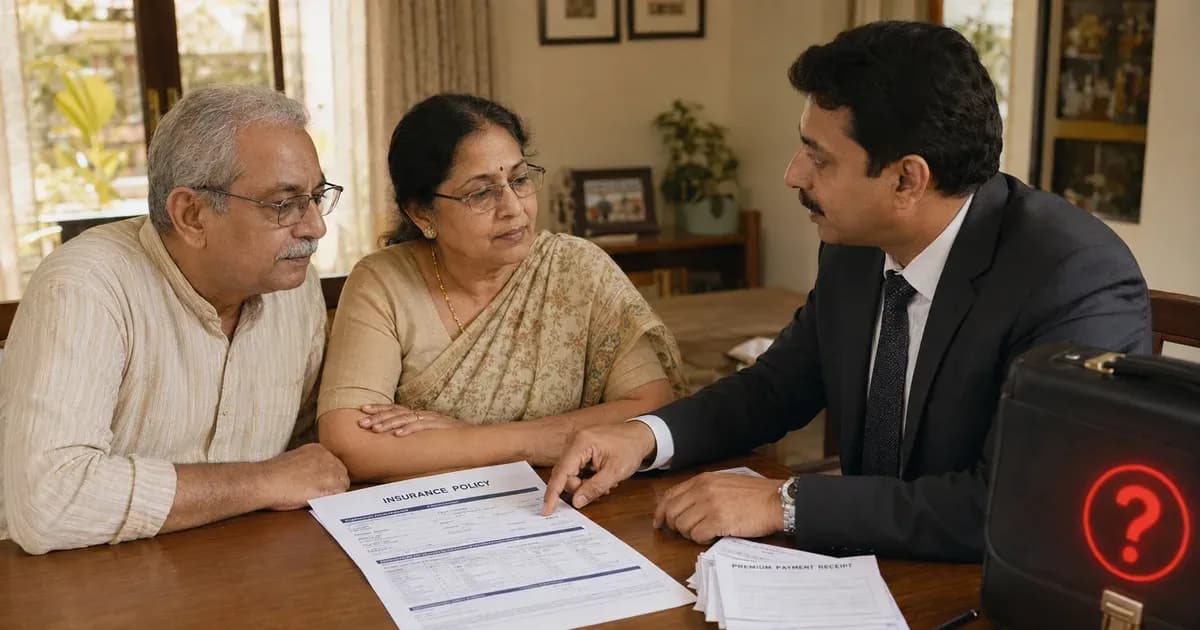
An elderly couple reviewing an insurance policy with an agent. Cash premium receipts on the table are one of the biggest warning signs of insurance fraud in India.
An agent visits your home, or calls claiming to represent a well-known insurer. He is polite, well-dressed, and knows exactly what to say. You hand over cash for the first premium, sign a form, and expect a policy document to arrive. Weeks later, nothing comes. The number is switched off. The "policy" never existed.
This is the insurance scam India 2026 pattern playing out in thousands of households every month: fake LIC agents collecting premiums for policies that were never issued, fake health insurance cover that turns out to be worthless at claim time, and fake calls promising to "release" a maturity bonus for a processing fee. Insurance fraud is one of the least reported financial crimes in India, largely because victims trust the person collecting their money and only discover the fraud years later, when they try to file a claim.
This guide covers the 5 insurance scam types active right now, how to verify any agent or policy through IRDAI in under 2 minutes, the red flags that expose fraud before you sign anything, and what to do if you have already paid a fake agent.
Why Insurance Is a Prime Target for Fraud in India
Insurance is sold, not bought. Most Indians do not walk into a branch asking for a policy; an agent approaches them, often through a personal reference from a friend, relative, or colleague. That built-in trust is exactly what fraudsters exploit. A fake agent does not need to build credibility from zero; he only needs to borrow it from a shared contact or a recognisable brand name like LIC.
The scale of the problem shows up directly in regulator data. IRDAI's Bima Bharosa grievance portal recorded 2.57 lakh insurance complaints in FY 2024-25, including 1,20,429 complaints against life insurers alone. Within that total, complaints classified as unfair business practices, the regulator's formal category for mis-selling, rose from 23,335 in FY 2023-24 to 26,667 in FY 2024-25, a 14% jump that now accounts for 22.14% of all complaints against life insurers, up from 19.33% a year earlier (source: IRDAI Annual Report 2024-25, via Outlook Money).
Insurance products are also genuinely complex. Terms like sum assured, surrender value, ULIP, and bonus accrual are unfamiliar to most buyers, which makes it easy for a fraudulent agent to misrepresent a product's benefits or invent features that do not exist. Add the fact that a policy's real test, a claim, often happens years after purchase, and a fraudulent agent has ample time to disappear before anyone notices something is wrong.
The problem runs deep enough that organised crime has built entire networks around it. Police in Uttar Pradesh's Sambhal district uncovered a syndicate that used the identities of terminally ill and recently deceased people to file bogus claims against more than 50 insurers, including SBI Life, ICICI Prudential Life, Canara HSBC, and PNB MetLife, extracting an estimated Rs 30 crore before an 800-page chargesheet was filed against 11 accused (source: The Print). Fraud on this scale is why IRDAI's new Insurance Fraud Monitoring Framework Guidelines, 2025, effective from April 1, 2026, require every insurer to run dedicated fraud-monitoring units rather than reacting to fraud case by case (source: Ankura, on IRDAI's 2025 Framework).
Elderly policyholders and first-time buyers are disproportionately targeted because they are least likely to independently verify an agent's credentials or read policy documents line by line before signing.
The 5 Insurance Scam Types Hitting Indians in 2026
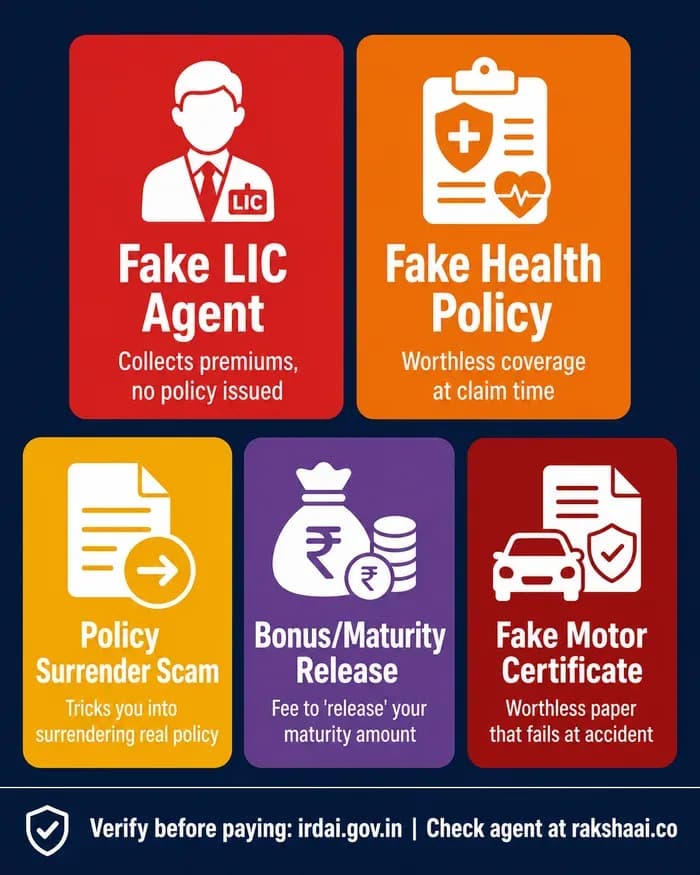
Five insurance scam formats active in India in 2026. Each targets a different stage of the policy lifecycle, from purchase to claim.
Type 1: The Fake LIC Agent Premium Collection
A person presents himself as an LIC or private insurer agent, collects the first year's premium in cash, and hands over a receipt on plain paper or a photocopied form. No policy document ever arrives because no policy was ever created. By the time the victim calls the insurer directly to check, the agent has moved on to the next target and stopped answering calls.
In July 2024, Noida police arrested 11 people, including nine women, running exactly this kind of operation from a call centre in Sector 51. The two masterminds were former employees of SBI Life Insurance who left the company and set up their own fake policy business: they bought contact details of roughly 10,000 people for Rs 2,500 from an online marketplace, activated SIM cards using fraudulently obtained Aadhaar cards, and had the women cold-call victims posing as insurance executives. The scheme ran for over a year and generated crores of rupees before it was shut down (source: Business Standard).
Type 2: The Fake Health Insurance Policy
A health policy is sold at an attractive premium, often lower than market rates, with promises of wide coverage. The certificate looks professional. The problem surfaces only at claim time: the insurer has no record of the policy, or the policy exists but excludes almost every condition the buyer actually needs covered.
Industry estimates show how widespread this is: the Insurance Institute of India and Deloitte put the annual cost of fraudulent healthcare claims to Indian insurers at Rs 600-800 crore, with roughly 15% of all health insurance claims containing some element of fraud (source: Ditto Insurance). In one case documented by the General Insurance Council, agents colluded with diagnostic labs to submit forged annual health checkup reports for services that were never performed, generating claims that policyholders were not even aware had been filed in their own name (source: General Insurance Council).
Type 3: The Policy Surrender Scam
A caller claiming to be from the insurer convinces a policyholder that their existing genuine policy has "matured early" or needs to be "upgraded," and talks them into surrendering it. The surrender value is paid out at a steep loss, or redirected entirely, while the caller pockets a commission for closing out a policy that was performing exactly as intended.
Type 4: The Bonus / Maturity Amount Release Scam
A call or SMS informs the policyholder that a bonus or maturity amount is ready but requires a "processing fee," "tax clearance charge," or "release fee" to be paid first. Genuine insurers never ask for advance payment to release money that is owed to the policyholder. Each fee paid is followed by a request for another, until the victim stops paying or runs out of money.
Type 5: The Fake Motor Insurance Certificate
A cheap motor insurance certificate is sold, often through unauthorised online sellers or roadside agents, at a fraction of the real premium. The certificate looks valid enough to pass a traffic check, but it is not registered with any insurer. The buyer discovers this only after an accident, when the claim is rejected and the certificate is found to be worthless.
Real Insurance Fraud Cases in India
These are not abstract warnings. Here are two recent, documented police cases that show exactly how these scams play out against real victims.
Delhi, May 2026
Fake "Policy Renewal" Syndicate Cheats Senior Citizen of Rs 4 Lakh
Delhi Police's South-West District Cyber Cell arrested four men who impersonated insurance company officials over WhatsApp calls made using mule SIM cards. They told a senior citizen that his policy had "expired" and that an urgent renewal premium was needed. The victim transferred money to mule bank accounts and was sent forged policy documents to make the transaction look genuine. Police recovered Rs 2 lakh in cash along with keypad phones, Android devices, and the forged paperwork used in the scam.
Source: The Hans IndiaMumbai, Uncovered 2023
Fake Agents Cheat Senior Citizen of Rs 19.28 Lakh Across 5 States
The North Mumbai Cyber Cell arrested six people for cheating a Mumbai-based senior citizen who received calls in March 2021 from callers posing as executives of two different insurance companies. He was lured into buying policies in his grandson's name with false promises of a lifetime pension and interest-free loans. Two of the accused worked at a mobile SIM retailer and had misused customers' KYC documents to fraudulently activate SIM cards used in the scam, which investigators traced across Delhi, Haryana, Uttar Pradesh, Telangana, and Maharashtra.
Source: National HeraldEvery one of these cases, along with the Noida call centre and Sambhal claims racket described above, shares the same root cause: the victim, or in Sambhal's case the insurer, had no independent way to verify who they were dealing with before money or a policy changed hands. The verification process below closes that gap.
How to Verify Any Insurance Agent or Policy in India
Every one of the five scam types above depends on one thing: the victim never independently verifying the agent or the policy through the insurer's official channels. Here is the complete verification process.
How to verify an insurance agent and policy in India
- 1Ask for the agent's IRDAI License Number
- 2Verify at irdai.gov.in, under Agent / Intermediary search
- 3Call the insurance company's official customer care to confirm the agent is registered
- 4Verify any policy by calling the insurer's official number and quoting the policy number
- 5Never pay premiums in cash, always through the official company bank account or payment gateway
- 6Check the agent's number at rakshaai.co for scam reports
- 7All legitimate insurance policies send a digital copy to your registered email, verify this
This entire process takes under 2 minutes and stops every version of the insurance scam above.
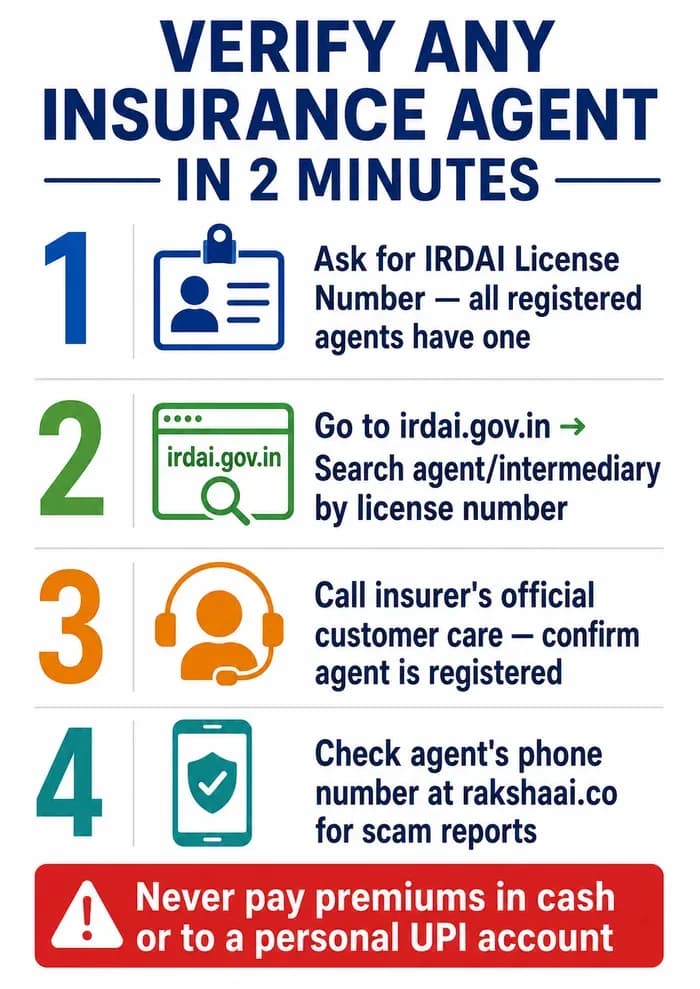
Save this checklist. Run it before you hand over your first premium to any agent, no matter how well they came recommended.
For fake website identification beyond insurance portals, see our full guide on how to check if a website is fake before you pay.
Red Flags of Insurance Fraud
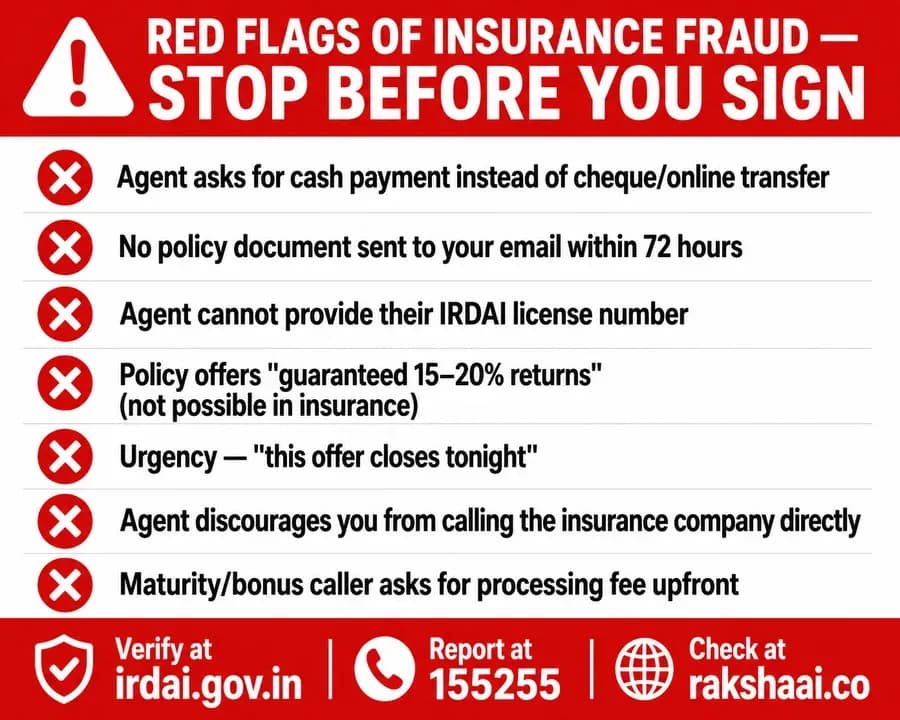
Screenshot this and check it before signing any insurance form. Share it with every policyholder in your family.
Insurance mis-selling and outright fraud almost always share the same tells. Watch for any of the following before you sign a form or transfer a rupee:
- The agent asks for cash payment instead of a cheque or online transfer
- No policy document is sent to your email within 72 hours of payment
- The agent cannot provide their IRDAI license number when asked
- The policy offers "guaranteed 15-20% returns," which is not possible in insurance
- There is urgency: "this offer closes tonight"
- The agent discourages you from calling the insurance company directly
- A maturity or bonus caller asks for a processing fee upfront
This pattern of manufactured urgency and unrealistic returns also drives stock market tip fraud and fake crypto investment platforms in India. If a financial product promises guaranteed high returns with no risk, that alone is enough reason to verify independently before paying.
If You Have Already Paid Premiums to a Fake Agent
Act immediately. Stop any further payments and start the reporting process today. The longer a fraudulent agent operates undetected, the harder recovery becomes.
- Stop all further payments immediately. Do not send another rupee, even if the agent claims it is needed to "activate" or "release" your existing policy.
- Call 1930 immediately. India's National Cybercrime Helpline can coordinate with banks and payment networks in real time if the payment was made via UPI or card.
- File a complaint with IRDAI Bima Bharosa. Call 155255 or 1800-4254-732, or file directly at igms.irda.gov.in. This is the official channel for all insurance-related grievances in India.
- File an FIR at your local police station and at cybercrime.gov.in. Submit the agent's name, phone number, any receipts, and all chat or call records.
- Report the number at RakshaAI. Submit the agent's phone number at rakshaai.co so the next family targeted by the same agent can identify the fraud instantly.
For a full step-by-step recovery guide covering every type of online and offline fraud, see Got scammed online in India? Do these 5 things in 30 minutes.
Frequently Asked Questions
How do I verify an LIC agent is real in India?
Every LIC agent has an IRDAI license number. Ask for it and verify at the IRDAI website (irdai.gov.in) or by calling LIC's official customer care at 1800-225-5226. You can also verify through LIC's official website at licindia.in using the agent's details.
What is the IRDAI helpline for insurance complaints in India?
IRDAI's Bima Bharosa helpline is 155255 or 1800-4254-732 (toll-free). You can also file complaints at igms.irda.gov.in, the Integrated Grievance Management System for all insurance-related complaints in India.
How do I know if my insurance policy is genuine?
Log in to your insurer's official website or app using your policy number to verify it exists in their system. Call the insurer's official customer care using the number from their official website, not from any agent. Genuine policies always generate a policy document sent to your registered email within 24 to 72 hours of purchase.
Can I recover money paid to a fake insurance agent in India?
File an FIR at your local police station and file at cybercrime.gov.in. Also file at IRDAI Bima Bharosa. If payment was made via UPI, call 1930 immediately. Early reporting maximizes recovery chances.
What is insurance mis-selling and is it illegal in India?
Insurance mis-selling is selling a policy by misrepresenting its benefits, returns, or terms. It is illegal under IRDAI regulations. Common mis-selling includes selling ULIP as a "guaranteed savings plan" or endowment policies as tax-free FDs. Report at igms.irda.gov.in.
Final Thoughts
Insurance fraud in India works because it hides behind trust and time. A fake agent borrows credibility from a familiar brand name or a personal reference, and the real damage from a fake policy often surfaces years after the money has changed hands, when there is a claim to be made and nothing to honour it.
The single rule that stops every version of this scam: verify the agent's IRDAI license number and confirm the policy directly with the insurer before you pay a single premium. That one habit, taking under 2 minutes, makes every insurance scam in this guide impossible to execute against you.
Share this article with every policyholder in your family, especially parents and retirees who are disproportionately targeted because they are less likely to question an agent who appears knowledgeable and comes recommended by someone they trust.
Sources and References
Every statistic and case referenced in this article is drawn from the following public sources. We link out directly so you can verify the original reporting and regulatory data yourself.
- IRDAI Annual Report 2024-25, mis-selling and grievance data, Outlook Money
- IRDAI Insurance Fraud Monitoring Framework Guidelines, 2025, Ankura
- Sambhal Rs 30 crore fake claims racket, The Print
- Noida fake insurance call centre bust, Business Standard
- Health insurance fraud cost estimates in India, Ditto Insurance
- Forged health checkup report case study, General Insurance Council
- Delhi fake policy renewal syndicate bust, The Hans India
- Mumbai fake insurance agent gang bust, National Herald
Free Tool
Got a suspicious insurance agent?
Paste any agent's phone number into RakshaAI before you pay a premium. Instant result. No sign-up. No cost.
Check a Phone Number Now →100% free · No sign-up required · Save 1930 in your contacts
More from RakshaAI Blog
Health Insurance Fraud India: Fake Mediclaim Policies and Hospital Scams
Mutual Fund Scam India: Fake SIP Offers and Investment App Fraud in 2026
Deepfake Celebrity Scam India: Ambani, Tata, and Kohli Never Said That
Stay Protected Online
Use RakshaAI to check websites, phone numbers, and UPI IDs for scams free, instant, no sign-up required.
RakshaAI is a private platform by Ehatech Services Pvt. Ltd. Not affiliated with any government body. Editorial policy