
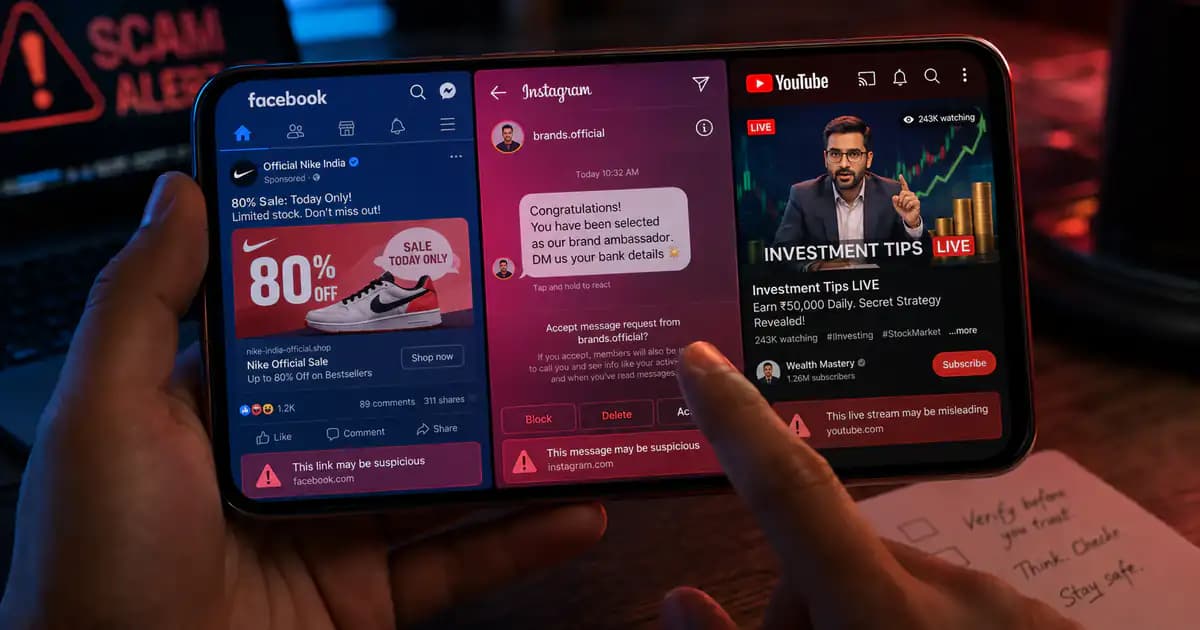
A sponsored sale, an exciting brand offer, and an investment live stream can all be paid or staged by criminals. Verify before you tap.
Social media scam India 2026 is no longer limited to obvious spam accounts. A modern social media fraud India campaign can begin with a paid Facebook ad, a polished Instagram store, a YouTube live stream, or a helpful reply beneath your public complaint. The profile may have thousands of followers, professional graphics, active comments, and even a verification badge. None of those signals proves that the offer is safe.
India had an estimated 500 million active social media user identities in October 2025, according to DataReportal's Digital 2026 India report. The same report says platform ad tools indicated potential audiences of about 500 million for YouTube, 481 million for Instagram, and 403 million for Facebook. These are advertising reach estimates and user identities, not perfectly deduplicated monthly active user counts, but they explain why one fraudulent ad can find a huge audience quickly.
Why Social Media Is India's Fastest-Growing Fraud Channel
Social platforms combine attention, trust, targeting, messaging, and payment prompts in one place. A scammer can buy an ad aimed at people interested in investing, fashion, jobs, or a specific brand. The click reveals who is curious. The victim is then moved into WhatsApp or Telegram, where planted group members post fake profits, fake delivery confirmations, or glowing testimonials.
The enforcement numbers show the scale of the problem, although they should not be mistaken for Indian victim counts. In May 2025, Meta said it removed clusters totalling more than 23,000 Facebook Pages and accounts that primarily targeted people in Brazil and India. In March 2026, Meta said it had banned more than 12.1 million pieces of ad content in India during 2025, with more than 93% removed proactively. Platform enforcement helps, but it cannot verify an offer for you before every impression.
I4C's official advisory on fake stock-market apps describes the full pipeline: sponsored deepfake ads on Facebook, Instagram, and Google redirect users to fraudulent WhatsApp or Telegram groups, which then push fake apps, mule bank accounts, and small initial payouts. That sequence is important. The social post is often only the first stage of a longer fraud.
The 8 Most Active Social Media Scam Types in India
Scam 1: Facebook Fake Business Pages and Marketplace Fraud
A Facebook scam India 2026 page may copy the name, logo, product photos, and recent posts of a real business. On Marketplace, an underpriced phone, car, rental, or appliance creates urgency. The seller asks for an advance, token amount, courier charge, or direct UPI payment, then blocks the buyer. Sellers are targeted too: a fake buyer sends a payment screenshot, a QR code, or a link that claims an account upgrade is required to receive money.
Facebook's own Marketplace guidance says users should avoid moving conversations outside Facebook early, inspect valuable items before paying, confirm payments inside the actual account, and report suspicious listings. A copied page can look older than the scam campaign if criminals have compromised an existing account, so account age is useful but not conclusive.
Scam 2: Instagram Fake Brand Stores and Sponsored Ad Fraud
An Instagram scam India storefront may advertise designer clothing, sneakers, electronics, beauty products, or jewellery at an impossible discount. An Instagram fake brand India account can steal photos and reels from a real seller, buy followers, disable comments, and send every buyer to a UPI ID or unknown website. Some stores deliver nothing. Others send a cheap substitute so the transaction looks like an ordinary product dispute.
A sponsored label only means the advertiser paid for reach. It does not mean Instagram guaranteed delivery or authenticated every claim. Search the exact handle and phone number with terms such as complaint or scam, find the brand's website independently, check return and contact details, and prefer payment methods with buyer protection. Use RakshaAI's full checklist for fake online sellers before paying an unfamiliar social-media store.
Scam 3: YouTube Deepfake Investment Live Streams
A YouTube investment scam India campaign uses a looped recording, stolen interview, AI voice, or face manipulation to make a trusted business leader, market expert, or creator appear to endorse a trading app. A fake viewer count and busy live chat create social proof. The video description, pinned comment, QR code, or live-chat moderator directs viewers to a website or private group.
YouTube prohibits get-rich-quick schemes and content intended to scam users, but viewers still need to verify before acting. Search for the person's official channel and public warning, check whether the intermediary is registered with SEBI, and use only the app link listed by the relevant exchange or official institution. Read RakshaAI's guide to the deepfake celebrity scam for the visual and behavioral checks.
Scam 4: Fake Celebrity Giveaways and Share-to-Win Traps
A fake giveaway scam India post promises an iPhone, cash, vehicle, holiday, or shopping voucher in exchange for likes, shares, comments, or survey completion. The public engagement spreads the bait. A lookalike account then replies that you won and asks for a delivery charge, processing fee, bank details, or login.
Verify the result on the organizer's known website and established account. Compare every character in the username. Read the original rules and closing date. A genuine organizer will not need your OTP, UPI PIN, card password, or payment to release a prize. If you never entered the promotion, you did not win it.
Scam 5: Social Media Comment Investment Groups
Fraudsters place comments below finance videos, business news, and creator posts: "I recovered my losses with this expert" or "Join our WhatsApp group for tomorrow's upper-circuit stock." Several accounts may answer one another to simulate independent success stories. The conversation eventually leads to an unregistered adviser, fake institutional account, or manipulated trading app.
Do not treat comments as customer evidence. Profiles can be created in bulk or taken over. Guaranteed returns, secret allotments, payments to changing bank accounts, and apps delivered through chat are decisive warnings. SEBI's 2026 investor material tells users to verify registered intermediaries, approved apps, and valid payment handles through official resources.
Scam 6: Instagram DM Modeling and Influencer Scam
A stranger claims to represent a fashion label, production house, talent agency, or hotel. The message praises your profile and offers a modelling shoot, ambassador role, product collaboration, or paid trip. The catch appears later as a portfolio fee, registration charge, refundable security deposit, travel booking, or purchase you must make first.
Contact the named brand through the email and phone number on its independently found website. Ask for a written brief, usage rights, payment terms, and the full legal identity of the agency. Real clients pay talent for work. They do not require a private UPI payment to unlock selection.
Scam 7: Fake Customer Care Replies to Complaints
You post publicly that an airline refund, bank transfer, courier, food order, or shopping delivery failed. Within minutes, an account using the company logo replies and asks you to DM a phone number. The fake agent then requests an OTP, card details, screen sharing, remote access, or a small UPI payment.
I4C warns that criminals tamper with customer-care details on social media. Delete your public post if it exposes an order number, phone number, email, or transaction reference. Open the company's official app or type its known website yourself. Support does not need a UPI PIN or remote access to issue a refund.
Scam 8: Account Hacking Through Phishing Login Pages
A message claims that your account will be suspended for copyright infringement, failed verification, or a Community Standards violation. Another version offers a blue badge, sponsorship, or creator payment. The link opens a fake Facebook, Instagram, or Google login page and captures the username, password, and one-time code.
CERT-In says compromised high-profile, government, and enterprise social accounts are used for scams and misinformation. Use a unique password, enable multi-factor authentication, review active sessions, and never sign in through a link received in a DM. If an account is taken over, use the platform's official recovery flow and warn contacts through another channel.
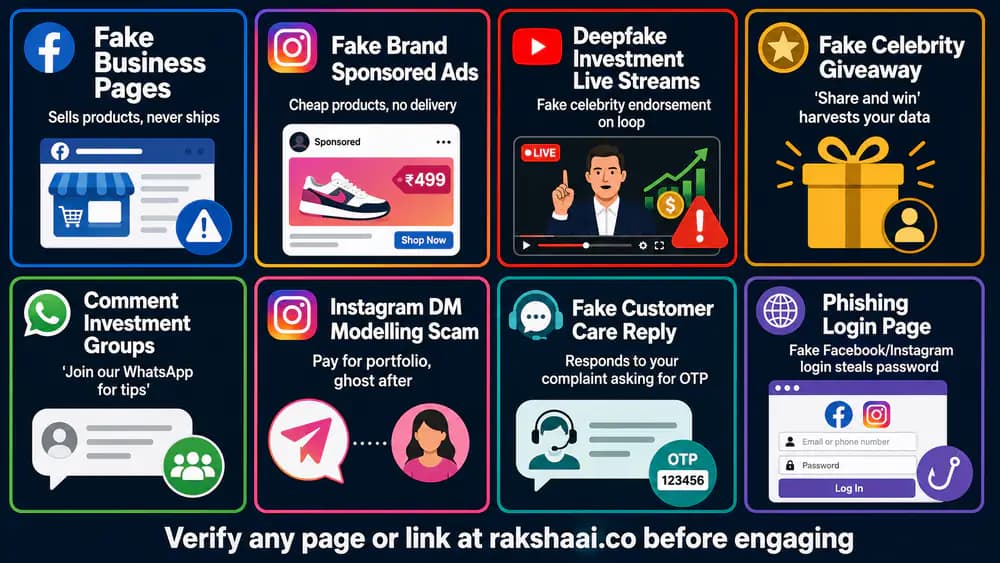
The bait changes by platform, but the requested action is familiar: leave the app, trust a copied identity, pay in advance, install an unknown app, or surrender credentials.
Recent Social Media Scam Cases Reported in India
These cases are based on police statements, complaints, court reporting, or platform disclosures. Allegations remain subject to investigation or court process where applicable.
- The Indian Express, 28 July 2026: Pune cyber police said a 50-year-old doctor lost about ₹95 lakh after a Facebook stock-analysis ad moved him into a WhatsApp group and fake trading app. Three small withdrawals totalling ₹11,000 built trust. A Delhi Cyber Crime Cell warning stopped him from sending another ₹1.59 crore.
- The Indian Express, 27 July 2026: the Kollam District Consumer Commission awarded ₹36,880 after an Instagram boutique failed to deliver one of two paid dresses or provide a refund. The commission said social-media sellers remain bound by the Consumer Protection Act, 2019.
- The Indian Express, 21 June 2026: Delhi Police said a 22-year-old engineer lost ₹2 lakh to an Instagram page promoting a fictitious faith healer. Investigators alleged that fake accounts posted supportive comments and that payment demands escalated over three days.
- The Indian Express, 23 July 2025: Pune police said a 59-year-old man lost ₹43 lakh after encountering a deepfake video that appeared to feature Narayana Murthy and Sudha Murty promoting AI-based share trading.
- Press Trust of India via NDTV, 14 January 2024: Delhi Police said a man used Instagram while posing as a casting director and requesting portfolio and selection payments. Police reported finding details of 15 aspiring models during the investigation.
The latest cases show why the visible post is not the whole scam. An ad may become a group, an early payout may become a large deposit, and enthusiastic comments may be controlled by the same operators. Record every step, not only the final payment.
How to Verify a Social Media Account or Business Is Real
How to verify a social media account or business is real in India:
- Check the verified badge, then verify independently: some badges are subscription-based, and a compromised verified account can still publish a scam. A badge is a signal, not proof that an offer is safe.
- Look at account history and Page transparency: fake pages are often recent, repeatedly renamed, or filled with many posts uploaded in a short period. An old account may also be stolen, so inspect recent changes.
- Compare followers with real engagement: large follower counts paired with generic comments, low interaction, or repeated wording may indicate purchased or coordinated engagement.
- Find the official website independently: search the business name, open the domain yourself, and check whether that website links back to the exact social account. Do not trust the bio link alone.
- Verify the legal business where relevant: if it claims to be an Indian company, use MCA21 to view Company or LLP Master Data. Registration confirms an entity exists, not that every social-media offer is genuine.
- Check reputation across sources: search the handle, domain, phone number, and business name with words such as complaint, fraud, and scam. Look for a consistent history outside social media.
- Inspect the link before engaging: copy the URL without opening it and use RakshaAI's website safety checker. Never buy or invest based only on a social media profile.
Real businesses usually have consistent contact details, an independently discoverable domain, a traceable legal or merchant identity, clear return terms, and a history that extends beyond one platform. Each check reduces risk, but no single signal guarantees safety.
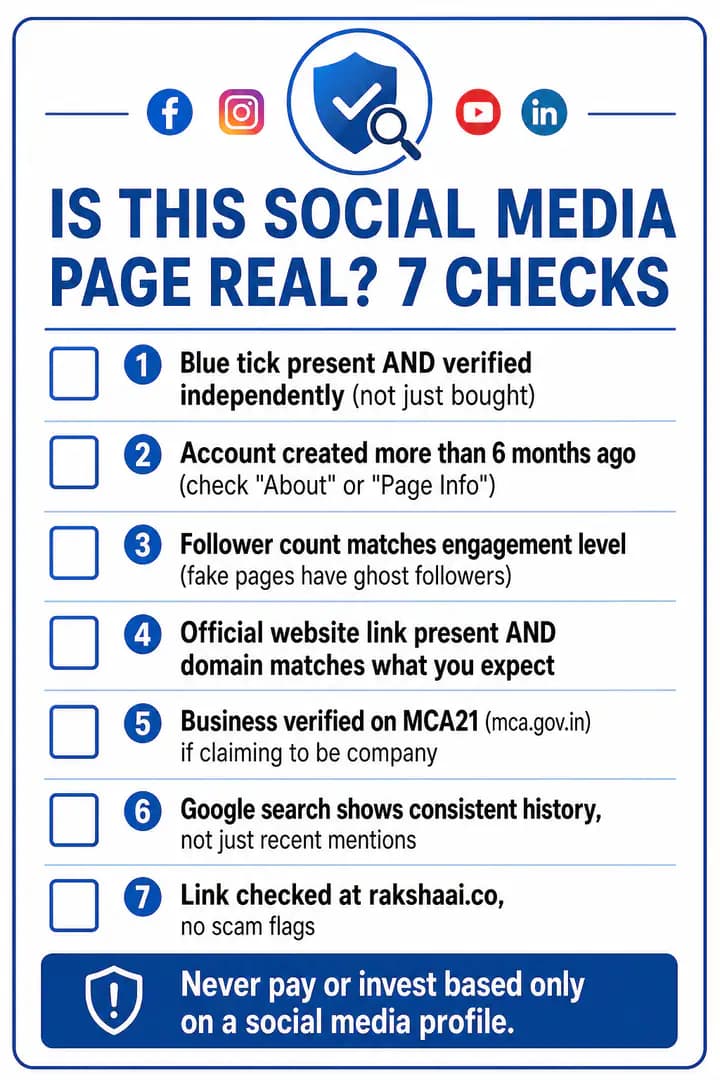
Save this checklist before responding to the next store, creator, investment page, or brand collaboration request.
How to Report a Scam on Facebook, Instagram and YouTube
Platform menus change across app versions, so use the closest scam, fraud, impersonation, spam, or misleading-content option currently shown on your device.
Report a Facebook page, post, profile, or Marketplace listing
- Capture the page URL, username, post, listing, messages, and payment details before blocking.
- Open the relevant content and use the options menu to select Report.
- Choose the closest reason, such as scam, fraud, impersonation, or false information, then follow the prompts.
- For Marketplace, Facebook's official process supports reporting the listing, seller, or buyer separately.
Report an Instagram profile, message, post, or ad
- Open the profile or content and select Report from its options menu.
- Choose scam, fraud, impersonation, spam, or the nearest reason presented.
- For a paid ad, use the ad's options menu and report the advertisement itself as well as the destination account.
- If your own account was stolen, use Instagram's official hacked-account recovery flow and change the linked email password.
Report a YouTube video, live stream, ad, or channel
- Use More and Report below the video or live stream, then select the reason that best matches the violation.
- For repeated activity, open the channel description, select Report user, and submit the relevant reason.
- For an ad, select Sponsored, then Report ad. Save the advertiser and landing-page details first.
- Report malicious links in descriptions, pinned comments, and live chat when the interface allows.
For how to report social media scam India beyond the platform, use the National Cyber Crime Reporting Portal's Report Suspect facility to submit a social media URL. If money was lost, call 1930 immediately, contact your bank through an official channel, file the full complaint at cybercrime.gov.in, and follow RakshaAI's step-by-step guide for people who already paid. If a seller delivered nothing or an unacceptable product and remains identifiable, you may also contact the National Consumer Helpline at 1915.
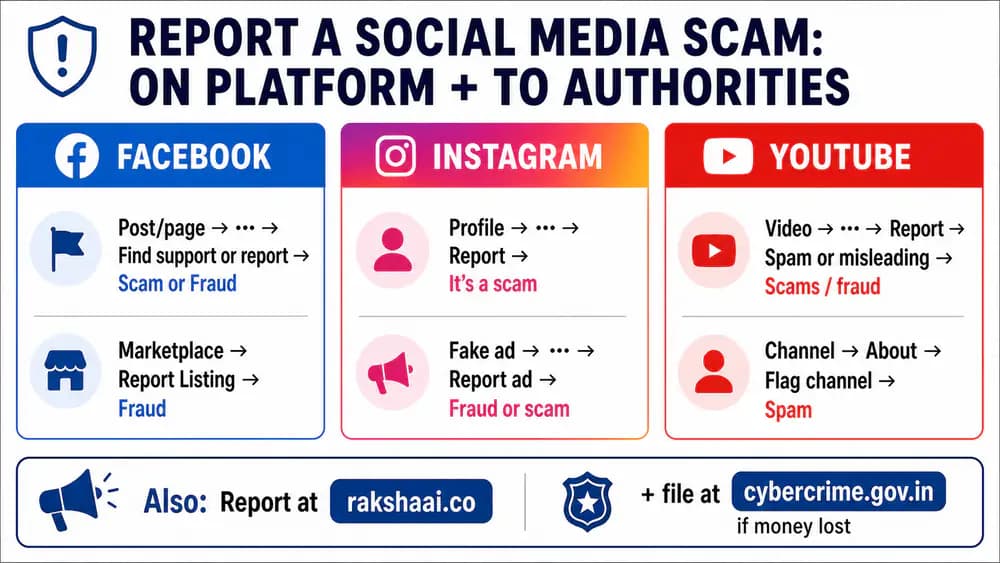
Report the content on-platform and use official Indian reporting channels when a financial or identity crime has occurred.
Frequently Asked Questions
How do I report a scam page on Facebook India?
Open the page, post, profile, or Marketplace listing and use its options menu to select Report. Choose the closest scam, fraud, impersonation, or misleading-content reason shown. Preserve screenshots first. If money was lost, call 1930, notify your bank, and file at cybercrime.gov.in. You can also submit the social media URL through the Report Suspect facility on the National Cyber Crime Reporting Portal.
Are Instagram sponsored ads safe in India?
No. Paid placement does not prove that an advertiser, product, investment, or website is legitimate. I4C specifically warns users to be cautious of sponsored Facebook, Instagram, and Google investment ads. Search the advertiser independently, inspect account history, verify the official domain, and check the destination before paying or entering credentials.
What is the YouTube investment live stream scam India?
Criminals may use a hacked or lookalike channel to run a recorded or AI-manipulated video that appears to show a celebrity, financial expert, or business leader promoting an investment. A link, QR code, pinned comment, or live chat then sends viewers to a fake trading platform or messaging group. Verify the claim through the real person and a SEBI-registered intermediary before acting.
How do I know if a social media giveaway is real in India?
Check the giveaway only through the brand or creator account you already know, read the published rules, and inspect the exact username. A genuine prize does not require a processing fee, UPI transfer, OTP, UPI PIN, card password, or remote-access app. A surprise winner message from a new lookalike account is a strong scam sign.
Can I get money back if I was scammed through Instagram in India?
Recovery is possible but not guaranteed. Call 1930 immediately, contact your bank or card issuer through an official channel, and file at cybercrime.gov.in. Preserve the profile URL, ad, messages, invoice, UPI ID, transaction reference, and screenshots. For a product dispute where the seller is identifiable, the National Consumer Helpline and consumer commission process may also apply.
30 Second Instagram Reel Script
0 to 3 seconds: hook
"That sponsored post can still be a scam. Here are eight social media traps hitting Indians right now."
3 to 13 seconds: rapid examples
"Fake Facebook shops. Instagram brand deals. Deepfake YouTube investments. Giveaways, comment tip groups, modelling DMs, fake support replies, and phishing logins."
13 to 24 seconds: safety check
"A blue tick, paid ad, or huge follower count is not proof. Find the official website yourself, inspect account history, and never pay to unlock a prize, job, refund, or investment."
24 to 30 seconds: action and CTA
"Check suspicious links at RakshaAI. Lost money? Call 1930 now. Save this reel and share it before someone you know taps the trap."
On-screen text: PAID AD DOES NOT MEAN SAFE | VERIFY OUTSIDE THE APP | NEVER PAY TO UNLOCK | CALL 1930
Sources, Credits and Methodology
- DataReportal, Digital 2026 India: internet, social-media identity, and platform advertising-reach estimates. The article preserves the source's methodological cautions and does not treat ad reach as exact monthly active users.
- Meta India, 7 May 2025: more than 23,000 Facebook Pages and accounts removed across clusters primarily targeting Brazil and India, plus descriptions of deepfake investment and advance-payment scams.
- Meta, March 2026 anti-scam update: platform-reported 2025 ad and account enforcement figures, including India-specific ad-content removals.
- I4C advisory on fake stock-market websites and apps: official source for the sponsored-ad, deepfake, messaging-group, fake-app, mule-account, and initial-payout sequence.
- CERT-In advisory CIAD-2024-0006: official guidance on social account compromise, multi-factor authentication, login alerts, active sessions, phishing, and access control.
- SEBI press release 20/2026: official source for the verified-label initiative for trading apps and SEBI's Check, Validate, Verify investor guidance.
- YouTube reporting guidance and Facebook Marketplace reporting guidance: platform sources used to check current reporting steps.
- Individual Indian cases are credited in the case section to The Indian Express and Press Trust of India via NDTV. Amounts and events are attributed to the police, complaint, commission, or publication stated there.
Research was checked against sources available on 29 July 2026. RakshaAI distinguishes platform enforcement figures, advertising estimates, official advisories, reported allegations, and final consumer findings. The four article images were supplied for this article, edited only to meet the punctuation requirement, and compressed to WebP files between 46 KB and 67 KB.
Verify the link before you trust the profile
Copy a suspicious bio, ad, comment, or message link without opening it. RakshaAI can help you inspect the destination before you click, buy, or invest.
Open Website Safety CheckerMore from RakshaAI Blog
PAN Card Fraud India: How Scammers Are Misusing Your PAN in 2026
Social Media Account Cloning India: When Scammers Become You Online
Cyber Fraud Case Studies India 2026: Real Victims, Real Losses, Real Lessons
Stay Protected Online
Use RakshaAI to check websites, phone numbers, and UPI IDs for scams free, instant, no sign-up required.
RakshaAI is a private platform by Ehatech Services Pvt. Ltd. Not affiliated with any government body. Editorial policy