
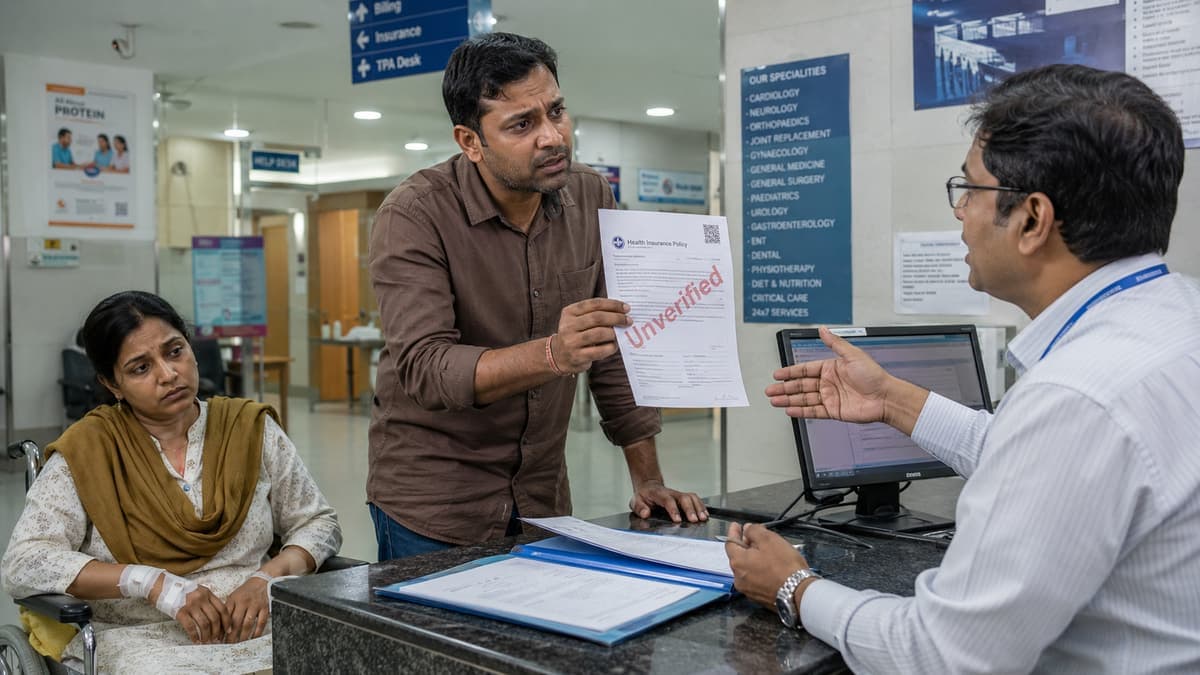
The worst place to discover that a policy is fake is a hospital reception desk, with a family member in a wheelchair three feet away.
The document looks right. It has a policy number, a sum insured, a QR code and a signature. The premium was paid on time for two years. And the administrator behind the counter turns the monitor slightly and says the sentence that ends the argument: this policy does not exist in our system.
Health insurance scam India 2026 is not a fraud that steals from you at the moment of payment. It steals from you months or years later, at the exact point where you have the least capacity to fight back. That delay is the whole design. A fake mediclaim policy generates no complaint for as long as nobody is ill, which means the fraudster has already moved on by the time the failure surfaces.
This guide covers the six health insurance fraud formats operating in India, the documented cases behind each one, a verification check that takes about two minutes, and the escalation ladder that actually works when a genuine claim is wrongly rejected. Read it while everyone in your family is healthy, because that is the only useful time to read it.
The 60 second version
- 1A fake health policy stays invisible until an admission, which is why it is discovered at the worst possible moment
- 2Insurers processed 3.26 crore health claims in FY25 and about 8 percent were repudiated, roughly one in twelve
- 3Verify the policy number inside the insurer official app, and the agent licence number at irdai.gov.in
- 4Never pay a premium in cash or to a personal UPI ID, only through the insurer official gateway
- 5Check the cashless network hospital list in the insurer app before admission, never at the billing counter
- 6IRDAI never calls about a bonus, a refund or a blocked maturity amount, and never collects money
- 7A rejection must cite the exact policy clause, and after 60 months of cover only proven fraud can defeat a claim
Why Health Insurance Is a Prime Target for Fraud
Four things make health cover unusually attractive to a fraudster, and none of them is about technology.
The first is scale. Health insurance covered about 580.6 million lives in India in FY25, and insurers processed roughly 3.26 crore health claims in that year, with about 58 percent handled as cashless and an average settled claim of Rs 28,910. A market that large absorbs an enormous amount of fraud before anyone notices a pattern. The health insurance market was worth about Rs 1.27 lakh crore in FY25, growing at roughly 17 percent a year, and is projected to reach between Rs 2.6 lakh crore and Rs 3 lakh crore by 2030.
The second is the delay between payment and use. Almost every other kind of purchase fails immediately if it is fake. Health insurance is the rare product where a complete fabrication can sit quietly for years, collecting renewal premiums, because it is never tested until an emergency.
The third is the emotional state of the buyer and the claimant. Nobody negotiates hard at a hospital admission desk. Nobody reads a policy wording while a parent is being wheeled into a ward. Fraud that targets that moment is targeting a person who has no bandwidth left for scepticism.
The fourth is the sheer size of the leakage, which tells you how industrialised this has become. A study by BCG and Medi Assist on fraud, waste and abuse in Indian health insurance estimated that 8 to 10 percent of total claim payouts leak out of the system, amounting to roughly Rs 8,000 crore to Rs 10,000 crore every year. Their breakdown is worth holding on to: about 90 percent of claims are genuine and risk free, about 2 percent are confirmed fraudulent, and the remaining 8 percent sit in a grey zone of abuse and inefficiency. Fraud risk concentrates in mid ticket claims, in the Rs 50,000 to Rs 2.5 lakh band, which is large enough to be worth stealing and small enough to escape close scrutiny.
That leakage is not absorbed by insurers out of goodwill. It is recovered through premiums, which means every honest policyholder in India is already paying for this.
The 6 Health Insurance Fraud Types in India in 2026
These six formats cover almost everything that goes wrong. Two of them steal from you directly, two steal from the insurer using your identity or your admission, and two steal from you through the fine print. All six end with the same result, which is a family paying a hospital bill they believed was covered.
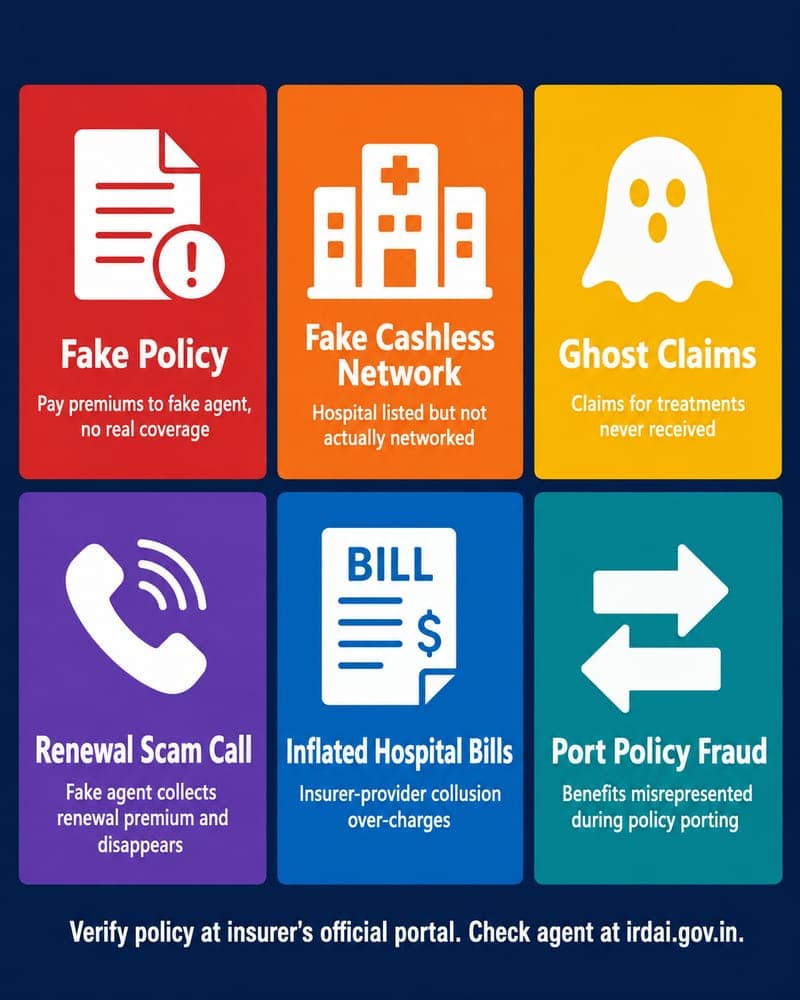
Six health insurance fraud formats
What each one looks like in India in 2026, and who is actually being robbed
1Fake policy, no real coverage exists
Premium is collected by an unlicensed or impersonating agent, a convincing policy document is handed over, and nothing is ever registered with the insurer. The family discovers it at a hospital desk during an admission.
2Fake cashless network hospital listings
A hospital presents itself as part of the insurer cashless network, or an agent supplies a forged network list, when no such empanelment exists. Cashless fails at admission and the family pays out of pocket.
3Ghost claim fraud
Admissions, lab reports and bills are manufactured for treatment that never happened, sometimes using a real policyholder identity, and submitted to multiple insurers at once.
4Mediclaim renewal scam call
A caller who knows your insurer, policy number and renewal date offers a discounted renewal, collects the premium to a personal account, and disappears. The real policy lapses on schedule.
5Inflated hospital bills and upcoding
A genuine admission is padded with tests never performed, consumables never used, or a procedure code swapped for a higher paying one. Your sum insured is consumed and your future premium rises.
6Port policy fraud
Portability is sold on a promise that waiting period credits, pre existing disease cover and room rent terms carry over unchanged, and the new policy quietly says otherwise.
Fraud 1: Fake Policy, You Pay Premiums and No Real Coverage Exists
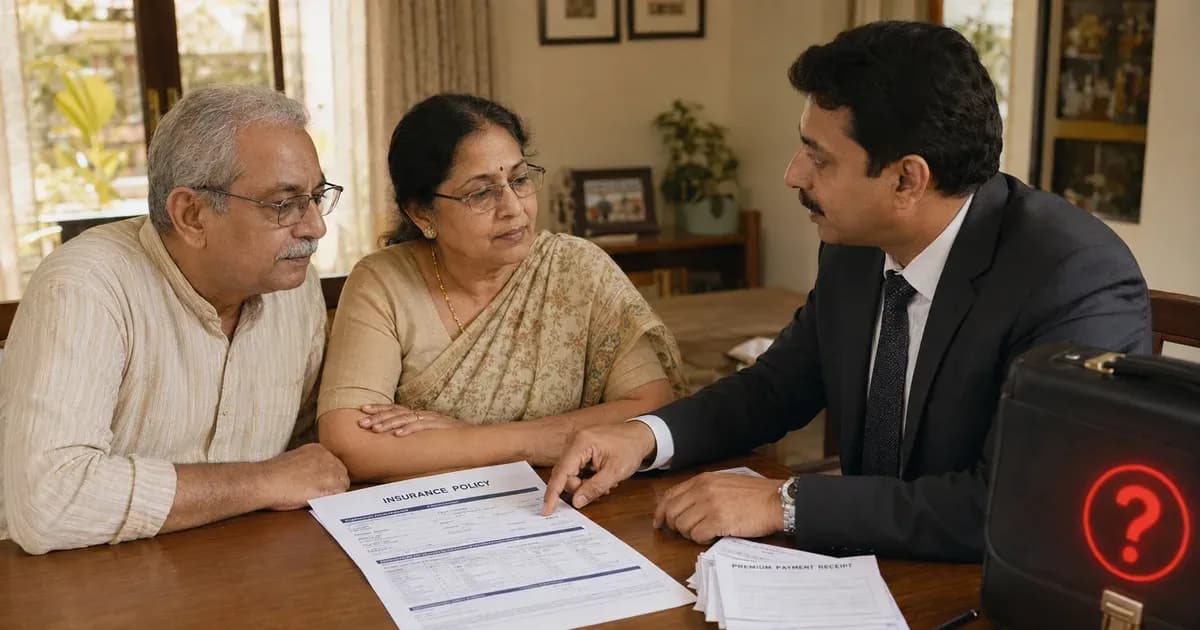
This is the purest form of fake mediclaim India fraud and the one the photograph at the top of this article shows. Somebody presents themselves as an agent of a well known insurer, quotes a premium slightly below the market, collects the money in cash or to a personal UPI ID, and hands over a policy document produced on a laptop. Nothing is ever submitted to the insurer.
The construction is deliberately durable. Renewal reminders arrive on time. A customer care number is provided, and it is answered, because the fraudster is running it. Some operations issue physical cashless cards in the name of a real insurer, which is what makes the deception survive years of casual inspection. The failure point is always the same and always late: the first hospitalisation.
The industrial version of this runs out of call centres. Noida police busted two of them on 20 July 2026 and arrested four people, one centre working entirely on fake insurance policy maturity benefits, credit cards, loans and other financial services, with 25 complaints traced through the National Cyber Crime Reporting Portal and seizures including a laptop, phones, 17 ATM cards and a cheque book. In an earlier Haryana case, six people were arrested from a gang that had run a call centre out of New Delhi posing as officials of a major insurer, linked to as many as 242 cheating incidents across the country.
The defence is one sentence long. A policy exists when the insurer system says it exists, and not when a document says so. Our guide to the wider insurance scam landscape in India covers the life insurance and bonus release variants of the same model.
Fraud 2: Fake Cashless Network Hospital Listings
A fake cashless hospital India case has a narrower shape and a nastier timing. The policy is genuine. The hospital is genuine. What is false is the claim that the two are connected.
It appears in three ways. An agent supplies a network hospital list that includes hospitals the insurer has never empanelled, usually to close a sale in a town where the real network is thin. A hospital tells a walk in patient that it accepts cashless for your insurer when its empanelment has lapsed or never existed. Or a hospital advertises a tie up it does not have in order to attract insured patients, then converts the admission to reimbursement at the billing counter, when the family has already committed.
The consequence is not that the claim is lost. It is that cashless fails, the family arranges lakhs in cash or on credit cards during an emergency, and then fights a reimbursement claim afterwards from a much weaker position, often with incomplete documentation because nobody was collecting paperwork carefully at 2 in the morning.
The check is thirty seconds and it has to happen before admission, not during it. Open the insurer own app, search the network list by city and hospital name, and screenshot the result. A list from an agent, a card in your wallet and the assurance of a billing executive are all worth nothing, because the party telling you has a commercial interest in the answer.
Fraud 3: Ghost Claim Fraud, Claims for Treatment Never Received
A ghost insurance claim India is a claim for a hospitalisation that never happened. The admission is entered into hospital records, lab reports and treatment charts are generated to match, bills are produced, and a complete file is submitted to an insurer for a patient who was never in the building.
The clearest recent documentation is the Gurugram case. On 18 and 19 February 2026, a joint team of police, civil hospital doctors, cyber experts and drug control officials raided Galaxy One Hospital in New Palam Vihar. Investigators found bogus in patient admissions created without any actual patient, along with forged medical records, laboratory reports and treatment bills built to support them. Around 60 fabricated insurance claim files linked to roughly 25 insurance companies were recovered, together with hospital stamps, computers, fake bill books and forged medical documents. Three hospital staff were arrested and at least Rs 1 crore in fraudulent claims was identified, with police stating that the true figure could run into several crore and that other hospitals and diagnostic centres were suspected of being part of the same network. The case was registered for cheating, forgery and criminal conspiracy.
The same pattern appears at scale inside government schemes, where the auditing is more visible. Under Ayushman Bharat PMJAY, the National Health Authority penalised 2,842 hospitals a total of Rs 114.06 crore during 2025-26, de empanelled 2,003 hospitals, suspended 839, and blocked Rs 678.47 crore of suspicious claims before payment. Its detection now runs on an automated adjudication engine with more than 100 continuously refined algorithms, a Hospital Vulnerability Index Dashboard that scores hospitals for fraud risk, and biometric authentication at every individual dialysis cycle.
Ghost claims matter to you personally for two reasons. Your policy details, once leaked, can be used to file a claim you never made, which consumes your sum insured and creates a claim history you then have to disprove. And the aggregate cost comes back as premium. Read your claim statement in the insurer app once a year, the same way you read a bank statement.
Fraud 4: Mediclaim Renewal Scam Call
The mediclaim renewal scam India call is effective because the caller already knows things about you. Your insurer name. Your policy number. Your renewal date. Sometimes your sum insured and the names on the policy.
That information comes from data leaks, from intermediaries, and from the ordinary churn of agents moving between companies. It converts a cold call into what sounds like a service call. The offer is a renewal at a discount, a loyalty benefit, or an upgrade for the same premium, valid only if you act today because the policy is about to lapse. Payment is requested to a personal UPI ID or an individual account, and the receipt that follows looks entirely plausible.
The real policy then lapses on its original date, and the family finds out at the next claim, or worse, discovers that continuity has broken and the waiting periods have restarted.
A second variant impersonates the regulator directly. IRDAI has issued repeated public notices warning that fraudsters pose as its officials to offer policies, to announce a bonus distribution to policyholders, or to persuade people to surrender an existing policy for a better return. IRDAI states plainly that it does not sell insurance directly or through any representative, does not invest premium collected by insurers, and does not announce any bonus. Any call that says otherwise is fraud, and the next request will be for a processing fee, TDS, or a registration charge to release money that does not exist.
The rule that removes both variants: never renew through an inbound call. Hang up, open the insurer app or the official website you typed yourself, and renew there. Before that, run the number through the phone number checker, and if you want the full pattern, our guide on how to check a scam phone number covers it.
Fraud 5: Inflated Hospital Bills and Insurer Provider Collusion
This is the fraud that hides inside a real admission, which makes it the hardest to see and the easiest to dismiss. You were genuinely ill. You were genuinely treated. The bill is simply larger than the treatment.
The techniques are well documented: tests billed but never conducted, consumables charged but never used, extra days of stay recorded, and upcoding, where a procedure code is swapped for a higher paying one so a treatment worth about Rs 30,000 is billed under a package worth about Rs 60,000. There is also a documented pattern of unnecessary procedures performed purely to generate a claim.
The most serious Indian case on record ran under a government scheme. At Khyati Multispeciality Hospital in Ahmedabad, seven PMJAY beneficiaries underwent angioplasty on 11 November 2024, and two of them died, prompting three FIRs the following day. The investigation found that the hospital had run free check up camps in villages to persuade PMJAY cardholders to undergo angioplasty with no medical necessity, and had recorded them under the emergency category to speed up scheme approval. The hospital had earned about Rs 11 crore from PMJAY in a year, with roughly 70 percent of it from such claims. Arrests included the visiting cardiologist, the hospital chief executive, the marketing director and marketing staff, and the chairman was arrested at Ahmedabad airport on return from Dubai and charged with culpable homicide not amounting to murder alongside defrauding the scheme.
Two habits protect you. Ask for the itemised bill, not the summary, and read it before you sign the discharge, because line items are far easier to question inside the hospital than after payment. And question any procedure recommended immediately after a free camp or a screening you did not seek out, and get a second opinion before consenting to anything invasive.
Fraud 6: Port Policy Fraud, Fake Portability Benefits
Portability is a genuine IRDAI right. You can move a health policy to another insurer and carry your accrued waiting period credits with you. That legitimacy is exactly what the fraud borrows.
The pitch is a lower premium or a higher sum insured for the same money, and the deception is in what silently changes. The waiting period credit you spent three years earning does not carry across. A pre existing condition that was covered becomes an exclusion. A room rent sub limit appears that did not exist before. A co payment clause is added, so a share of every future claim is yours. None of this is illegal on the insurer side if it is in the policy wording. The fraud is in the selling, where an intermediary earns a commission on a switch that leaves you materially worse covered.
Three defences work. Read the Customer Information Sheet of the new policy rather than the brochure, since the IRDAI master circular requires it to state cover, exclusions, sub limits and co payment in plain language. Compare the waiting period and pre existing disease clauses of the old and new policies side by side, in writing. And apply for portability yourself through the new insurer official channel, at least 30 days before renewal, so every acknowledgement lands on your own email and phone rather than an agent.
Documented case, February 2026
Gurugram hospital raid uncovers manufactured admissions and claim files for 25 insurers
- Facility
- Galaxy One Hospital, New Palam Vihar, Gurugram
- Raid dates
- 18 and 19 February 2026
- Raiding team
- police, civil hospital doctors, cyber experts and drug control officials
- Method
- bogus in patient admissions with forged records, lab reports and treatment bills
- Files recovered
- about 60 fabricated insurance claim files
- Insurers targeted
- roughly 25 insurance companies
- Detected value
- at least Rs 1 crore, with police suspecting several crore
- Arrests
- three hospital staff, with charges of cheating, forgery and criminal conspiracy
- Seized
- hospital stamps, computers, fake bill books and forged medical documents
How to Verify Your Health Insurance Policy is Genuine
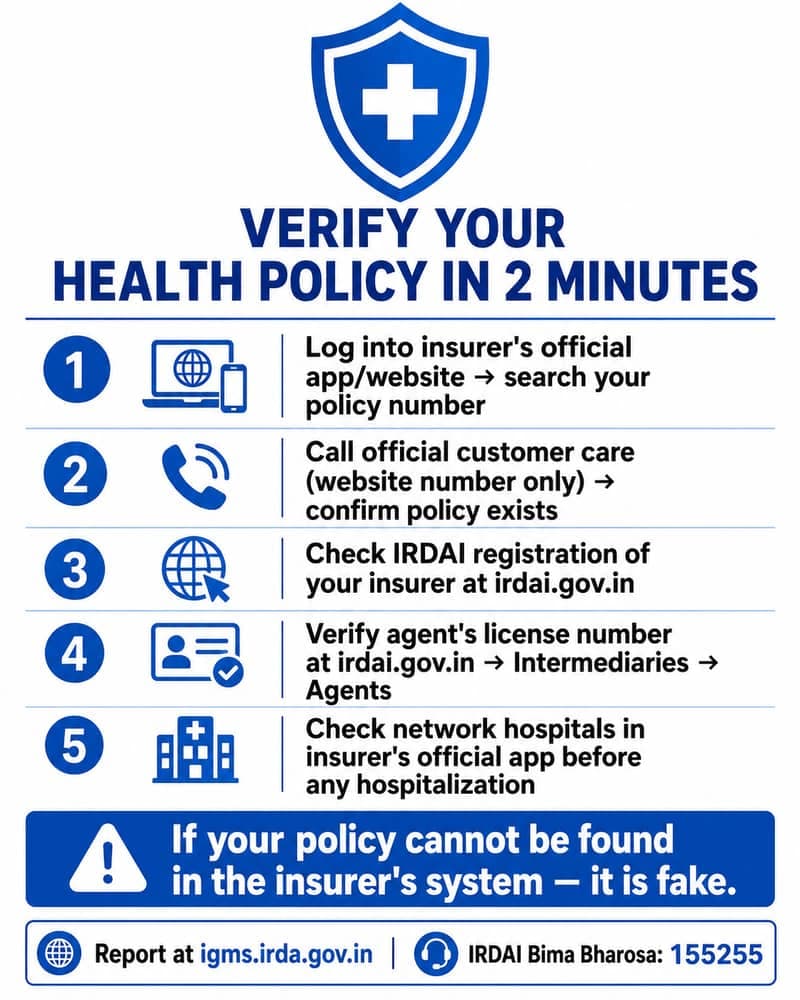
This is the section to run today, on a policy you already hold, before anybody needs it. It takes about two minutes and it settles the question completely.
How to verify your health insurance policy is genuine in India:
- 1
Log into the insurer official website or app and search your policy number
The policy must appear with the sum insured, the member names and the cover period. If the insurer system has no record of the number, the document in your hand is not an insurance contract.
- 2
Call the official customer care number taken from the insurer website, not from an agent
Ask the executive to read your policy number, cover dates and sum insured back from their records. A fake agent controls the phone number he gave you, and nothing else.
- 3
Check that the insurer is registered with IRDAI at irdai.gov.in
Only IRDAI registered insurers can issue a health policy in India. An unregistered name on a policy document is the end of the check, not the beginning of a negotiation.
- 4
Verify the agent licence number at irdai.gov.in before any money moves
A licensed agent has a verifiable licence number tied to a named insurer. Ask for it in writing, then verify it yourself rather than accepting a photograph of an identity card.
- 5
Confirm the policy document reached your own registered email within 24 to 72 hours
A genuine purchase generates a digital policy and a Customer Information Sheet to the email and mobile number you registered. Documents that only ever arrive on WhatsApp from an agent are a warning.
- 6
Check the network hospital list inside the insurer app before any planned hospitalisation
Search by city and hospital name in the official app. Do not rely on a list from an agent, a card in your wallet or the assurance of the hospital billing desk.
- 7
Pay only through the insurer official payment gateway
Never pay a premium in cash, and never to a personal UPI ID or an individual bank account. A premium that does not reach the insurer never becomes a policy, whatever the receipt says.
If you cannot find your policy in the insurer own system, it is fake. Nothing printed on the document changes that.
One more habit belongs here, and it is the cheapest insurance of all. Do this check once a year at renewal, and do it for your parents as well, because senior citizens are the group most likely to hold a policy sold entirely through a single agent they trust and never verify. Our cyber safety guide for senior citizens covers the wider version of that problem.
How to Check If a Hospital Is on Your Insurer Cashless Network
Cashless is the feature people buy health insurance for, and it is the feature most often misrepresented. Four rules keep it reliable.
- Search the network list in the insurer own app or website. Search by city and by hospital name, and take a screenshot with the date visible. That screenshot is your evidence if the position changes at admission.
- Do not accept a list from any other source. Not from an agent, not from a card, not from the hospital. Every one of those parties benefits from you believing the answer is yes.
- Confirm by phone for a planned hospitalisation. Call the insurer customer care number published on the official website and ask them to confirm the empanelment on the record, along with the room rent limit and any co payment that applies.
- Know the two timelines. Under the IRDAI health insurance master circular of 29 May 2024, the insurer must grant cashless authorisation within one hour of the hospital request, and the final discharge authorisation within three hours of the discharge request, with any hospital charges caused by a delay beyond that borne by the insurer rather than by you.
Those last two numbers change the conversation at a billing counter more than anything else in this article. A family that knows the one hour and three hour obligations stops asking for a favour and starts recording a breach.
What To Do If Your Claim Is Wrongly Rejected
Not every rejection is fraud, and not every rejection is wrong. Non disclosure of a pre existing condition, an unexpired waiting period, a permanent exclusion and treatment that does not meet the definition of hospitalisation are all legitimate grounds. But the volume tells you that plenty of rejections deserve a fight.
Insurers processed about 3.26 crore health claims in FY25, settling roughly 87 percent and repudiating about 8 percent, which is close to one claim in twelve. In FY24, insurers disallowed claims worth about Rs 15,100 crore. The IRDAI Bima Bharosa portal recorded 2,57,790 grievances in FY25, about 20 percent more than the year before, of which 1,37,361 came from general and health insurance, and the large majority of those concerned claims, meaning delays, underpayment or outright rejection.
Two provisions are worth knowing before you start. A repudiation must reference the specific policy term relied on, because a generic denial is non compliant under the 2024 master circular. And after 60 months of continuous coverage, the moratorium applies, which means no claim can be contested on grounds of non disclosure or misrepresentation, only on established fraud. A non disclosure allegation raised in year seven is very often an argument the insurer cannot win.
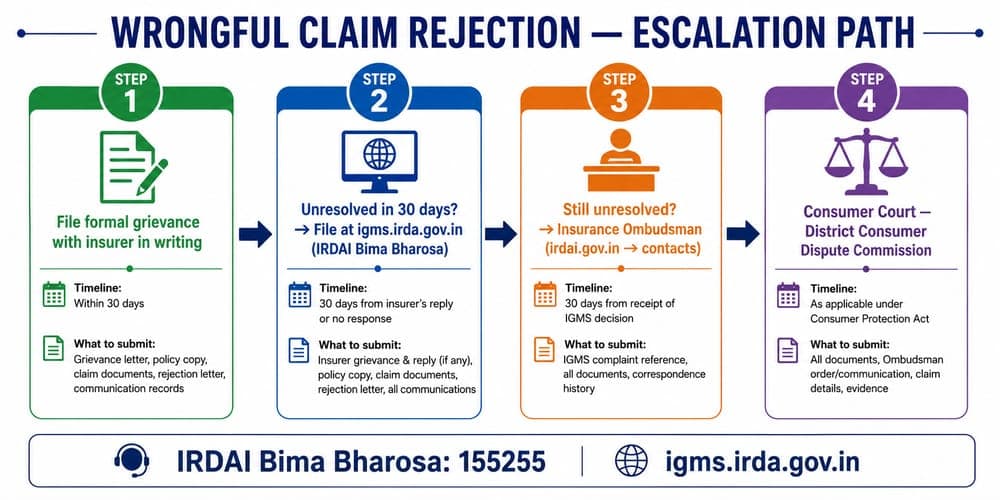
- File a written grievance with the insurer grievance redressal officer. Demand the specific policy clause the rejection relies on. Under the 2024 master circular a repudiation must reference the exact term, and a generic denial is non compliant. Expect a response within about two weeks.
- Escalate to IRDAI through the Bima Bharosa portal. File at bimabharosa.irdai.gov.in, or call the grievance call centre on 155255 or 1800 4254 732, attaching the grievance, the insurer reply, the policy copy, the claim file and the rejection letter.
- Approach the Insurance Ombudsman for your state. The Ombudsman is free, needs no lawyer, and can award compensation up to Rs 50 lakh. State wise Ombudsman contacts are published on irdai.gov.in. Carry the Bima Bharosa reference and the full correspondence history.
- File before the District Consumer Disputes Redressal Commission. A wrongful repudiation is a deficiency in service under the Consumer Protection Act. Bring every document, the Ombudsman order or communication, the claim details and the evidence of loss.
Keep everything in writing at every rung, including a dated copy of what you sent and what came back, because the Ombudsman and the consumer commission both decide on the record rather than on the argument. If money was taken by a fake agent rather than a claim being denied, the route is different and faster: our guide on what to do in the first 30 minutes after a scam covers it, and your rights as a cyber fraud victim under Indian law covers what you can compel a bank or an intermediary to do.
One structural change is coming that will help. The IRDAI Insurance Fraud Monitoring Framework Guidelines, 2025, issued on 9 October 2025 and effective from 1 April 2026, replace a framework that had stood since 2013. They require every insurer to constitute an independent fraud monitoring committee headed by a key managerial person, to run a dedicated fraud monitoring unit, and to have a board approved anti fraud policy reviewed annually, with binding timelines for reporting to law enforcement and to IRDAI. For the first time the framework explicitly recognises cyber fraud and extends to distribution channels, which is where the fake agent problem actually lives.
30 Second Instagram Reel Script
Format: open at the hospital desk, reveal that the policy does not exist, run the six formats fast, land on the two minute check. Shoot vertical 9:16, burn in Hindi and English captions for sound off viewers.
On-screen caption: A fake mediclaim policy stays silent until the day you need it. Search your policy number in the insurer official app, call the customer care number from the official website, verify the agent licence at irdai.gov.in, and never pay a premium in cash or to a personal UPI ID. If a claim is wrongly rejected, file at bimabharosa.irdai.gov.in or call 155255.
Frequently Asked Questions
How do I know if my health insurance policy is real in India?
Log into the insurer official website or app with your policy number and confirm the policy appears with the full sum insured, member names and cover dates. Then call the customer care number published on that official website, never a number an agent gave you, and ask the executive to read the policy number back from their records. A genuine policy also generates a digital copy to your registered email within 24 to 72 hours of purchase, along with a Customer Information Sheet that sets out cover, exclusions, sub limits and co payment in plain language, which the IRDAI health insurance master circular of 29 May 2024 made mandatory. Finally, check that the insurer itself is registered at irdai.gov.in and that the agent licence number is valid. If the policy number does not exist in the insurer system, no amount of paperwork in your hand makes it real. You are holding a receipt from a fraudster, not an insurance contract.
What is ghost claim fraud in Indian health insurance?
Ghost claim fraud is a claim filed for treatment that never happened. A hospital creates an in patient admission record for a person who was never admitted, generates matching lab reports, treatment charts and bills, and submits the file to an insurer. Gurugram police documented exactly this in February 2026 at Galaxy One Hospital in New Palam Vihar, where a raid recovered around 60 fabricated claim files linked to roughly 25 insurance companies, along with hospital stamps, fake bill books and forged medical records. Three hospital staff were arrested and at least Rs 1 crore in fraudulent claims was identified. Ghost claims matter to ordinary policyholders for two reasons. Your identity and policy details can be used to file one without your knowledge, which then shows up as a claim against your sum insured. And the industry wide cost of this fraud, estimated at around Rs 10,000 crore a year across fraud, waste and abuse, is recovered from everyone through higher premiums. Report a suspected ghost claim to your insurer in writing and to IRDAI at bimabharosa.irdai.gov.in.
How do I check if a hospital is on my health insurer cashless network?
Use the insurer own app or website to search the network hospital list by city and hospital name, and do it before admission rather than at the reception desk. Never rely on a list sent by an agent, printed on a card, or shown to you by the hospital itself, because all three are trivially forged and the hospital has a commercial reason to say yes. If the hospital claims to be networked and the insurer app does not list it, call the insurer customer care from the number on the official website and ask them to confirm on the record. Under the IRDAI master circular the insurer must grant cashless authorisation within one hour of the hospital request and the final discharge authorisation within three hours, and charges caused by a delay beyond that window fall on the insurer rather than on you. Knowing those two timelines is what turns an argument at the billing counter into a documented grievance.
What should I do if my mediclaim was wrongly rejected in India?
Work the escalation ladder in order, because each rung creates the record the next one needs. First, file a written grievance with the insurer grievance redressal officer and demand the specific policy clause relied on, since under the 2024 master circular a repudiation must reference the exact term and a generic denial is non compliant. The insurer is required to respond within roughly two weeks. Second, if it is rejected or unresolved, file at the IRDAI Bima Bharosa portal, bimabharosa.irdai.gov.in, or call the grievance call centre on 155255 or 1800 4254 732. Third, approach the Insurance Ombudsman for your state, which is free, needs no lawyer and can award compensation up to Rs 50 lakh. Fourth, file before the District Consumer Disputes Redressal Commission under the Consumer Protection Act. One rule protects you throughout: after 60 months of continuous cover, the moratorium means no claim can be contested on grounds of non disclosure or misrepresentation, only on established fraud.
How do I report a fake health insurance policy scam in India?
File a complaint with IRDAI at bimabharosa.irdai.gov.in or call the grievance call centre on 155255. File in parallel at cybercrime.gov.in, because selling a policy that does not exist is cheating and forgery, not merely a regulatory matter, and the Gurugram and Noida cases were both prosecuted as criminal offences. If money moved by UPI or bank transfer, call 1930 within the first hour, since that window is when funds can still be held in the beneficiary account. Keep the premium receipt, the policy document, the agent phone number, every WhatsApp message and the payment reference, because the complaint is built on that trail. Then report the agent number at rakshaai.co so the next person who checks it sees a warning instead of a sales pitch.
Can IRDAI call me about my insurance policy bonus or refund?
No. IRDAI has issued repeated public notices stating that it does not sell insurance or financial products directly or through any representative, does not invest the premium collected by insurers, and does not announce or distribute any bonus to policyholders. Any call claiming an IRDAI bonus, an unclaimed maturity amount or a blocked policy refund is fraud, and the request that follows will be for a processing fee, TDS, registration charge or GST payment to release money that does not exist. The same script is run by fake call centres at scale. Noida police busted two such operations on 20 July 2026 and arrested four people, one centre working purely on fake insurance policy maturity benefits, credit cards and loans. Hang up, and deal only with the insurer or a licensed intermediary you contacted yourself.
What is port policy fraud in health insurance and how do I avoid it?
Port policy fraud happens when someone persuades you to move your health cover to another insurer by misrepresenting what carries over. The pitch is a lower premium or a higher sum insured, and the deception sits in the details, typically the waiting period credit you have already earned, a pre existing disease that quietly stops being covered, a new sub limit on room rent, or a co payment clause that did not exist in the old policy. Genuine portability is a real IRDAI right and you keep the credits accrued for waiting periods, but only if the port is applied for correctly, at least 30 days before renewal, and only if the new policy actually says so. Three defences work. Read the Customer Information Sheet of the new policy, not the brochure. Compare the waiting period and pre existing disease clauses side by side with your old policy. And apply for portability yourself through the new insurer official channel rather than letting an agent handle it, so the acknowledgement comes to your own email and phone.
Why are health insurance claims rejected so often in India?
Some rejections are legitimate and some are not, and the published data does not clearly separate the two, which is the core of the problem. Insurers processed about 3.26 crore health claims in FY25 and roughly 87 percent were settled while about 8 percent were repudiated, which is around one claim in twelve. In FY24 insurers disallowed claims worth about Rs 15,100 crore. The IRDAI Bima Bharosa portal recorded 2,57,790 grievances in FY25, up about 20 percent on the previous year, with general and health insurance accounting for 1,37,361 of them and most of those relating to claims. The common legitimate grounds are non disclosure of a pre existing condition, a waiting period that has not expired, a permanent exclusion and treatment that does not meet the definition of hospitalisation. The common illegitimate ones are a generic denial letter with no clause cited and a non disclosure allegation raised after the 60 month moratorium has already passed. Both of those are contestable, and the escalation path in this article is how you contest them.
Sources and Credits
- IRDAI Annual Report 2024-25 and Ditto Insurance, IRDAI Annual Report: Key Insights for Policyholders: the 3.26 crore health claims processed in FY25, about 58 percent of them cashless, the average settled claim of Rs 28,910, health insurance cover across about 580.6 million lives, and the 2,57,790 grievances recorded on the Bima Bharosa portal in FY25 of which 1,37,361 came from general and health insurance.
- Insurance Business Asia, IRDAI Cannot Explain Why Health Insurance Claims Go Unpaid: the FY25 split of roughly 87 percent of health claims settled, about 8 percent repudiated and about 5 percent pending at year end, and the absence of published insurer level data on the specific grounds for rejection.
- Business Standard, Health Insurers Reject Claims Worth Rs 15,100 Crore in FY24: the value of health insurance claims disallowed by Indian insurers in FY24.
- The420.in, Insurance Sector Faces Rs 10,000 Crore Annual Leakage Due to Fraud and Inefficiencies and Business Standard, Insurance Industry Takes Rs 10,000 Crore Hit Each Year on Frauds: the BCG and Medi Assist report Rebuilding Trust, including the estimate that 8 to 10 percent of claim payouts leak to fraud, waste and abuse, the split of about 90 percent risk free claims, 2 percent confirmed fraudulent and 8 percent in a grey zone, the concentration of misuse in mid ticket claims between Rs 50,000 and Rs 2.5 lakh, and the market size of about Rs 1.27 lakh crore in FY25 growing at roughly 17 percent a year.
- Court Kutchehry, Gurgaon Fake Hospital Insurance Fraud Racket Exposed and Medical Drafts, Insurance Fraud Racket in Gurgaon: Fake Hospitals, Ghost Patients and Crores in Bogus Claims: the February 2026 raid on Galaxy One Hospital in New Palam Vihar, the bogus in patient admissions and forged medical records, the roughly 60 fabricated claim files linked to about 25 insurance companies, the at least Rs 1 crore detected, the three arrests, the seizure of hospital stamps, computers, fake bill books and forged documents, and the charges of cheating, forgery and criminal conspiracy.
- The420.in, NHA Fines 2,842 Hospitals Rs 114.06 Crore Over Scheme Irregularities and Medical Dialogues, Ayushman Bharat Fraud: National Health Authority Slaps Rs 114 Crore Penalty on 2,842 Hospitals: the National Health Authority action in 2025-26, covering Rs 114.06 crore in penalties on 2,842 hospitals, 2,003 hospitals de empanelled and 839 suspended, Rs 678.47 crore of suspicious claims blocked before payment, and the automated adjudication engine, the more than 100 fraud detection algorithms, the Hospital Vulnerability Index Dashboard and biometric authentication at each dialysis cycle.
- Deccan Herald, Chairman of Hospital at Centre of PMJAY Scam Arrested and Medical Dialogues, PMJAY Deaths Case: Another Khyati Hospital Director Arrested: the Khyati Multispeciality Hospital case in Ahmedabad, the seven PMJAY beneficiaries who underwent angioplasty on 11 November 2024 and the two who died, the village check up camps used to recruit cardholders for medically unnecessary procedures, the recording of cases under the emergency category to speed up scheme approval, the roughly Rs 11 crore earned from PMJAY in a year with about 70 percent from such claims, and the arrests of the chairman, the visiting cardiologist, the chief executive and marketing staff.
- Business Today, Noida Police Bust Call Centres Running Fake Airline Jobs and Fake Insurance Payouts: the 20 July 2026 action against two call centres in Noida Sector 2 and Sector 6, the four arrests, the Sector 6 operation built on fake insurance policy maturity benefits, credit cards and loans, the 25 complaints traced through the National Cyber Crime Reporting Portal, and the seizure of a laptop, phones, 17 ATM cards and a cheque book.
- The Tribune, Fake Insurance Gang Busted, Six in Police Net: the gang running a call centre from New Delhi while posing as officials of a major insurer, the six arrests, and the link to as many as 242 cheating incidents across the country.
- IRDAI, Public Notice on Spurious Calls and Moneylife, Insurance Regulator Warns About Spurious Phone Calls and Fictitious or Fraudulent Offers: the IRDAI position that it does not sell insurance directly or through any representative, does not invest the premium collected by insurers and does not announce any bonus for policyholders, and the pattern of callers posing as IRDAI officials to offer policies, bonuses and policy surrender benefits.
- Analysis of the IRDAI Health Insurance Master Circular, reference IRDAI/HLT/CIR/PRO/84/5/2024 dated 29 May 2024: the requirement to grant cashless authorisation within one hour of the hospital request, the final discharge authorisation within three hours with delay charges borne by the insurer, the 60 month moratorium after which a claim can be contested only on established fraud, the 30 day free look period, the mandatory Customer Information Sheet, and the requirement that a repudiation reference the specific policy term rather than a generic reason.
- Lexology, IRDAI Guidelines on Insurance Fraud Monitoring Framework and Ankura, Playbook to Unlocking the Power of the IRDAI 2025 Insurance Fraud Monitoring Framework: the IRDAI Insurance Fraud Monitoring Framework Guidelines, 2025, reference IRDAI/IID/GDL/MISC/112/10/2025 dated 9 October 2025, effective from 1 April 2026 and replacing the 2013 framework, including the independent fraud monitoring committee headed by a key managerial person, the fraud monitoring unit, the annually board approved anti fraud policy, the binding reporting timelines, the explicit recognition of cyber fraud and the extension to distribution channels.
- Guidance on the Insurance Ombudsman complaint process: the escalation requirement that a grievance be raised with the insurer first and taken further if rejected or unresolved, and the Ombudsman power to award compensation up to Rs 50 lakh at no cost to the complainant.
- Insurance Regulatory and Development Authority of India: the register of licensed insurers and intermediaries, and state wise Insurance Ombudsman contacts.
- IRDAI Bima Bharosa grievance portal: the official route for an insurance grievance, with the grievance call centre reachable on 155255 or 1800 4254 732.
- National Cybercrime Reporting Portal: the official complaint route for online financial fraud, and the India national cybercrime helpline, 1930.
More from RakshaAI Blog
Stay Protected Online
Use RakshaAI to check websites, phone numbers, and UPI IDs for scams free, instant, no sign-up required.
RakshaAI is a private platform by Ehatech Services Pvt. Ltd. Not affiliated with any government body. Editorial policy