
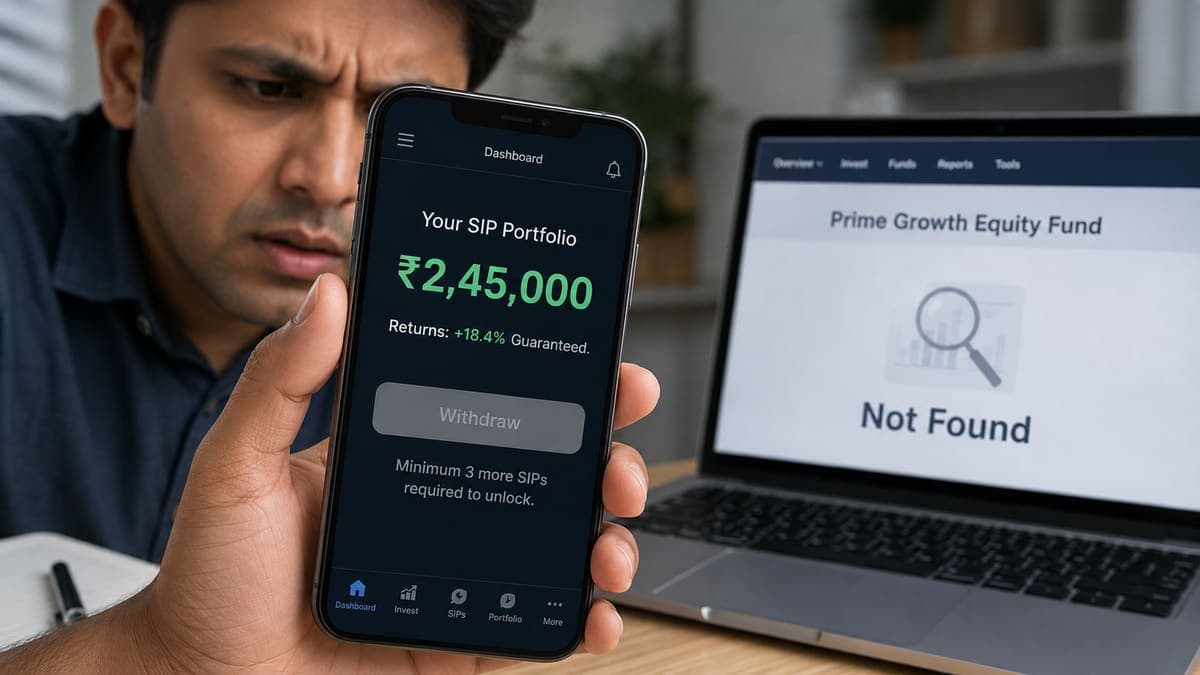
The dashboard shows a SIP portfolio worth ₹2,45,000 and returns of 18.4 percent, marked guaranteed. The withdraw button is greyed out. A note says three more SIPs are needed to unlock it. This is the shape of a mutual fund scam India 2026 case, and it is spreading precisely because genuine mutual fund investing in India has never been bigger. Total mutual fund folios touched 28.09 crore by 31 July 2026 with industry assets under management at ₹85.76 lakh crore, and SEBI's chairman has put the number of unique investors at over 14 crore.
Growth on this scale has pulled in scammers who now run fake SIP scam India operations, clone real AMC apps, and impersonate SEBI itself. SEBI has separately warned about fraudulent redemption requests and fake trading and mutual fund apps, and has cautioned investors about scamsters impersonating mutual fund CEOs and CIOs. None of this requires panic. It requires knowing exactly what a genuine mutual fund offer looks like and the two minute check that exposes a fake one.
This guide covers the six active scam formats, real Indian cases with sources, the exact verification steps SEBI and AMFI provide for free, and the platforms that are actually safe to invest through.
How to verify a mutual fund investment offer in India
- 1Check SEBI registration at sebi.gov.in, Intermediaries, then Investment Adviser
- 2Verify AMFI registration at amfiindia.com, Registered MF Distributors
- 3Any offer with guaranteed returns from a mutual fund is illegal, no exceptions
- 4Check the app on the official Google Play Store and confirm the developer name matches the AMC
- 5Never transfer a SIP amount to a personal UPI ID, only to the AMC's official payment gateway
- 6Use SEBI Check at siportal.sebi.gov.in to verify the UPI ID or bank account of a registered intermediary
- 7Call the AMC's official customer care, found on its own website, to confirm any advisor
- 8Check any suspicious MF app or website at rakshaai.co before investing
Why India's Growing Mutual Fund Investor Base Created a Fraud Surge
Mutual fund folios have grown roughly six-fold in a decade, from around 70 lakh in 2016 to 28.09 crore by the end of July 2026, alongside 9.64 crore active SIP accounts as of May 2026. Speaking at an Association of Mutual Funds in India event, SEBI Chairman Tuhin Kanta Pandey flagged fraudulent redemptions by impersonators as an emerging operational risk, alongside fraudulent trading and mutual fund apps, and urged AMCs to safeguard KYC details, use only official channels, and share fraud patterns across the industry.
Separately, SEBI's chairman has said the regulator is deploying AI and data analytics to track unregistered advisory activity and misleading content in real time, and put India's unique investor base at more than 14 crore, up from a much smaller pool a decade ago. That combination, a huge new investor base plus unregulated broadcast channels like WhatsApp and Telegram, is exactly the environment a mutual fund fraud India 2026 operation needs: an audience large enough that even a low success rate is profitable.
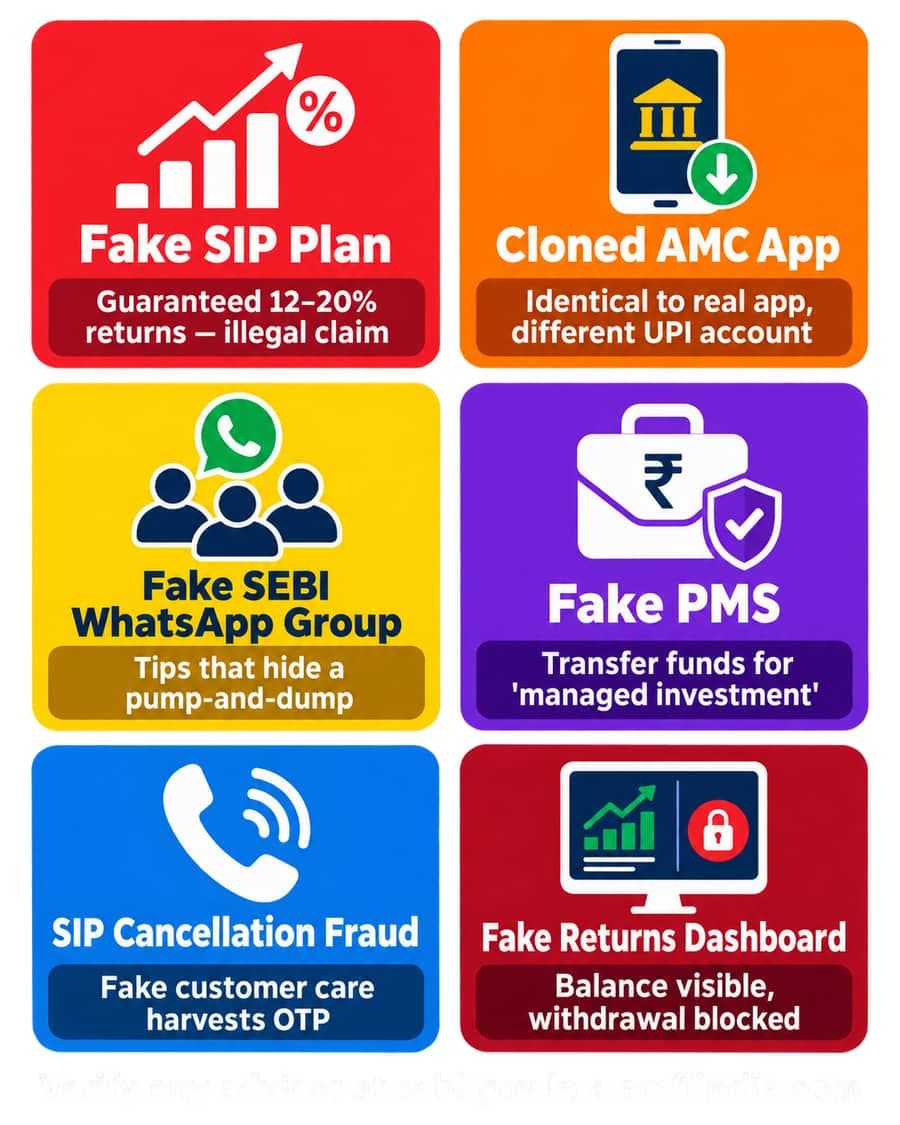
The 6 Mutual Fund Scam Types Targeting Indian Investors
Every format below has the same underlying trick: borrow the credibility of a real AMC, SEBI or AMFI, and then move the money outside their official channels.
Scam 1: Fake SIP Plan With Guaranteed Returns
The offer promises a fixed 12 to 20 percent annual return on a SIP, sometimes with the word guaranteed printed directly on a slick dashboard screen. This is the fastest tell available: SEBI regulations prohibit any mutual fund, distributor or adviser from promising a fixed return, because every scheme is subject to market risk by law. If a plan cannot lose money on paper, it is not a real mutual fund product.
Scam 2: Cloned AMC App, Identical to the Real One
Fraudulent apps copy a real AMC's name, logo and interface almost exactly, then route payments to a different UPI handle or personal account instead of the AMC's registered collection account. SEBI has been rolling out a Verified App Label so investors can confirm an app belongs to a registered intermediary before trusting it, after finding and getting more than 66 fake trading apps removed from app stores and escalating over 130,000 pieces of misleading investment content for takedown.
Scam 3: Fake SEBI or AMFI WhatsApp Group
A WhatsApp or Telegram group presents itself as a SEBI or AMFI-affiliated tip channel, sometimes using a forged SEBI letterhead, logo or seal, or impersonating named executives. SEBI has specifically cautioned investors about scamsters impersonating mutual fund CEOs and CIOs, including real industry leaders whose names have been misused in these operations, and separately warned about fraudsters forging SEBI officials' identities to demand compliance or penalty payments. Genuine SEBI communication only ever comes from an official @sebi.gov.in address.
Scam 4: Fake Portfolio Management Scheme
Investors with larger sums are offered a private, actively managed portfolio for a cut of the profits, positioned as an upgrade from an ordinary mutual fund. Genuine Portfolio Management Services (PMS) are SEBI-regulated but operate under a different, higher-minimum framework than mutual funds and should never be confused with one. A fake PMS asks for a lump sum transfer to a personal or unregistered account rather than a SEBI-registered PMS provider's official channel.
Scam 5: SIP Cancellation Fraud via Fake Customer Care
A caller claims a SIP is about to fail, be flagged, or auto-cancel unless the investor "verifies" their folio over the phone, sharing an OTP or screen-sharing app to complete the fix. This mirrors the exact fraudulent redemption pattern SEBI's chairman warned AMCs about: impersonators posing as an investor, or as the AMC, to move money out of a genuine folio using stolen KYC details.
Scam 6: Fake Returns Dashboard, a Pig Butchering Variant
The investor sees their balance and returns climb steadily inside an app, exactly like the ₹2,45,000 SIP portfolio pictured at the top of this guide, but every withdrawal attempt fails or triggers a new demand, for a tax, a processing fee or additional SIPs to unlock the account. This is the same mechanic documented in fake trading app cases across India, where fabricated profit screens are used to keep victims depositing more money before the app disappears.
Real Cases That Show These Are Not Hypothetical
Fake investment app fraud in India has produced individually documented losses in the lakhs and crores, and SEBI has confirmed the mutual fund specific version of the pattern in its own statements.
- Fraudulent MF redemptions confirmed by SEBI: at an AMFI event in August 2025, SEBI Chairman Tuhin Kanta Pandey highlighted cases of fraudulent redemptions where impersonators posed as investors to redeem mutual fund units, and asked AMCs to safeguard KYC data, restrict transactions to official channels and share the modus operandi across the industry.
- Bengaluru, ₹88.36 lakh lost to a fake trading app posing as a SEBI-registered firm: a Banaswadi resident invested between June and September 2025 after downloading an app that displayed fabricated gains for a company presented as SEBI-registered, and was able to withdraw only ₹50,000 before the fraud was confirmed and reported to the East Cybercrime police.
- Shajapur, Madhya Pradesh, ₹68 lakh lost in February 2026: an investor was lured by promises of unusually high stock market returns through a fake trading link that showed fabricated profits, then was made to pay further amounts described as TDS and taxes before police managed to freeze ₹25 lakh across the beneficiary accounts.
- Uttar Pradesh, ₹800 crore racket busted in April 2026: police action described a network combining fake trading apps with shell companies to move fraud proceeds, illustrating how the same infrastructure scales from individual victims to organised, industrial-sized operations.
The common thread across every case above is the same: money moved outside an AMC or SEBI-registered intermediary's official channel, and a fabricated screen kept the victim confident until withdrawal became impossible.
How to Verify Any Mutual Fund Offer or Advisor in India
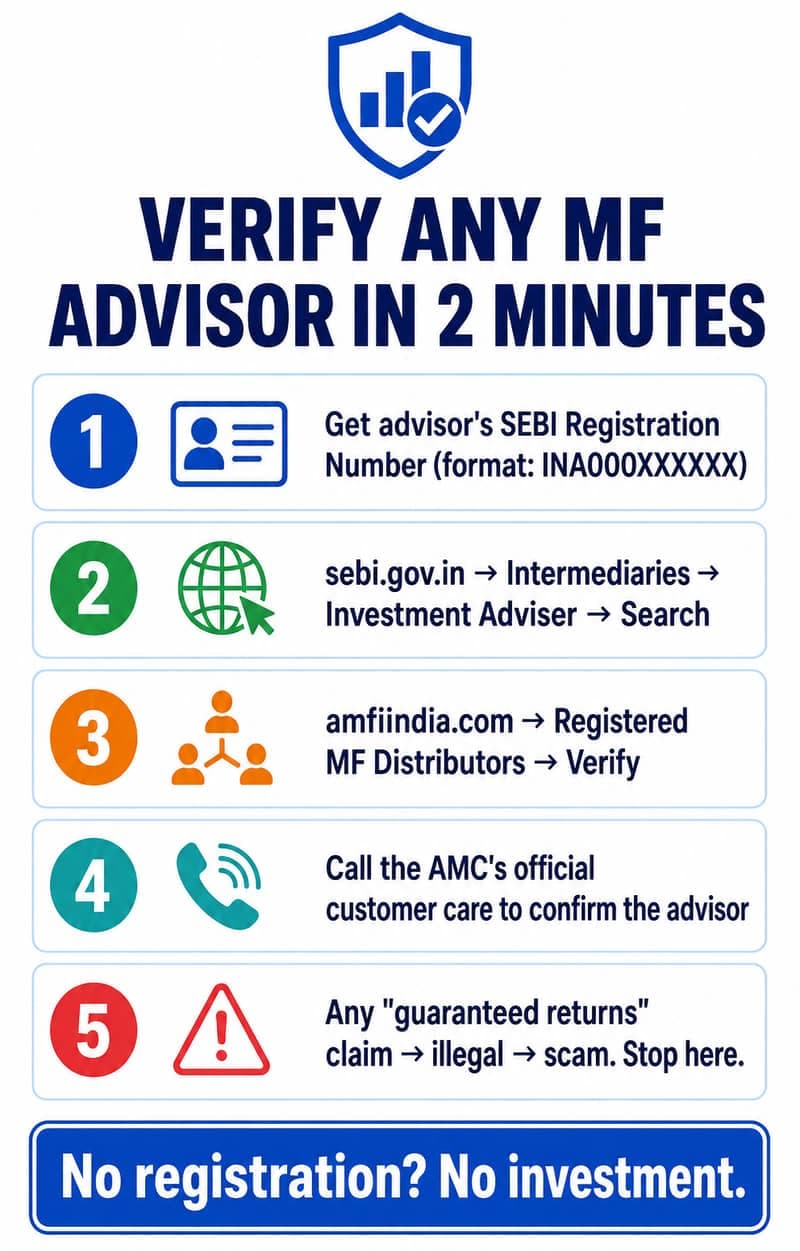
This is the single check that ends most mutual fund scams before a rupee moves, and every tool involved is free and official.
- Get the advisor's SEBI Registration Number. Investment advisers use the format INA000XXXXXX. A genuine adviser gives this number without hesitation.
- Search sebi.gov.in. Go to Intermediaries, then Investment Adviser, and confirm the name, address and status all match what the advisor claims.
- Cross-check amfiindia.com. Under Registered MF Distributors, search the same name to confirm AMFI registration for anyone selling mutual fund schemes on commission.
- Verify the payment destination with SEBI Check. The tool at siportal.sebi.gov.in lets investors confirm a UPI ID or bank account and IFSC code against SEBI's own database of registered intermediaries before sending money.
- Call the AMC directly. Use the customer care number listed on the AMC's own official website, never a number provided by the advisor, to confirm the person or scheme is genuine.
No matching entry on either site, or a payment request to a personal account instead of the AMC's registered collection channel, is enough on its own to stop and walk away.
Red Flags in Any Investment Offer
- Guaranteed or fixed returns. Illegal for any mutual fund, distributor or adviser to promise, regardless of how the number is dressed up.
- Installation outside the Play Store or App Store. A genuine AMC app never needs to be side-loaded from a WhatsApp or Telegram link.
- Pressure to act within hours. A limited-time SIP bonus or closing window is designed to prevent verification, not to reward speed.
- Payment to a personal UPI ID or bank account. Every legitimate AMC transaction settles through its own registered collection account, never an individual's handle.
- A dashboard balance that never becomes withdrawable cash. Real mutual fund redemptions settle to a bank account within one to a few working days, with no extra fee required to release them.
- Contact only through WhatsApp or Telegram. A registered adviser or distributor can always be reached and verified through official, non-anonymous channels.
Safe MF Investment Platforms in India
Every option below is SEBI-regulated. The safety comes from the source, direct AMC channels or an established, regulated platform, not from any particular app's design.
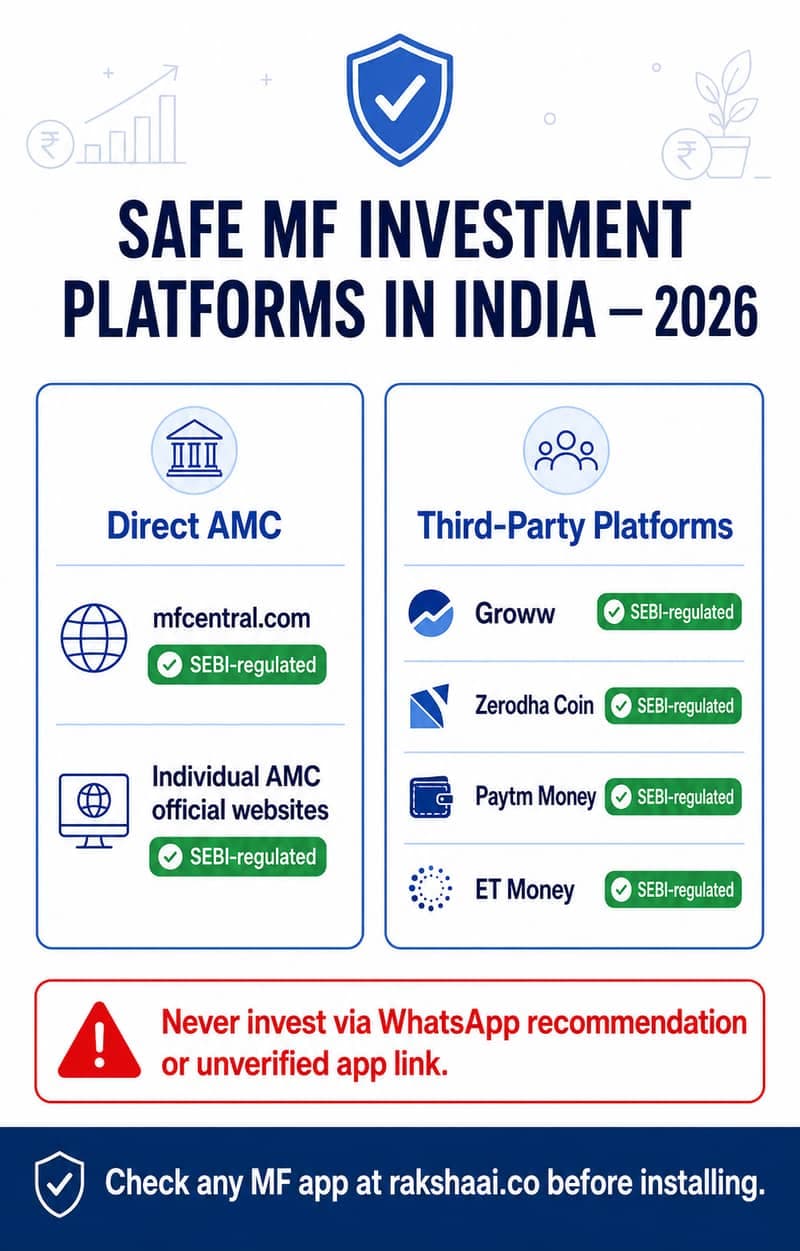
- Direct AMC channels: mfcentral.com, the industry-run investor service utility, and the official website of the specific AMC.
- Third-party platforms: Groww, Zerodha Coin, Paytm Money and ET Money, all SEBI-regulated and available on official app stores.
Never invest through a WhatsApp recommendation or an app installed from an unverified link, regardless of how professional the interface looks. Check any unfamiliar MF app or website at rakshaai.co before installing it.
30 Second Instagram Reel Script
Format: phone dashboard close-up, quick cuts between the fake app and the real SEBI or AMFI search, on-screen counter animation.
On-screen caption: Verify. Then invest. Never the other way around.
Frequently Asked Questions
Can a mutual fund guarantee returns in India?
No. Under SEBI regulations, no mutual fund, distributor or investment adviser can guarantee returns. Every mutual fund investment is subject to market risk, and this warning appears on every official scheme document. Any SIP plan or advisor claiming guaranteed 12 to 20 percent returns or assured income is operating illegally and is almost certainly a scam.
How do I check if a mutual fund advisor is SEBI registered in India?
Go to sebi.gov.in, open Intermediaries, select Investment Adviser and search by name or registration number, which follows the format INA000XXXXXX. Cross-check the same person at amfiindia.com under Registered MF Distributors. A legitimate advisor gives their registration number immediately and it matches on both sites.
What are safe platforms to invest in mutual funds in India?
SEBI-regulated options include direct AMC websites, the industry utility mfcentral.com, and third-party platforms such as Groww, Zerodha Coin, Paytm Money and ET Money. Install any of these only from the official Play Store or App Store, never through a WhatsApp or Telegram link.
How do I know if a mutual fund investment app is fake?
Warning signs include installation from a link rather than the Play Store, returns that are unusually high or described as guaranteed, no verifiable AMC or SEBI registration, requests to pay a personal UPI ID instead of the AMC's official gateway, and a dashboard that shows a growing balance while every withdrawal attempt fails or asks for another fee.
What should I do if I invested in a fake mutual fund scheme in India?
Stop paying immediately and call 1930, India's national cybercrime helpline, with your transaction details. File a complaint at cybercrime.gov.in under financial fraud, and file separately at SEBI's SCORES portal at scores.sebi.gov.in, since SEBI can act against unregistered entities misusing its name. Report the app or website at rakshaai.co to warn other investors.
Sources and Credits
- SEBI press release PR No. 27/2025, 21 May 2025: official caution to investors on stock market and investment scams run through social media.
- All India Radio News, 25 March 2026: SEBI Chairman Tuhin Kanta Pandey launches the Verified App Label Initiative, over 600 apps badged, more than 130,000 misleading content instances escalated, 66 fake trading apps removed.
- SEBI Check, siportal.sebi.gov.in: official tool to verify a registered intermediary's UPI ID and bank account before paying.
- Cafemutual: SEBI caution on scamsters impersonating mutual fund CEOs and CIOs.
- Business Standard, 25 August 2025: SEBI Chairman's warning on fraudulent mutual fund redemptions and fraudulent trading apps at an AMFI event.
- Outlook Business: SEBI's tech and AI-driven enforcement against fake trading apps and WhatsApp groups, and India's unique investor base of over 14 crore.
- StartupTalky, reporting AMFI data, 11 June 2026: 9.64 crore active SIP accounts and industry AUM as of May 2026.
- Business Remedies, reporting AMFI data, 11 August 2026: 28.09 crore mutual fund folios and ₹85.76 lakh crore AUM as of 31 July 2026.
- The420.in: Shajapur, Madhya Pradesh fake trading app case, February 2026.
- Business Standard, April 2026: Uttar Pradesh Police action on an investment scam ring combining fake trading apps and shell firms.
- National Cybercrime Reporting Portal: official complaint portal and cybercrime helpline 1930.
Verify before you invest a rupee
Check a suspicious mutual fund app, website, phone number or UPI ID on RakshaAI before you install, sign in or pay.
Check for freeMore from RakshaAI Blog


Stay Protected Online
Use RakshaAI to check websites, phone numbers, and UPI IDs for scams free, instant, no sign-up required.
RakshaAI is a private platform by Ehatech Services Pvt. Ltd. Not affiliated with any government body. Editorial policy