
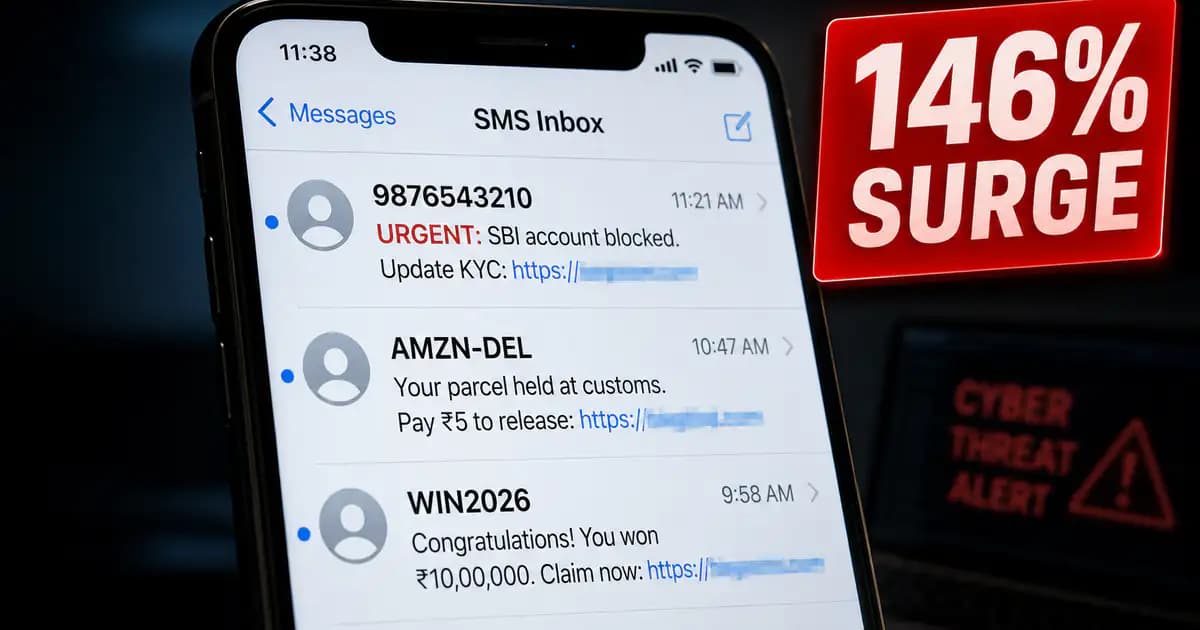
A fake bank warning, a tiny parcel fee, and an impossible prize all use the same tactic: make you act before you verify.
SMS scam India 2026 is now a mainstream financial threat, not a rare nuisance. On 22 July 2026, BioCatch reported that cases of text-message-based scams in its Indian customer data had risen 146% in the stated year-on-year comparison. The message may claim your bank account is blocked, your parcel needs a ₹5 fee, your tax refund is waiting, or a government benefit has arrived. The story changes. The goal does not.
Every smishing message tries to move you away from a trusted channel and into a decision controlled by the scammer. That decision may be a tap, a call, an APK installation, a login, an OTP entry, or a small payment that captures card details. This guide explains seven common formats, real Indian cases, a 30 second identification check, and the correct reporting route.
The Numbers India Cannot Ignore: BioCatch July 2026 Report
The primary BioCatch release dated 22 July 2026 says reported text-message scam cases increased 146% between the second half of 2025 and the first half of 2026 compared with the corresponding period a year earlier. Mobile fraud sessions rose 67% overall, with an 86% increase on iOS and a 35% increase on Android. Browser-based fraud sessions fell 10%.
The report also found that the total value of attempted fraud payments rose 35%, while average call length fell 31% and median fraud-session length fell 32%. That combination suggests faster and more practiced social engineering. BioCatch also recorded a 12% fall in attempted fraud sessions among its customers, which is a useful reminder that different measures can move in different directions.
These figures come from BioCatch's proprietary customer network in India. They show a strong trend inside that network, but they do not measure every Indian mobile user or every SMS delivered nationally. The BioCatch release does not support the claim that India receives more than one crore scam SMS messages each day, so RakshaAI has not treated that extrapolation as fact.
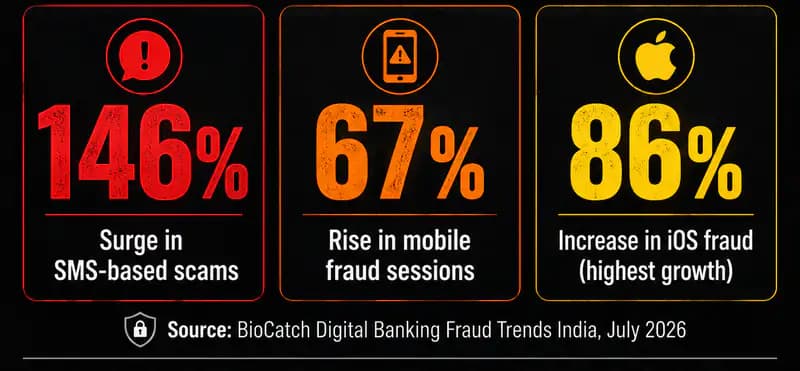
Verified BioCatch figures: SMS scam cases up 146%, mobile fraud sessions up 67%, and iOS fraud sessions up 86% in the stated comparison. The unsupported daily-message estimate has been removed from this web version.
Why SMS Scams Are More Dangerous Than Ever in 2026
Smishing India 2026 works because an SMS feels immediate and personal. Phones display a brand name, sender header, amount, and link in a small space. Attackers copy the language of banks, couriers, the Income Tax Department, and welfare schemes. They also time messages around real behavior. A person waiting for a parcel is more likely to trust a delivery warning.
Sender details are useful but not conclusive. A normal 10-digit mobile number impersonating a bank is a major red flag. Yet the Department of Telecommunications has also warned that criminals can misuse or tamper with SMS headers. In May 2024, DoT said it blacklisted 73 headers and 1,522 content templates after I4C identified more than 10,000 fraudulent messages sent through eight misused headers. A familiar-looking header cannot replace independent verification.
SMS phishing India is also becoming faster. A link may open a pixel-perfect bank or courier page. An Android message may push a malicious APK that asks for SMS, accessibility, contact, or screen permissions. A ₹5 payment page may capture full card data and an OTP. The safe response is to leave the message untouched and open the relevant official app yourself.
The 7 Most Common Scam SMS Types in India Right Now
Type 1: Fake Bank Alert SMS
Bank SMS fraud India often begins with a debit you do not recognize, a frozen account, or a security alert. The scammer supplies a link or callback number and relies on panic. Do not use either. Open the bank app, check the account, and call the number printed on your card or listed on the bank's official website.
Type 2: KYC Update or Account Block Threat
A KYC update SMS threatens suspension within hours. The destination may copy a bank login and collect account, card, PAN, Aadhaar, password, or OTP details. RBI warns that it does not send messages asking for bank details or passwords. Banks may contact customers about KYC, but you should complete the process only through the verified app, branch, or official site.
Type 3: Parcel Delivery Customs Fee
A parcel delivery SMS scam claims an address failed, a customs payment is pending, or one final delivery attempt remains. The small fee lowers your guard. Instead of opening the link, find the order in the retailer or courier app and use the tracking number already attached to your purchase.
Type 4: Fake Prize or Lottery Win
A lottery prize SMS promises lakhs of rupees, then demands a registration fee, tax, processing charge, or bank details. You cannot win a draw you never entered. A real prize is not verified by paying an unknown person or sharing an OTP.
Type 5: OTP Request Disguised as Verification
The message or follow-up caller says an OTP will cancel a debit, complete KYC, approve a refund, or verify your identity. Read the actual OTP message. It usually states what transaction or login the code authorizes. Never read or forward that code to another person. A support agent does not need it.
Type 6: Fake Income Tax Refund
A refund message says your bank account must be verified or a small fee is due. Do not trust a link just because it mentions PAN or an accurate refund season. Sign in by typing incometax.gov.in yourself and check pending actions there. The National Portal of India also carries the Income Tax Department's warning about fraudulent refund messages and fake websites.
Type 7: Government Scheme Fake Benefit SMS
The message copies a ministry, state department, PM scheme, subsidy, pension, electricity benefit, or free-device offer. It may request Aadhaar, bank details, a fee, or an app installation. Search the scheme on its official gov.in or nic.in site. Do not accept a government claim from the message itself.
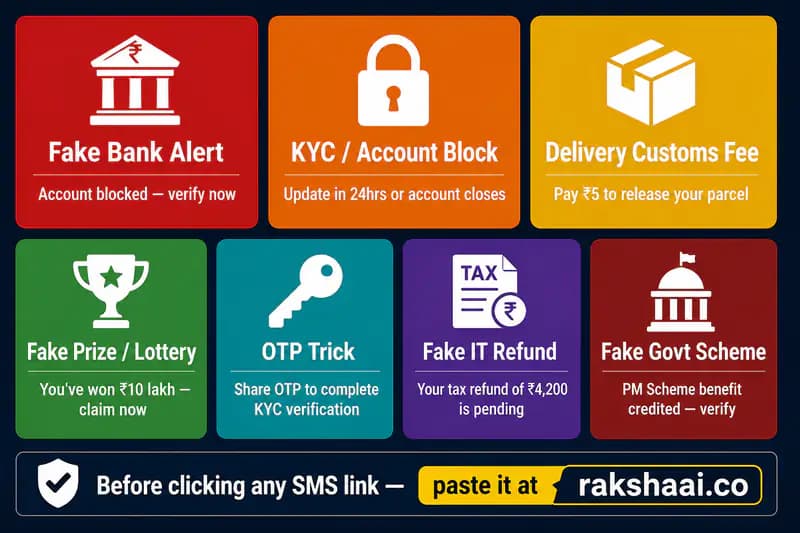
The seven stories differ, but every one tries to create urgency and move you into a link, call, credential entry, app installation, or payment.
How to Identify a Scam SMS in India in 30 Seconds
How to identify a scam SMS in India in 30 seconds:
- Check the sender: a bank alert from a normal 10-digit mobile number is a major warning sign. A registered header is helpful, but it is not proof of authenticity.
- Do not open the message link: open the bank, courier, tax, or service app directly, or type its known official address yourself.
- Notice pressure: threats such as "act in 24 hours" or "final attempt" are strong scam indicators.
- Question the requested action: no genuine support agent needs your OTP, UPI PIN, password, remote-access app, or screen share.
- Inspect the destination safely: copy the URL without opening it and paste it into RakshaAI's website safety checker.
- Verify outside the SMS: check the event inside the official app and use a phone number from the card or official site, not the message.
- Preserve and report: screenshot the complete message, sender, link, date, and time before blocking it.
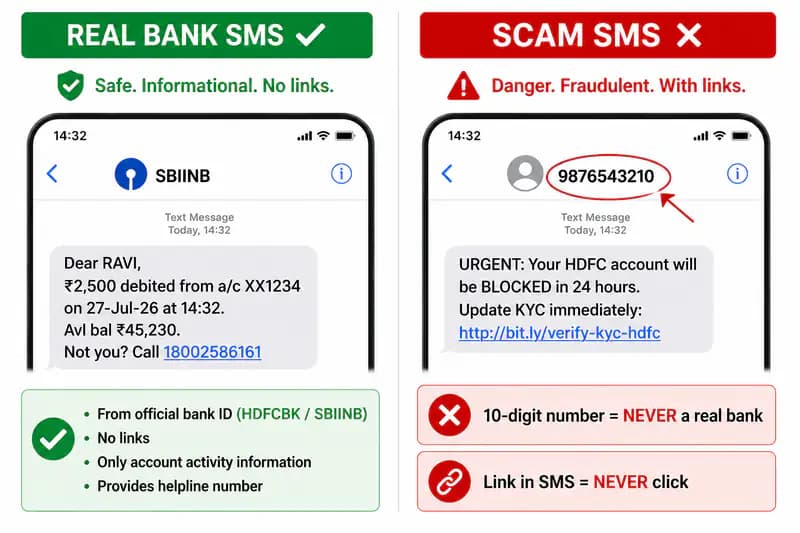
Use this as a quick comparison, not an authenticity guarantee. DoT warns that SMS headers can also be misused or tampered with.
Real SMS Scam Cases and Enforcement in India
Recent cases show why timing and context make a fake SMS India campaign believable.
- The Indian Express, 15 July 2026: a Delhi senior citizen had received an SMS asking him to complete KYC. After he used the link, ₹45,000 left his SBI account in two transactions. In July 2026, the Delhi State Consumer Commission upheld refund and compensation after finding that the bank had not proved customer negligence and had failed to resolve the complaint properly.
- Siasat, 5 November 2025: police said a Secunderabad man waiting for his vehicle registration certificate trusted a fake DTDC delivery SMS. The report says his phone froze after he opened the link and ₹2.47 lakh was then spent on his credit card. The real delivery he expected made the false message convincing.
- DoT and MHA, 27 May 2024: I4C intelligence led to the blacklisting of eight principal entities, 73 SMS headers, and 1,522 content templates associated with fraudulent communication. The release said more than 10,000 fraudulent messages had been sent through the eight identified headers over three months.
- DoT electricity KYC action: reports through Chakshu helped investigators connect suspected electricity KYC messages with 392 handsets and 31,740 mobile connections, after which DoT directed blocking and reverification measures.
The lesson is not that every loss happens from one tap alone. Reports may not reveal every technical and social step between the link and the transaction. The practical lesson is that a fraudulent SMS can begin a chain involving a fake page, permissions, credentials, OTP interception, calls, or card authorization.
How to Report a Scam SMS in India
- If money was lost: call 1930 immediately, contact the bank or card issuer through its official fraud channel, and file the full complaint at cybercrime.gov.in.
- If it is suspected fraud communication: report the call, SMS, or WhatsApp message through Chakshu on Sanchar Saathi. Chakshu is for prevention and telecom action, not for recovering money already lost.
- If it is spam or unsolicited commercial communication: use your provider's reporting channel, the TRAI DND app, or 1909. TRAI explains that a spam report and a formal complaint are handled differently.
- Keep evidence: save the message, sender number or header, link, date, time, screenshots, transaction references, and complaint acknowledgements.
- Warn others safely: check the sender in RakshaAI's phone number checker and submit a report where the result page offers that option. Do not post your own bank or identity details publicly.
For TRAI SMS spam India complaints, follow the current format shown by TRAI or your telecom provider. Do not forward a dangerous link to friends or family as a warning. Share a screenshot or this guide instead.
Frequently Asked Questions
How much did SMS scams surge in India in 2026?
BioCatch reported on 22 July 2026 that text-message-based scam cases in its Indian customer data increased 146% for the stated comparison period. Mobile fraud sessions rose 67%, including an 86% increase on iOS and a 35% increase on Android. These are BioCatch customer-network trends, not a census of every SMS sent in India.
What is the difference between SMS spam and an SMS scam in India?
SMS spam is an unwanted commercial or promotional message. An SMS scam, also called smishing, is designed to steal money, credentials, personal data, or control of a device. Report spam through 1909 or your provider. Report suspected fraud communication through Chakshu, and call 1930 immediately if money was lost.
How do I report a scam SMS in India?
Preserve a screenshot and the sender details. Report suspected fraud communication through the Chakshu facility on Sanchar Saathi. TRAI accepts spam and unsolicited commercial communication reports through 1909 and provider channels. If you lost money or exposed financial credentials, contact your bank, call 1930, and file at cybercrime.gov.in immediately.
Can a scam SMS steal my money without me clicking anything?
Most mass-market smishing attacks need you to click, call, reply, install an app, approve a permission, enter credentials, or authorize a payment. Rare zero-click exploits exist, but they are not the normal SMS scam. Keep your phone updated, do not install APK files from messages, and verify alerts through the official app.
Why do legitimate banks use alphanumeric sender IDs in India?
India uses registered SMS headers so customers and telecom providers can identify commercial and transactional senders. A bank alert from an ordinary 10-digit mobile number is a major warning sign. However, government advisories say criminals can misuse or tamper with SMS headers, so an alphanumeric sender ID is a clue, not proof. Verify unexpected instructions inside the bank app.
30 Second Instagram Reel Script
0 to 3 seconds, hook
"That bank SMS on your phone may be fake. Reported text scams in India just jumped 146%."
3 to 12 seconds, show the traps
"Account blocked. KYC expired. Parcel fee pending. Prize won. Tax refund ready. Different stories, same trap: an urgent link."
12 to 23 seconds, safety check
"Do not tap. Open the official app yourself. Never share an OTP or UPI PIN. A 10-digit bank sender is a major red flag, and even a sender ID is not proof."
23 to 30 seconds, action and CTA
"Lost money? Call 1930 now. Otherwise, screenshot and report it through Chakshu. Save this reel and send it to your family."
On-screen text: SMS SCAMS UP 146% | DO NOT TAP | VERIFY IN THE APP | CALL 1930
Sources, Credits, and Methodology
- BioCatch, 22 July 2026: primary source for the 146%, 67%, 86%, 35%, payment-value, call-length, and fraud-session findings.
- The Economic Times, 24 July 2026: independent news coverage of the BioCatch report.
- TRAI complaint and reporting guide: official source for 1909, telecom-provider reporting, and the distinction between reports and complaints.
- Department of Telecommunications, 4 March 2025: official warning that phone numbers, IMEIs, IP addresses, and SMS headers can be misused or tampered with.
- Reserve Bank of India KYC caution: official warning that RBI does not ask for bank details or passwords through messages or calls.
Research was checked against sources available on 28 July 2026. Statistics are presented with their source scope and comparison period. News cases are attributed to the reporting outlet or agency and do not imply that every technical step has been independently reconstructed by RakshaAI.
Check the link before it checks you
Copy a suspicious SMS link without opening it. RakshaAI can help you inspect the destination before you trust it.
Open Website Safety CheckerMore from RakshaAI Blog
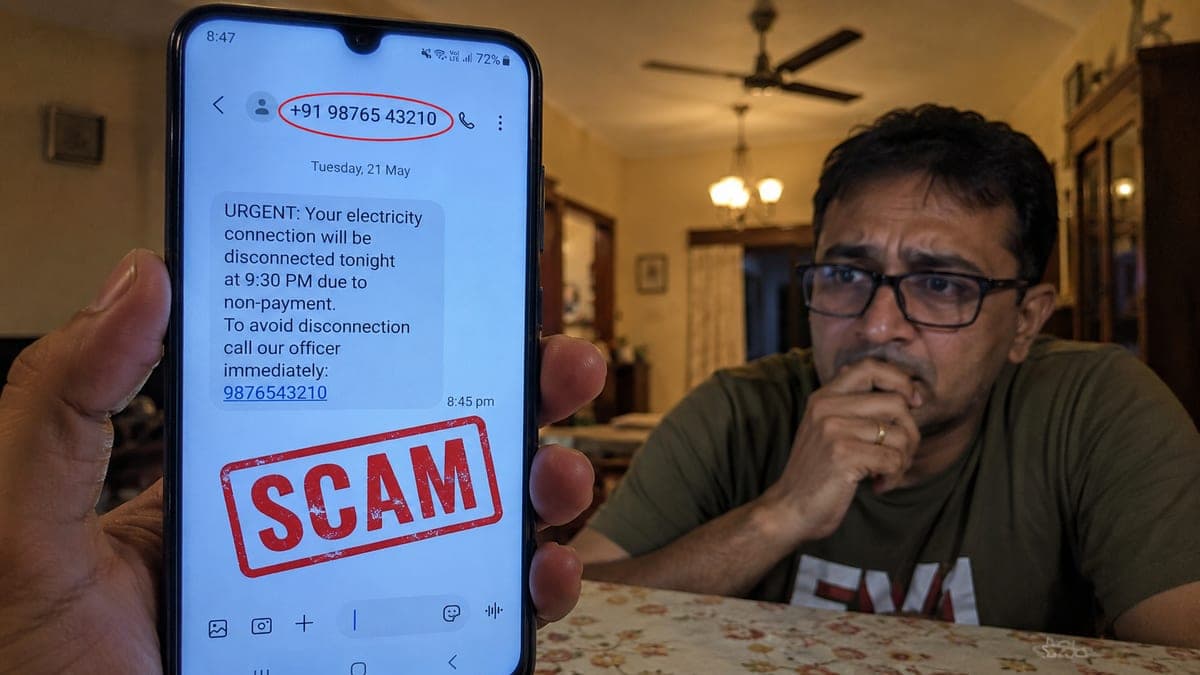
Electricity Bill Scam India: That Disconnection Today SMS Is Always Fake

AI Scam India: How Artificial Intelligence Is Making Fraud More Dangerous in 2026
Credit Card Fraud India 2026: How Scammers Clone and Misuse Your Card
Stay Protected Online
Use RakshaAI to check websites, phone numbers, and UPI IDs for scams free, instant, no sign-up required.
RakshaAI is a private platform by Ehatech Services Pvt. Ltd. Not affiliated with any government body. Editorial policy