
OTP & UPI PIN Fraud via Fake Bank Calls India 2026
Fake bank, RBI, TRAI, UIDAI, and UPI support callers ask for your OTP or UPI PIN to "verify", "cancel", or "protect" your account. The moment you share it, money can leave your account in under 60 seconds.
Share of UPI fraud complaints - OTP fraud
Time for account to be emptied after OTP shared
Average loss per OTP fraud victim in India
Recovery rate when reported within 30 minutes
The One Rule That Eliminates OTP and UPI PIN Fraud
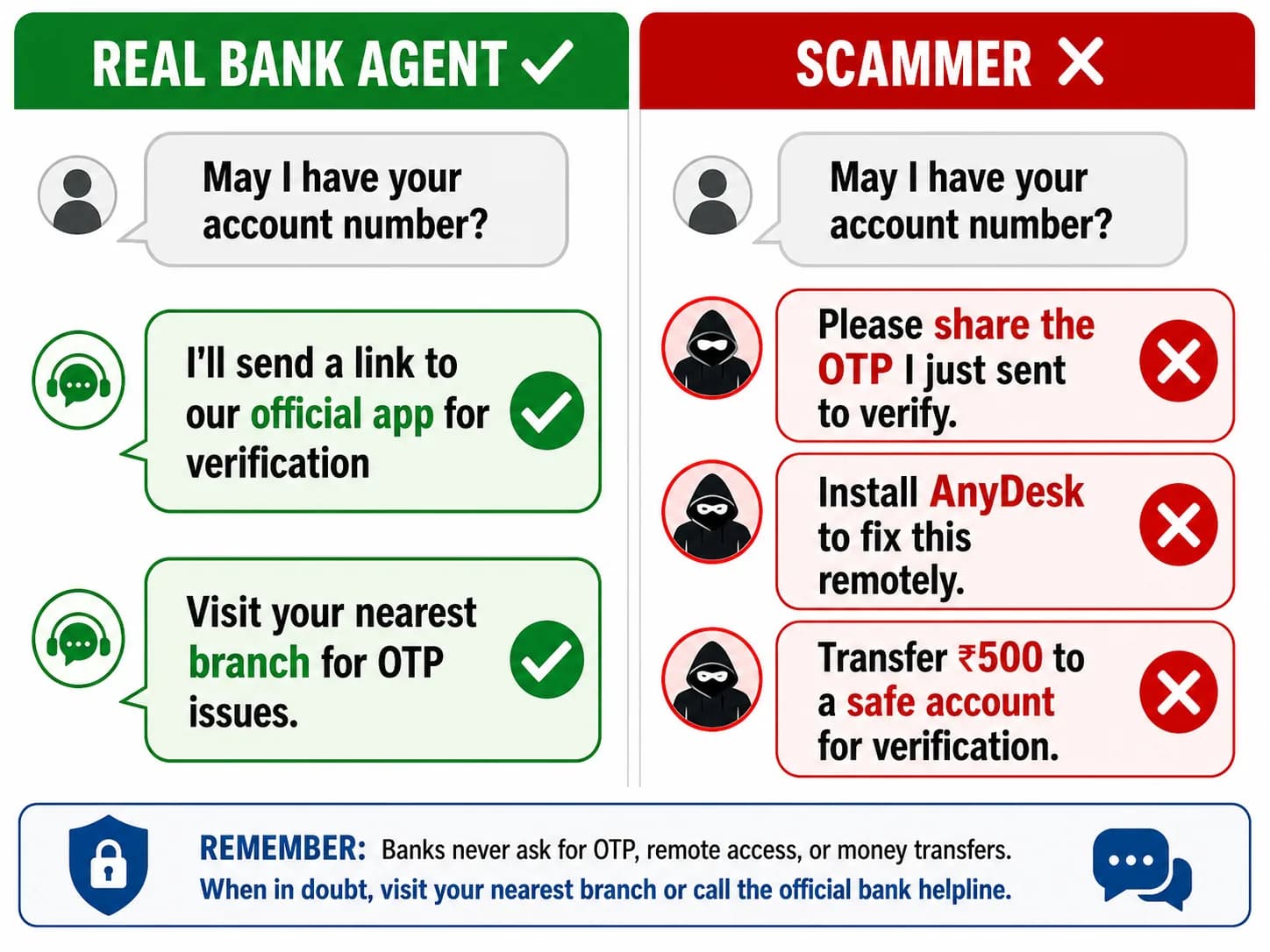
Never share OTP or UPI PIN with anyone on a call. No exception. No emergency.
OTP
A one-time authorisation code for your use only.
UPI PIN
Your payment password. Sharing it is like handing over your debit card PIN.
Caller pressure
Urgency, threats, and official-sounding language are part of the script.
How OTP Fraud via Fake Bank Calls Works
Every fake bank call OTP scam follows the same pattern: a pretext, credibility building, then the OTP extraction while a transaction is already waiting on the scammer's device.
The pretext
The caller claims KYC expiry, fraud alert, RBI update, SIM block, Aadhaar misuse, or cashback.
Credibility
They know partial details, use fake employee IDs, spoof caller ID, or send fake ID-card images.
The OTP entry
They trigger a transaction, ask for the OTP, enter it instantly, and move funds to a mule account.
Common Fake Bank Call Scripts
Real India OTP Fraud Case Examples
| Bank / Pretext | What Happened |
|---|---|
| SBI OTP Scam - KYC Expiry | Caller claimed SBI KYC had expired, asked for OTP to update records, and Rs 1,45,000 moved out within 45 seconds. |
| HDFC OTP Scam - Blocked Transaction | Fake fraud-team caller said a high-value transaction was blocked and asked for UPI PIN to confirm the block. |
| ICICI Fake Call - Aadhaar Linking | Caller said Aadhaar was linked to a suspicious account and used the OTP to authorise transfers. |
| Fake RBI Call - Account Upgrade | Scammer posed as an RBI officer and claimed accounts would close unless OTP verification was completed. |
| TRAI Fake Call - SIM Block Threat | Automated call threatened SIM disconnection, then a fake officer asked for OTP to cancel the block. |
| Aadhaar OTP Fraud - UIDAI Impersonation | Fake UIDAI caller asked for Aadhaar OTP to de-link suspicious activity and used it for financial authentication. |
8 Warning Signs of a Fake Bank Call OTP Scam
- 1The caller asks for OTP, UPI PIN, CVV, net-banking password, or any security credential.
- 2The caller says your account or SIM will be blocked unless you act within minutes.
- 3The caller knows your name, city, or partial account details and uses that to sound official.
- 4An OTP arrives during the call. That OTP is for a transaction the scammer has triggered.
- 5The caller says not to share OTP with anyone except them.
- 6The caller number is a normal mobile number or an official-looking spoofed number.
- 7They ask you to download an app, click a link, or share your screen.
- 8The call is unsolicited and about a transaction or account problem you did not initiate.
5 Rules to Protect Yourself
Never share OTP or UPI PIN with any caller
OTP and UPI PIN are designed to be known only by you. If a caller needs them, they are not helping you. They are authorising a transaction.
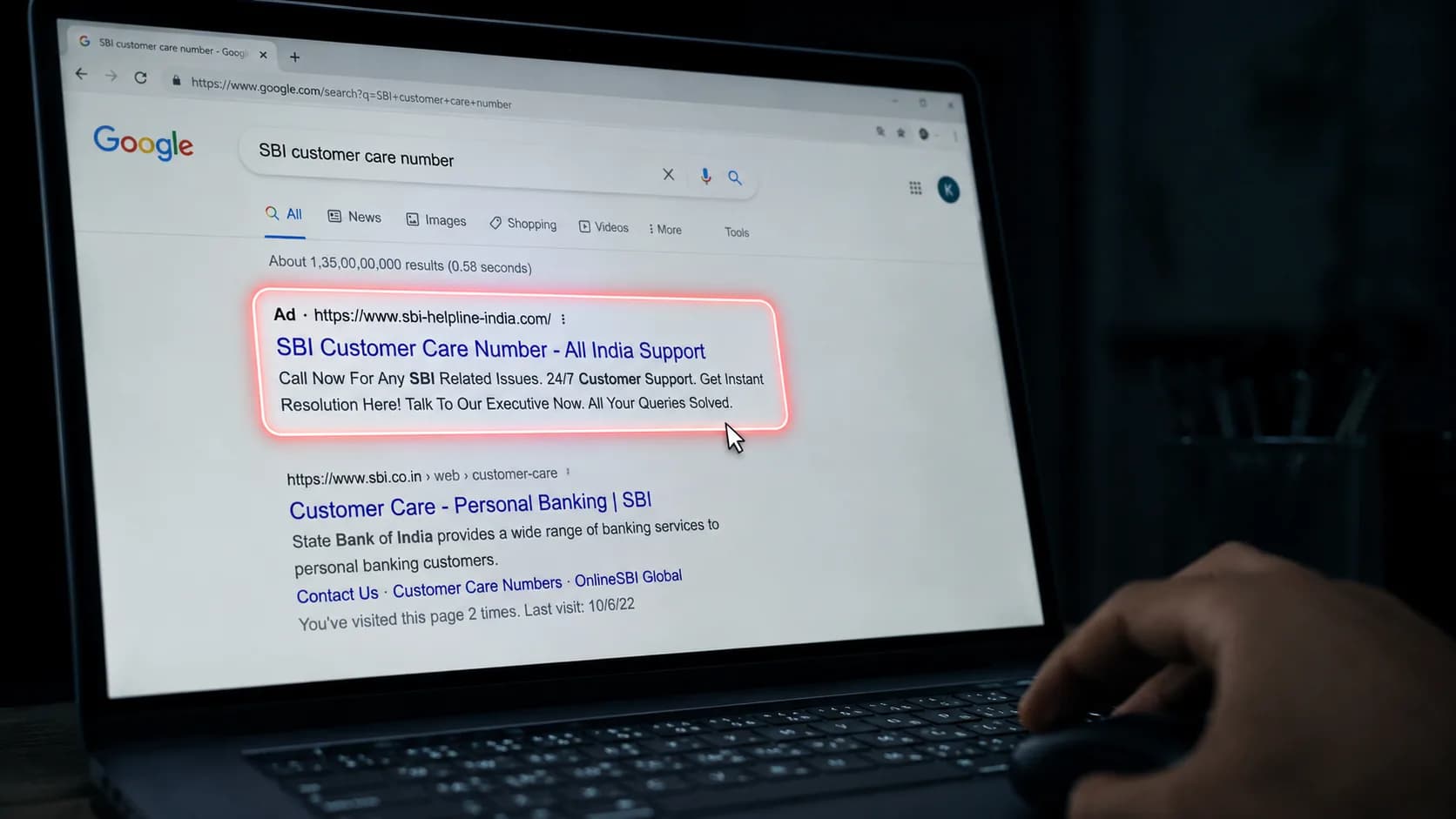
Hang up and call back on the official number
Use the number printed on your debit card or the bank website you type yourself. Caller ID can be spoofed.
Check the caller number before engaging
Search the number on RakshaAI Phone Number Checker. Active vishing numbers often collect reports within hours.
Check caller numberCheck your own UPI app in real time
Do not trust the caller description. Open PhonePe, Google Pay, Paytm, or your bank app and verify transaction history yourself.
Check UPI IDEnable alerts and transaction limits
Instant debit alerts and lower UPI limits reduce the damage and help you call 1930 within the critical freeze window.
What to Do If You Already Shared Your OTP or UPI PIN
Act in the next 10 minutes. The speed of your response determines whether the receiving account can be frozen before funds are moved.
Call 1930 immediately
Do this before finishing any article. Give the amount, transaction time, recipient UPI ID, and caller number.
Block UPI access and change your PIN
Change UPI PIN in PhonePe, Google Pay, Paytm, or your bank app. If net banking was exposed, change that password too.
File on cybercrime.gov.in
Choose Financial Cyber Fraud - UPI Fraud and attach transaction screenshots, call records, phone numbers, and messages.
Contact your bank fraud team
Use the bank official fraud helpline and share the 1930 and cybercrime complaint references.
Report the number and file FIR
Report the phone number and UPI ID on RakshaAI, then file an FIR with all evidence and complaint references.
OTP fraud recovery timeline
Immediately - Change UPI PIN. Call 1930. Stop further transactions.
Within 30 min - 1930 account freeze request.
Within 1 hour - cybercrime.gov.in, in-app dispute, bank fraud team.
Within 7 days - FIR at cybercrime police station.
Report this OTP scam and protect other Indians
OTP Fraud Statistics India 2026
| Metric | Data | Source |
|---|---|---|
| OTP fraud share of UPI complaints | 31% | NPCI Annual Report 2025 |
| Average loss per OTP fraud victim | Rs 68,000 | MHA I4C 2025 |
| Recovery rate when reported within 30 minutes | ~5% | 1930 helpline data 2025 |
| Most impersonated entity | SBI | cybercrime.gov.in 2025 |
| Fastest growing OTP scam variant | Fake TRAI SIM block calls | CERT-In advisory 2025 |
| Primary delivery channel | Phone call | I4C Cyber Crime Report 2025 |
| Time from OTP shared to account emptied | <60 seconds | NPCI forensics data 2025 |
Advanced Variant: SIM Swap Fraud
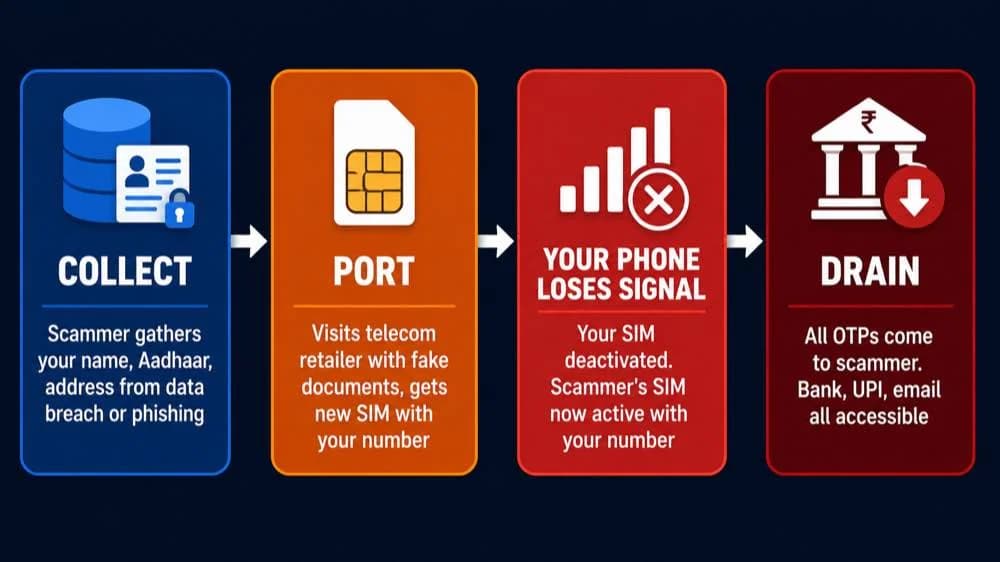
SIM swap fraud is an advanced OTP theft method where the scammer ports your mobile number to a SIM card they control. Once they have your number, every OTP goes to them.
- Your phone suddenly shows No Service or SIM Not Registered.
- You stop receiving SMS, calls, and OTPs.
- You receive a SIM replacement confirmation you did not request.
- You cannot log in because OTPs are not arriving.
Immediate action: call your telecom provider from another phone, request SIM reversal, call 1930, and file on cybercrime.gov.in.
Other UPI Fraud Types That Use Similar Tactics
| Related UPI Scam | How It Relates | Full Guide |
|---|---|---|
| QR Code UPI Fraud | Also creates urgency so the victim acts before checking the payment direction. | Read guide |
| Digital Arrest Scam | Vishing escalation where a fake police or CBI caller demands UPI transfer under legal threat. | Read guide |
| Wrong Transfer Refund Scam | Also begins with a stranger call and social engineering, but exploits goodwill instead of fear. | Read guide |
| Fake Payment Screenshot | Uses payment deception and urgency to make victims release goods without verified payment. | Read guide |
| Fake UPI Payment Link | A fake page can steal UPI PIN or bank credentials before a follow-up OTP call drains the account. | Read guide |
| Investment & Job UPI Fraud | Task and investment scammers may later ask for OTP or PIN as a second extraction layer. | Read guide |
Free Tools to Protect Your UPI Account
Frequently Asked Questions About OTP and UPI PIN Fraud
What is OTP fraud in India and how does it work?
OTP fraud is when a scammer calls posing as a bank, RBI, TRAI, UIDAI, or UPI support officer and persuades you to share the one-time password sent to your phone. The OTP is actually for a transaction the scammer has initiated, and sharing it authorises the payment.
Do banks in India ever call customers and ask for OTP or UPI PIN?
No. Banks, RBI, NPCI, TRAI, UIDAI, and UPI apps do not call customers to ask for OTP, UPI PIN, CVV, net-banking password, or debit card PIN. Any caller asking for these is a fraudster.
Why do I get an OTP during a suspicious call?
An OTP arriving during a suspicious call usually means the scammer has triggered a login or payment attempt using your registered mobile number. The OTP is for their transaction, not for verification.
What should I do immediately if I already shared my OTP?
Change your UPI PIN, call 1930 immediately, screenshot the fraudulent transaction, call your bank fraud team, file at cybercrime.gov.in, and file an FIR with your complaint references.
How do I identify if a bank call is fake in India?
It is fake if the caller asks for OTP, UPI PIN, CVV, password, remote access, screen sharing, or urgent action under threat. Hang up and call your bank on the official number printed on your card.
What is TRAI fake call fraud in India?
TRAI fake call scams threaten SIM disconnection and transfer you to a fake cybercrime officer who asks for OTP or UPI PIN. TRAI does not make automated calls threatening immediate SIM block.
How do I report OTP fraud to police and the cybercrime portal?
Call 1930, file at cybercrime.gov.in under Financial Cyber Fraud, raise a bank or UPI app dispute, report the caller number on RakshaAI, and file an FIR at your nearest cybercrime police station.
What is SIM swap fraud and how is it related to OTP fraud?
SIM swap fraud is when a scammer ports your mobile number to a SIM they control, so all OTPs go to them. Warning signs include sudden no-service, stopped SMS, or SIM replacement messages you did not request.
Can I recover money lost to OTP fraud in India?
Recovery is difficult but possible if you report quickly. The best chance is calling 1930 within 30 minutes so the receiving mule account can be frozen before the funds are moved.
What is Aadhaar OTP fraud and how does it work?
Aadhaar OTP fraud involves fake UIDAI callers claiming your Aadhaar is misused and asking for an OTP to de-link it. UIDAI does not call individuals to request Aadhaar OTPs.