
Task Scam India 2026Like & Earn Fraud, Boosted Deposits & Why the Group Vanishes
A task scam pays small real amounts for likes, ratings or reviews, then introduces a boosted task that requires your money first. The deposit demands grow, the balance becomes impossible to withdraw, and the Telegram group or platform disappears.
Free · No login · Built for India

100+
Task and part-time job fraud websites recommended for blocking by I4C
MHA · Dec 2023
₹0
What a legitimate task platform should charge you to unlock earnings
Safety rule
1930
National helpline for immediate financial cyber-fraud reporting
MHA / I4C
4 stages
Invitation, real small payouts, deposit escalation and blocked withdrawal
Scam pattern
The one rule: any task platform that asks you to deposit money before you can earn more is a scam. A genuine platform pays for completed work; it does not sell access to higher-paying tasks.
Task scam or WhatsApp job-offer scam?
Task scam: a platform gives you real micro-tasks and small payouts before escalating deposit demands. WhatsApp job scam: a recruiter offers a fake work-from-home role without a genuine hiring process. The delivery channels overlap, but the victim journey is different.
Compare the WhatsApp job-offer scamThe full mechanism
The 4-Stage Task Scam: How It Pulls You In
The early work and payouts are designed to feel normal. The scam becomes visible when earning is made conditional on a deposit.
- 1
The invitation
A Telegram group, WhatsApp channel, social-media message or ad promotes an 'online task earning platform'. The group appears busy, with admins, task announcements and screenshots showing members earning money.
- 2
Real small payouts build trust
You like videos, rate places or submit screenshots and receive a small real payment. That payout is deliberately affordable for the operator and makes the platform feel safe enough for you to risk more later.
- 3
The boosted-task deposit trap
A premium or boosted task requires a deposit to activate. The displayed return rises with each deposit, and a supervisor pushes you toward larger rounds. The work has turned into 'pay to earn'.
- 4
Withdrawal is blocked or the group vanishes
The dashboard demands another tax, correction or upgrade payment. The admin stops replying, the group is deleted, or the website disappears. The displayed balance was never freely withdrawable money.
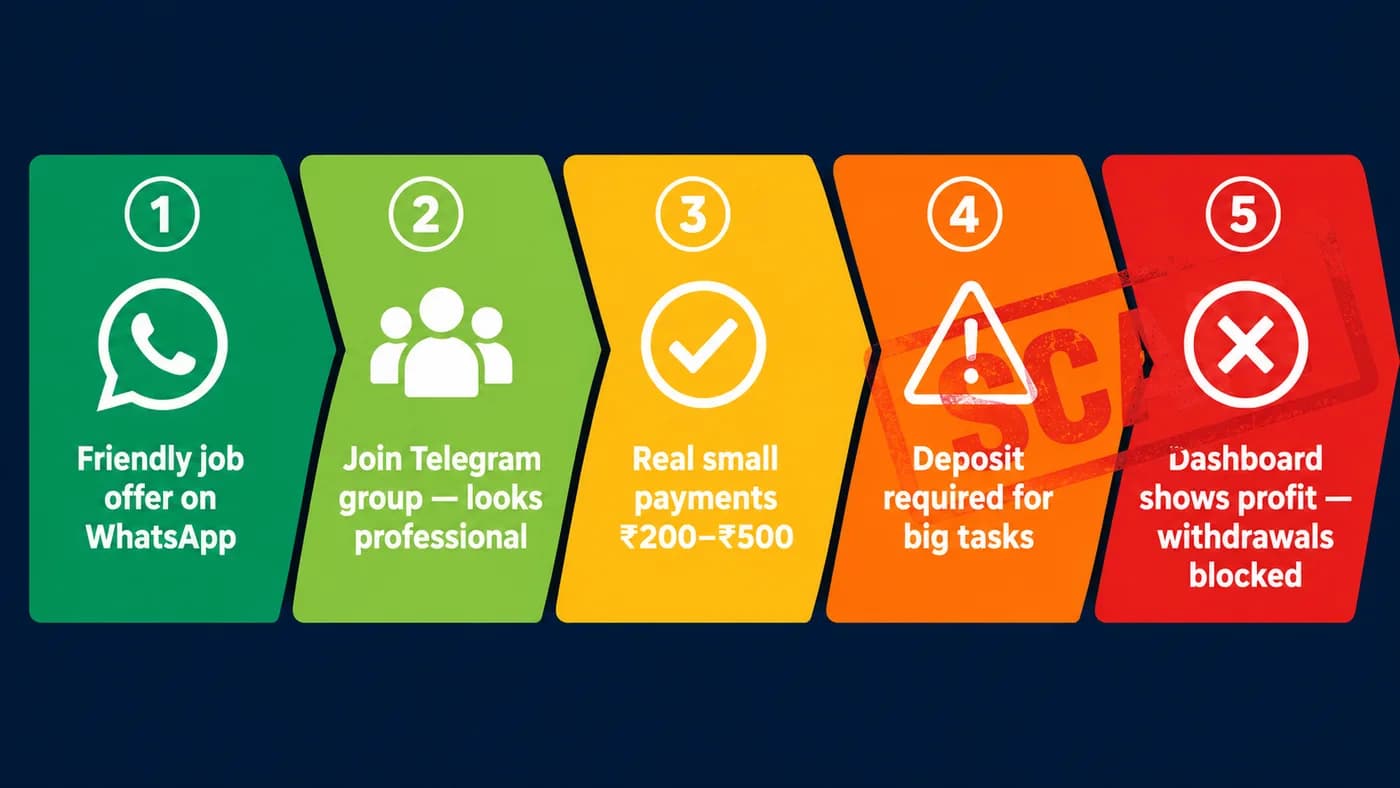
Why early payouts do not prove legitimacy
The Deposit Escalation Ladder
The operator can afford a small payout if it persuades you to risk a much larger amount. The displayed return rises, but your ability to withdraw disappears.
₹50–₹200
Real task payout
₹500–₹2K
First deposit
₹5K–₹10K
Boosted round
₹20K+
Pressure escalates
Blocked
Pay again or lose all
Trust-building tasks
3 Task Types Used in India—and Why They Are Chosen
YouTube likes and subscriptions
Like, comment on or subscribe to specified channels, then submit screenshots.
Google hotel ratings
Post five-star ratings or reviews for hotels and places you have never visited.
Product and app reviews
Review products you did not purchase or rate apps you did not genuinely use.
Before you deposit
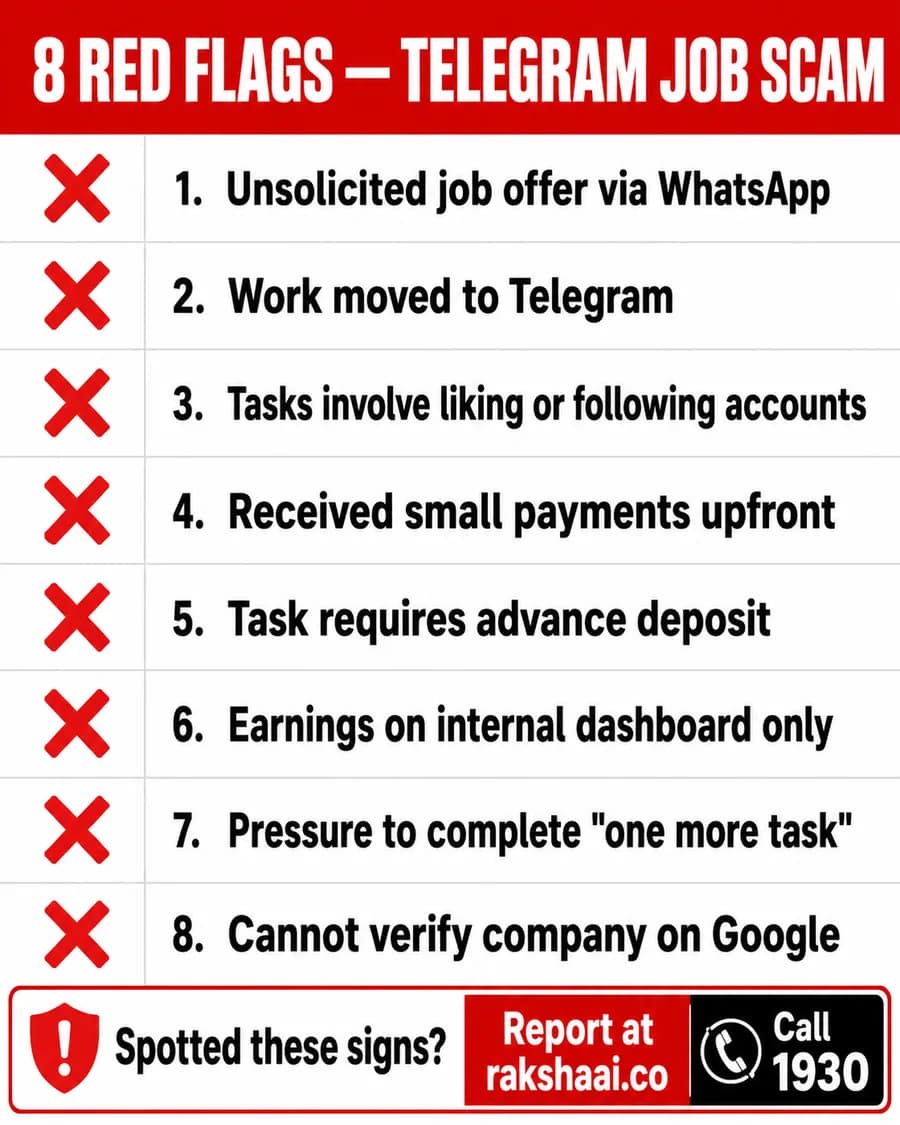
8 Red Flags of a Task Scam or Like-and-Earn Fraud
- 1
A deposit unlocks higher-paying tasks
Legitimate work pays you. It does not require your money before you can earn more.
- 2
The operation lives in Telegram or WhatsApp
There is no independently verifiable company, address, support team or contractual relationship.
- 3
Tasks manipulate public ratings or engagement
Scripted likes and false reviews are not ordinary freelance work and can put your accounts at risk.
- 4
The supervisor only uses a chat-app identity
There is no corporate email, independently listed phone number or verifiable employment history.
- 5
Small early payments arrive unusually fast
Real payments are part of the trust-building phase and do not prove the platform is legitimate.
- 6
Group members post dramatic earnings screenshots
The accounts and screenshots may be controlled or staged by the same operators.
- 7
Deposit amounts increase after every success
The progression from a small activation fee to much larger rounds is the core extraction mechanism.
- 8
You earn by recruiting depositors
Recruitment rewards make the structure even more dependent on money from new participants.
Five quick checks
How to Identify Whether a Task Platform Is Legitimate
- Check number
Step 1
Check the inviting number and admin
Search the phone number that sent the invitation. Preserve the Telegram username, group link and admin profile even if the operator does not expose a phone number.
- Check platform
Step 2
Verify the platform's legal identity
Check its site, domain history, official app listing, company name and MCA records. A polished dashboard is not proof that a legal company operates behind it.
Step 3
Apply the deposit-and-return test
If your promised return increases with the amount you deposit, you are being offered a financial return—not ordinary task wages. Do not fund another round.
Step 4
Check whether the task itself is legitimate
Do not post a review for a place you never visited or a product you never used. Coordinated likes, reviews and ratings may violate the target platform rules.
Step 5
Compare it with a genuine gig platform
A legitimate service has transparent terms, independently reachable support and a clear business model. Your earnings should come from work completed—not from increasing your deposit.
Legitimate task or gig platform
- Pays for completed work without requiring an earnings deposit.
- Has an independently verifiable company, terms and support channels.
- Work creates a genuine service or deliverable rather than false engagement.
- Earnings grow with completed work or skill—not with the amount you fund.
Task scam platform
- Admin, co-workers and support exist only inside a private group.
- A deposit, activation fee or correction payment unlocks earnings.
- Tasks involve scripted likes, false reviews or coordinated ratings.
- The displayed balance rises with deposits but cannot be freely withdrawn.
Suspicious task invite?
Check the number and platform before joining the group.
If you already paid
Task Deposit Recovery and Reporting Guide
Do not pay a person claiming they can recover the balance for another fee. Preserve evidence and report through official channels.
- 1
Stop depositing and call 1930
Do not pay a withdrawal, tax, correction or recovery fee. Give the helpline the recipient accounts, UPI IDs, transaction amounts and times as soon as possible.
- 2
Capture the group before it disappears
Screenshot or screen-record the group title, invite link, admin profiles, task instructions, payment demands, website and dashboard. Export or preserve chats where possible.
- 3
File at cybercrime.gov.in
Select the closest online job or financial cyber-fraud category and attach every payment reference, group identifier, phone number, URL and screenshot.
- 4
Contact your bank and payment provider
Report the transactions as fraud and follow the dispute process. Keep the bank complaint and cybercrime acknowledgement numbers together.
- 5
Escalate with documented evidence
Take the complaint reference to cybercrime police where needed. Report the phone numbers, UPI IDs, group link and platform URL to help warn other users.
Report the task scam before more people deposit
Keep the group link, admin username, UPI IDs and payment records ready.
Verified public information
What Official India Sources Confirm
| Official finding | Detail | Source |
|---|---|---|
| Task and part-time job fraud sites recommended for blocking | More than 100 | MHA / I4C · Dec 2023 |
| Contact channels described by the government | WhatsApp and Telegram | MHA / I4C |
| Task examples named by the government | Video likes, subscriptions and map ratings | MHA / I4C |
| Fake CAPTCHA-job complaint trend | Significant rise reported | I4C · Apr 2025 |
| Fee labels in the I4C advisory | Registration, training and security fees | I4C · Apr 2025 |
| Immediate reporting channel | 1930 and cybercrime.gov.in | MHA / I4C |
The supplied 410%, ₹3,200 crore, ₹42,000, age-share, platform-share and recovery-rate figures are not shown because no matching primary government publication was located. Legal classification depends on the facts and should be determined by the relevant authority.
Keep the distinction clear
How Task Scams Differ from Other Job Scams
WhatsApp & Telegram Job Offer Scam
A fake work-from-home role with no real hiring process. This task-scam guide focuses on platform-based earning and escalating deposits.
Advance Fee Job Registration Fraud
A formal offer-letter process that demands registration, verification, training, uniform or equipment fees before joining.
Fake Company / Fake HR Portal Scam
A dedicated website impersonating TCS, Infosys or Wipro, with a fake Google Meet interview and a forged offer letter before laptop or clearance fees.
MLM / Pyramid Scheme Scam
A recruitment-based "business opportunity" funded by joining fees and starter packs, rather than a task platform with deposit-to-unlock earnings.
Telegram Task Scam Article
A narrative walkthrough of Telegram groups, fake co-workers, dashboards and blocked withdrawals.
Job Scams India Hub
Compare task scams with fake job offers, advance fees, recruitment portals and overseas job rackets.
Free RakshaAI checks
Verify Any Task Platform
Phone Number Checker
Search the inviting number or task supervisor's number for community fraud reports.
Check a numberWebsite Safety Checker
Inspect the task website or dashboard URL before opening an account or depositing.
Check a websiteUPI ID Checker
Search the beneficiary UPI ID before sending an activation or boosted-task deposit.
Check a UPI IDTask-scam alerts
Check the latest scam warnings
Current campaigns change names, group links, phone numbers and dashboards frequently. Review recent alerts before trusting a platform.
Quick answers
Frequently Asked Questions About Task Scams
What is a task scam and how does it work in India?
A task scam offers small payments for simple online actions, often inside a Telegram or WhatsApp group. After real early payouts build trust, 'boosted tasks' require deposits. The required amount rises, withdrawals are blocked, and the group or platform eventually disappears.
Why does the task scam require me to deposit money to earn more?
The deposit is the extraction mechanism. The early tasks and small payments create confidence, while the boosted round shifts the relationship from being paid for work to paying for a promised return. A legitimate task platform does not need workers to pre-fund their earnings.
How do I identify a genuine task platform versus a task scam?
Stop if a deposit unlocks tasks, earnings depend on how much you fund, the operator only exists in a chat group, the company cannot be independently verified, or the tasks involve false reviews and coordinated engagement. A polished app or small payout does not overcome those signals.
Why can the Telegram group disappear overnight?
Group owners can delete or close their communities and deactivate accounts quickly. Preserve the group title, invite link, admin usernames, chat history, payment instructions and dashboard before confronting or blocking the operator.
I received real payments. Does that mean the platform is legitimate?
No. Small real payments are a known trust-building technique. They lower your caution before the operator requests a much larger deposit. Judge the platform by its legal identity, business model and withdrawal rules—not by a small early payout.
Can I recover money lost in a task scam?
Recovery is not guaranteed, but rapid reporting can help. Stop paying, call 1930, preserve the group and transaction evidence, file at cybercrime.gov.in, contact your bank or payment provider, and follow police instructions associated with the complaint.
How do I report a task scam in India?
Call 1930 for financial cyber fraud, file at cybercrime.gov.in, contact your bank, and report suspicious WhatsApp numbers, Telegram handles, phone numbers and websites through the official Report Suspect facility. Keep every UPI ID and transaction reference.
Are fake YouTube likes, hotel reviews and app ratings allowed?
Coordinated artificial engagement and reviews that do not reflect a genuine experience can violate the target platform policies and may lead to content removal or account restrictions. Do not use your personal account to post claims you cannot honestly make.
What makes a task scam different from a legitimate gig platform?
On a legitimate platform, earnings come from completed services or skilled work. In a task scam, the displayed earnings grow mainly when you deposit more money. Legitimate services also have an independently verifiable operator, transparent terms and support outside a private chat group.
Remember
If you have to pay to earn, stop before the next task.
A small real payout does not make a deposit-based platform legitimate.