
Cyber hygiene India 2026 is about turning cyber safety tips India 2026 into automatic daily actions. Most everyday scams depend on a rushed click, an unchecked recipient, a reused password or an OTP disclosed under pressure. A small routine cannot guarantee that 90 percent of every scam will stop, but these ten habits block the human actions that many common OTP, phishing, UPI and account takeover attacks require.
The scale makes prevention urgent. A Ministry of Home Affairs parliamentary answer recorded 38,22,550 cyber fraud incidents and about ₹36,448 crore reported on the National Cybercrime Reporting Portal from inception through 28 February 2025. Those are reported incidents and amounts, not a count of proven cases or recovered losses. The safest response is not panic. It is a repeatable set of scam prevention habits India users can apply before money or information moves.
Digital Hygiene India: Why Awareness Is Not Enough and You Need Habits
Awareness tells you that phishing exists. A habit makes you close the message and open the official bank app. Awareness says OTPs are secret. A habit makes your answer an immediate no, even when a caller sounds convincing. This is the difference between knowing a rule during a calm training session and following it during a frightening call.
Good digital hygiene India routines add friction at exactly the right moment. They reduce reliance on memory, mood and technical knowledge. The goal is a default response: stop, verify through an independent channel, then act.
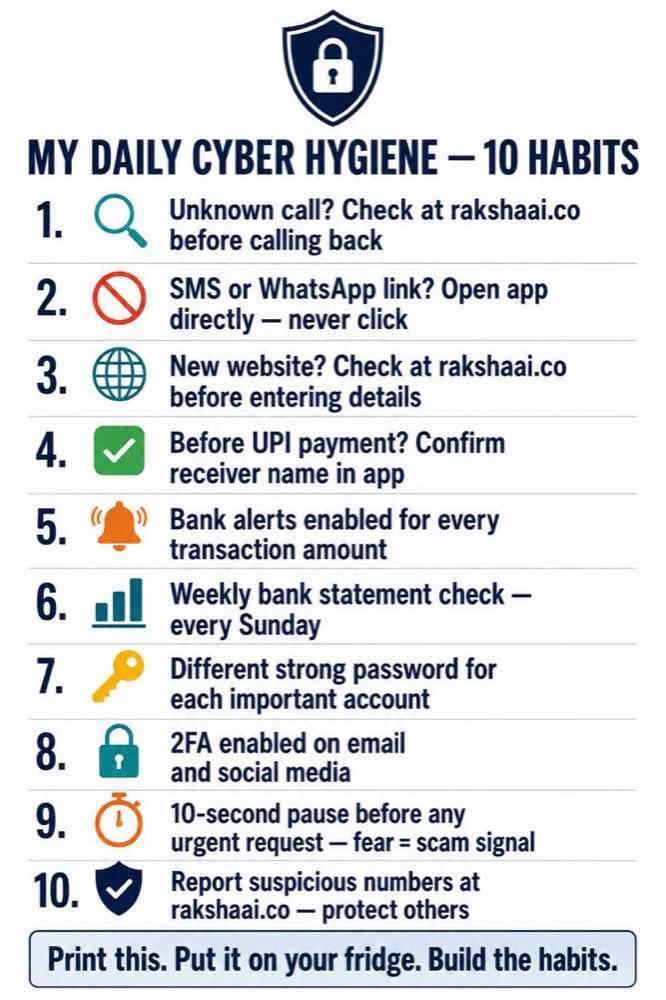
Online Safety Habits India: The 10 Daily Cyber Hygiene Habits Everyone Needs
Habit 1: Check Unknown Numbers Before Calling Back
Do not return a missed call simply because it looks local or urgent. Search the number, check community reports through RakshaAI's phone number checker, and find the organisation's number on its official app, card or website. Caller ID can be spoofed, so a familiar label is not proof.
Habit 2: Never Click Links in SMS or WhatsApp; Open Apps Directly
A delivery fee, KYC expiry, electricity disconnection or reward message can imitate a genuine brand. Do not use its link. Open the service from your home screen or a saved bookmark and check for the same alert. This one online safety habit India users can practise removes the scammer's fake page from the journey.
Habit 3: Check Any Suspicious Website Before Entering Details
Read the complete domain, not just the logo or padlock. Use the RakshaAI website safety checker, search for independent warnings and compare the domain with the organisation's verified profile. A padlock only means the connection is encrypted; it does not prove the operator is honest.
Habit 4: Verify Payment Details Before Every Transfer
Before confirming UPI or bank payment, read the receiver name shown inside the official app and compare it with the intended person or business. A QR code is a payment address, not proof of identity. Remember that receiving money does not require your UPI PIN.
Habit 5: Enable All Transaction Alerts on Your Bank Account
Turn on SMS, email and app alerts for every amount, including ₹1 where the bank permits. Alerts shorten the time between fraud and discovery. Keep the registered phone number and email current, and investigate a sudden loss of mobile service because it can be an early SIM swap warning.
Habit 6: Check Your Bank Statement Weekly, Not Only After a Problem
Small test charges are easy to miss. Review the transaction list and credit card statement every Sunday, not just the balance. If an entry is unfamiliar, lock the affected payment instrument, contact the bank through its official channel and call 1930 quickly for financial cyber fraud.
Habit 7: Use a Different Strong Password for Each Important Account
One breached password should not unlock email, shopping and social accounts. Use a reputable password manager to generate and store long unique passwords. Our password safety guide explains passphrases, managers and account recovery in detail.
Habit 8: Enable 2FA on Email and Social Media
Secure email first because it can reset many other accounts. Add two-factor authentication and prefer a passkey, security key or authenticator app when available. Never approve a sign-in prompt or disclose a code for a login you did not start.
Habit 9: Pause 10 Seconds Before Any Urgent Request
Fear plus urgency is a scam signal. Stop when a caller says an account will close, police will arrest you, a family member is in danger or an investment window expires. End the contact and verify independently. Real support staff can wait while you call an official number.
Habit 10: Report Every Suspicious Number or Website
Reporting creates warnings for others. Save screenshots and identifiers, add a community report on RakshaAI, use the government's National Cybercrime Reporting Portal, and report suspicious communications through the official Chakshu facility on Sanchar Saathi. If money moved, call 1930 immediately rather than waiting to write a detailed report.
Real Indian Cases Show Why These Habits Matter
A duplicate SIM helped expose an ₹87 lakh loss: In June 2026, The Indian Express reported that the Karnataka High Court held BSNL liable for negligence after an unauthorised duplicate SIM helped fraudsters access a cooperative bank's net-banking account. The court directed compensation of more than ₹55 lakh. The case shows why a sudden signal loss needs immediate action and why SMS alone is not the strongest second factor.
An eSIM upgrade story ended in a ₹10.5 lakh loss: The Indian Express reported in October 2025 that a Nagpur victim allegedly disclosed an OTP during a fake telecom upgrade process. His email password was later changed and ₹10.5 lakh was transferred. The practical habits are direct: do not act on an incoming telecom call, do not share a code, and protect email with phishing-resistant authentication where possible.
Identity complaints are not rare: A March 2025 parliamentary answer listed 38,295 profile hacking or identity theft complaints on the NCRP in 2024, compared with 10,419 in 2020. The category does not establish the attack method in every complaint, but it supports unique passwords, 2FA and routine session reviews as basic digital hygiene India controls.
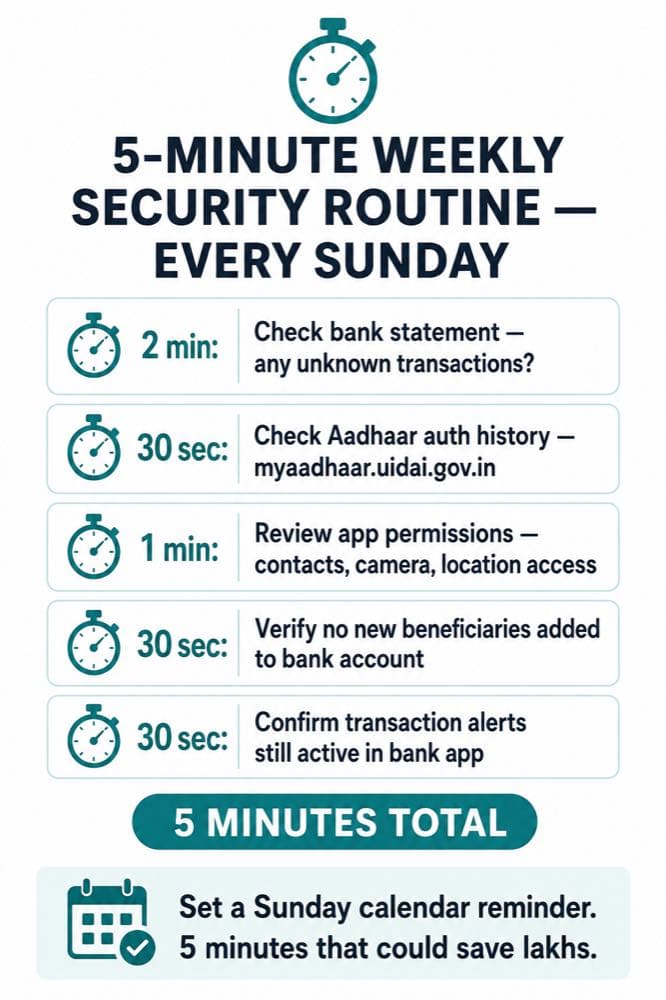
How to Stay Safe Online India: The 5-Minute Weekly Security Routine
5-minute weekly cyber security routine for Indians:
- Check bank statement for any unknown transactions (2 min)
- Check Aadhaar authentication history at myaadhaar.uidai.gov.in (30 sec)
- Review which apps have access to your location, contacts, and camera (1 min)
- Check if any new payees were added to your bank account without your knowledge (30 sec)
- Verify that all transaction alert settings are still active in your bank app (30 sec)
Total: 5 minutes per week that could save you lakhs.
This daily security routine India households can support with a weekly review answers the practical question of how to stay safe online India. UIDAI says its authentication-history service displays authentication records from the previous six months, up to 50 records at a time. Use only myaadhaar.uidai.gov.in, reached independently rather than through a message.
Protect Yourself Online India: Teaching Cyber Hygiene to Your Family
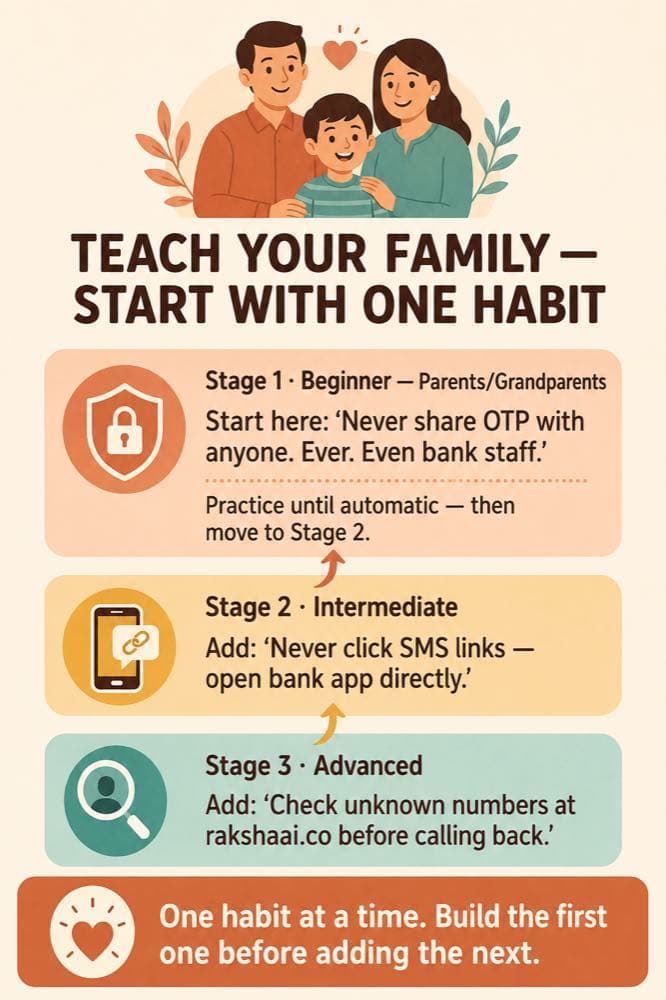
To protect yourself online India families need a shared response, not a lecture full of jargon. Start with one sentence: "Never share an OTP with anyone." Role-play a fake bank call and let the family member practise hanging up. Only after that response feels automatic, add the rule about opening official apps directly.
For parents and grandparents, place the bank's official number beside the phone and agree on a family code word for emergency requests. Read our guide to cyber safety for senior citizens. Do not shame anyone who nearly clicked. Calm reporting is more useful than embarrassment because scammers rely on secrecy.
30 Second Instagram Reel Script
Format: quick phone close-ups, checklist overlays, timer animation and calm urgent delivery.
On-screen caption: Stop. Check. Confirm. Report.
Frequently Asked Questions
What is cyber hygiene and why does it matter in India?
Cyber hygiene means regular digital safety habits that protect devices, accounts, identity and money, much like personal hygiene helps prevent illness. In India, habits such as opening official apps directly, checking recipients, using unique passwords, enabling 2FA and reviewing transactions can interrupt common phishing, OTP, UPI and account takeover attempts.
How can I teach cyber safety habits to elderly parents in India?
Begin with one rule: never share an OTP with anyone, including someone claiming to be bank staff. Practise it until the response is automatic. Then add a second rule: never click an SMS link, and open the bank app directly. Enable transaction alerts and, with their consent, create a family check-in plan for suspicious calls.
How often should I check my bank statement in India?
Check it at least weekly and read alerts for every transaction as they arrive. Set a recurring Sunday reminder. If an unknown debit appears, contact the bank immediately and report financial cyber fraud quickly through 1930 and cybercrime.gov.in.
What is the most important single cyber safety habit in India?
Never share an OTP, UPI PIN, password or screen-sharing access with anyone who contacts you. An OTP is useful protection only when you keep it private and use it for an action you initiated in the official app or website.
Is there a quick way to check if my accounts are safe right now in India?
Review bank transactions, Aadhaar authentication history on the official UIDAI service, mobile connections issued in your name through Sanchar Saathi, and recent credit enquiries in your credit report. Also inspect active sessions and recovery details on your email account. An unfamiliar entry is a warning to contact the relevant provider immediately.
Sources and Credits
- Ministry of Home Affairs, Rajya Sabha answer 1517, 12 March 2025: NCRP incident, reported amount, lien and refund statistics through 28 February 2025.
- Ministry of Home Affairs, Lok Sabha answer 2944, 18 March 2025: phishing, impersonation, fake profile and identity theft complaint categories.
- The Indian Express, 5 June 2026: Karnataka High Court reporting on the BSNL duplicate-SIM fraud and compensation order.
- The Indian Express, 27 October 2025: Nagpur eSIM-upgrade scam account and expert explanation.
- UIDAI Aadhaar authentication history FAQ: scope of the official authentication-history service.
- National Cybercrime Reporting Portal: official complaint portal, suspect reporting and cybercrime helpline 1930.
- Sanchar Saathi: official mobile-connection checks and Chakshu suspicious-communication reporting.
Make checking your default habit
Check a suspicious phone number, UPI ID, website or business on RakshaAI before you reply, sign in or pay.
Check suspicious details freeMore from RakshaAI Blog
PAN Card Fraud India: How Scammers Are Misusing Your PAN in 2026
Social Media Account Cloning India: When Scammers Become You Online
Cyber Fraud Case Studies India 2026: Real Victims, Real Losses, Real Lessons
Stay Protected Online
Use RakshaAI to check websites, phone numbers, and UPI IDs for scams free, instant, no sign-up required.
RakshaAI is a private platform by Ehatech Services Pvt. Ltd. Not affiliated with any government body. Editorial policy