
Sextortion India 2026Do Not Pay - The Complete 5-Step Response Guide
If someone is threatening to share intimate images or video of you unless you pay, this is a crime being done to you, not something you caused. The single most important thing to know right now: do not pay. This page walks through exactly what to do instead, in order.
Helpline 1930 · cybercrime.gov.in · NCW (for women): ncwapps.nic.in
340%
Growth in sextortion complaints in India, 2023-2025
MHA I4C 2025
78%
Of victims who paid faced a higher follow-up demand
MHA I4C 2025
68%
Of victims who did not pay and reported saw demands stop
cybercrime.gov.in 2025
₹32,000
Average demand - the psychological harm goes far beyond the financial figure
NCRB 2025
Do Not Pay
Paying does not end sextortion. It confirms you will pay, and is followed by a higher demand far more often than it is followed by silence. Every step that actually helps — reporting, image removal, an FIR — is below.
The evidence behind the one rule
Why This Advice Holds Up
Why paying makes it worse
Victims who make an initial payment overwhelmingly report a second demand, usually higher, within a day or two. A payment does not close the matter for the person demanding it — it confirms that pursuing you is worth their time.
Why stopping and reporting works
Sextortion operators typically run many targets at once, on a low investment per person. A target who refuses to pay and responds with a cybercrime complaint reference signals that continuing to pursue that one case is no longer worth the risk to them.
Three mechanisms
How Sextortion Happens in India
Type 1 - Fake Romance, Content Shared Voluntarily
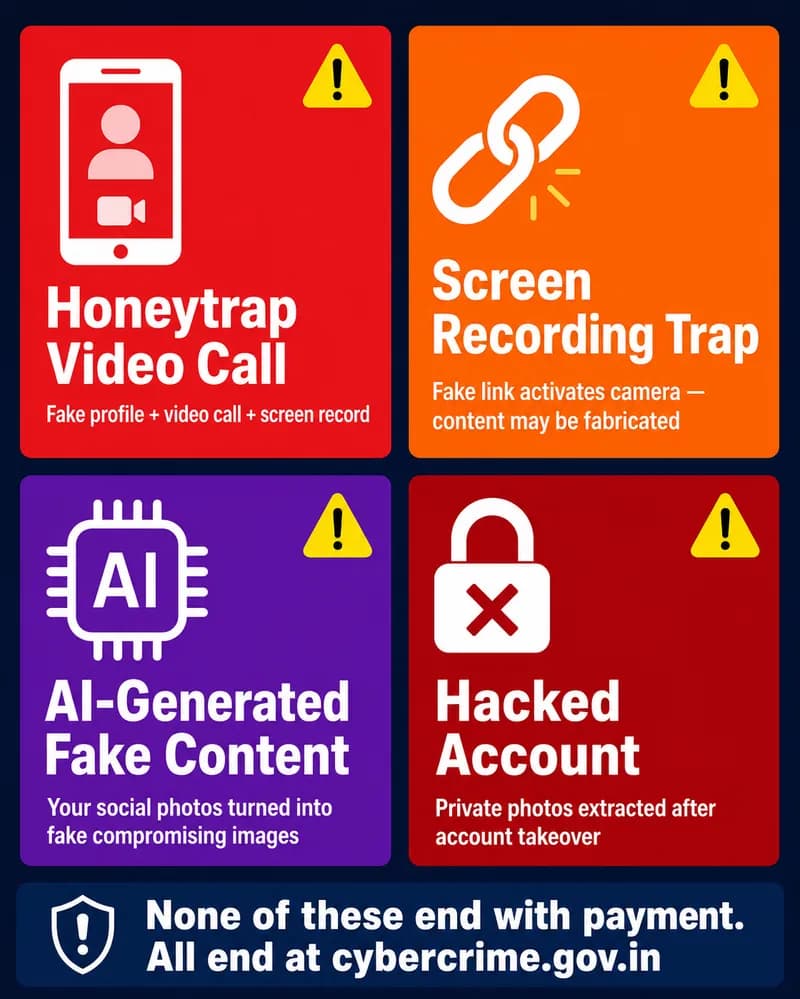
A relationship is built over weeks on a dating app or social media, using a stolen or fabricated identity. As intimacy develops, intimate photos or video are eventually shared as what feels like a natural part of the relationship. Within hours, the tone changes completely and a payment demand arrives, often accompanied by a screenshot of your contact list as leverage.
Type 2 - The Video Call Trap
No relationship is required for this variant. An unknown WhatsApp contact starts a video call; explicit pre-recorded content appears on their end, and your face — visible in the call interface, however briefly or however confused your reaction — is screenshotted as apparent “evidence.” The blackmail message can arrive within minutes of the call ending.
Type 3 - Deepfake Content
A small number of ordinary photos, taken from a public profile or shared earlier in a relationship, are used to generate explicit images or video that never actually happened. The victim is blackmailed with fabricated content — this variant can target anyone with public photos, whether or not they ever shared anything intimate.
Understanding it, without any blame
Why This Targets Young Indians So Effectively
Family reputation used as leverage
Threats to contact parents, siblings or relatives are specifically chosen because of how closely family standing is tied to this kind of content in many Indian households.
Employment and marriage-prospect threats
Threats to contact an employer, or to send content to a marriage prospect or their family, are used because of the outsized weight those relationships carry.
Limited prior reference point
For someone in an early digital relationship, a fabricated romance can feel entirely genuine, and the shock of the blackmail that follows can be disorienting rather than instantly recognisable as a scam.
Low awareness of the do-not-pay principle
Many first-time targets are not aware that paying typically leads to a higher demand rather than resolution, and understandably default to trying to make the immediate threat go away.
Organised, high-volume operations
Some operations run hundreds of targets simultaneously with scripted escalation. This is a business model built on volume, not a personal vendetta against any one target.
None of these factors make a victim responsible. This is a crime committed by a criminal, exploiting a normal human response to manufactured intimacy and a credible threat. There is nothing here to be ashamed of.
What the law says
The India Laws That Protect You
| Law | What it covers | Penalty |
|---|---|---|
| IT Act Sections 67 & 67A | Publishing or transmitting obscene material (67) or sexually explicit material (67A) in electronic form - applies to sextortion content and demands referencing it. | Sec 67: up to 3 yrs first / 5 yrs repeat. Sec 67A: up to 5 yrs first / 7 yrs repeat. |
| Extortion (BNS 308, formerly IPC 384) | Putting a person in fear of harm - here, the threat to share intimate content - in order to make them hand over money. The demand itself is the offence, whether or not content is ever shared. | Up to 3 years, fine, or both. |
| Voyeurism (BNS 77, formerly IPC 354C) | Capturing or sharing images of a person in circumstances implying privacy, without consent. | Up to 3 yrs first conviction, up to 7 yrs repeat. |
| IT Act Section 66E | Capturing or transmitting images of a person’s private areas without consent - applies to both real and deepfake content. | Up to 3 years, fine, or both. |
| Defamation (BNS 356, formerly IPC 499/500) | Threatening to publish false or fabricated damaging content - directly relevant to deepfake sextortion. | Up to 2 years, fine, or both. |
| IT Act Section 67B and POCSO | Where the victim is under 18, these apply automatically alongside the above - see the dedicated note below. | See POCSO note below. |
India’s criminal code was replaced by the Bharatiya Nyaya Sanhita (BNS) on 1 July 2024. The older IPC section numbers are included above because they remain the most commonly searched terms for these offences.
If the victim is under 18: POCSO applies, and the child is protected first
The Protection of Children from Sexual Offences (POCSO) Act, 2012 applies automatically whenever the person targeted is under 18. Threatening to use a real or fabricated depiction of a child in a sexual context is sexual harassment under Section 11, carrying up to 3 years and a fine under Section 12. Where child sexual abuse material has actually been created or circulated, the more serious Sections 13 and 14 apply alongside IT Act Section 67B, each carrying 5 years on a first conviction and 7 on a repeat one — and other, far more severe categories of offence exist under POCSO for physical sexual assault, which is a different situation from image-based blackmail.
- Parents or guardians should report directly at the nearest police station, in addition to cybercrime.gov.in, so the mandatory child-protection process is triggered.
- A child should never be asked to produce the images as evidence — the blackmail message and a verbal account are sufficient to file a complaint.
- Investigating officers are required to use child-friendly interviewing protocols, and schools have a duty to report if they become aware of a student affected.
In order, starting now
The 5-Step Response Protocol
Speed matters most in the first two steps. Everything after that matters too — just slightly less urgently.
- 1
Do not pay. Do not delete. Do not block yet.
Save the blackmail message with the sender’s account name or number visible, their profile, the exact threat, and any payment demand (UPI ID, amount). Blocking before you have this evidence means losing what police need — the account can be abandoned by the operator regardless of whether you block it, so gather evidence first.
- 2
File at cybercrime.gov.in, and call 1930 if you paid
File under Cybercrime Against Women or Online Blackmail / Sextortion with every screenshot attached, citing extortion and IT Act Section 67 or 67A. Keep the complaint number — you will use it in the next step. If any UPI payment was made, call 1930 immediately as well.
- 3
Report the account and start image removal
Report the account on Instagram, Facebook or WhatsApp directly. Then, if you are 18 or older, submit the image to StopNCII.org — a free tool operated by the Revenge Porn Helpline (SWGfL) in partnership with Meta and other platforms, which creates a digital hash of your image without the image ever leaving your device, and shares that hash so matching uploads are automatically blocked on participating platforms. If you were under 18 in the images, use NCMEC’s equivalent tool, Take It Down, instead.
- 4
Report to CERT-In, and to the NCW if the victim is a woman
Report the account, website or any links sent to you to CERT-In at incident@cert-in.org.in for coordinated takedown. If the victim is a woman, file simultaneously with the National Commission for Women at ncwapps.nic.in, which handles cybercrime against women and can provide counselling referrals alongside its complaint process.
- 5
File an FIR, and let yourself be supported
File at your cybercrime police station citing every applicable section from the table above, adding POCSO if the victim is under 18. Once the reporting steps are moving, talk to someone you trust. The legal process and the emotional process both matter — you do not have to carry this alone, and free confidential counselling is available (see below).
Report the account and stop it reaching someone else
Keep screenshots, the account details, and the demand ready.
Reported case patterns
How Sextortion Plays Out - India Case Patterns 2024-2025
These are composite patterns drawn from commonly reported cases in India, not individual identifiable incidents.
Fake romance, escalating payments
Intimate content shared during what felt like a genuine relationship is followed by a demand, a payment, and then a second and third demand each higher than the last — the pattern that makes reporting after the first demand the better outcome.
Video-call trap, no payment made
An unsolicited WhatsApp video call captures a reactive screenshot. The target refuses to pay, reports within the hour, and sends the resulting complaint reference back — demands stop.
Deepfake from public photos
No intimate content was ever shared. Fabricated images generated from public profile photos are used for a demand. The content is still unlawful to create and distribute, and is reported and pursued exactly as real content would be.
A minor targeted through a school social circle
A minor is targeted via a platform popular with their peer group, and a parent or guardian discovers the blackmail message. Reporting directly to the local police station, rather than only the online portal, triggers the mandatory child-protection process — the child is the victim and the focus throughout is their protection.
A young adult, first online relationship
A college-age target in an early digital relationship shares content and is blackmailed. Reporting after the demand — even after an initial payment — leads to identification of the operator, who is found to be running many simultaneous targets.
Organised, high-volume operation
An operation running hundreds of simultaneous fake profiles and video-call traps is identified and dismantled after a cluster of coordinated victim reports, illustrating why every individual report matters even when a single case feels small.
If content exists or has spread
How to Remove Intimate Images From the Internet
If you are 18 or older
Use StopNCII.org, run by the Revenge Porn Helpline (SWGfL) in partnership with Meta and other platforms. Select “Create a Case” — you never upload the actual image, only a cryptographic hash is generated on your own device. That hash is shared with participating platforms, including Instagram and Facebook, and any upload matching it is automatically blocked, typically within 24-48 hours for content already circulating.
If you were under 18 in the images
Use NCMEC’s dedicated tool, Take It Down, which serves the same hash-matching purpose specifically for this situation.
Removing it from Google Search
Google offers a direct removal request for non-consensual explicit images from Search results, accessible from the three-dot menu on the image in Google Images, selecting “Remove result” and then “It shows a sexual image of me.”
If content has already reached your contacts
Each share is an additional criminal act you can report as further evidence. In practice, most recipients who get such content from an unknown number recognise it as blackmail — the social fallout is very often smaller than it feels in the moment. Content can be removed. Nothing about a criminal’s actions changes who you are.

Scale of the problem
Sextortion Statistics India 2025-2026
| Metric | Data | Source |
|---|---|---|
| Growth in complaints, 2023-2025 | +340% | MHA I4C 2025 |
| Victims who paid and faced a higher demand | 78% | MHA I4C 2025 |
| Victims who did not pay and saw demands stop | 68% | cybercrime.gov.in 2025 |
| Average demand | ₹32,000 | NCRB 2025 |
| Fastest-growing variant | Deepfake sextortion | MHA I4C 2025 |
| Most-targeted age group | 18-30 years | MHA I4C 2025 |
Before it happens
Protecting Yourself - Prevention by Platform
| Where | Prevention step | Why it matters |
|---|---|---|
| Set your profile to private, enable Restrict for unknown followers, and turn on the Hidden Words filter for DMs. | A private account makes both a fake-romance approach and deepfake photo gathering harder. | |
| Review who can see your photos in privacy settings, and limit friend requests to friends of friends. | Reduces the pool of public face photos available for deepfake generation and limits cold-contact approaches. | |
| Set your profile photo visibility to My Contacts, and turn off read receipts for unknown numbers. | Reduces the information available to an operator working from a purchased or leaked number list. | |
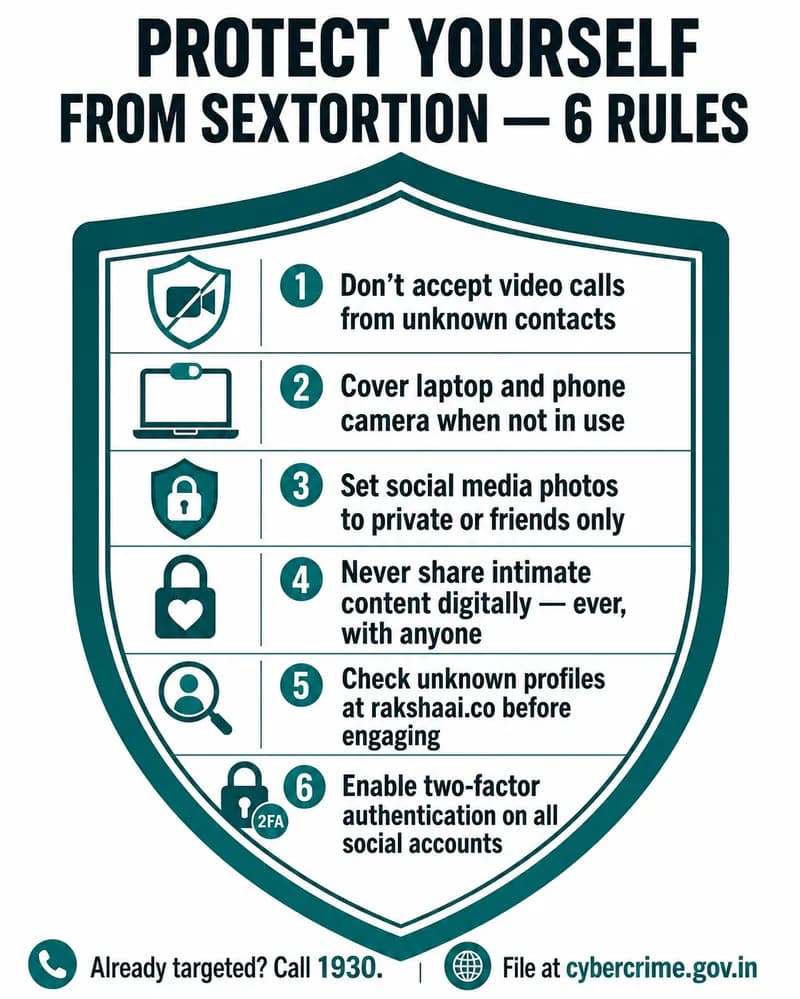
| Video calls | Never appear intimately on a video call with someone you have not met in person and verified. | This one habit fully prevents the video-call-trap variant. |
| Photo sharing | Treat any intimate photo or video as permanent once sent - it cannot reliably be recalled. | The single most effective prevention against the voluntary-sharing variant. |
Related guides
How This Relates to Other Romance Scams
| Related guide | How it relates | Full guide |
|---|---|---|
| Instagram & Facebook Romance Scam | Covers the unsolicited-DM approach and sextortion as one of two harm tracks. This page goes deeper on sextortion specifically, including deepfakes, POCSO and organised operations. | Read guide |
| Catfishing / Fake Dating Profile | Covers the dating-app fake-identity mechanism where the primary harm is a financial money request rather than blackmail over intimate content. | Read guide |
Related guides
Keep Exploring
Instagram & Facebook Romance Scam
The unsolicited-DM entry point that often leads here - covers both the financial-fraud and sextortion tracks together.
Catfishing / Fake Dating Profile Scam
The dating-app version of fake-identity fraud, where the primary harm is a money request rather than blackmail.
Romance Scams India Hub
Compare every romance-fraud mechanism active in India today.
Take action now
Report, Verify, and Get Support
Report a Scam
Report the blackmailer’s account, number and demand to warn other Indian users.
Phone Number Checker
Check any number contacting you before you engage further.
Check numbercybercrime.gov.in
File your complaint directly with India’s national cybercrime reporting portal.
File a complaintSextortion alerts
Check current scam warnings
New tactics and operations are identified constantly. Check the live alert feed rather than relying on any static list.
Quick answers
Frequently Asked Questions About Sextortion
What is sextortion and how does it happen in India?
Sextortion is when someone uses intimate images or video — real, screenshotted, or entirely fabricated — to demand money under threat of sharing it with your contacts, family or employer. In India it most often follows a fake romantic relationship, or a WhatsApp video call engineered to capture a reactive screenshot. Complaints have grown roughly 340% between 2023 and 2025, and the single most important response is not to pay: most victims who pay face a higher follow-up demand, while most who refuse and report see demands stop.
I just received a sextortion demand. What should I do right now?
Do not pay. Do not delete the conversation. Do not block the sender yet — screenshot the blackmail message, their account details, and the exact demand first, since evidence collection matters more than cutting contact immediately. File at cybercrime.gov.in citing extortion and IT Act Section 67 or 67A, and call 1930 if you have already made any payment. Report the account on its platform, and if you are 18 or older, submit the image to StopNCII.org. You are not in trouble for reporting this — reporting is how it gets resolved.
What if I already paid?
Stop making further payments, and report anyway — a late report is always better than continuing to pay. Include the amounts, dates, and UPI IDs used in your complaint. If a UPI payment was recent, call 1930 for a possible account freeze. File an FIR citing extortion. Many sextortion operators run this as an organised, high-volume operation, so your report — even after payment — genuinely contributes to identifying them.
How do I get intimate images removed from the internet in India?
If you are 18 or older, use StopNCII.org: it creates a digital hash of your image, which never leaves your device, and shares that hash with participating platforms including Instagram and Facebook so matching uploads are automatically blocked. If you were under 18 in the images, NCMEC’s equivalent tool, Take It Down, serves the same purpose. Google also offers a direct removal request for explicit images appearing in Search results, accessible from the image’s menu in Google Images. Report to CERT-In for coordinated multi-platform takedown, and report each specific URL to the platform where it appears.
What is deepfake sextortion, and does the law still apply if the images aren’t real?
Deepfake sextortion uses AI tools to generate explicit images or video of a person from ordinary public photos — content that never actually happened. It is one of the fastest-growing sextortion variants, because it can target anyone with public photos, not only people who shared anything intimate. The law applies regardless: transmitting sexually explicit electronic content is an offence under IT Act Section 67A whether the content is real or generated, and threatening to share fabricated damaging content is also defamation. Report and pursue it exactly as you would real content — and consider setting your public photos to private, since that is what deepfake generation typically relies on.
How do I report sextortion in India?
File at cybercrime.gov.in under Online Blackmail or Cybercrime Against Women, citing extortion, voyeurism and IT Act Section 67 or 67A. Call 1930 if any payment was made. Report the account on Instagram, Facebook or WhatsApp directly. Report to CERT-In at incident@cert-in.org.in. File with the National Commission for Women at ncwapps.nic.in if the victim is a woman. File an FIR at your cybercrime police station, and report the scam to RakshaAI to help warn others. If the victim is under 18, go directly to your nearest police station as well, so the mandatory child-protection process is triggered.
What is the POCSO Act and how does it apply if the victim is under 18?
The Protection of Children from Sexual Offences (POCSO) Act, 2012 applies automatically whenever the victim is under 18. A threat to use a real or fabricated depiction of a child in a sexual context is sexual harassment under Section 11, punishable under Section 12 with up to 3 years and a fine; where actual child sexual abuse material is created or circulated, the more serious Sections 13 and 14 apply, alongside IT Act Section 67B, each carrying 5 years on a first conviction and 7 on a repeat one. Some other categories of offence under POCSO carry far higher sentences, but those apply to physical sexual assault, not to this kind of image-based blackmail specifically. What matters most practically: police are required to treat a POCSO report as a child-protection matter, a minor should never be asked to produce the images as evidence — the blackmail message and a verbal account are enough — and parents or guardians should report directly to the nearest police station in addition to cybercrime.gov.in.
Why do sextortion operations target young Indians specifically?
A combination of factors makes this age group a common target: the outsized weight family reputation and marriage prospects carry in many Indian households, which operators use as leverage; limited prior experience with online relationships, which can make a fabricated romance feel entirely genuine; low awareness that paying tends to make demands worse rather than better; and the sheer size of India’s young, highly-connected user base on the platforms these operations use. None of this reflects any failing on a victim’s part — it reflects a criminal business model built around exploiting normal human trust.
How is a social media romance scam different from sextortion specifically?
Instagram and Facebook romance scams can end in one of two ways: a financial-fraud track, where the relationship leads to a money request framed as a crisis or opportunity, or the sextortion track, where the relationship leads to captured intimate content and blackmail. Sextortion itself is broader than that one entry point — it also includes the video-call trap, which needs no prior relationship at all, and deepfake content, which needs no shared content at all. This page focuses specifically on the sextortion mechanism across all of its forms.
I feel ashamed about what happened to me. What should I know?
That shame was manufactured by someone who deliberately built a fake sense of intimacy in order to exploit it — it is a predictable human response to a deliberate manipulation, not a sign of poor judgement or bad character. This happens to people from every background: students, professionals, parents. The steps forward are the same regardless of how you feel: screenshot, report, do not pay. Reporting is not an admission of anything — it is an accurate account of what someone did to you. If you would like to talk to someone, free and confidential support is available in India through iCall (9152987821) and the Vandrevala Foundation (1860-2662-345), alongside the reporting steps on this page.
Before you go
This happened to you. It does not define you.
Free, confidential support: iCall (9152987821) and Vandrevala Foundation (1860-2662-345). You do not have to go through this alone.