
Army Officer Romance Scam India 2026How Fake Soldiers Build Trust, What They Request, and How to Verify Any Military Identity
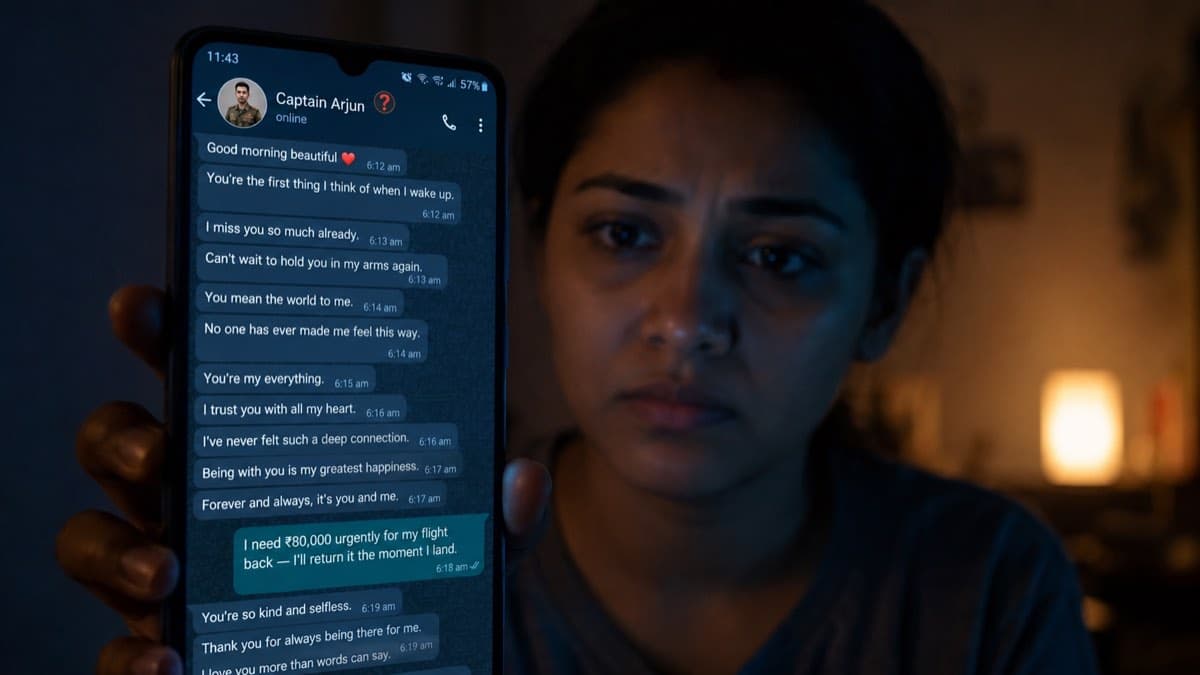
A scammer poses as an Indian Army, CRPF or BSF officer, or a UN peacekeeper on deployment, and builds a deep relationship before requesting money for leave travel, a provident-fund release, a medical emergency, or a valuables shipment. The uniform in the photo is stolen. The deployment is fictional. The request that follows months of trust-building is the entire purpose.
Free · No login · 10M+ fraud numbers · Built for India
₹2.8L
Average loss per military romance scam victim in India
NCRB 2025
4×
Higher than the general romance-scam average loss of ₹68,000
NCRB 2025
12,000+
Army officer impersonation romance complaints, 2024-25
MHA I4C 2025
3-4×
Estimated unreported cases - shame and respect for the Army suppress reporting
MHA I4C 2025
The one rule: a serving Indian Army officer never asks a civilian they have not met in person for money. Trust in the uniform is well placed — trust in an unverified online contact claiming to wear one is not.
Why this is a crime with its own charge sheet
The India Law That Makes Military Impersonation Distinct
Unlike a generic fake profile, using a soldier’s uniform to deceive is its own named offence in Indian criminal law — on top of the fraud itself.
Wearing the uniform of the armed forces
Using a soldier’s garb or token with intent to be believed a member of the armed forces is a specific offence — historically IPC Section 140, now Section 168 of the Bharatiya Nyaya Sanhita (BNS), 2023. A stolen uniform photo used to build a fake identity falls squarely within it.
Cheating by personation and fraud
Presenting as a military officer to defraud someone is cheating by personation — formerly IPC Section 416, now BNS Section 319(1) — alongside fraud and cheating, formerly IPC Section 420, now BNS Section 318(4).
Identity theft and impersonation online
IT Act Section 66C covers identity theft — using a real officer’s stolen photographs and identity without consent — and Section 66D covers cheating by impersonation using a computer resource, which is the fake profile itself. Both carry penalties of up to three years’ imprisonment.
India’s criminal code was replaced by the Bharatiya Nyaya Sanhita (BNS) on 1 July 2024. The older IPC section numbers are included above because they remain the most commonly searched terms for this offence.
Four framings, one pattern
4 Money-Request Types Used in the Military Romance Scam
Each request is chosen because it sounds like a genuine, temporary need within a plausible military context.
Leave Travel Advance
₹40,000 – 1,50,000
The officer’s leave is ‘finally approved’ but his official travel advance is delayed by paperwork. He needs funds sent to a personal UPI ID or ‘travel agent’ to book tickets home, promising repayment on arrival. He never arrives, or a second delay demands a second transfer.
DSOP Fund Release Fee
₹80,000 – 2,00,000
The Defence Services Officers Provident Fund is a genuine benefit — which is exactly why this framing is so credible. The scammer claims a large DSOP payout is ready but needs a ‘civilian guarantor transfer’ to unlock government processing. Real DSOP releases never require a civilian payment.
Medical Emergency Abroad
₹60,000 – 3,00,000
A sudden surgery, accident or illness during deployment, with military insurance ‘delayed’ or ‘not accepted’ locally. The combination of life-threatening urgency and an existing emotional relationship makes this the highest-success framing for the scammer.
Gold or Package Shipment Fee
₹30,000 – 1,50,000
Gold, jewellery or a ‘diplomatic package’ accumulated during deployment needs a customs or clearance fee before it can be shipped home. A first payment is always followed by a second ‘tax’ or ‘security deposit’ — the package never arrives.
Identify it before Stage 3
The 3-Stage Trust-Build
| Stage | What happens | Detection signal |
|---|---|---|
| Stage 1 - Contact (Weeks 1-2) | A profile photographed in uniform sends a connection request on Facebook or follows on Instagram. Messages are respectful and formal, using the language of duty, honour and sacrifice. | Recently created profile, thin post history, professional but generic photos that reverse-image search elsewhere. |
| Stage 2 - Deep Bond (Weeks 3-10) | Daily messages, shared ‘deployment hardship’ stories, a widowed-parent backstory, and talk of retirement and meeting your family. | The relationship escalates faster than normal. Video calls are avoided or consistently poor quality. Contact is only ever on WhatsApp, never an official service email. |
| Stage 3 - The Request (Week 8-14+) | After extended trust-build, a crisis or opportunity requiring money arrives, framed to sound credible within a military context. | Any money request from someone never met in person, via UPI to a personal number, wire transfer or crypto, wrapped in urgency designed to prevent verification. |
Five archetypes
The Military Personas Used in India, and Why They Work
| Persona | Story pattern | Why it works in India |
|---|---|---|
| Colonel / Brigadier, deployed abroad | Widowed, deployed under a UN mandate in Syria, Lebanon or South Sudan, one child in boarding school, seeking companionship before retirement. | Senior rank implies large DSOP funds and travel allowances, making financial requests feel proportionate and credible. |
| CRPF / BSF officer, counter-terror operation | Deployed in a ‘restricted zone’ on counter-terror operations — explains the absence of video calls or official contact. | Para-military deployment restrictions are real, so victims are less likely to question the lack of verifiable contact. |
| UN peacekeeper, foreign deployment | International peacekeeping posting (Congo, South Sudan, Lebanon), blue-beret photos, a ‘working for world peace’ narrative. | Peacekeeping per-diem allowances are used to explain ‘savings’ that supposedly need transferring home, adding financial plausibility. |
| Retired general or ex-military professional | Not on active deployment, so limited video calls are possible. Runs a ‘security consulting firm’ with government contracts. | Targets older, more financially established victims and opens the door to investment-style requests alongside romance. |
| Defence ministry official or military attaché | Poses as a defence ministry official abroad with ‘diplomatic packages’ or government funds requiring civilian facilitation. | Institutional framing creates maximum authority and typically the highest-value fee demands of any persona. |
Reported case patterns
How the Scam Plays Out - India Case Patterns 2024-2025
These are composite patterns drawn from commonly reported military romance scam cases in India, not individual verified incidents.
Leave-travel escalation
Weeks of daily messages and a stated deployment lead to a leave-travel advance request paid in tranches via UPI. The profile never appears on an unscripted video call, and reverse image search later traces the photos to an unrelated real officer.
DSOP fund, multi-stage transfer
A UN-deployment persona introduces a DSOP fund release that needs a ‘civilian guarantor transfer’, collected across three separate payments before the victim recognises the pattern and stops.
Medical emergency under time pressure
A counter-terror deployment persona reports a sudden medical emergency requiring immediate funds, invoking an ‘Army welfare fund reimbursement’ that never materialises after the UPI transfer clears.
Diplomatic package, gold shipment
A retired-officer persona describes a package of valuables from a deployment zone, with a customs fee followed by a second ‘tax clearance’ and a third ‘security deposit’ — each new fee justified by the last.
Military romance into investment pitch
A border-deployment persona transitions a months-long relationship into a forex or crypto trading platform. Withdrawal is blocked behind a ‘security clearance fee’ before the platform disappears — a hybrid of this scam and pig butchering.
Ministry-official diplomatic fee
A profile claiming a senior ministry posting abroad describes a diplomatic package requiring an official-sounding ‘clearance certificate’ fee — the highest-value variant, and entirely fictitious as a real government process.
Before sending anything
8 Red Flags of a Fake Army Officer Online
These eight signals are consistent across nearly every documented case.
- 1
Contact came via Facebook, Instagram or WhatsApp, not an official channel
Serving officers do not use personal social media to initiate romantic contact with civilians, and use official service email for professional communication.
- 2
The profile cannot or will not do a live, unscripted video call
‘Classified deployment’, ‘restricted communication policy’ or a ‘broken camera’ are excuses, not explanations. A real person can appear on a call at a time you choose.
- 3
Profile photos are traceable to someone else
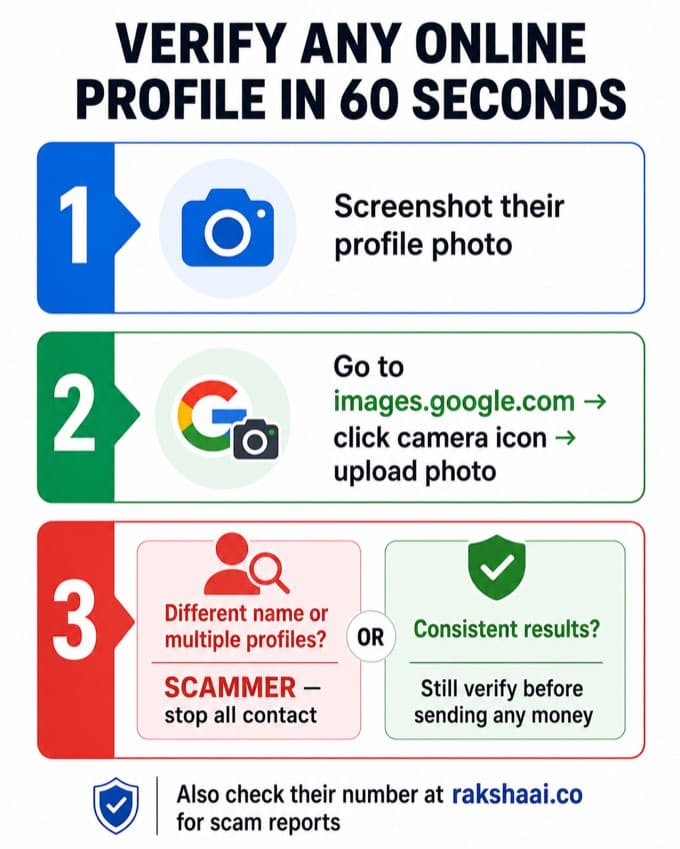
A reverse image search of any uniform photo often traces it to a real officer’s social media, a regimental tribute page, or a stock photo library.
- 4
A money request arrives, however it is framed
Leave travel, DSOP fund release, medical emergency or a customs fee — no serving officer needs a civilian they have never met to transfer money on their behalf.
- 5
The DSOP Fund narrative is used to justify a transfer
DSOP releases are processed entirely through official government channels. No civilian ‘guarantor transfer’ is ever required to unlock one.
- 6
Contact is only possible via a personal number with no verifiable unit
A ‘Colonel’ reachable only on a personal WhatsApp number, with no verifiable regiment or unit contact, is not a serving officer.
- 7
The relationship was initiated by the profile, not by you
Serving officers do not proactively approach unknown civilians for romance on social media. Unsolicited military-persona messages are overwhelmingly fraudulent.
- 8
The account is new, thin, and made up of curated professional photos
A handful of uniform photos at professional-looking locations, without years of varied personal content, is a strong signal of a built-for-purpose fake profile.
Five checks
How to Verify Any Indian Army Officer Online
Step 1
Understand that the Army has no public officer look-up tool
For operational security reasons, the Indian Armed Forces do not run a public self-service portal where anyone can look up a serving officer’s identity. If an online contact points you to a specific ‘verification website’ to reassure you, treat that itself as a red flag rather than proof.
Step 2
Demand an unscripted live video call
Ask for a call at a time you choose, and ask them to show an Army identity card, hold up today’s newspaper, or write your name on paper. A genuine person can comply; a scammer using stolen photos cannot.
- Check number
Step 3
Check the phone number
Before sharing personal information, check the number they message from. Military-persona operators contact multiple victims from the same numbers, and active numbers are typically reported within days.
- Official Army contacts
Step 4
Cross-check through the Army’s official channels
Look up the claimed regiment or unit through the Indian Army’s official contact page at indianarmy.nic.in, and check the Army’s official public-information and fact-check accounts for known scam patterns before trusting an unsolicited claim.
Step 5
Never send money, regardless of the story
Leave travel, DSOP fund, medical emergency or customs fee — apply one test: would you give this amount to a stranger on the street based on the same request? Until identity is verified in person, that is exactly what is happening.
If you already sent money
Recovery Guide - What to Do Next
Speed matters most in the first 30 minutes. Report the impersonation angle explicitly — it opens a different, often faster, enforcement path than a generic fraud complaint.
- 1
Call 1930 within 30 minutes of any UPI transfer
Provide the recipient UPI ID, amount and time for a chance at account freeze. Screenshot the full conversation, the profile, exchanged photos and payment confirmations before blocking the contact.
- 2
File on cybercrime.gov.in citing the impersonation angle explicitly
File under Online Financial Fraud / Romance Scam, and state clearly in the description that the person claimed to be a serving Army, CRPF, BSF or UN officer, with their claimed rank and name. Citing the impersonation angle, not just the fraud, helps route the case correctly.
- 3
File a grievance with the Ministry of Defence and report to CERT-In
File a written grievance with the Ministry of Defence through the government’s central grievance portal (CPGRAMS, at pgportal.gov.in), which routes complaints to the correct department, and report the fake profile and stolen photographs to CERT-In at incident@cert-in.org.in.
- 4
File an FIR, and treat the emotional recovery as seriously as the financial one
File at your cybercrime police station citing wearing the garb or token of the armed forces (BNS Section 168, formerly IPC 140), cheating by personation and fraud (BNS Sections 319(1) and 318(4), formerly IPC 416 and 420), and IT Act Sections 66C and 66D. The relationship, though fake, generated real feelings — speaking with a counsellor or someone you trust matters as much as the financial process.
Report the profile before it reaches someone else
Keep screenshots, the profile, the claimed rank and unit, and payment details ready.
Scale of the problem
Military Romance Scam Statistics India 2025-2026
| Metric | Data | Source |
|---|---|---|
| Average loss per victim | ₹2.8 lakh | NCRB 2025 |
| Compared to the general romance-scam average | 4× higher than ₹68,000 | NCRB 2025 |
| Total complaints filed, 2024-25 | 12,000+ | MHA I4C 2025 |
| Estimated unreported cases versus filed complaints | 3-4× — shame and respect for the Army suppress reporting | MHA I4C 2025 |
| Most common initial-contact platform | Facebook, followed by Instagram and WhatsApp | cybercrime.gov.in 2025 |
| Most common money-request type | Leave travel advance | NCRB 2025 |
The 4× gap versus the general romance-scam average is the defining statistic here — it is the uniform, not the story, doing most of the persuading.
Don’t confuse the mechanisms
How This Differs From Other Romance and Job Scams
| Related guide | Key distinction | Full guide |
|---|---|---|
| Catfishing / Fake Dating Profile (General) | This page is specific to military-officer impersonation, with India-specific armed-forces impersonation law and official Army contact channels. General catfishing covers NRI, doctor and other personas. | Read guide |
| Pig Butchering (Investment Romance) | If a military persona pivots into a trading or crypto opportunity, that investment-fraud mechanism is covered in the investment scams section. This page covers only direct money-request fraud. | Read guide |
| Fake Company / Fake HR Portal (Army Job Scam) | A fake Army JOB offer with a registration fee is job fraud, not romance fraud. This page covers a fake romantic relationship built around a military persona. | Read guide |
Related guides
Keep the Mechanism Clear
Catfishing / Fake Dating Profile Scam
The broader fake-identity mechanism — NRI, doctor and other personas — that this military-specific page sits alongside.
Instagram & Facebook Romance Scam
The same platforms carrying NRI, entrepreneur and model personas instead of a military one, with a distinct sextortion harm track.
Pig Butchering / Investment Romance
What happens when a military persona pivots into a trading-platform pitch rather than a direct money request.
Fake Company / Fake HR Portal Scam
A different mechanism entirely — a fake Army or MNC job offer with a registration fee, not a romantic relationship.
Romance Scams India Hub
Compare every romance-fraud mechanism active in India today.
Free RakshaAI checks
Verify Any Military Contact Before You Trust or Pay
Phone Number Checker
Check any mobile number before engaging further with a military persona online.
Check numberWebsite Safety Checker
Verify any website a military contact asks you to visit or transfer through.
Check websiteReport a Scam
Report the fake profile and protect other Indians from the same operator.
Military romance scam alerts
Check current scam warnings
New fake-officer profiles and stolen-photo networks appear constantly. Check the live alert feed rather than relying on any static list.
Quick answers
Frequently Asked Questions About Military Romance Scams India
What is a military romance scam and how does it work in India?
A fake profile claiming to be an Indian Army, CRPF, BSF or UN officer contacts a victim on Facebook, Instagram or WhatsApp using stolen uniform photographs. Over weeks of daily messages, declarations of affection and manufactured hardship, a deep emotional bond is built. A money request eventually follows — a leave-travel advance, a DSOP fund release fee, a medical emergency, or a customs fee for a gold or gift shipment. The average loss is around ₹2.8 lakh, roughly four times the general romance-scam average, because the military framing produces unusually strong trust and financial cooperation.
How do I verify if someone claiming to be an Indian Army officer online is genuine?
The Armed Forces do not operate a public self-service portal for looking up a serving officer’s identity, for operational security reasons — be wary of anyone directing you to a specific ‘verification site’. Instead: demand a live, unscripted video call and ask them to show an Army ID card or write your name on paper; check the phone number they are messaging from; look up their claimed regiment or unit through the Indian Army’s official contact page; and reverse image search their photos. Genuine officers use official service email for professional communication, not personal WhatsApp numbers alone.
What is the DSOP Fund and how is it used in the army romance scam?
The Defence Services Officers Provident Fund (DSOP Fund) is a genuine benefit accumulated during an officer’s service. Scammers exploit its familiarity by claiming a large DSOP payout is ready for release but requires a ‘civilian guarantor transfer’ from the victim to unlock government processing, promising repayment plus a share of the fund. In reality, DSOP Fund releases are processed entirely through official government and Army channels and never require a payment from a civilian outsider. Anyone requesting such a transfer is impersonating an officer and committing fraud.
What law applies to someone using a stolen Army uniform photo to build a fake identity?
Wearing the dress or carrying a token used by a soldier, sailor or airman of the Indian Armed Forces with intent to be believed a member of the forces was IPC Section 140, and is now Section 168 of the Bharatiya Nyaya Sanhita (BNS), 2023, which took effect on 1 July 2024. Using a stolen uniform photograph to construct a fraudulent identity falls within this offence. It typically applies alongside cheating by personation and fraud (formerly IPC Sections 416 and 420, now BNS Sections 319(1) and 318(4)) and IT Act Sections 66C and 66D for the identity theft and online impersonation.
How is the ‘leave travel’ request used, and why should I never pay it?
Serving officers have an official Leave Travel Concession processed entirely through Army administrative channels — the officer claims it, the Army pays, and travel proceeds. No officer needs a civilian to advance personal funds for leave travel. The scammer claims an ‘administrative delay’ has blocked the official process and needs money sent to a personal account or ‘travel agent’ to book tickets, with a clear promised repayment date designed to lower financial caution. After payment, the trip is postponed again, or the contact disappears.
I sent money to someone I believed was an Army officer. How do I recover it?
Call 1930 immediately if the payment was by UPI — within 30 minutes gives the best chance of an account freeze. File at cybercrime.gov.in, explicitly stating the person claimed to be a serving officer and citing the impersonation and fraud provisions alongside IT Act Sections 66C and 66D. File a grievance with the Ministry of Defence through the government’s CPGRAMS portal, and report the fake profile to CERT-In. File an FIR at your cybercrime police station, and call the National Consumer Helpline on 1915. Emotional support matters as much as the financial process — do not let shame delay reporting.
How do I report an army officer impersonation romance scam?
Call 1930 for a UPI freeze. File at cybercrime.gov.in under Romance Scam, citing the military-impersonation angle explicitly. File a Ministry of Defence grievance through CPGRAMS at pgportal.gov.in. Report the fake profile and stolen photographs to CERT-In at incident@cert-in.org.in. Report the profile directly on Facebook or Instagram. Call the National Consumer Helpline on 1915. File an FIR citing BNS Sections 168, 319(1) and 318(4) and IT Act Sections 66C and 66D. Report the profile and number to RakshaAI to warn other users.
What makes a gold shipment or diplomatic package request a scam?
The scenario is plausible-sounding because personnel returning from deployment do sometimes bring items home, and customs fees are a real concept — which is exactly why the framing works. The fraud is exposed by one fact: if a package is genuinely held at customs, the officer or the Indian mission in that country handles its release through official channels, not a civilian in India wiring money over UPI. A first ‘customs fee’ is reliably followed by a second ‘tax’ or ‘security deposit’ demand, and the package never arrives.
Why is the average loss in army romance scams so much higher than other romance scams?
Two factors combine. First, trust acceleration: the military uniform carries immediate, high institutional trust in Indian society, so victims who would question an unknown NRI professional’s money request are far less likely to question an Army officer’s, because the person is understood to be serving the nation. Second, a compounding request structure: leave travel, medical emergency and DSOP fund framings often involve several sequential payments — each new request justified by the last — by which point weeks of emotional investment make refusal psychologically much harder.
Remember
A real officer never needs a stranger’s money to come home.
Demand a live video call and check their number before you trust anything else.