
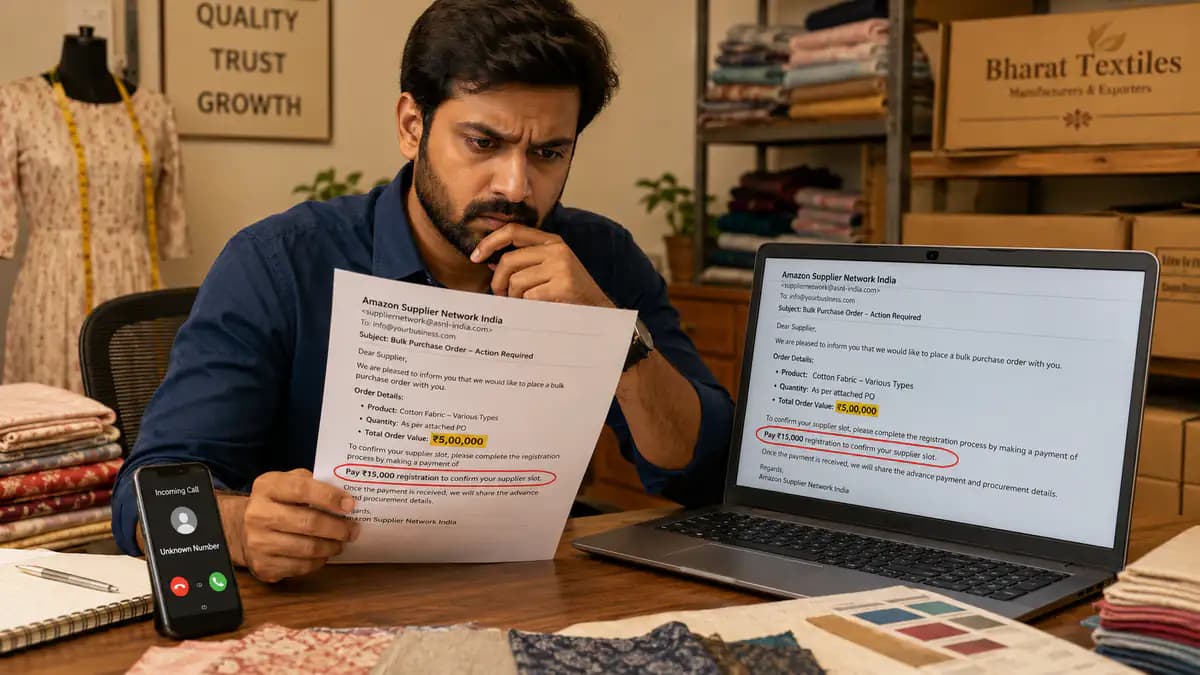
Business scam India 2026 attacks do not begin with an obvious hacker screen. They begin with a valuable purchase order, a new overseas client, a GST refund message, or a senior executive asking accounts to act quickly. Small teams see a chance to grow, while fraudsters see a business where one person may handle sales, verification, invoicing, dispatch, and payment.
The danger is documented. In March 2026, a Bengaluru supplier reported losing more than ₹26 lakh after people posing as Border Security Force officials issued a fake purchase order and turned small refunded test payments into larger transfers. A Hyderabad company reported a similar defence procurement and vendor registration fraud in 2025. These are allegations recorded in complaints and police reporting, not final court findings.
This guide explains seven active formats, separates a genuine credit from fake payment proof, and gives SMEs, sole proprietors, agencies, shopkeepers, exporters, and freelancers a repeatable client verification process.
The core rule
A new buyer should pay your business. You should not have to pay the buyer, its accounts officer, its preferred vendor, or a payment platform to receive an order or release your earnings.
Why SME Fraud India 2026 and Freelancer Scam India Work
SME fraud India 2026 is effective because a large order can equal months of normal revenue. A fraudster adds a recognizable logo, GSTIN, designation, purchase order number, and urgent deadline. Some details may belong to a real institution whose identity has been copied. A database match alone therefore proves that an entity exists, not that the caller represents it.
The freelancer scam India version exploits a different pressure. A designer, developer, writer, consultant, video editor, or marketing agency may fear losing a first international client. The scammer asks for a free sample, moves the chat away from the genuine platform, shows a fake payment dashboard, and then invents a fee for currency conversion, account upgrade, tax clearance, or withdrawal.
India's broader fraud environment makes strong controls necessary. A June 2026 TransUnion analysis said 7.1% of attempted transactions involving consumers in India during 2025 were suspected digital fraud attempts in its network. This is not a count of SME victims, but it shows the identity and transaction risk businesses must manage during onboarding.
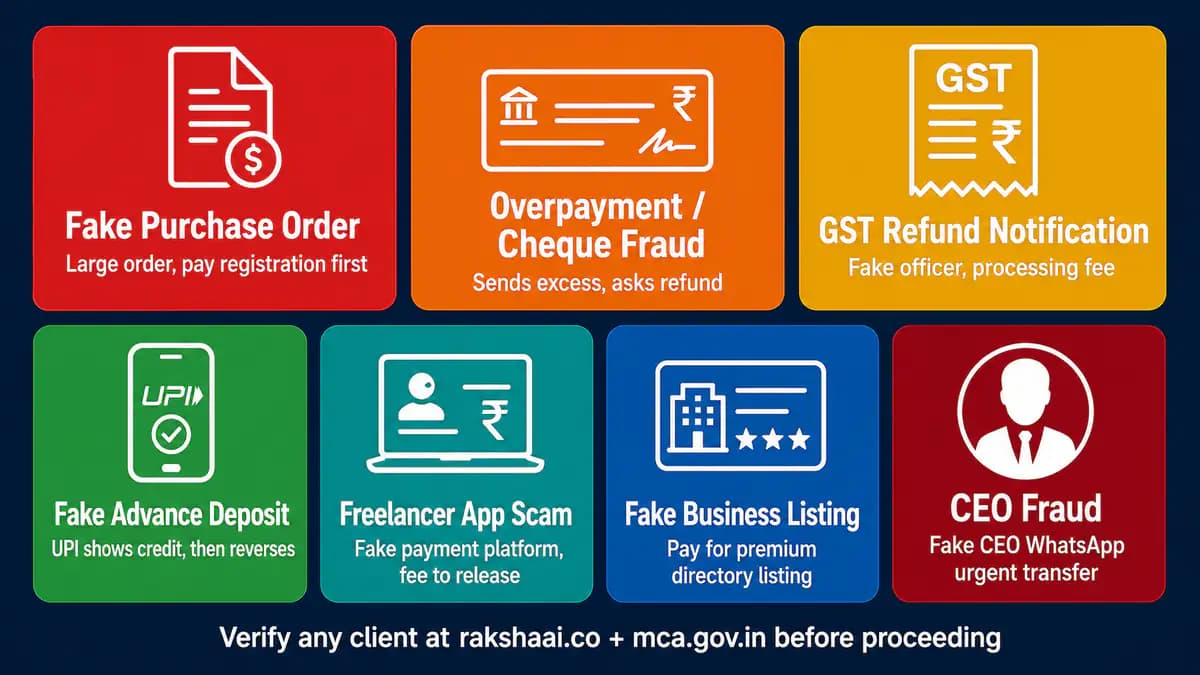
The 7 Business Scam Types Active in India in 2026
Scam 1: Fake Purchase Order India and Bulk Order Advance Fraud
In a fake purchase order India scheme, a supposed corporate, hospital, school, police, Army, Air Force, or BSF buyer requests a large quote. The documents look formal. Once the seller is emotionally committed, an accounts officer demands vendor registration, security deposit, tender activation, test transfer, transport, or certification fees. Small transfers may be returned with an extra amount to build confidence before the demand grows.
This is advance payment fraud business India in reverse: the seller expects an advance but is persuaded to send money first. Call the institution using the number on its official website, verify the officer, domain, purchase order, delivery address, and procurement process, and refuse any request to move money to personal accounts.
Scam 2: Overpayment Cheque and Refund Fraud
A new client sends a cheque for more than the invoice and asks for the difference back quickly. Your balance may temporarily display the deposit while the cheque is still subject to collection. If it bounces after you send a refund, the loss is yours. A digital version uses a fake screenshot, altered UTR, or unrelated credit and pressures staff to refund through another UPI ID.
Never refund an alleged overpayment until your bank confirms the original payment has cleared and the payer identity matches. Return money only through a documented process to the verified originating party.
Scam 3: GST Refund Scam India
A GST refund scam India message claims a refund is approved, a return contains an error, or a registration will be suspended. The link leads to a lookalike portal or the caller asks for a processing charge, login, OTP, bank information, or software installation. The Press Information Bureau and CBIC warning identified fake fast-track GST refund messages and directed taxpayers to the genuine GST portal.
Open gst.gov.in yourself. Refund status can be tracked through the portal and official workflow. Do not trust a search ad, shortened link, or cold caller merely because they know your GSTIN.
Scam 4: Fake Client Advance Deposit and UPI Proof
A client says the advance has been paid and sends a polished screenshot. Another message claims you must scan a QR code or enter your UPI PIN to receive it. Both are danger signs. A receiver does not enter a UPI PIN to receive a normal payment. A screenshot is only an image.
Moneycontrol's April 2026 merchant guidance states that only the credit shown in the recipient's own bank or UPI history confirms payment. Check the amount, sender, reference, and status inside your system before goods, source files, credentials, or services are released.
Scam 5: Freelancer Payment App Scam
The fake client approves work unusually quickly and directs the freelancer to an unfamiliar bank or payment site. The dashboard shows earnings, but withdrawal requires a deposit, verification payment, minimum balance, tax, or upgrade. Every new payment creates another condition. Sometimes the goal is also to collect identity documents and passwords.
Keep contracts and milestones on a reputable platform when that is how the relationship began. Verify the client outside the chat, take a cleared advance into your real account, watermark previews, and never pay to unlock wages or project fees.
Scam 6: Fake Business Directory Listing and Invoice Scam
A caller claims your company listing, trademark directory entry, Google profile, export directory, or industry registration is expiring. The form resembles an invoice or renewal notice. Fine print may turn a harmless correction request into a paid subscription. In a related fake invoice scam India attack, criminals impersonate a known vendor and provide replacement bank details.
Centralize vendor onboarding and invoice approval. Independently call the known supplier before any bank detail change. Match invoice, purchase order, goods receipt, GSTIN, beneficiary name, and approved contract before payment.
Scam 7: CEO and Boss Fraud Targeting Employees
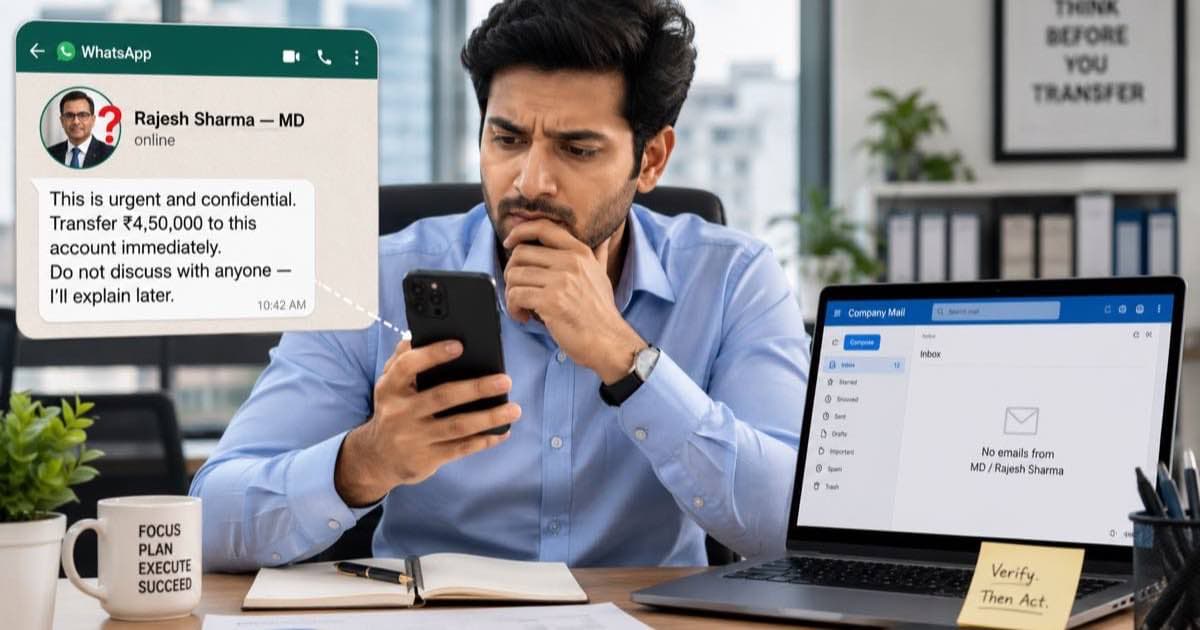
An employee receives a WhatsApp or email from a director who is supposedly in a meeting and needs an urgent confidential transfer. The photo, signature, writing style, or even existing chat context may appear real. The request bypasses normal approval because the executive says speed and secrecy are essential.
In June 2026, Hyderabad Cybercrime Police registered a case after a company reported losing ₹25 lakh through a manipulated WhatsApp conversation, according to The New Indian Express. Require dual approval and confirm through a separately stored number. Read the full Boss scam India guide with a finance-team protocol.
How to Verify a New Client or Business Partner in India
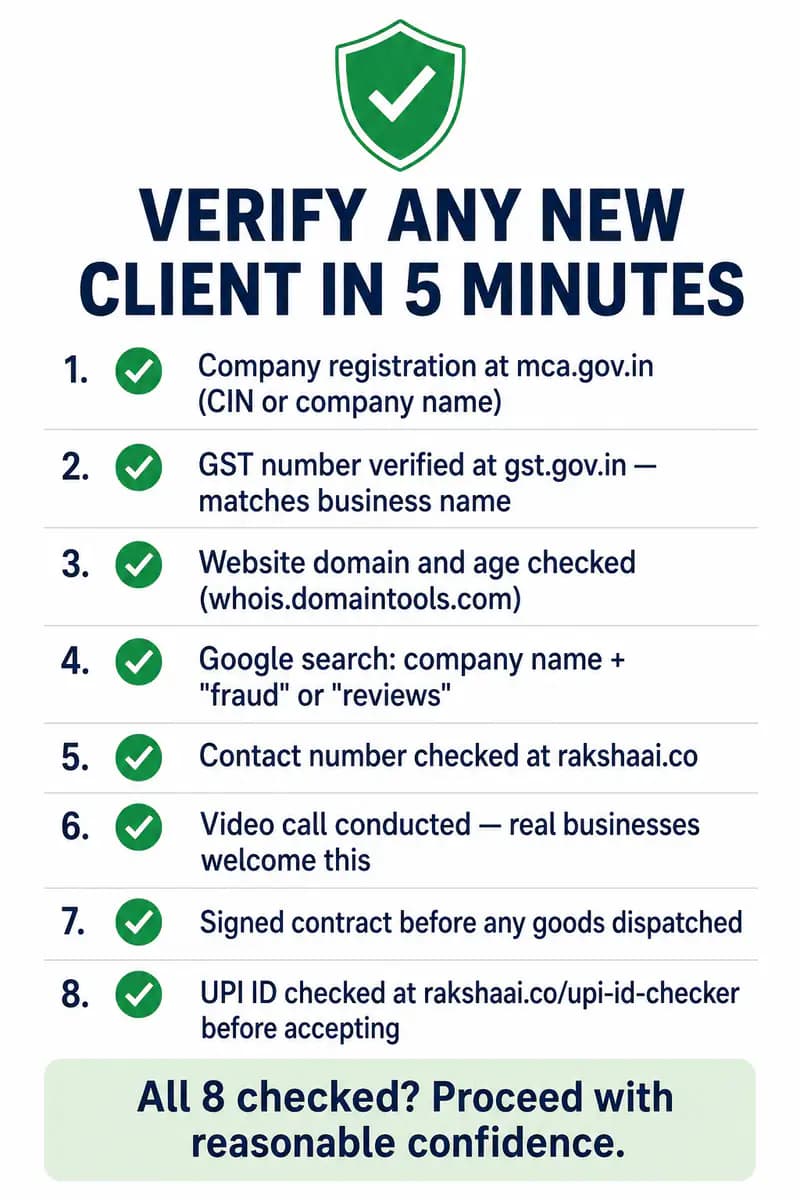
How to verify a new client or business in India before proceeding:
- Verify company registration at mca.gov.in using the company name or CIN.
- Verify the GST number at gst.gov.in and confirm that the legal name, trade name, state, and status match.
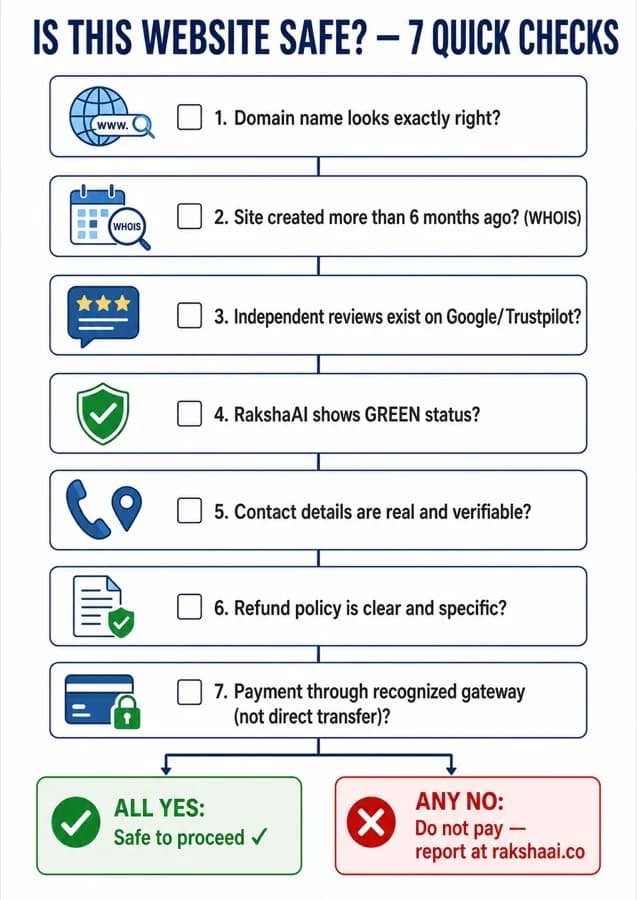
- Check the business website domain, spelling, contact details, and creation date. A copied brand on a new lookalike domain is a major warning.
- Search the company name with terms such as fraud, scam, complaint, and reviews. Separate verified reporting from anonymous allegations.
- Check the contact phone number at rakshaai.co for available scam reports and public risk signals.
- For large orders, require a signed contract and independently verify the purchase order before delivery or production begins.
- For advance payments, check the proposed UPI ID at RakshaAI, confirm beneficiary-name consistency, and verify the actual credit in your own account.
- Video call the client and independently call the organization through contact details you found yourself. A video call helps, but it does not replace registration and payment checks.
This how to verify client India routine takes longer for a high-value contract than for a small job, and that is appropriate. Verification depth should increase with order value, credit period, data access, delivery risk, and requested exceptions.
An MCA or GST match is not enough on its own. A fraudster can quote a real company's public details. Confirm that the person, email domain, phone number, bank account, delivery address, and authority all belong to that entity. RakshaAI checks are supplementary risk signals, not government registration or a guarantee.
For a deeper due-diligence walkthrough, use RakshaAI's business verification guide. Before any payment or refund, also review the UPI ID fraud check guide.
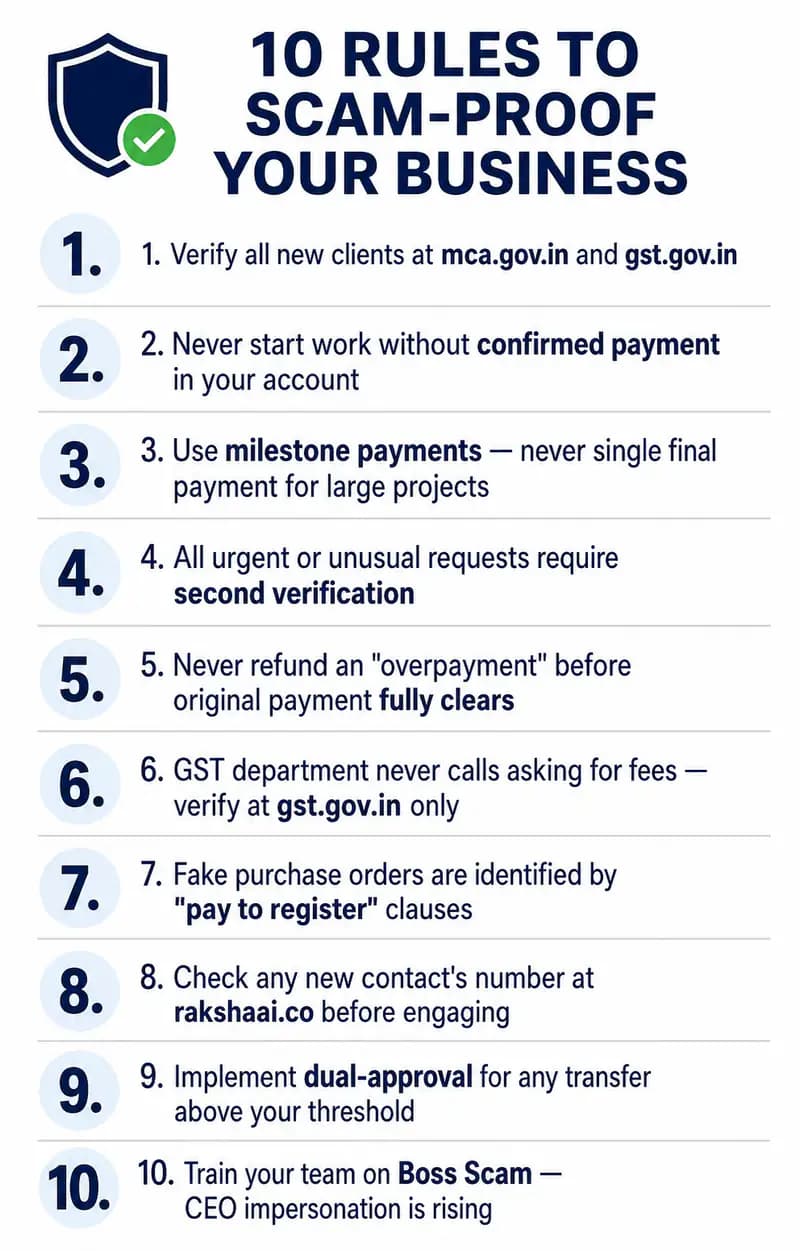
Business Protection Checklist: 10 Rules for Every SME
- Verify every new client: match MCA, GST, domain, phone, contact authority, and beneficiary details.
- Confirm actual payment: use your bank or UPI history, never the customer's screenshot or SMS.
- Use paid milestones: divide large freelance and service projects into clear deliverables and cleared payments.
- Verify unusual requests twice: use an independent channel for urgency, secrecy, refunds, or changed bank details.
- Never rush an overpayment refund: wait for bank confirmation and return only to the verified originating party.
- Use the GST portal directly: do not pay a caller or open a message link to release a refund.
- Reject pay-to-register orders: legitimate procurement must survive verification with the named institution.
- Separate duties: the person who creates a beneficiary or invoice should not be the only payment approver.
- Protect email and devices: enable multi-factor authentication, review forwarding rules, update software, and restrict remote access.
- Train the team: sales, accounts, procurement, dispatch, and freelancers should rehearse fake order and Boss scam scenarios.
Real Business Scam Cases in India and Source Credits
These cases show how business identity, procurement procedure, payment proof, and hierarchy are exploited. Amounts and methods are based on complaints or police statements reported by the cited publications. They should not be read as final findings against any person who has not been convicted.
- The Indian Express, April 2026: a Bengaluru supplier reported losing more than ₹26 lakh after fraudsters allegedly posed as BSF procurement and accounts officials, issued a fake purchase order, returned an early test payment, and then induced larger transfers.
- Deccan Chronicle, 1 October 2025: a Hyderabad company MD reported losing ₹2.26 lakh after a caller claiming to represent the Air Force Academy shared forged procurement and GST details and demanded vendor registration test payments.
- Hindustan Times, 27 February 2026: Gurugram Police said a hotel was allegedly deceived through repeated fake UPI screenshots totalling ₹6.17 lakh, demonstrating why merchants must confirm credit in their own account.
- The New Indian Express, 15 June 2026: a Hyderabad firm reported a ₹25 lakh loss after an accounts employee acted on WhatsApp messages that appeared to come from a director.
- PIB and CBIC GST refund warning: taxpayers were warned that fake fast-track refund links were phishing messages and were directed to use the official GST website.
- Ministry of Home Affairs, 24 March 2026: the government said the 1930-linked financial fraud system had helped save more than ₹8,690 crore across more than 24.65 lakh complaints by 31 January 2026. This is aggregate cyber-fraud response data, not business-only loss data.
What to Do If Your Business Already Paid or Dispatched Goods
- Call 1930 immediately for financial cyber fraud and ask your bank's fraud team to hold, recall, or trace the transfer.
- File at cybercrime.gov.in and save the acknowledgement number.
- Preserve purchase orders, contracts, proforma invoices, GST details, email headers, WhatsApp exports, phone numbers, beneficiary accounts, UTRs, cheque images, courier records, and CCTV.
- Contact the impersonated company or institution through its official channel so it can warn other suppliers.
- Tell your accountant, legal adviser, insurer, platform, marketplace, and relevant employees. Do not hide the incident or let the fraudster control the response.
- If goods were dispatched, contact the courier, warehouse, transporter, and destination police immediately to request an intercept where legally possible.
- Reset compromised accounts, remove unknown email forwarding rules and linked devices, and preserve forensic evidence before wiping anything.
Fast reporting cannot guarantee recovery, but it gives banks, payment intermediaries, police, and logistics providers the best available chance to stop funds or goods from moving further.
Frequently Asked Questions
What is the fake purchase order scam for small businesses in India?
A fraudster poses as a corporate, government, defence, or institutional buyer and sends a forged purchase order for a large urgent deal. The seller is then asked to pay vendor registration, account activation, test transaction, logistics, or processing charges. In another version, goods are dispatched on credit to an address controlled by the fraudster. Verify the order with the named organization through independently sourced contact details before paying or dispatching anything.
How do I verify a GST number is real in India?
Go directly to gst.gov.in and use Search Taxpayer. Enter the GSTIN and compare the legal name, trade name, state, registration status, and principal place of business with the client details. An active GSTIN is one positive signal, not proof that the person contacting you controls that business.
Is it safe to accept UPI payments from unknown clients in India?
Receiving a genuine UPI credit does not require you to enter a UPI PIN or scan a QR code. Confirm the credit in your own bank or UPI transaction history, not through the payer screenshot. Do not refund an alleged excess payment until your bank confirms the original credit is final, and verify the client before delivering goods or services.
What is the GST refund scam targeting businesses in India?
Fraudsters send calls, messages, emails, or links claiming that a GST refund is ready or a filing problem must be fixed. They seek a processing fee, credentials, bank details, or a malicious download. Check refund status only by opening gst.gov.in yourself. Do not use a link sent in an unsolicited message.
How do I protect my freelance business from payment scams in India?
Use a written contract, verify the client identity and business, take a cleared advance, divide large projects into paid milestones, watermark previews, and keep final files or production access until payment is confirmed. Never pay a platform, payment officer, or client to release money you supposedly earned.
Where should an Indian business report cyber fraud?
For financial cyber fraud, call 1930 immediately, alert the bank, and file at cybercrime.gov.in. Preserve purchase orders, invoices, email headers, chats, phone numbers, UPI IDs, beneficiary accounts, transaction references, delivery records, and device evidence.
Check the payment identity before the deal moves
Use RakshaAI to check a proposed UPI ID for available scam signals, then verify the actual payment in your own bank account. Share this guide with every person who handles sales, invoices, refunds, or dispatch.
Check a UPI IDMore from RakshaAI Blog

Stay Protected Online
Use RakshaAI to check websites, phone numbers, and UPI IDs for scams free, instant, no sign-up required.
RakshaAI is a private platform by Ehatech Services Pvt. Ltd. Not affiliated with any government body. Editorial policy