
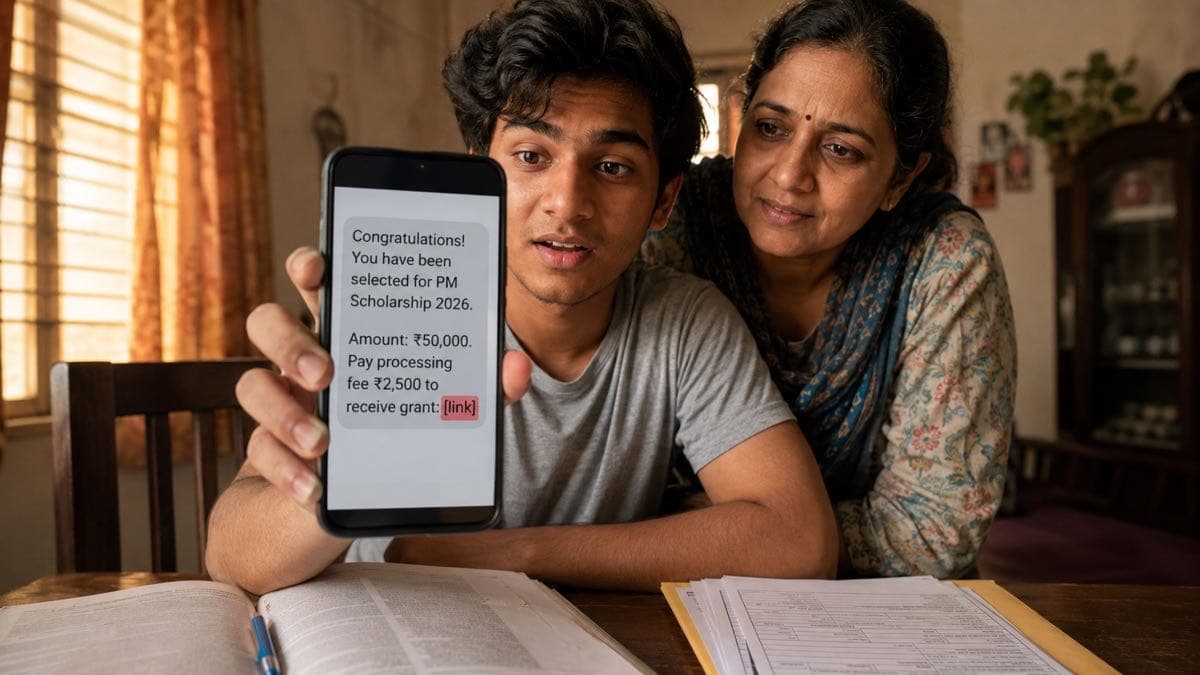
A mother leans over her son's shoulder at the kitchen table, both of them staring at the same phone screen. The message reads: "Congratulations! You have been selected for PM Scholarship 2026. Amount: Rs 50,000. Pay processing fee Rs 2,500 to receive grant." Their books and college admission papers are still open on the table. This is the exact shape of a fake scholarship scam India 2026 incident, and August, when lakhs of Indian students are actively searching for scholarships and education loans to fund the new academic year, is when it happens most.
The stakes are real on both sides. The National Scholarship Portal disbursed more than Rs 8,000 crore to over 2 crore students across 140-plus schemes in FY 2024-25 alone, a 95 percent jump in applications since 2023. That is exactly the pool of hopeful, financially stretched families that scammers are fishing in, and separately, a Ministry of Minority Affairs evaluation found Rs 144.33 crore had already been siphoned off by fake and partially fake institutions gaming the scholarship system itself.
This guide covers the six active scholarship and education loan scam formats hitting Indian students right now, with sourced real cases, the exact steps to verify any scholarship offer in five minutes, and what to do if you already paid.
If you just received a scholarship or loan message asking for payment
- 1Do not click the link and do not pay anything
- 2Check the sender: real scholarship bodies do not text from random 10-digit mobile numbers
- 3Verify the scheme name on scholarships.gov.in before doing anything else
- 4Never share Aadhaar, bank details, or an OTP to "unlock" a scholarship or loan
- 5If money is already gone, call 1930 and file at cybercrime.gov.in immediately
- 6Forward the message to a parent, teacher, or friend before you decide anything
Why Scholarship Season Is Peak Scam Season in India
Every August, as Indian colleges begin a new academic year, three things line up at once: students are actively searching for scholarships and education loans, families are under real financial pressure to pay fees, and scammers know both facts. The National Scholarship Portal's own scale, over 2 crore students and Rs 8,000 crore disbursed in FY 2024-25 across 140-plus schemes, is public knowledge, which gives fraudsters a believable script to imitate: a real portal name, a real scheme name, and a plausible payout amount.
The fraud is not limited to opportunistic SMS blasts either. India's Ministry of Minority Affairs commissioned an NCAER evaluation of 1,572 institutions receiving Pre-Matric, Post-Matric, and Merit-cum-Means minority scholarship funds and found 830 of them, more than half, were completely fake, partially fake, or simply non-operational, siphoning off an estimated Rs 144.33 crore. Separately, the National Scholarship Portal itself flagged 6,055 suspicious institutes nationwide, of which 609 were confirmed fake or partially fake after verification. That fraud was severe enough that all three flagship minority scholarship schemes have remained frozen since 2022-23, with only Rs 29 lakh recovered against the Rs 144-crore-plus loss, as reported by ThePrint. In Uttarakhand, a Special Investigation Team is separately probing suspected minority scholarship fraud that could exceed Rs 500 crore, involving fake student admissions, fabricated attendance records, and manipulated academic documents at 17-plus institutions, per The420.in's reporting.
None of that institutional-level fraud directly empties a student's own wallet, but it explains why the ecosystem is now crawling with fake portals, fake institutes, and fake intermediaries, all built on the same trust signal: the National Scholarship Portal name. The individual-facing version of that fraud is what this guide focuses on next.
The 6 Scholarship and Education Fraud Types in 2026
These are the formats currently active against individual students and parents, not institutions.
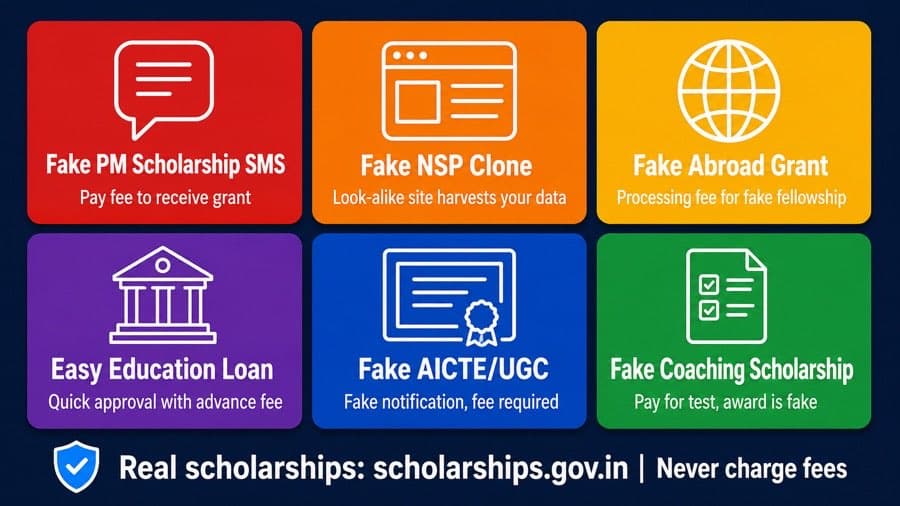
Scam 1: Fake PM / Government Scholarship SMS
A message arrives claiming the student has been "selected" for a scheme like "PM Scholarship 2026," often with a tiered cash amount based on marks, a fixed rupee figure, and a link to a site that copies government branding. CyberPeace, India's cyber-safety nonprofit, has documented this exact playbook: viral WhatsApp and SMS messages mimicking official government schemes, using urgency and government-style logos to push victims to bogus lookalike portals that harvest personal data. This is not a new trick either. The Quint fact-checked an almost identical "PM Scholarship" SMS scam back in 2018, complete with tiered payouts of Rs 5,000, Rs 10,000, and Rs 25,000 based on Class 10 and 12 marks, and a fake link to collect personal details. The pattern has simply been recycled every admission season since, with the scheme name and year swapped out.
Scam 2: Fake NSP Portal Clone
A cloned or lookalike site copies the design of scholarships.gov.in closely enough that a student in a hurry cannot tell the difference, then asks for Aadhaar, bank account, and OTP details under the guise of "final verification." The scale of trust being exploited here is not small: the real NSP has already had to flag 6,055 suspicious institutes and confirm 609 as fake or partially fake through its own verification drive, which shows how much organised fraud is already built around the NSP brand at the institutional level. A cloned front-end aimed at individual applicants follows the exact same logic, borrowing the portal's credibility to extract data or money directly from a student instead of routing it through a fake institution.
Scam 3: Fake Study Abroad Grant or Fellowship
An email or message claims the student has been shortlisted for a foreign university grant or fellowship, then asks for a "processing," "visa sponsorship," or "administrative" fee before the award can be released. Genuine foreign scholarships and fellowships, whether Fulbright, Chevening, Commonwealth, or a university-funded award, are disbursed after admission through the university or the scheme's own verified portal, and none of them require an upfront fee from the applicant to release an award already granted. Any grant that needs to be paid for before it pays out is not a grant.
Scam 4: Easy Education Loan, Processing Fee Fraud
A caller or app promises fast, low-document education loan approval, then collects an upfront processing or insurance fee before the loan ever appears. This is one of the best-documented scam categories in India. In June 2023, the CEO of Bengaluru-based edtech firm GeekLurn was arrested for allegedly defrauding nearly 2,000 students of about Rs 18 crore, having taken money from students on the promise of arranging education loans and then misappropriating the sanctioned funds, as reported by Inc42. Separately, a Kerala-based instant loan app network was found to have defrauded victims, students, homemakers, and private employees, of an estimated Rs 70 crore over three years, according to The420.in, using apps distributed outside official app stores, charging over 40 percent interest plus a 10 percent upfront processing fee, and secretly harvesting contacts and photos from victims' phones for later blackmail when repayment became difficult.
Scam 5: Fake AICTE / UGC Scholarship Notification
A message, email, or even a phone call cites AICTE or UGC branding to offer a scholarship, internship stipend, or fee waiver, then asks for payment or personal details. Both regulators have issued direct warnings about exactly this. AICTE published an official notice cautioning students and institutions about fake and fraudulent calls made in its name, and in December 2024 it issued a separate caution notice about edtech companies and their affiliates misusing the AICTE logo to mislead students about internship and training programmes while charging fees. UGC, meanwhile, published a list of 22 fake universities in October 2025 and, in a further notice dated 17 December 2025, named three more self-styled institutions in Delhi, Maharashtra, and Karnataka operating without valid recognition, warning students and parents directly not to take admission there, per Careers360's reporting.
Scam 6: Fake Coaching Centre Scholarship Test
A coaching institute advertises a free entrance-cum-scholarship test, builds excitement around a partial fee waiver, then either demands payment to "unlock" the announced scholarship or simply vanishes after collecting enrollment fees. The mechanism is not hypothetical: in Thane, Maharashtra, a coaching institute was accused of duping JEE aspirants of more than Rs 3 crore, collecting fees from students starting January 2024 and then abruptly shutting operations without delivering the promised coaching, reportedly threatening students who demanded refunds, with around 80 identified victims and the true number believed to be higher, according to Deccan Herald's reporting. A genuine scholarship test never requires payment to receive a result or an award that was already announced as free.
How to Verify Any Scholarship is Real in India
Every one of the six scams above fails the same five-minute check.
How to verify any scholarship is real in India:
- 1All central government scholarships are listed on the National Scholarship Portal: scholarships.gov.in
- 2State scholarships are listed on state education department websites, official .gov.in domains only
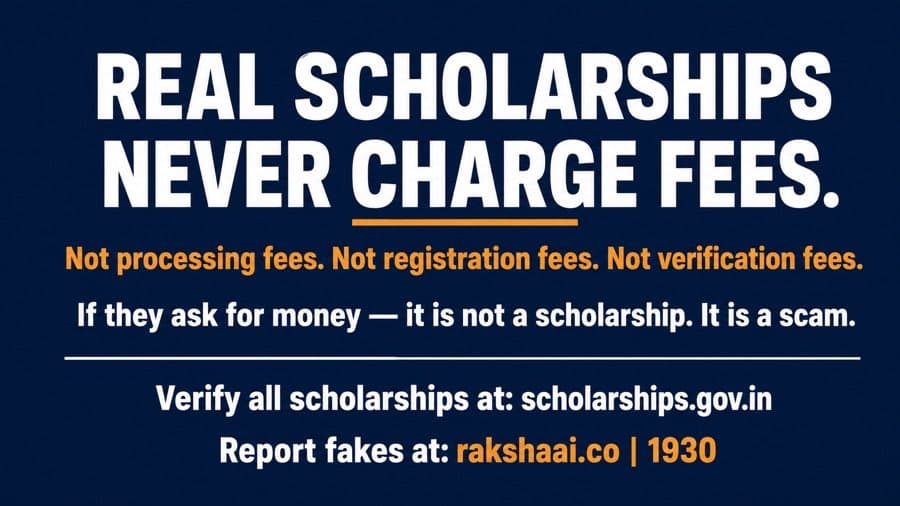
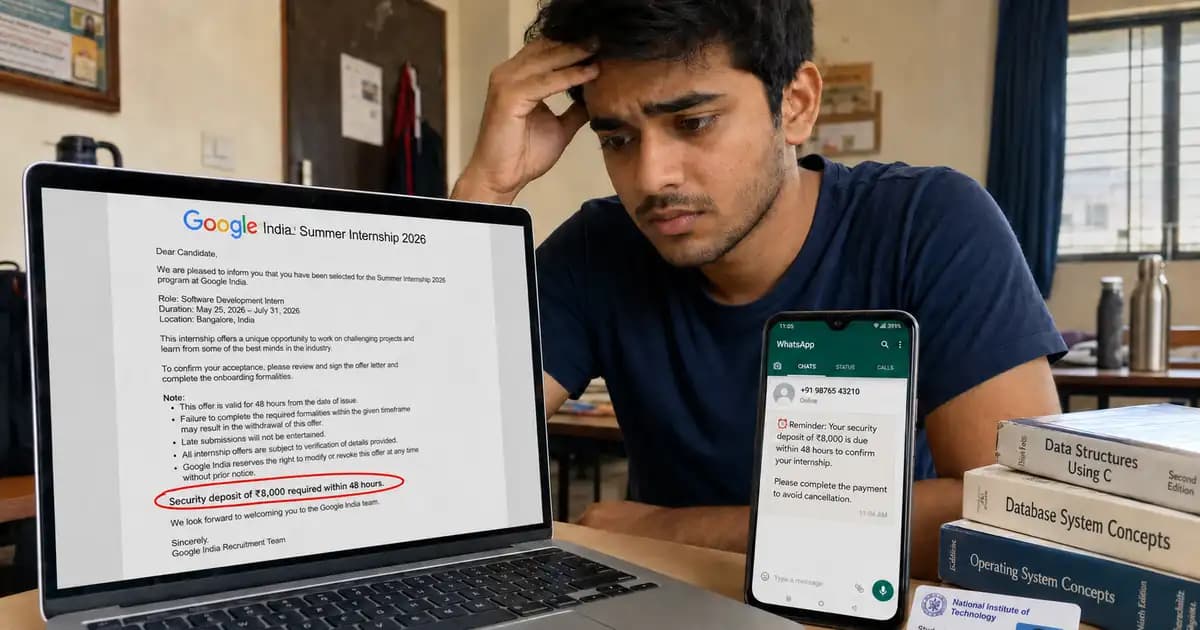
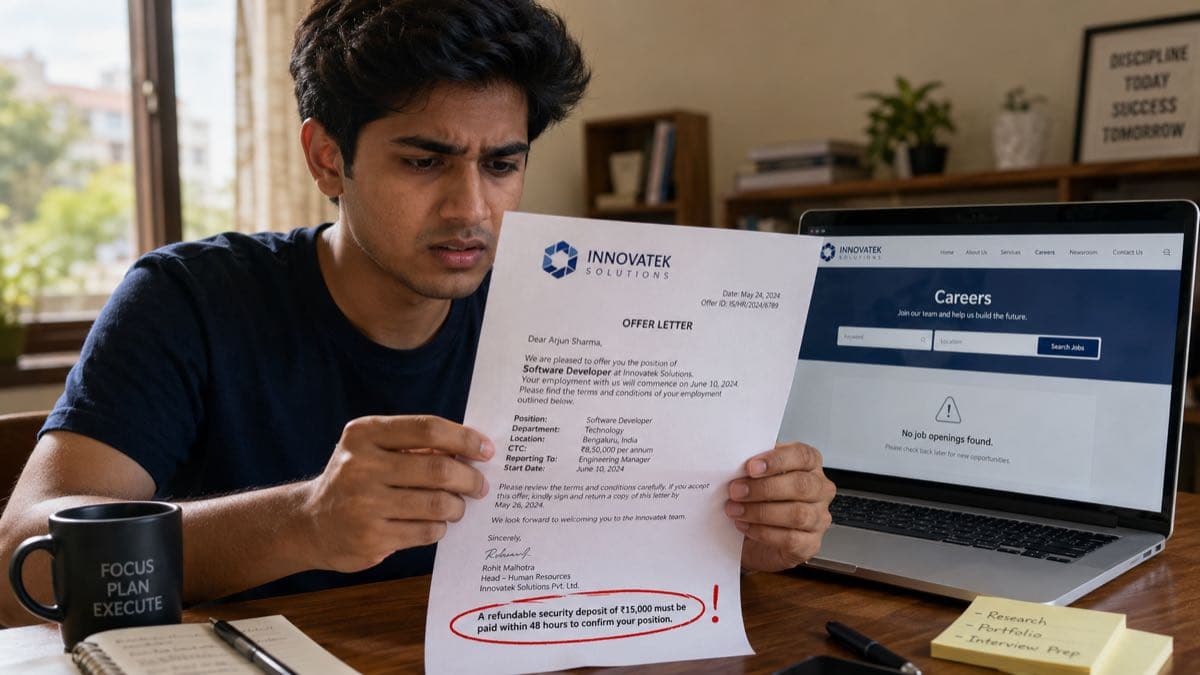
- 3Real scholarships never ask for a processing fee, registration fee, or advance payment
- 4Verify the scholarship by calling the institution or ministry directly using official website numbers, never the number in the message
- 5AICTE scholarships: verify at aicte-india.org, the official portal only
- 6UGC scholarships: verify at ugc.gov.in
- 7Check any scholarship SMS link at rakshaai.co before clicking
If a scholarship requires payment before disbursement, it is always a scam.
Official Scholarship Portals: Bookmark These
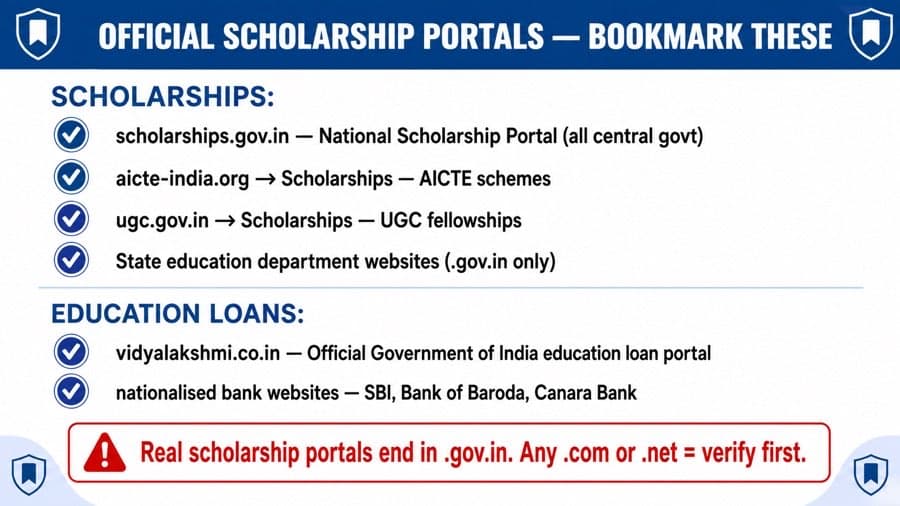
Every scam in this guide loses its power the moment a student checks the offer against the actual government source instead of the link in the message.
- scholarships.gov.in, the National Scholarship Portal, for every central government scheme.
- aicte-india.org then Scholarships, for AICTE schemes.
- ugc.gov.in then Scholarships, for UGC fellowships.
- State education department websites, .gov.in domains only, for state-run scholarships.
- vidyalakshmi.co.in, the official Government of India education loan and PM Vidyalaxmi portal.
- Nationalised bank websites, SBI, Bank of Baroda, Canara Bank, for direct education loan applications.
30 Second Instagram Reel Script
Format: warm home lighting for the hook, then quick cuts between the fake SMS, the six-scam grid, and the official portals card.
On-screen caption: No real scholarship ever charges a fee. Verify at scholarships.gov.in.
Frequently Asked Questions
Is the PM scholarship SMS real in India?
Most "PM Scholarship" SMS messages from unknown 10-digit numbers are fake. This exact pattern, tiered cash amounts tied to marks with a link to a lookalike portal, has been fact-checked as false as far back as 2018 and continues to circulate every admission season. Legitimate communications about any central scholarship come only through the National Scholarship Portal at scholarships.gov.in or an official institution channel, never through a random SMS. Never pay any fee based on an SMS claiming to offer a government scholarship.
What is the National Scholarship Portal (NSP) in India?
The NSP at scholarships.gov.in is the official Government of India portal covering more than 140 central and state scholarship schemes, from Class 1 through PhD. In FY 2024-25 alone it disbursed over Rs 8,000 crore to more than 2 crore students. All genuine applications and disbursements happen through this single portal. Scammers build lookalike sites copying its design, so always check the URL is exactly scholarships.gov.in before entering any Aadhaar or bank detail.
Do real scholarships charge processing fees in India?
Never. Legitimate government scholarships, university scholarships, and most private foundation scholarships do not charge students any processing, registration, or verification fee. Any message or call demanding payment before a scholarship is released, whether it is called a processing fee, GST, courier charge, or verification deposit, is a scam.
How do I get an education loan safely in India?
Apply directly through nationalised banks such as SBI, Bank of Baroda, or Canara Bank, or use the Vidya Lakshmi portal at vidyalakshmi.co.in, the Government of India’s official education loan and PM Vidyalaxmi scheme portal. Avoid any lender that approaches you first over WhatsApp, demands an upfront fee before disbursing a rupee, or promises approval with no credit check.
What should I do if I paid a fake scholarship or education loan processing fee in India?
Call the national cybercrime helpline 1930 immediately and file a complaint at cybercrime.gov.in. If you paid by UPI or card, ask your bank to raise a dispute on the transaction right away. Also report the SMS, website, or app at rakshaai.co so other students see the warning before they pay.
Sources and Credits
- CyberPeace, Fact Check: Viral PM Scheme Scam and the Growing Menace of Fake Government Offers: documentation of viral WhatsApp and SMS messages mimicking official government scholarship and welfare schemes to harvest personal data.
- The Quint WebQoof, No, PM's Scholarship Scheme is Not for Class 10 and 12 Students: the original fact-check of the tiered Rs 5,000 to Rs 25,000 fake PM Scholarship SMS scam, still recycled every admission season.
- ThePrint, Govt's Minority Scholarship Scheme Frozen 3 Years as Probe Into Fraud Meanders: the NCAER evaluation finding Rs 144.33 crore lost across 830 fake or partially fake institutions of 1,572 assessed, NSP flagging 6,055 suspicious institutes with 609 confirmed fake, and 193 FIRs recovering only Rs 29 lakh.
- The420.in, Uttarakhand Scholarship Scam, Digital Verification Probe in Rs 500 Crore Fraud: the Uttarakhand SIT investigation into suspected minority scholarship fraud exceeding Rs 500 crore via fake admissions and fabricated attendance records.
- The420.in, Kerala Loan App Scam, Students and Homemakers Worst Hit as Rs 70 Crore Fraud Exposed: the Kerala instant loan app network defrauding students, homemakers, and private employees of an estimated Rs 70 crore over three years.
- Inc42, Bengaluru-Based GeekLurn Accused of Defrauding 2,000 Students With INR 18 Cr, CEO Arrested: the June 2023 arrest of the GeekLurn CEO over an alleged education loan fraud affecting nearly 2,000 students.
- AICTE, Notice Regarding Receiving Fake and Fraud Call from AICTE: AICTE's official warning that it uses only its own domain for communication, alongside its December 2024 caution notice on edtech companies misusing the AICTE logo to charge students fees.
- Careers360, UGC Warns Students About 3 Self-Styled Fake Institutions: UGC's October 2025 list of 22 fake universities and its 17 December 2025 notice naming three further unrecognised institutions in Delhi, Maharashtra, and Karnataka.
- Deccan Herald, Coaching Institute Dupes JEE Students of Rs 3 Crore in Thane City: the Thane coaching institute fraud affecting roughly 80 identified JEE aspirants who paid fees before the institute shut down.
- Buddy4Study, National Scholarship Portal (NSP) 2026: NSP disbursement data showing over 2 crore students benefited and Rs 8,000 crore disbursed in FY 2024-25 across 140-plus schemes, a 95 percent rise in applications since 2023.
- National Scholarship Portal: the official Government of India scholarship application and verification portal.
- Vidya Lakshmi Portal: the official Government of India education loan and PM Vidyalaxmi scheme portal.
- National Cybercrime Reporting Portal: the official complaint portal and India's national cybercrime helpline, 1930.
Verify before you pay a single rupee
Every fake scholarship and loan scam in this guide starts with one link or one call. Check a suspicious website, phone number, or UPI ID on RakshaAI before you click, apply, or pay.
Check for freeMore from RakshaAI Blog
Stay Protected Online
Use RakshaAI to check websites, phone numbers, and UPI IDs for scams free, instant, no sign-up required.
RakshaAI is a private platform by Ehatech Services Pvt. Ltd. Not affiliated with any government body. Editorial policy